

Nearly a year into the pandemic, the number of people employed by U.S. airlines has rebounded slightly but remains significantly lower than pre-COVID-19 days, according to the latest federal data.
Even after receiving federal aid contingent on limiting layoffs, airlines had about 60,000 fewer people working for them at the end of the year than they had in the spring. About 695,000 people worked for U.S. airlines as of December 2020, and that’s up from about 678,000 in November, according to the U.S. Bureau of Transportation Statistics. Last March, 755,000 were employed by the nation’s airlines.
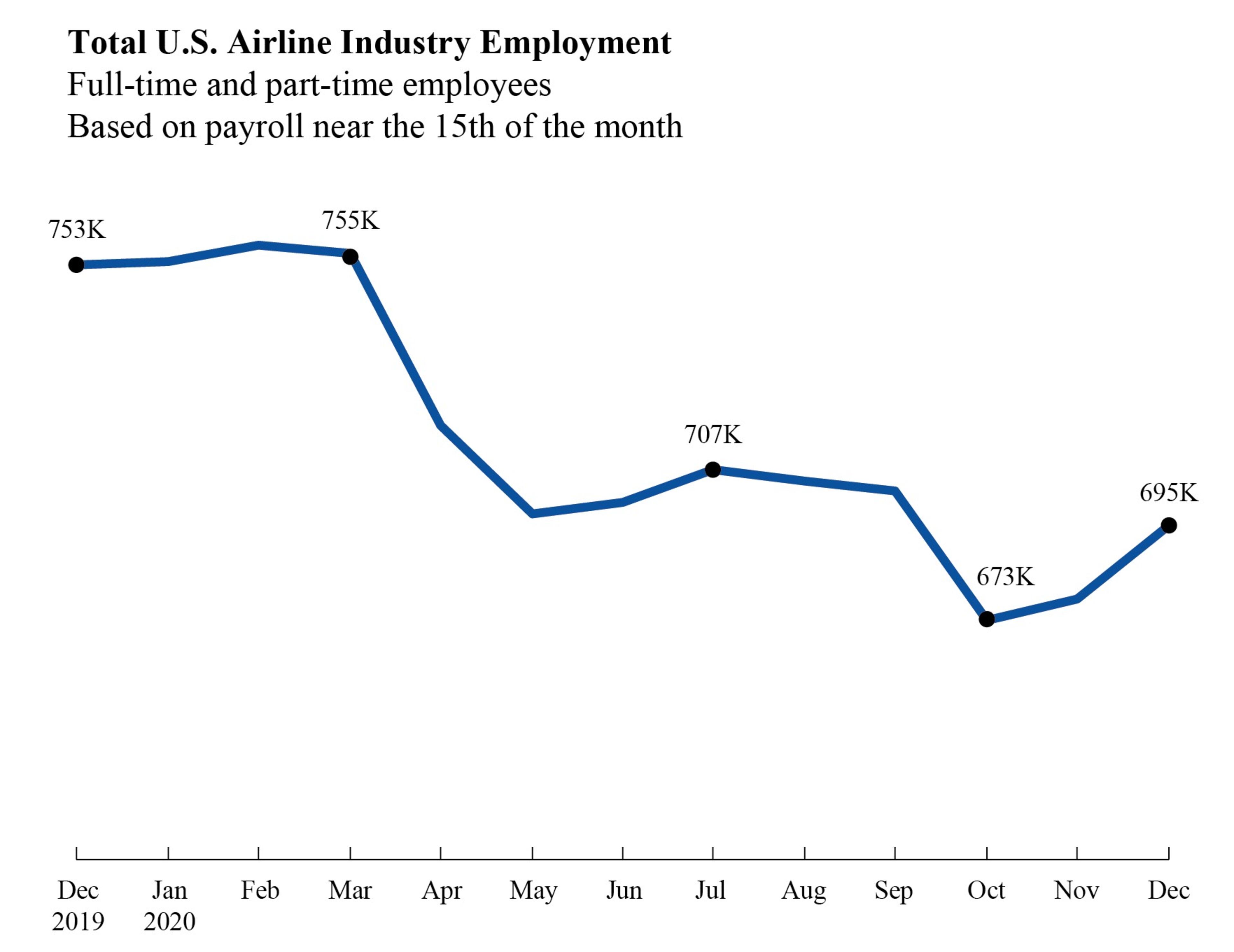
Federal stimulus funding for airlines prohibited layoffs through September. In October, staffing dropped.
Atlanta-based Delta had already cut its workforce from more than 90,000 employees to about 75,000 through early retirements and buyouts by July.
The number of Delta employees actually working and getting paid is even lower. That’s mainly because roughly 10,000 employees are still on voluntary unpaid leave.
Delta’s paid workforce dropped to as low as 51,000 in May, after more than 40,000 employees agreed to take unpaid leave.
By December, Delta’s paid headcount had rebounded to 62,786 employees, according to the federal data.
Delta’s headcount in 2020 reached its lowest point in a decade, dating back to before it absorbed the employees of merger partner Northwest Airlines to create a workforce of more than 80,000 employees by 2010.
The Centers for Disease Control and Prevention continues to recommend that people not travel, since traveling increases the chance of getting and spreading COVID-19.
Delta had been on a growth path in recent years, until the coronavirus pandemic brought that to an abrupt halt.
Delta CEO Ed Bastian has emphasized that the company has been able to avoid involuntary furloughs.
Major carriers United and American have warned that thousands of employees could be furloughed after the second round of federal aid barring such cuts expires at the end of March.
Bastian said in an interview on CNN on Tuesday morning, “We are not in danger of any furloughs at Delta.”
With all the upheaval airlines have faced, Bastian said he’s against the idea of mandating COVID-19 testing for domestic flights, which federal officials are considering.
Because the airline industry has been carrying more than 1 million people a day during peak periods, Bastian said such a travel mandate could take testing resources away from sick people who need to be tested.
Bastian said he thinks that would “be a horrible idea” — and “would set us back at least probably another year in the recovery.”