Crime roiled Atlanta during COVID. Its fallout has shaped governor’s race.



On March 12, 2020, then-Atlanta Mayor Keisha Lance Bottoms planned to announce the city was getting safer. Her State of the City address that day would tout decreasing crime numbers, pay raises for first responders and a growing public safety budget.
But it was a speech she never gave. The annual event at the Hyatt Regency was abruptly canceled as the coronavirus rapidly spread throughout the country. That same day, Georgia reported its first virus-related death.
Violent crime in Atlanta soon spiked amid the lockdowns that followed, a trend that plagued major cities across the country. But a review of data from 70 large police agencies shows a more dramatic increase in Atlanta.
Atlanta’s reported homicides rose 59% from 2019 to 2020, compared to a 33% increase in other cities. Meanwhile, aggravated assaults rose 15% compared to 13% in other places, according to data compiled by the Major Cities Chiefs Association, of which Atlanta is a member.
Bottoms is now the Democratic nominee for governor. Her opponent, Republican Rick Jackson, has spent nearly $100 million reminding voters about the rise in violent crime during her time as mayor.
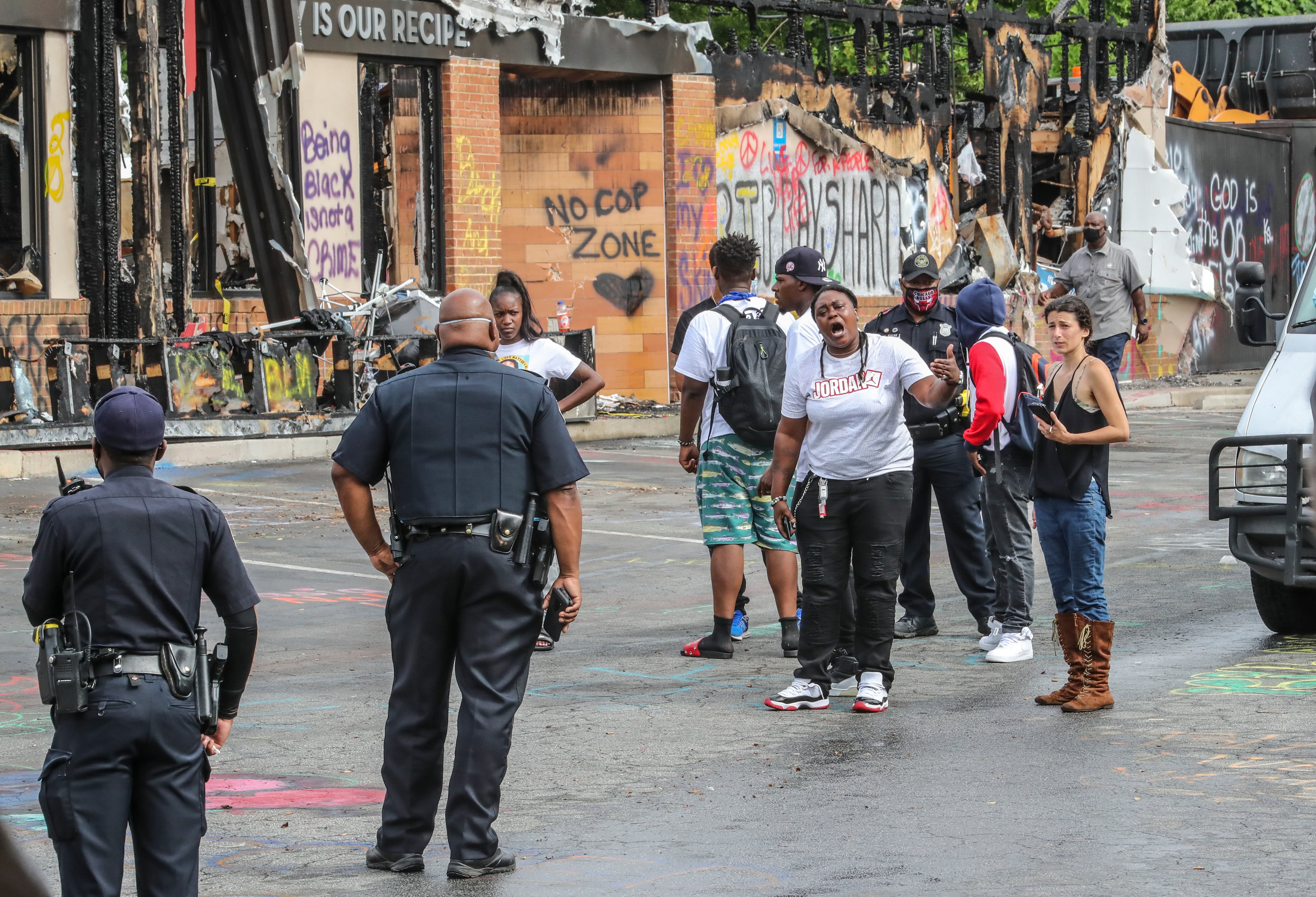
In one TV ad, a narrator says Bottoms “let Atlanta burn” while showing footage of a Wendy’s ablaze after protesters set it on fire to protest the police shooting death of Rayshard Brooks.
Eight-year-old Secoriea Turner later died near the site after being shot by a gunman who was part of the mob. Her death became a symbol of increased crime during the pandemic.

Experts are still unraveling how the public health crisis impacted crime rates across the country, including why certain communities were hit harder than others.
Atlanta was better than its peers in some areas. Robberies decreased by 10% across all agencies, while they dropped 14% in Atlanta. Reported rapes decreased by 16% across all agencies, while in Atlanta the decline was 53% year over year.
But Bottoms’ time as mayor — and how it is remembered by metro Atlanta voters — could play a role in her chances in November. Bottoms needs to run up big margins in the densely populated metro Atlanta counties to offset Republican turnout in rural areas.
How we reported this story
Keisha Lance Bottoms’ tenure as mayor of Atlanta - particularly her track record on crime - has been a key focus of Georgia’s campaign for governor.
To assess how crime in Atlanta during the pandemic compared to other metropolitan areas, The AJC analyzed crime data reported to the FBI that was later compiled by the Major Cities Chiefs Association (MCCA), a professional organization of police leaders that represent the largest cities in the United States and Canada. Specifically, the MCCA’s Violent Crime Survey Year End Comparison for 2020 and 2019 was reviewed.
The AJC compared Atlanta to the other 66 agencies that responded to the survey that year. The DeKalb County Police Department is the only other member in the state of Georgia.
In the AJC’s monthly analysis of homicides within the city of Atlanta, the city’s weekly crime report data was used along with historic AJC reporting.
Bottoms argues Jackson, who is mostly self-funding his campaign, is using his wealth to “to “rewrite history” by ignoring other factors like widespread protests over police brutality, a financial crisis and divisive partisan battles over the outcome of the 2020 election.
“Atlanta didn’t burn. A police car, a Wendy’s and a dumpster burned,” Bottoms told the AJC. “That’s very different than an entire city burning.”

During Tuesday night’s debate hosted by Atlanta News First — and what will likely be the only time the rivals share a stage this election cycle — Jackson continued to zero-in on Bottoms on her record.
“A bad mayor doesn’t make for a good governor,” he said.
‘Shock to the system’
Criminal justice experts say the factors driving crime rates are complex and they caution against oversimplifying the causes.
Volkan Topalli, criminology professor at Georgia State University, said Atlanta’s status as a major travel hub and its high rate of guns per residents could have played a role in its crime surge.
“In the same way that I never give any politician or chief of police too much credit for a crime drop,” he said, “I also don’t give them too much blame for a crime spike — there are cities that did worse than us, and cities that did a lot better than us.”
“The pandemic was such a massive shock to the system,” Topalli added. “It stretches the imagination to think that you could react in a way that would somehow make its outcomes disappear.”

The Atlanta Journal-Constitution reviewed data submitted to the FBI as well as crime reports from the Atlanta Police Department before, during and after the pandemic. It also reviewed data from dozens of large police agencies from around the United States.
Numbers from APD crime reports show that in the months before the pandemic began, Atlanta did have a decrease in homicides and violent crime. But from June to August 2020, homicides in the city were more than double compared with that same period in 2019.
“What people have to remember is this was the most unprecedented time in our lifetime,” said Rodney Bryant, Atlanta’s chief of police during the pandemic.
Bryant took over the department after former Police Chief Erika Shields resigned following the fatal police shooting of Rayshard Brooks. Bryant pointed to the tense conditions of lockdown which also contributed to an increase in domestic violence.
“People had no outlets,” Bryant told the AJC.

Topalli, with GSU, also stressed the importance of looking at the numbers themselves, saying even with jumps in the overall rate, a “homicide is an extremely rare event.”
“You’re talking about 100 to 150 homicides in a city of well over 500,000 people and in a metro area that’s got more than 6 million people,” he said. “(The numbers) are so small that even small fluctuations can cause things to look much better or much worse than they actually are.”
‘Perfect storm of distress’
Before the pandemic, the country experienced a relatively safe period, said Thaddeus Johnson, assistant professor of criminal justice and criminology at Georgia State University.
“I was a police officer in Memphis in the 2000s into the mid to 2010s, and it was a safer time than I had ever experienced,” he said, adding that leaders across the country were “caught off-guard” when crime spiked.
Visible crime also began to spill into areas of Atlanta that hadn’t dealt with that level of violence before, he said. Lenox Square mall in Buckhead became a hotbed of shootings and aggravated assaults and nighttime street racing plagued its transit corridors.
Frustrations in the wealthy, northern neighborhood fueled an ultimately unsuccessful effort by some residents to split from Atlanta altogether and create a Buckhead city.
But as the city’s public safety leaders were working to address rising crime, communities across the city started echoing nationwide calls for police reform.

During the first 48 hours of Atlanta’s downtown protests a police car burned against the CNN sign and protesters destroyed storefronts. Bottoms imposed a curfew and pleaded alongside rappers T.I. and Killer Mike for crowds to disperse.
“I think that was the come-to-grips moment that we saw during the pandemic,” Johnson said.
In the years that followed, public safety leaders across the country increased their focus on violence reduction programs and co-responder models to deter crime, he said.
“A lot of things started to change in both how we combat and think about crime,” Johnson said. “I think (Bottoms) got caught in that era, where they just started establishing the foundation for the things that we see now.”
The city’s police force also saw an exodus of officers. Some said they had lost confidence in Bottoms as mayor just two years after she approved a 30% pay hike. More than 200 officers quit in 2020.
“Police officers weren’t just leaving because of Mayor Bottoms,” Bryant said. “They were leaving in many major cities because of what was going on and the rhetoric around law enforcement.”

Just one week before early voting kicks off, Bottoms’ campaign announced more than 30 endorsements from law enforcement leaders across the state that includes sheriffs and district attorneys.
All the hardships converged into what Bottoms called “the perfect storm of distress” during a July 2020 interview on “Good Morning America.”
A major part of Bottoms’ response to crime came in April 2021 when she announced plans to build a sprawling public safety training center that opponents quickly dubbed “Cop City”
Even before launching her campaign for governor, Bottoms has said she looks back on some things with regret.
During a sweeping Black History Month interview with the AJC, she addressed the delayed crackdown on the violent occupation of the southwest Atlanta Wendy’s.
Armed vigilantes had taken over the charred remains of the fast-food restaurant near University Avenue and Pryor Road, becoming what police called an “autonomous zone.” Officers were told to avoid the area in the days leading up to Secoriea Turner’s death while Bottoms and other local leaders weighed what to do.
Some said tear down the structure, Bottoms recalled, while some Atlanta City Council members pushed for more time to negotiate with the mob. Bryant had just called the mayor to inform her the department was waiting on backup to move the makeshift barricades protesters constructed around the site, she said.
Not an hour later, he called again and told her a child had been shot while riding in the back seat of a passing SUV.
“If anything, that’s my biggest regret: that I didn’t move forward with the timeline that I thought was best,” she said in January 2025. “I agreed to give it a few more days, and so you can’t help but wonder, if there was anything differently that I could have done that would have given us a different outcome.”
Since Bottoms won the primary election outright, Democrats have rallied behind her, eyeing the opportunity to flip the office for the first time in nearly three decades.
Former Atlanta City Council President Felicia Moore — who frequently clashed with Bottoms over the city’s handling of crime and the pandemic — said it’s not surprising to see the city’s pandemic response used to fuel Jackson’s campaign.
“I don’t take back any criticism I had at the time,” Moore said, “And no one should pretend it didn’t happen.”
Although, she also pointed to Atlanta not being alone in it’s spike in violent crime.
“In a campaign, any weak point is fair game — and that’s exactly what we’re seeing now,” she added. “ However, I would say that even with all of that having occurred, the race is still neck and neck.”