The $3B candidate: Unpacking Rick Jackson’s vast business empire
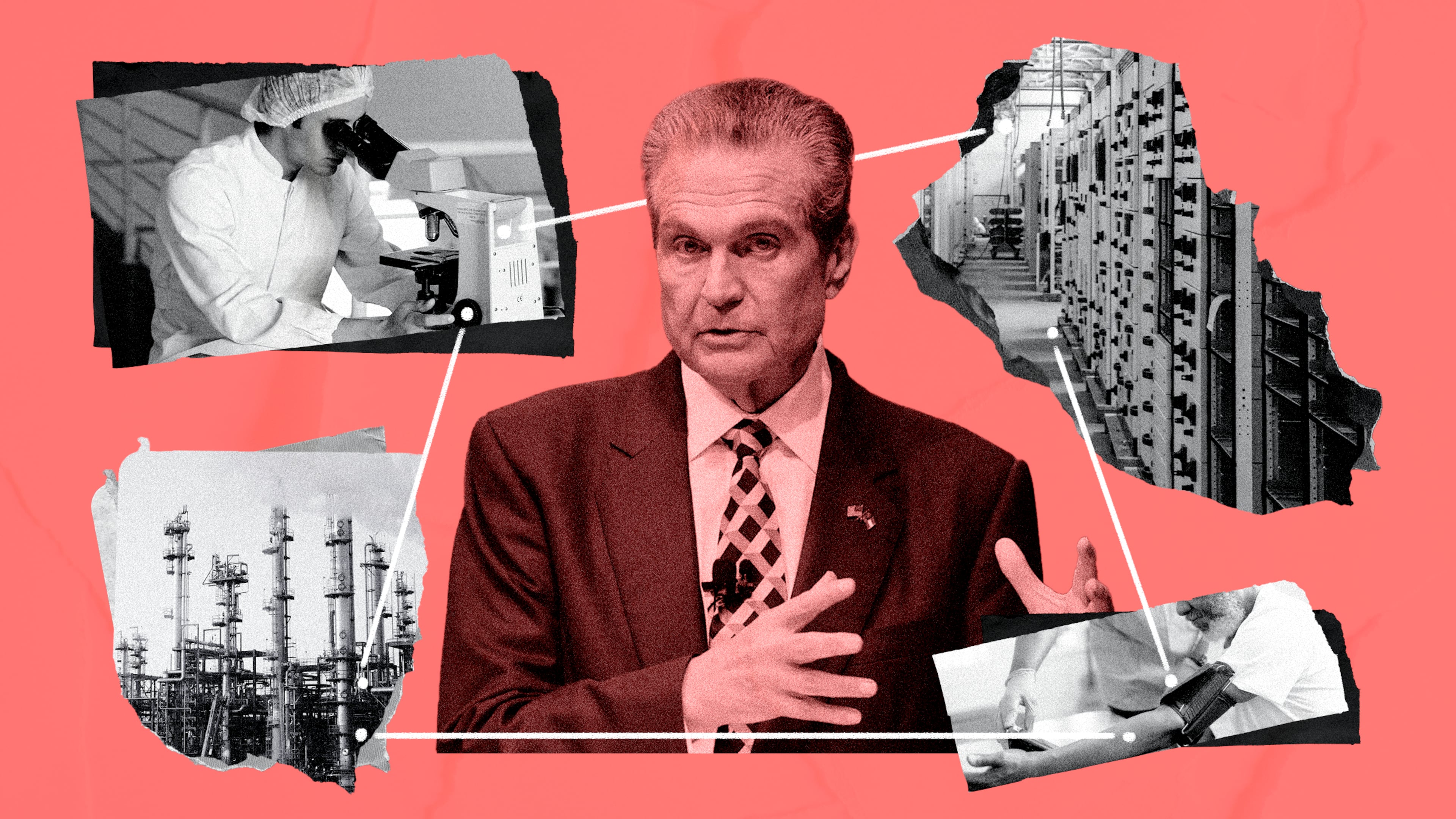

Even before Rick Jackson disrupted Georgia’s political landscape in February by announcing his candidacy for governor, he was best known by the shorthand “healthcare executive.”
But that description barely scratches the surface.
The Atlanta native who famously lifted himself from Georgia’s foster care system to become a billionaire businessman spent his adult life building a sprawling empire that extends far beyond Jackson Healthcare, his signature, Alpharetta-based medical staffing business.
Jackson Healthcare is a holding company that includes scores of specialized businesses nestled within it, from medical staffing to biomedicine to consulting, according to a review of hundreds of records by The Atlanta Journal-Constitution.
Those companies account for the bulk of his immense wealth, but Jackson has separately invested in motion pictures, real estate and an online buy-now-pay-later financing company for firearms and outdoor accessories, among other interests. All told, the 72-year-old, self-described serial entrepreneur’s portfolio includes more than 100 corporate entities he either founded, purchased or invested in, the AJC found.
And while the portfolio illustrates Jackson’s successful ascent in business, any one of these companies presents a possible conflict of interest should he be elected.
How we got the story
The Atlanta Journal-Constitution is committed to educating and empowering voters so they can make informed choices in the November election. As part of that effort, The AJC commissioned background research on the two candidates seeking to become Georgia’s next governor.
This story is the first in a series that springs from that research. Others will publish in the upcoming days.
The AJC worked with the Sunlight Research Desk, a part of the Muckrock Foundation, a non-profit which collaborates with news organizations on investigative projects.
The AJC reviewed and confirmed the material they provided, which included hundreds of pages of business documents, legal filings and campaign finance reports.
If he wins, Jackson has promised to “responsibly unwind any existing contracts” with the state of Georgia. But does it follow that he would resign his corporate positions? Step down from the numerous boards he serves on? Divest from companies whose industries are regulated by the state?
And even if he does step away, his son, Shane Jackson, is president or CEO of some of Rick Jackson’s most profitable entities, including Jackson Healthcare. As governor, how would he distance himself from conflicts there?
“The biggest thing is making sure there is not the semblance of him using the office of governor to make direct payments to Jackson Healthcare or awarding state contracts,” campaign spokesman Garrison Douglas said.
Douglas said Jackson plans to focus on the “actual job” of running the state.
“He said he doesn’t even believe that his company should be doing business in the state of Georgia while he is governor,” he said.

Ending his business arrangements with the state is a starting point — a big one.
Over the past decade, Jackson Healthcare and its subsidiary businesses inked contracts with the state worth more than $1 billion, much of that coming on no-bid deals awarded during the COVID-19 pandemic when hospitals in Georgia and across the nation were staffing up to meet the emergency.
His healthcare companies also have signed contracts with federal agencies over the past dozen years worth more than $364 million, the AJC found. And his companies do business with states across the nation.
In a statement, TaNisha Cameron, campaign spokesperson for Keisha Lance Bottoms, Jackson’s Democratic opponent, said the Republican has “unprecedented conflicts of interest for a Georgia gubernatorial candidate.”
Cameron said Bottoms’ ethics plan would prevent self-dealing in office and tighten contracting rules.
“That’s the transparency that Georgia taxpayers deserve,” she said.
Georgia has had its share of wealthy politicians in the past. But with all the companies he started and those he has invested in, Jackson is in a class all by himself. There aren’t enough columns in Georgia’s financial disclosure forms to fit his $3 billion net worth.
Matthew Gunning, a political science professor at Georgia Gwinnett College, said the size and scope of Jackson’s business interests make it impossible for him to govern without impacting — directly or indirectly — his companies’ bottom line.
Gunning said that leaves Jackson with a couple of choices: Ignore the criticism, as President Donald Trump largely has, or place his assets in some sort of blind trust. Aside from ending his companies’ direct contracts with Georgia, Jackson has not offered a plan to further disconnect from his business empire.
“It’s clear that, at least for some voters, Trump’s choice wasn’t a deal breaker for them,” Gunning said.
The race for Georgia Governor
All about Democrat Keisha Lance Bottoms and Republican Rick Jackson and what they would do if elected.
The Issues: Education | Healthcare | Data Centers | Taxes | Abortion | Immigration
Polls and predictions: Track the race for Governor
Their agendas: Keisha Lance Bottoms | Rick Jackson
Bottoms’ record: Crime roiled Atlanta during COVID. Its fallout has shaped governor’s race.
Jackson’s business deal: Why Rick Jackson poured millions into a failing Alabama hospital
Debate: 5 takeaways from the Georgia governor debate
Crossover voters: Prominent Georgia Democrat crosses aisle for Rick Jackson
Data centers: Bottoms, Jackson clash over data centers. Both have history with the industry.
Complete coverage: 2026 Georgia Voter Guide
‘He changes the marketplace’
If Jackson is elected and withdraws his contracts to provide medical staffing across the state, it doesn’t answer every question. The state would need to find another contractor, which means the department heads Jackson appoints would be selecting from among his competitors.
“He has such a dominant role (in healthcare staffing), if he steps out of the marketplace, he changes the marketplace,” Gunning said.
Avoiding direct payments from the state of Georgia to Jackson’s healthcare staffing business is just one of many possible pitfalls, said Mark Lee Greenblatt, a former inspector general for the U.S. Department of the Interior during the Biden administration.
“When folks come in from the private sector, particularly when they have no government background, it can be difficult to unwind all their holdings,” he said. “Especially exceptionally wealthy people.”

Greenblatt said wealthy politicians like Jackson have a hard time inoculating themselves from conflicts. He cited wealthy industrialist Wilbur Ross, who served as U.S. commerce secretary during Trump’s first term. Ross faced multiple ethics investigations stemming from his complex web of finances.
Still, Greenblatt said we shouldn’t discourage people who have been successful in business from holding public office.
“We don’t want a system that punishes them or makes it unreasonably burdensome to make the shift from the private sector to government,” he said. “We want really smart, really successful people to do that.”
But, he said, there need to be guardrails to prevent self-dealing.
As governor, Jackson would have an outsized role in setting state government spending and economic policy. Theoretically, he could back legislation on tax incentives that would favor his investments or steer state contracts to parts of his business portfolio that he doesn’t directly control.
Jackson’s core businesses go deep into every aspect of healthcare, and his other businesses vary widely. With financial entanglements in so many areas, it would be difficult for Jackson to entirely avoid conflicts when policy and profit collide.
His healthcare empire includes companies that specialize in physician recruitment, temporary staffing, credential verification, medical consulting, and solutions for hospital management and medical decision-making. Just the staffing part of his business includes companies that specialize in nurses, doctors, anesthesiologists, pharmacists, physical therapists, administrators and more.
Jackson Healthcare is vertically integrated, meaning one subsidiary company might help a hospital to organize and streamline its operations, including the use of freelance or temporary physicians or nurses. Other businesses under the Jackson Healthcare umbrella would then offer that outside labor force and the technology to optimize how those employees are deployed. Another subsidiary company can recruit the administrator to put the system in place and the non-medical staff to run it.
Building an empire
It didn’t happen overnight. In the early 1970s, Jackson was a high school graduate without the money for college. After a short period working as a telephone collection agent for unpaid medical bills, Jackson took a position with a small secretarial recruiting company.
Because he didn’t have a degree, Jackson accepted a smaller commission and no salary. A year into the job, he bought the financially struggling company from the owner, assuming the company’s debt in the process. By the late 1970s, he was in the business of recruiting and placing physicians, which would become the core of his vast corporate network for decades.
“For the first half of my career, I was a serial entrepreneur and trying a lot of different things and owning a couple of small hospitals, surgery centers, pain centers and so forth,” Jackson testified in January in U.S. Tax Court, according to a transcript reviewed by the AJC.
Jackson was in court in an attempt to overturn an IRS decision disallowing tax deductions Jackson claimed on investment losses, including on some movies he backed that flopped. That case is ongoing, but Jackson’s testimony reveals a lot about how he built his businesses and his thinking that guides his investments.
He started Jackson Healthcare in 2000, focusing exclusively on healthcare staffing. Jackson describes the company as a “venture holding company,” with revenues for all of these subsidiaries flowing into parent company Jackson Investment Group.

While his companies were successful in the first two decades of the century, Jackson testified that the 2020 COVID pandemic was “huge” for Jackson Healthcare.
“The governor of Georgia came to me and said that they needed supplemental staff to (test) people for COVID, to get vaccines when that came in,” he said, according to a transcript of his testimony.
The flood of COVID patients required hospitals to increase staff and replace staff when they got sick. To meet the emergency, Jackson was awarded a no-bid contract.
“Our companies were working seven days a week, 24 hours a day,” he said. “So it had a short-term impact of significant revenues and so forth.”
‘I make every decision’
Even before the pandemic, Jackson was exploring ways to invest some of Jackson Healthcare’s profits by lending money to businesses in other sectors.
“We wanted to diversify because all of our assets were in one thing, and that was healthcare staffing,” he said.
Rather than invest his excess capital in the stock market, Jackson was inspired by other entrepreneurs who invested in growing other businesses.
Jackson noted that those investors were getting a 15% to 20% a year return lending money to startups, according to the tax court transcript.
“And the definition of rich in my mind, really, is not the assets that you could sell it for, but the fact money is working hard for you versus you working hard for money,” he said.
Once he started investing his excess capital outside of his core business, banks and brokers came to him with opportunities. He’s lent millions to companies with biotech breakthroughs or clean energy solutions. He’s also financed a number of modest-budget motion pictures, including the 2015 movie adaptation of the book “90 Minutes in Heaven” and the Billy Crystal-Tiffany Haddish vehicle “Here Today,” which came and went in 2021.
As part of the investment, Jackson took equity stakes in the companies, giving him a say in their management and business plan. And because he controls the decision-making process on loans, Jackson said he can act fast to offer money to businesses desperately in need of capital.
“I make every decision,” he said. “We don’t make a significant investment, I would say, over $250,000 or something like that that I don’t approve up front.”
In return, Jackson said he gets a higher interest rate on his loans and a larger equity stake in the business.
“We know how to run a business, and most people that lend money really don’t,” he said. “So we add more than money to the business. We add discipline, accounting, these kinds of things and so forth, to show them how to be a successful business person.”
Jackson lent $20 million to a company to build a new oil refinery on the Texas Gulf Coast. Jackson testified that the loan now translates to a 15% ownership stake in a company valued at $2 billion. He also has invested in a massive data center in northeast Texas that has angered some local residents.
And several years ago, he lent $2 million to an artificial intelligence company. The 15% ownership stake he got in return is worth a minimum of $75 million today, according to his January testimony.

Democrats seized on that investment and part of the testimony where Jackson referred to the AI company’s ability to do targeted, real-time marketing to customers as “scary,” saying Jackson was hiding the investment in a controversial technology from Georgia voters.
“Slick Rick Jackson will do anything to make a quick buck, even investing millions in an AI technology company that tracks people’s location — something Jackson himself admits is scary,” Democratic Party of Georgia Chair Charlie Bailey said in a statement.
Conflicts of interest?
Those investments can also present uncomfortable conflicts should Jackson become the state’s chief executive. Hypothetically, the state Legislature could pass regulations on AI, which a Gov. Rick Jackson would be in a position to veto.
Gunning, the Georgia Gwinnett College political scientist, said these kinds of potential conflicts may not matter much to the typical voter, who doesn’t know much about Jackson’s business background.
“It’s not going to matter unless they are looking for a reason to be unhappy with Rick Jackson,” he said.
That will change quickly, if he is elected.
“I could see Rick Jackson winning this election, and as he starts to govern, people start raising questions,” he said.
Every major decision Jackson makes could be viewed through the lens of a conflict of interest with one of his many corporate interests, he said.

And it’s not just voters who may have trouble adjusting to an extremely wealthy businessman occupying the Governor’s Mansion. Jackson will have to adjust as well.
Greenblatt, the former inspector general, said businesspeople who enter public office sometimes do not immediately see the difficulties their private holdings pose when they enter the public sphere.
“All of a sudden they realize there are rules they have to abide by,” he said. “These rules can be a real smack in the face.”
Gunning said entrepreneurs like Jackson, who are used to having granular controls over their businesses, may find it difficult to adjust to the give-and-take of governing.
“If you get into office, you have to cut deals with other players, even if you think it is a bad idea,” he said. “As an executive, you don’t have to put up with things you think are dumb.”
-Helen Santoro, Michael Nolan, Seraphina Feron, Anna Massoglia and MuckRock’s Sunlight Research Desk provided research and data analysis for this story.