Qualifying week sets the stage for a turbulent Georgia 2026 campaign

The marble hallways of the Georgia Capitol were packed this week with the familiar rites of qualifying: candidates clutching paperwork, aides positioning for the best camera angles and rivals eyeing each other from across the Gold Dome rotunda.
But beneath the pageantry, something unusual was unfolding.
Accustomed to scrambling for viable contenders in statewide races, Democrats entered this election cycle with crowded primaries and a deeper bench of candidates.
Democrats qualified in 204 state legislative races, contesting 89% of House seats and 82% of Senate seats — their broadest slate of candidates under the Gold Dome in at least three decades, according to party officials.
And Republicans, who control all the levers of power under the Gold Dome, are suddenly facing unsettled primaries that could define the 2026 campaign.
“Republicans are running scared,” said Nabilah Parkes, a Democratic state senator who made a surprise move into the race for lieutenant governor this week. “We’ve been under Republican leadership for two decades, and it’s time to fire them.”
Republicans say they’ve heard that argument before and it rarely matches the results. The GOP has controlled the governor’s office since 2003 and held every statewide, nonfederal office for much of the past two decades.
Even after President Joe Biden narrowly carried Georgia in 2020 and Democrats Jon Ossoff and Raphael Warnock won U.S. Senate seats, Republicans have maintained their grip on state government.
“Cutting taxes, cutting regulations, being strong on public safety and educational opportunities — that’s the message that resonates with people all across the state, and that’s what I’m going to keep pushing,” Lt. Gov. Burt Jones said.

Still, Democrats see signs of momentum. Two Public Service Commission seats flipped decisively to Democrats last year, and party leaders say a deeper roster of candidates gives them their best chance in years to compete statewide.
The five-day qualifying period that ended Friday marked a new phase in the race and revealed just how unpredictable the two-month sprint to the May primaries could be.
Georgians will have many options to represent them in the U.S. House, with 83 people qualified to run for 14 seats.
In the state Capitol, about one in three legislative races have one, unopposed candidate. In the state Senate, 19 of 56 have only one candidate running. In the House, 66 of 180 seats are unopposed.
When it comes to contested races, early polling shows voters are still making up their minds, even in the top contests. A new Emerson College Polling/Nexstar Media survey shows roughly 40% of voters in both the Republican Senate primary and the Democratic and Republican governor’s races still undecided.
That leaves the biggest contests wide open.
A governor’s race in flux
Nowhere is the volatility clearer than in the Republican race for governor.
For months, Jones held a comfortable lead and a coveted endorsement from President Donald Trump. That changed abruptly when billionaire health care executive Rick Jackson entered the race in February and immediately began blanketing the airwaves with attacks.
The clash between the two GOP rivals has quickly reshaped the contest.
“Obviously, the newness is going to wear off, and they’re going to look to the person who has been most consistent through the years,” Jones said. “I’ve got a proven track record that I’ll put against anybody in this race.”

Jackson has largely ignored the other Republicans in the race, Attorney General Chris Carr and Secretary of State Brad Raffensperger, focusing his fire on Jones as the two battle for the pro-Trump wing of the party.
“I would tell you there is no way to buy an election. You’ve got to earn it, and there’s no way to get endorsed by President Trump and be lazy and earn it either,” Jackson said.
Carr, meanwhile, is betting the clash could open a lane for him.
“It doesn’t change the path for me; it’s always about being in the runoff and winning the runoff,” Carr said after qualifying. “It looks to me like he and the lieutenant governor are going to be duking it out.”
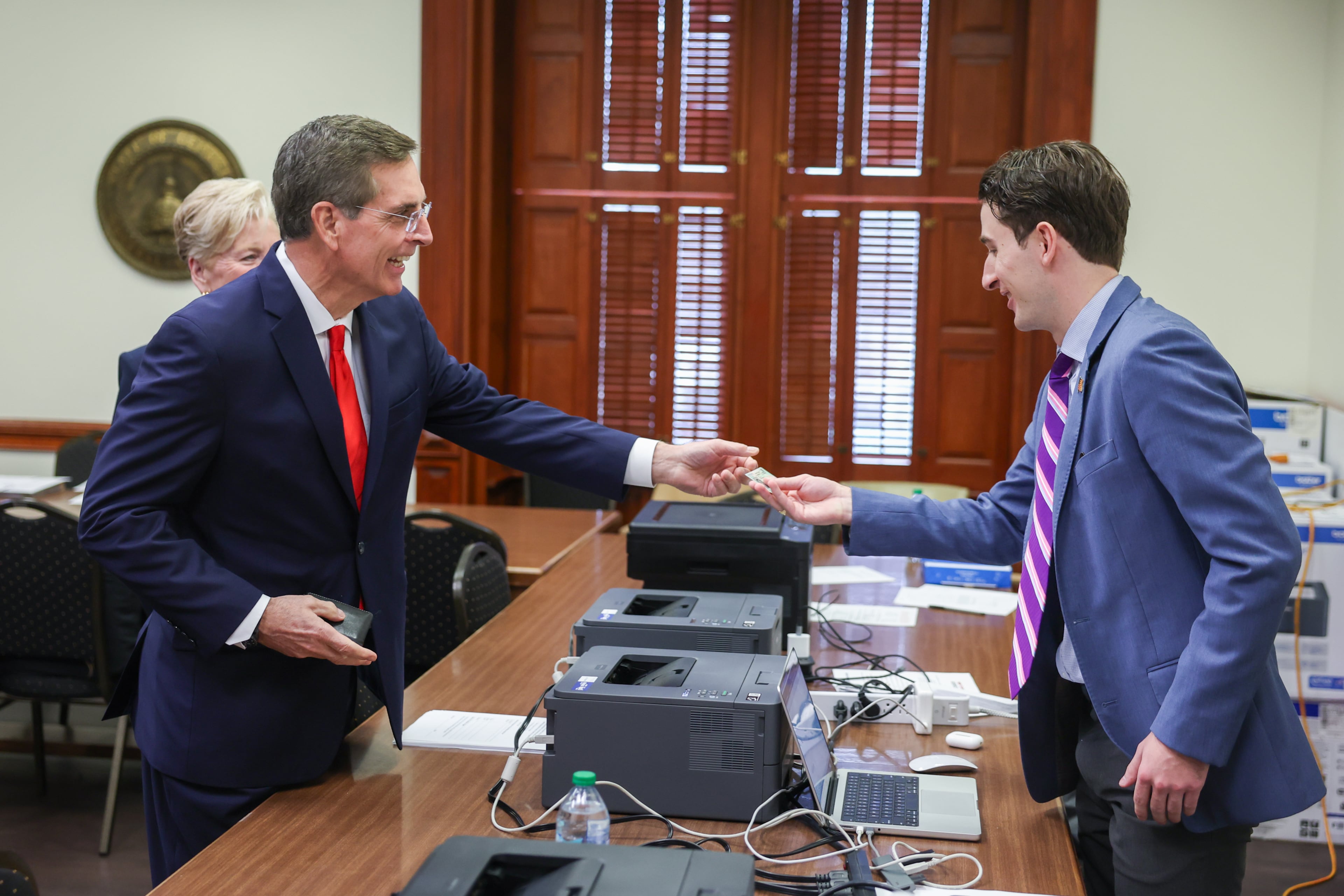
Raffensperger quietly filed for the race despite a toothless Georgia GOP resolution last year seeking to block him from qualifying. He cast himself as a conservative willing to stand up to political pressure.
“People know, no matter what, that I’m going to stand up for the people of Georgia,” he said.
‘The greatest nation’
On the Democratic side, the dynamic is equally competitive.
Former Atlanta Mayor Keisha Lance Bottoms, former Lt. Gov. Geoff Duncan, former state Sen. Jason Esteves and former DeKalb County Chief Executive Michael Thurmond are battling in a heated Democratic primary.

Bottoms entered qualifying with little fanfare, waiting in line with other Democrats to file her paperwork.
Esteves, who launched a volley of campaign ads this week, chose a different approach. He bolted up a staircase lined with cheering supporters before taking aim at his rivals.
He accused Duncan of helping pass “the worst bills that Georgians have seen in the last decade” and slammed Bottoms for leaving office during what he described as a crisis in Atlanta.
And Duncan, a party-switching former Republican, framed his candidacy as a pragmatic attempt to win a statewide race Democrats haven’t captured in decades.
“If a Democrat doesn’t win the next governorship in this state,” he said, “Donald Trump will, by default, have an office in this Capitol.”

Thurmond made his biggest statement on the eve of qualifying with an emotional town hall describing his campaign as the culmination of the American dream. He expanded on that sentiment moments after he signed his paperwork.
“When you start out on a dead-end dirt road, a house with no indoor plumbing, and then go on this life’s journey, you recognize — with all of the challenges we face in this country — we don’t have to make America great again,” he said.
“America has been, is and will always be the greatest nation on the face of this Earth.”
A crowded Senate fight
The contest to challenge Democratic U.S. Sen. Jon Ossoff is equally unsettled.
Two sitting Republican congressmen, U.S. Reps. Mike Collins and Buddy Carter, are competing with former football coach Derek Dooley in a primary that’s expected to head to a runoff.
Collins has emerged as an early leader among voters who have made up their minds, according to the Emerson survey. He used his qualifying appearance to attack Ossoff, while taking a jab at Dooley, who has acknowledged rarely voting over the past two decades.
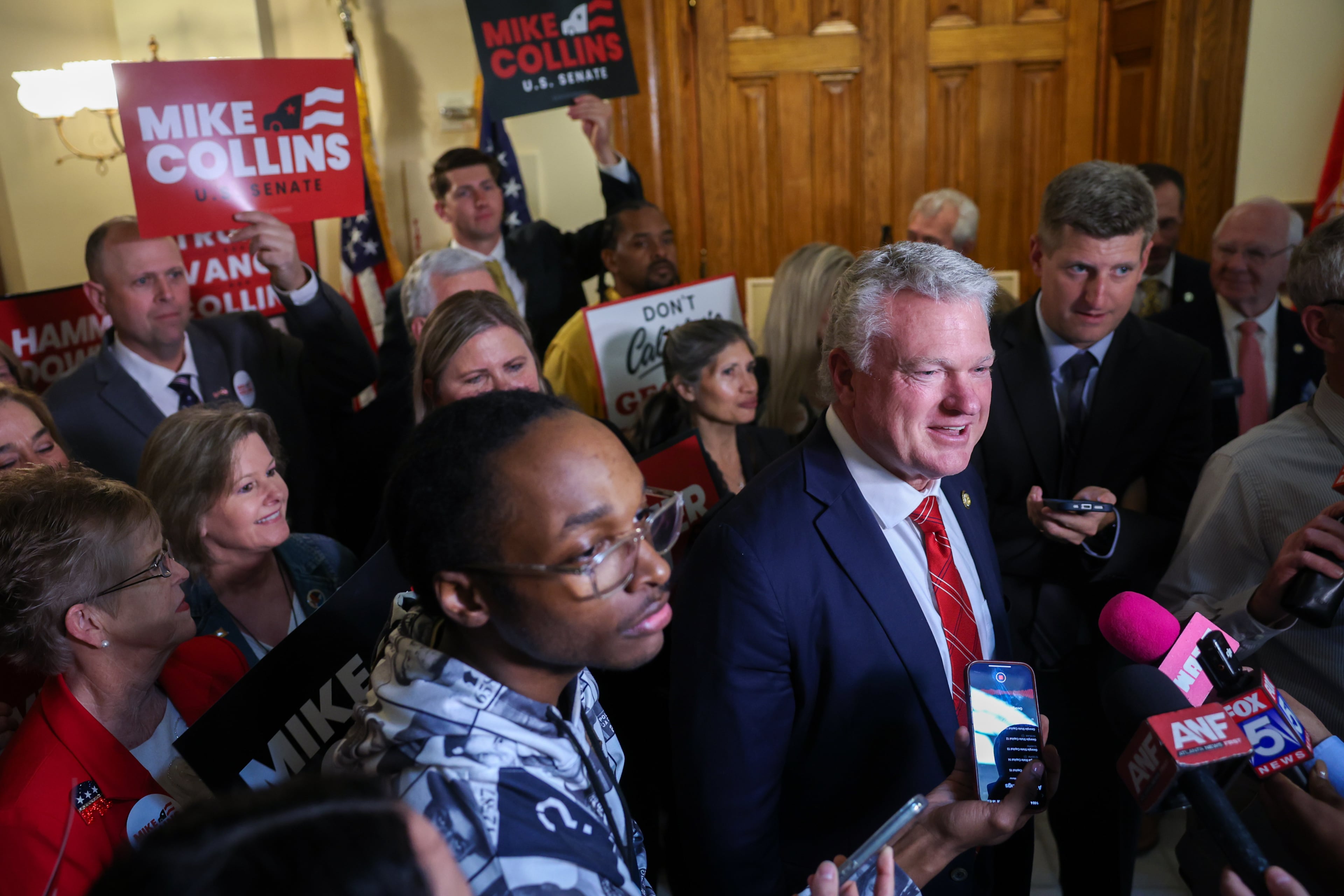
“I’ve been 30-plus years in the private sector. This is only my second term in Congress,” Collins said. “But Republican voters, especially, they not only want to elect Republican candidates, but they also want to elect people that have voted.”
Dooley framed his own candidacy as an outsider bid fueled by frustration with Washington — and a wide-open race for a slot in a runoff against Collins.
“The front-runner right now is undecided,” said Dooley, who benefits from support from Gov. Brian Kemp and his network.
Carter, meanwhile, emphasized his support for Trump and his “America First policies.”
Ossoff entered the race with advantages Republicans hope to erase.

Early polling shows him leading potential GOP rivals in hypothetical November matchups. But the Democrat also used his qualifying moment to highlight his opposition to recent U.S. military strikes on Iran.
“These midterms will be among the most consequential in American history, because if there were ever a moment that called for checks and balances, this is it,” he said. “And my opponents have already made clear they will be Donald Trump’s puppets.”
Congressional crunch
Qualifying week also locked in a rare round of churn in Georgia’s congressional delegation.
Four U.S. House seats are open this cycle, a mix of retirements, resignations and ambitions that test fresh faces down the ballot.
Dozens of contenders lined up to run for seats held by Collins and Carter, both now Senate candidates, and retiring U.S. Rep. Barry Loudermilk.

The first contest comes Tuesday when voters in northwest Georgia will choose a successor to former U.S. Rep. Marjorie Taylor Greene, who resigned in January.
That vote has turned into a crowded free-for-all, with Trump’s endorsement of former prosecutor Clay Fuller facing an early stress test on an all-party ballot.
Meanwhile, some contenders are facing stiff opposition. U.S. Rep. David Scott, the 80-year-old Atlanta Democrat, qualified for reelection as a slate of challengers bring calls for generational change amid concerns about his health.

Scott declined to answer questions from reporters after filing paperwork, as aides escorted him out of the Capitol in a wheelchair. That didn’t go over well with his challengers, who blasted him for declining to speak.
“If a candidate can’t tell you why they’re running, that tells me that they don’t deserve your vote,” said Everton Blair, a former Gwinnett County school board chair who is among several primary opponents to Scott.
Surprises and conflicts
The week also produced its usual mix of spectacle and surprises.
One of the more unusual developments unfolded in a Democratic-leaning state Senate race after state Rep. Ruwa Romman abandoned her gubernatorial campaign to instead run for an open state Senate seat.
Her move triggered an extraordinary response from two legislative rivals, Rahul Garabadu and Astrid Ross, who issued a joint statement endorsing each other while opposing Romman’s bid.
Near the end of the five-day period, Parkes abandoned her bid for insurance commissioner and instead jumped into the race for lieutenant governor. She’ll now face fellow Democratic state Sen. Josh McLaurin, D-Sandy Springs, for the party’s nomination.
And in one of the more striking moments of the week, state Rep. Esther Panitch stood behind Ossoff despite public friction with the fellow Democrat over Israel policy.
“Notwithstanding our disagreements, we still have to work together for the betterment of Georgia,” she said.

The week also brought reminders of the changing political landscape. Others announcing their retirement include House Speaker Pro Tem Jan Jones, Republican state Rep. Lynn Smith, Democratic state Sen. Elena Parent and Democratic state Rep. Dewey McClain.
State Sen. Ed Harbison of Columbus, the longest-serving Black senator in Georgia history, also announced he will not seek reelection after more than three decades in office.
“Even though February is Black History Month,” state Sen. David Lucas said in a speech on the Senate floor, “we are watching Black history unfold at our eyes.”
About the Author

Greg Bluestein is the Atlanta Journal Constitution's chief political reporter. He is also an author, TV analyst and co-host of the Politically Georgia podcast.


