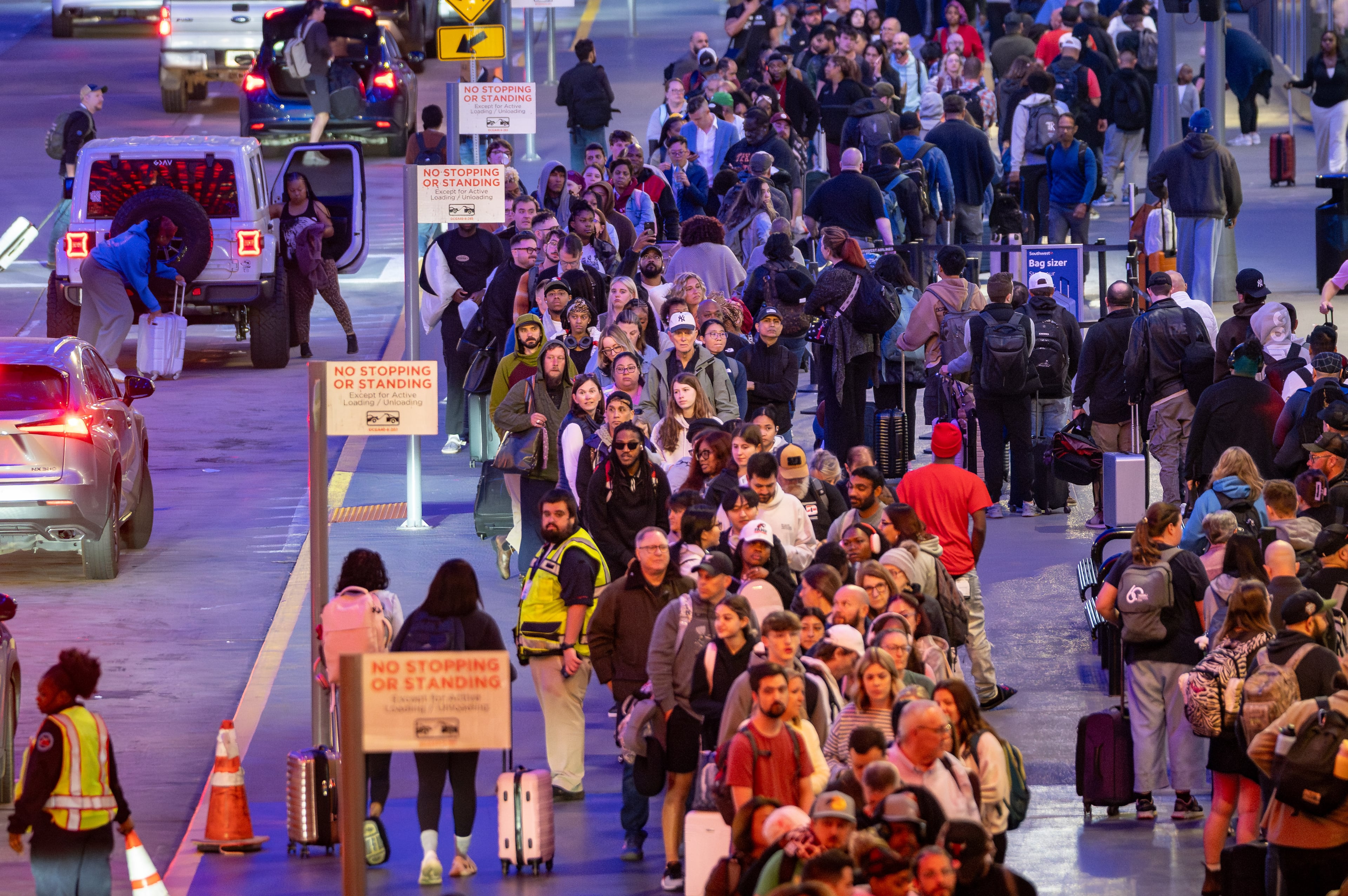
Why have airport lines seemed worse at ATL? The reasons are many.

Hartsfield-Jackson Atlanta International Airport has been the backdrop for some of the worst scenes of the ongoing government shutdown’s toll on the nation’s airports.
Travelers waiting hours stuck in lines snaking through baggage claim and outside the terminal building have been featured on television and splashed across the internet.
Last Sunday is considered by veteran airport employees the worst day in recent memory, with one report of a nine-hour line overnight.

A congressional fight over immigration enforcement left Transportation Security Administration officers caught in the middle, working without pay for nearly six weeks and causing severe understaffing.
President Donald Trump on Friday directed the Homeland Security secretary to immediately pay TSA agents.
It was unclear how fast TSA workers will be paid or how much conditions at airports will immediately improve if the funding moves forward.
Chaos at Atlanta airport
A partial government shutdown has left TSA workers unpaid for weeks, causing many to seek other work or childcare. Meanwhile security lines have ballooned with officials estimating wait times could reach four hours.
Live updates: What we’re seeing from Hartsfield-Jackson Atlanta International Airport
Paychecks arriving: Atlanta TSA employees begin receiving backpay. Future pay remains uncertain.
Worst waits: Why have airport lines seemed worse at ATL? The reasons are many.
Airport reports: The latest Atlanta airport wait times, as reported by passengers
How bad is it: Tell us about your ATL wait time
Donations: How to help TSA officers
Staying away: ICE presence makes airport a no-fly zone for immigrant community
Changing flights: Delta extends flight change flexibility because of security waits
ICE Deployment: ICE at Atlanta airport appear to step into some TSA functions
Security debate: Should the Atlanta airport privatize security? TSA woes raise the question.
Horror story: This traveler waited 9 hours in line
AJC Editorial: Congress must act now
Opinion: The airport perks for Congress may be drying up, not a minute too soon
Photos: Scenes from a packed airport
Pay divide: TSA workers are unpaid during shutdown; not so for members of Congress
Shutdown strain: TSA workers weigh showing up or staying afloat
Flight missed: Here’s the best food in every concourse
Complete coverage: Atlanta airport
Atlanta has seen some of the country’s highest callout rates and longest lines, along with airports in Houston, New Orleans and New York.
But some airports have been faring better.
So why has the Atlanta airport, at peak periods, cracked under the pressures of the shutdown?
There’s no one simple reason, but some of the answers have to do with Hartsfield-Jackson’s role as the world’s busiest airport and the pressures TSA’s workforce here is facing.
‘No way to recover’
Hartsfield-Jackson handles more passengers than any other airport on earth, including tens of thousands of people passing through checkpoints every day.
Even so, “I don’t think it’s accurate that Atlanta is the worst in the country,” Hartsfield-Jackson General Manager Ricky Smith said of the recent long waits.
“It’s a bad experience,” he acknowledged in an interview with The Atlanta Journal-Constitution on Thursday before Trump’s announcement and the Senate vote. “But you’ve heard stories in Denver and Philadelphia, some other airports that have had some pretty bad experiences.”
TSA officers all over the country have called out of work as they seek other ways to earn money and pay their bills.
With more than 40% of TSA officers calling out of work in Atlanta on some recent days, Smith pointed out a stark reality: “The checkpoint doesn’t have a lot of capacity, so the more people trying to go through at the same time, the longer the lines.”
Spring break travel has been exacerbating the situation.
On top of this heavy leisure travel, Atlanta is a major market for regular business travel.
During busy periods like the business travel-heavy morning rush, there are thousands of passengers streaming in for screening each hour — at times more than 100 a minute.
It can pile up quickly, especially at the main domestic terminal, because roughly 86% of Hartsfield-Jackson’s passenger traffic is domestic.
Smaller airports don’t have as many flights per hour, “so there’s a period when the queues can dissipate, and they can start all over again,” said Richard de Neufville, a Massachusetts Institute of Technology professor and expert in airport systems planning.
But during peak periods, Atlanta is “busy all the time, and there’s no way to recover,” de Neufville said.
That’s what seemed to happen last Sunday, when crowds filled the terminal all day and all night long.
“Once the queues build up, it’s hard to get them down again until people stop coming in,” de Neufville said.
With the total hourly capacity to screen passengers sharply cut because of understaffing, things are even worse.
When the unpredictable flow of passengers streaming into the terminal per hour reaches 80% of the capacity, queues not only build, but “the whole system gets clogged up for a while,” de Neufville said.
And it gets worse as the passenger flow gets to 90% of capacity or more.
“It just fails functionally,” de Neufville said, calling it a “wall of doom.”
“The reliability and the consistency, the performance goes to pieces, and you get a very, very bad situation,” he said.
It “may only happen 5% of the time, but it means that 5% of the time you get a reputation for just not being very reliable.”

Workers under pressure
Hartsfield-Jackson has had some of the highest call out rates in the nation, with TSA officers forced to find other ways to make money and pay their bills.
Aaron Barker, a longtime TSA worker and president of American Federation of Government Employees Local 554 in Atlanta, said some of the reasons for that may be that many TSA workers live south of the airport without MARTA train service, and it’s more costly for them to get to work than in regions with more extensive transit systems.
He also said many workers rely entirely on TSA for their livelihoods and do not have second jobs.
People in cities with a higher cost of living, on one hand, might have second jobs, he noted. At smaller airports like Savannah, TSA officers might only be working part-time.
In some parts of the country, starting pay for TSA can be in the $40,000 range.
“Most officers cannot afford to live in Atlanta, so they’re living an hour, up to an hour, sometimes an hour and a half away to work, to commute to work,” Barker said. “So that is probably why you may see a big difference.”

An airport for connections
Atlanta’s airport is heavily focused on connecting passengers between flights.
That’s why there are just two terminals with security checkpoints to access all seven concourses.
Connecting passengers, who are often rushing from concourse to concourse to catch their next flight, make up a majority of passengers at the Atlanta airport every day.
Atlanta-based Delta Air Lines and its partners operate about 80% of flights at Hartsfield-Jackson, and Delta operates flights on every concourse.
In Atlanta, “we’re a connection airport,” said Laurie Garrow, a professor at Georgia Tech’s College of Engineering and an expert in air travel behavior.
“You literally are only bringing people in one of two ways,” she said of departing passengers who aren’t connecting here. That’s either through the domestic terminal or international terminal.

Most passengers starting journeys in Atlanta enter through its domestic terminal.
Airport traffic forecasts show more than 50,000 domestic passengers pass through security checkpoints on the busiest days.
Other airports are laid out similarly to the original design of the terminal complex at Hartsfield-Jackson today. Denver International Airport and Delta’s redesigned hub in Salt Lake City, for example, have a main terminal to enter parallel concourses.
That’s designed for efficiency in connecting passengers as well as staffing because check-in employees are not split among many terminals, Garrow explained.
Some other large airports are more focused on travelers going to or from that city, like New York’s LaGuardia.
LaGuardia serves far fewer passengers than Hartsfield-Jackson but has three separate terminals, each with its own security checkpoint.
Even so, LaGuardia has had some three-hour wait times amid the shutdown, according to media reports.
Smith said in Atlanta, even with just one domestic terminal, having multiple security checkpoints can help spread out lines, but it also can make TSA staffing more complicated.
“That does make it a little more challenging for TSA to allocate staff” across multiple checkpoints, he said.
Smith said the wait times at different airports also depend on “what’s going on with the schedule at that particular airport.”
“I wouldn’t say Atlanta’s the worst,” Smith said Thursday.
“But we don’t have to be the worst to be bad. And we’re not happy with the lines that we’re experiencing here.”
About the Authors


As a business reporter, Emma Hurt leads coverage of the Atlanta airport, Delta Air Lines, UPS, Norfolk Southern and other travel and logistics companies. Prior to the Atlanta Journal-Constitution she worked as an editor and Atlanta reporter for Axios, a politics reporter for WABE News and a business reporter for the Arkansas Democrat-Gazette.