Love bonds happen for animals, too: Tales behind Atlanta’s cutest pairs

Our furry and scaly friends aren’t so different from us: They, too, form special bonds with mates and lovers, bicker like spouses, play like pals and cuddle in cozy corners.
In celebration of Valentine’s Day, The Atlanta Journal-Constitution searched Zoo Atlanta, Noah’s Ark Animal Sanctuary and LifeLine Animal Project to find bonded animal pairs and tell their tales.
Bramble and Baloo
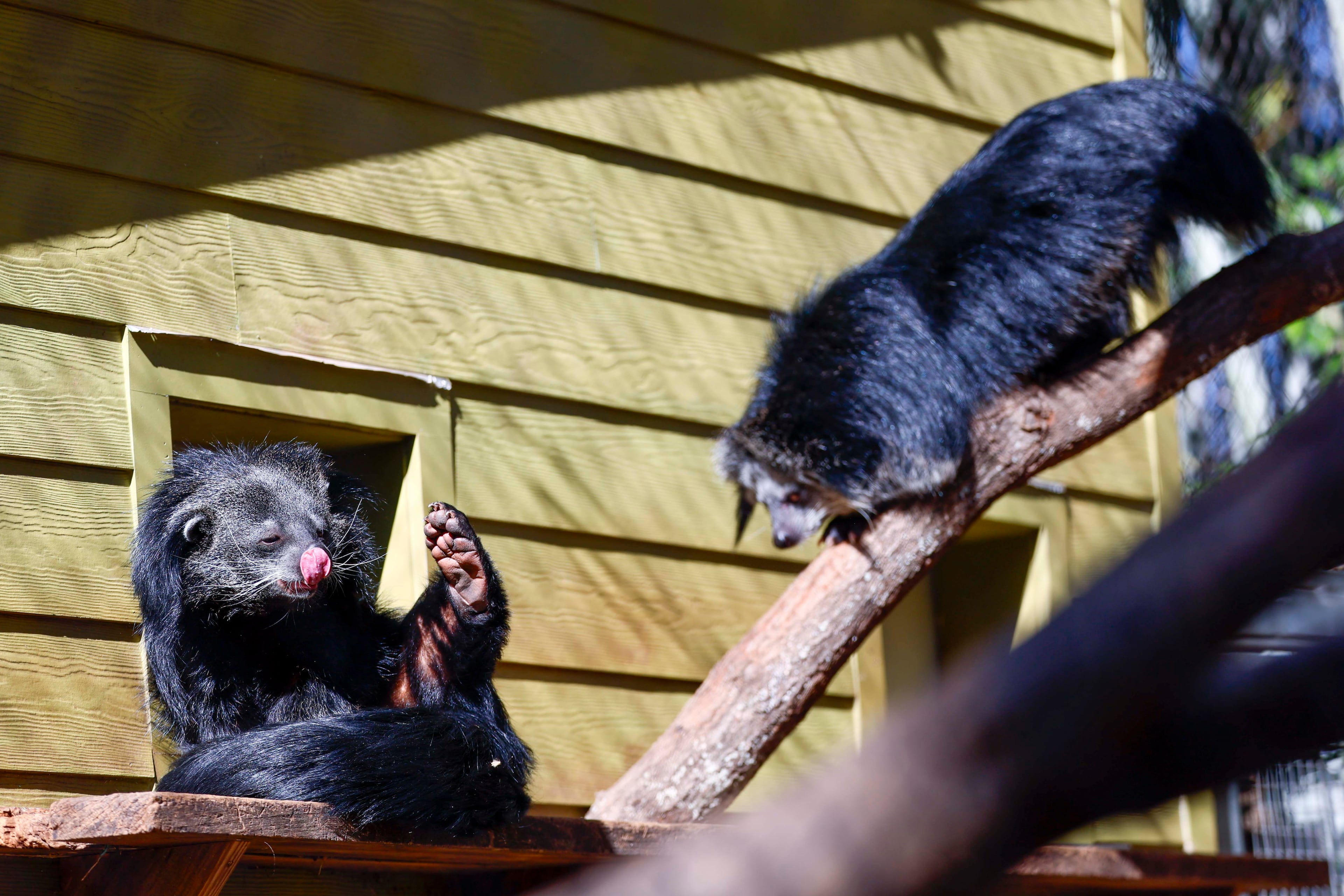
The cutest “BnB” around, Bramble and Baloo are two binturongs living at Zoo Atlanta.
Binturongs — often called “bearcats” — are native to South and Southeast Asia. The portmanteau makes sense: with pink noses, white whiskers and a passion for tree-climbing, they can resemble cats; while their wide, fleshy paws and black shaggy coats are reminiscent of bears. Unlike either, binturongs have a prehensile tail (one that operates like a fifth limb capable of grasping objects).
Baloo, a male binturong, came to Zoo Atlanta in late 2019, while Bramble, a female, arrived in 2020. The two act like a jaded married couple, said Jenny Elgart, lead keeper of carnivores for Zoo Atlanta.
“They more or less cohabitate. While they will sleep or move near one another, Bramble tends to remind Baloo of his lower status to her,” she said. Bramble, however, plays “boss” in the relationship.
“She occasionally will let Baloo know his place by growling at him or swatting at the air if he comes near, but then she will lay down near him,” Elgart said. “Baloo often tests his boundaries by approaching her even if she doesn’t seem in the mood.”
If these two were to go on a date, Elgart said, they would face off in a paintball game, then watch a movie and eat popcorn. Binturongs, she added, are “said to smell like popcorn.”
Valentine’s Day in Georgia
Still in love: Lessons from 65 years of marriage
Close bonds: Georgia’s strongest couples share this trait, UGA study finds
Friendship: Why Galentine’s Day is good for your health. (No, really!)
No reservations: These 15 easy Valentine’s Day recipes save the day
Celebrate: Tango dancing, truffle rolling and more in metro Atlanta
Cocktails: 11 Valentine’s Day drinks to set your heart aflutter
Gift ideas: Valentine’s presents that feel thoughtful, cool and actually useful
Read a book: 4 new romance novels to spice up your Valentine’s Day
Modern romance: McCaviar is how we’re doing Valentine’s Day now
Opinion: Sending flowers on Valentine’s Day to grieving loved ones forever changed me
Furry friends: Love bonds happen for animals, too. Tales behind Atlanta’s cutest pairs
Luke and Leia

With Star Wars-themed names, this pair of siblings is out-of-this-galaxy-cute.
They are up for adoption as a pair at LifeLine Animal Project’s shelter in DeKalb County.
The almost-3-year-olds were half of a litter of four siblings who came to the shelter together in May 2025. Their sisters, Lottie and Dottie, were adopted together last year, but Luke and Leia got left behind.
Luke is funny and rambunctious, while Leia is slightly more shy, said Samantha Warner, marketing and media coordinator for LifeLine Animal Project. They walk well on leash, but sometimes get “comically twisted together.”
If these two were to go on a date, Warner said, they would likely hop in a bouncy castle, then polish off some dog-friendly ice cream cake.
Fiddy Cent and Wakka Flocka

Fiddy Cent (male) and Wakka Flocka (female) arguably have the coolest names of the wattled crane flock at Zoo Atlanta.
The two came to Atlanta in 2016 as part of an Association of Zoos and Aquariums Species Survival Plan recommendation. The SSP program aims to help ensure genetically diverse, self-sustaining animal populations for future generations. Wattled Cranes are listed as a vulnerable species (fewer than 8,000 worldwide) by the International Union for Conservation of Nature.
Watching Fiddy Cent and Wakka Flocka’s bond grow has likely been entertaining.
“Wattled cranes are known for their elaborate courtship displays that include jumping, dancing, and vocalizing,” said Lauren Wilson, Zoo Atlanta’s curator of birds. “This pair has also successfully built nests and defended their territory and chicks together.”
The pair is currently guarding a foster egg.
“Fiddy Cent is a super dad,” Wilson said. “He is most often seen brooding eggs … He is also very fierce when it’s breeding season.”
If these two were to go on a date, Wilson said, they’d “go out dancing.”
Baobab and Marula

While “vultures tend to squabble a lot, Baobab and Marula do so less often than other vulture pairs we’ve seen,” said Rebecca Young, curator of ambassador animals for Zoo Atlanta. These hooded vultures met at Zoo Atlanta.
Baobab is publicly presented as part of the zoo’s World of Wild Theater presentation sponsored by Georgia Natural Gas. Marula was hatched at Zoo Atlanta and moved in with Baobab when she outgrew her parents.
If these two scavengers were to go on a date, Young said, “Imagine ‘Lady and the Tramp’, but with guts instead of spaghetti.”
Persephone and Finnegan

These two southern three-banded armadillos are expecting their first baby together in March. They both came to Zoo Atlanta as part of the AZA SSP breeding recommendation.
Their species is on the near-threatened list by the IUCN because of habitat loss from agricultural expansion, hunting and the illegal pet trade.
While they are both hard-shelled, they enjoy sleeping together in their hide box.
If they were to go on a date, Young said, they would find a sandbox and dig together.
Millie and Billie

After a farmer planned to cull 500 goats from his herd in Georgia, an individual sought the help of Noah’s Ark Animal Sanctuary in Locust Grove, Georgia to see if it could save some. Millie, a female, and Billie, a male, were among three Noah’s Ark saved in 2024.
Millie is the alpha, said Noah’s Ark CEO Lisette George. Billie is more laid back. Before arriving at Noah’s Ark (the sanctuary does not permit breeding), the goats conceived one offspring, Lil’ D, which was born at Noah’s Ark and was named in memory of a beloved tiger named Doc that had died at the sanctuary.
If Millie and Billie were to go on a date, George said they would definitely go to an all-you-can-eat salad bar.
“They love nibbling on fresh greens, fruits and veggies,” George said. “They are voracious.”
Munchkin and Gabe

When spider monkey Gabe (short for Clark Gable) was just 2 months old, he was living with an exotic animal dealer. After Gabe bit the dealer’s daughter, the man removed all of Gabe’s teeth so Gabe could no longer bottle-feed. The dealer contacted Noah’s Ark to take in the baby spider monkey. That was 37 years ago, and Gabe has called Noah’s Ark home for almost four decades.
In 2000, Gabe was introduced to Munchkin, a then 5-year-old spider monkey who had been confiscated by the Department of Natural Resources as an illegal pet.
“They bonded immediately,” said George.
The much-younger Munchkin protected toothless Gabe, stealing food for him and caring for him.
“She is definitely the lead in the relationship,” George said. “ … If there’s a ray of sunshine or a patch of sun, they’ll both share it.”
If they were to go on a date, George said they would go to metro Atlanta adventure park Treetop Quest.
Taz and Brogan

Taz and Brogan, two foxes, were rescued from a fur farm with the aid of a Minnesota nonprofit called Save a Fox and brought to Noah’s Ark.
While furs were once considered couture, demand has decreased.
“Fur farming in the U.S. is no longer a thriving business,” said George. “Most of these places are struggling or shutting down or leaving their animals to perish.”
Taz and Brogan were saved alongside six other foxes, landing at Noah’s Ark in February 2025. The group of eight was split into two enclosures of four. Taz and Brogan bonded seamlessly.
“It was kind of like speed dating for the four of them,” said George. “Taz and Brogan totally bonded. They curl up together in the sun … they are big cuddlers. And they do not have food aggression with each other … We have even seen them food share.”
If they were to go on a date, George said, they would go to the historic Hapeville Dwarf House Chick-fil-A.
Cleopatra and Anubis

Cleopatra and Anubis, two jackals, were at the same fur farm as Taz and Brogan. The fur farmer was attempting to breed them for their fur, but was not successful.
“They were kept in the same horrid conditions outdoors in the Minnesota winter,” said George. “Their feet never touched ground, living in a wire-bottomed cage.”
After a rescue adopted them, Cleopatra and Anubis had three pups together. Five jackals was too many for the rescue to care for, so it reached out to Noah’s Ark.
“I jumped on the opportunity,” said George. “Jackals are very rare in the U.S. in captivity right now.”
George guesses Noah’s Ark may be one among just four private sanctuaries in the country housing jackals.
“They’re a little skittish. They get nervous around people, but together they’re really wonderful,” said George.
If Cleopatra and Anubis were to go on a date, George said, they would be a “little bit bougie (because) they are very sophisticated” — perhaps a fine-dining Mediterranean restaurant.
Makarlee and My’Lena

Makarlee and My’Lena, two shy but beautiful girls (possibly sisters), showcase soft white coats. They are both up for adoption at LifeLine Animal Project’s DeKalb County location.
Each are roughly 6 years old and 40 pounds. They prefer a calm environment and become more confident as they warm to loving people.
If they were to go on a date, they would likely pack a picnic and head to the woods.
“They love a good hike,” Warner said.
Make their Valentine’s Day hiking date a reality: LifeLine Animal Project allows visitors to take out dogs for a weekend through its Weekend Warriors program.
Cakes and Casper

Cakes and Casper, two inseparable cats, “act like they’re married and have a mortgage,” said Warner. “Cakes is a hopeless romantic … She may be shy around humans, but she blossoms in the presence of other cats, especially her favorite guy, Casper.”
Casper is more outgoing. He will approach visitors at LifeLine Animal Project’s DeKalb County location and indicate that he wants to be petted. Both cats are roughly 5 years old. Cakes has been at the shelter since December 2023, while Casper joined her in November 2025. They are both up for adoption.
If these two were to go on a date, Warner said, they would stay in, order takeout and binge-watch reality television.
About the Author