Kemp redefines his legacy and looks ahead to a Capitol without him

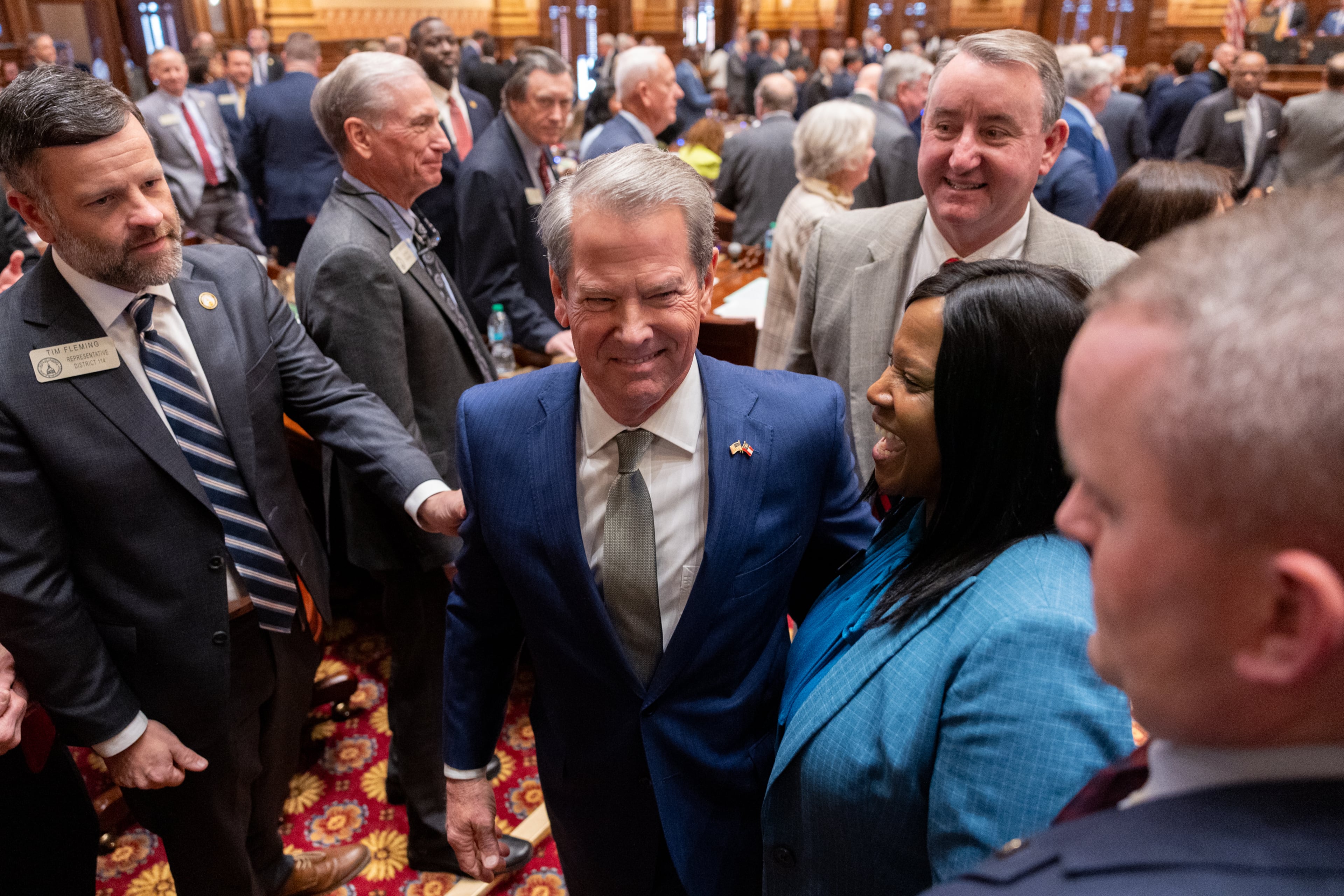
Gov. Brian Kemp’s final State of the State address was less a wish list for the year ahead than a balance sheet of what he has built and what he wants protected once he’s gone.
The two-term Republican touted a fourth $1 billion tax rebate, another trim to Georgia’s income tax and a one-time, $2,000 supplement for state employees. Just as telling was what Kemp left out of his speech Thursday before a House chamber filled to the rafters.
There was no sweeping new initiative unveiled on the scale of last year’s civil litigation overhaul. No opening salvo in a fresh culture-war fight. No revamp of his conservative vision of a limited Medicaid expansion.
Instead, Kemp signaled to his captive audience that in his final year in office he intends to wield the most powerful tool in his political arsenal — control of the state’s purse strings — as the race for his job intensifies.
And as he looks toward an undeclared political trajectory after office and an unpredictable contest to succeed him, Kemp offered a cautionary note to the candidates now jockeying for position.

He did not explicitly reject Lt. Gov. Burt Jones’ six-year plan to eliminate the state income tax and the roughly $16 billion it generates. But Kemp not-so-subtly indicated he favors a more measured approach.
“This tax cut doesn’t promise to pay for itself years down the road,” the governor said of his scaled-back proposal to shave another fraction off the income tax, “or create future budget holes with today’s one-time money.”
Top headlines from the Georgia Capitol
Money priorities: Kemp plan includes tax cuts, $2,000 for teachers and state employees
Analysis: Kemp redefines his legacy and looks ahead to a Capitol without him
Mental health: Georgia hits insurance companies with $25 million in fines
Guns: On his last day in Senate, Colton Moore’s gun bill advances to governor
Complete coverage: Georgia legislative session 2026
He also defended his refusal to hollow out Georgia’s bulging surplus, projecting he’ll leave office with about $10 billion in reserves even after a fresh round of big-ticket spending.
That’s roughly four times what any previous administration has handed off, he said.
“It’s not a question of if hard times will hit our state again,” he said. “It is simply a question of when.”
Then came the biggest surprise. In his final year, Kemp proposed a $325 million infusion into Georgia’s needs-based scholarship program — a priority Democrats have pressed for years to supplement the lottery-funded, merit-based HOPE scholarship.
Kemp framed it not as a concession to his critics but as an extension of his business-minded agenda — a “one-time endowment that will create opportunities for generational economic advancement for thousands of students.”
“And down the road,” he added, “it will allow them to complete college and begin meaningful careers without the burden of crippling debt.”
A conservative centrist?
The moment served as a reminder of the political duality that has defined Kemp’s rise.
The first lifelong Republican governor in state history, he defied corporate boycott threats to sign an anti-abortion law, vastly expanded where Georgians can carry guns and inked a “religious liberty” measure his GOP predecessor vetoed.
He lifted coronavirus restrictions as the pandemic raged and sparked national protests and claims of voter suppression with a rewrite of election rules.
Yet Kemp also won the middle with a business-friendly agenda, twice defeating Democrat Stacey Abrams by assembling a coalition that reached beyond the party’s base.
And even with his conservative bona fides, he also may be remembered partly as the Republican who defied Donald Trump’s demands to overturn the 2020 election — and withstood years of his fury — only to find his way back into the president’s good graces.
Those contradictions were evident not only in what Kemp said Thursday, but in what he deliberately avoided.
He recounted a legacy that includes nearly $10 billion in tax cuts, more than 200,000 new jobs and $9,500 teacher pay hikes on his watch.
But there was no mention of the 2020 election fight that vaulted him onto the national stage. And there was no revival of the polarizing social issues he successfully corralled over the past seven years to energize conservatives.
Those ideological victories remain central to Kemp’s record. But they seem sidelined this year as his party pivots to safer ground — pocketbook issues, public safety and economic development — in a midterm where ascendant Democrats threaten every statewide office.
‘Big red pen’
The lack of Republican red meat in Kemp’s speech puts Democrats in a bind.
It’s hard to come out against tax cuts or infrastructure improvements or sex trafficking crackdowns in any year — but particularly an election year when “affordability” is all the rage.
Even the response from Democratic leaders were more focused on the midterm than Kemp. Party chair Charlie Bailey said Kemp’s record of “failed leadership” has fueled growing unrest with the GOP that will manifest at the ballot box.
“This November, Georgia voters will once again say enough to failed Republican leadership and elect a strong Democratic governor who will fight every day for them and their families.”

One reason for the muted agenda is simple: Kemp has prevailed in nearly every major policy fight he chose to wage since taking office in 2019. Most of his campaign vows have been checked off.
But there’s another factor at play. A grueling fight over Kemp’s litigation overhaul last year tested the outer bounds of his power.
With would-be successors growing bolder, lame-duck status is no longer theoretical — even if Kemp reminded the audience he still has a “big red pen” at the ready to veto irksome legislation.
Kemp also acknowledged how fleeting power can be beneath the Gold Dome, where the constant churn of political dramas can distract from overall policy goals.
He closed with a reflection on his faith, urging lawmakers to make the most of their fleeting time in public office and “finish the great work we started.”
“My family’s service to this state will be a small footnote in the history books,” he said. “Your service under this Gold Dome will likely be the same.”
About the Author

Greg Bluestein is the Atlanta Journal Constitution's chief political reporter. He is also an author, TV analyst and co-host of the Politically Georgia podcast.