The improbable story of Bobby Cox’s first career ejection is worth retelling
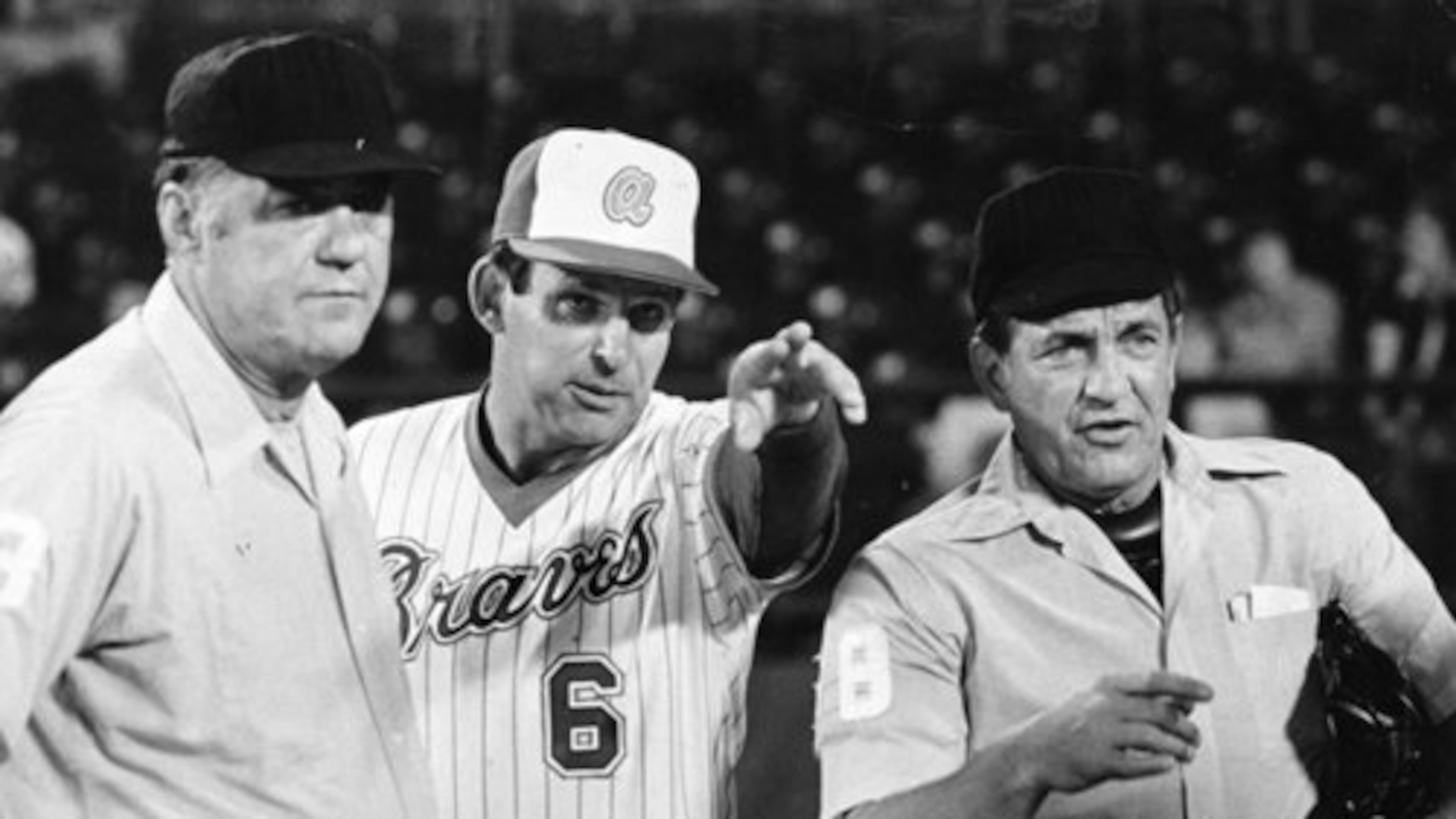

Perhaps no one realized it at the time, but the first of Bobby Cox’s MLB-record 162 ejections told Atlanta just how deep his loyalty to the Braves franchise would run.
On the evening of May 1, 1978, Cox was thrown out for, essentially, sticking up for the scoreboard operator.
In the wake of Cox’s recent death at the age of 84, memories of his ferocity in defending his players against umpires have run deep and colorful. Long forgotten, the story of his first tossing is worth retelling.
It was a Monday night. Early in Cox’s first season, the Braves were 6-14. Cox was a few weeks from his 37th birthday. The New York Mets were in town for a three-game series. Attendance at Atlanta-Fulton County Stadium was 5,399.
In the bottom of the fourth inning, left fielder Jeff Burroughs hit a slow ground ball to third and was called out in a close play at first by umpire Satch Davidson, according to The Atlanta Journal account in the following day’s newspaper.
Cox came out to argue the call before retreating to the dugout. But after the inning, the scoreboard operator apparently showed a replay that indicated Davidson had gotten the call wrong and Burroughs was safe.
Such technology was in its infancy. It was a matrix board that showed images in black and white with nowhere near the crispness stadiums in 2026 can provide fans.
The Braves had installed it above center field before the 1977 season. It was a logical feature for a team owned by a budding television mogul desperate to get attention on his team and sell tickets. (That would be Ted Turner.)
“I don’t know if anybody else had it,” Bob Hope, then a club vice president in charge of public relations, promotions and ticket sales, told The Atlanta Journal-Constitution recently. “To us, it was just, like, amazing. But Ted, his world was television. The video screen and all that fit right in.”
It didn’t take long to realize one particular usage of the board that got fans’ notice.
“We started replaying plays or controversial plays where we thought the umpire missed it or even if it was close,” Hope said. “We’d replay it on the board, and the umpires had never had that before. And they were just going nuts, just crazy.”
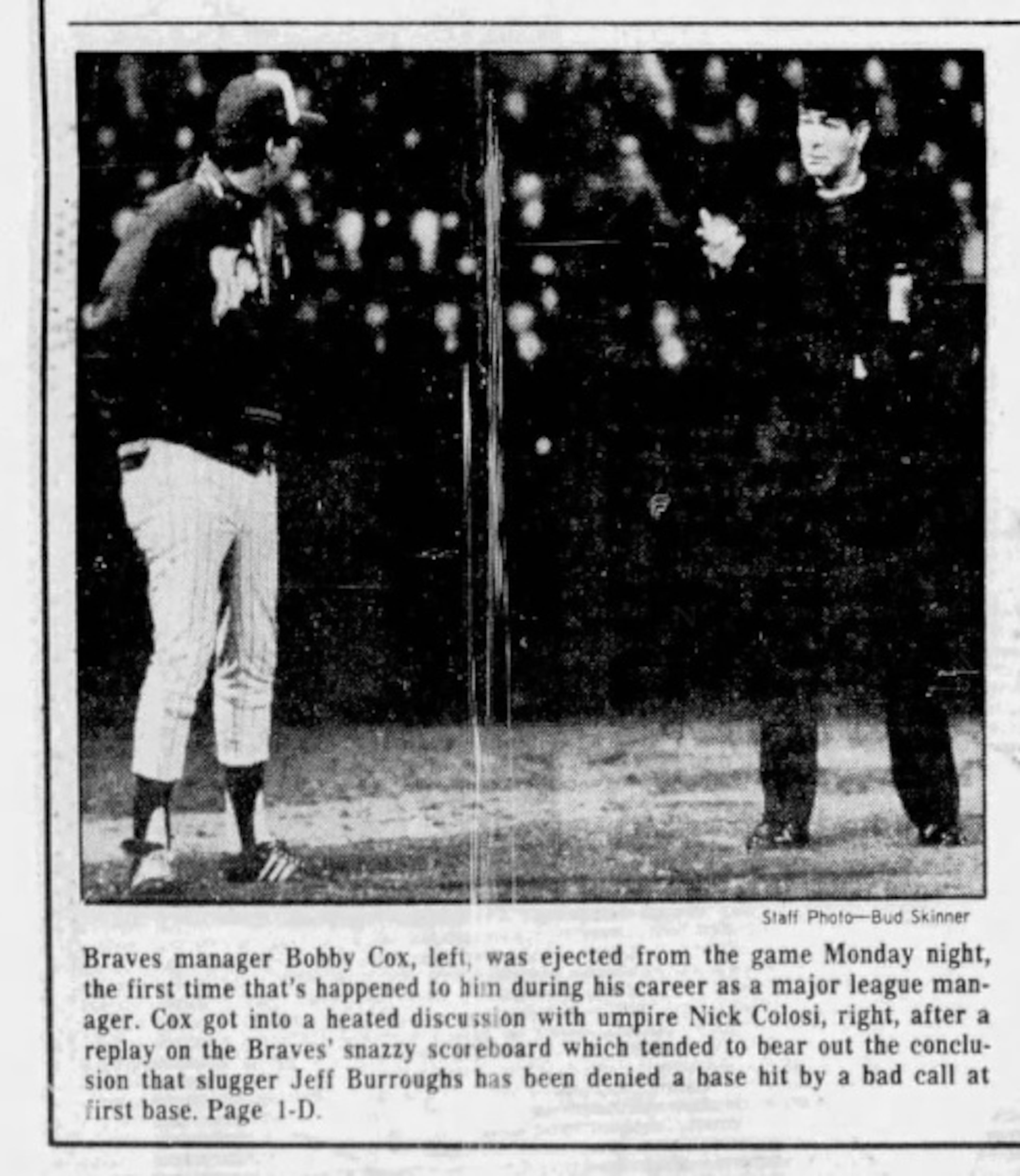
And so it was on May 1, 1978. Different newspaper accounts reported the board showed a picture of umpire Davidson and that it showed a replay of the Burroughs play. It’s likely both happened.
Regardless, what Journal staff writer Gary Caruso described as “thunderous booing” followed, and home plate umpire Nick Colosi warned Cox the umpiring crew would leave the field if the board were used for that purpose again.
In the decades to come, Cox would earn the respect and undying devotion of his players for his fury with umpires when they felt they’d been wronged. Such ferocity would help earn him a place in Cooperstown.
But on this night, Cox showed that not only would he have their backs, but even the scoreboard operator’s.
“I went over and tried to tell (Cox) like a nice guy,” Colosi told the Journal, “and he came out yelling that it wasn’t in the rule book and that they could put anything they wanted up there.”
At that point, Colosi removed Cox from the game, his first career ejection.
Said Hope, the team PR man who would come to know Cox well, “I’m very proud of him that he stood up for us.”
It was a peculiar game. Aside from Cox’s ejection, four balks were called and, according to the Newark (New Jersey) Star-Ledger, a bird flew at Colosi in the seventh inning, took a peck at him to the cheers of the crowd and “flew out to right field and plummeted to the ground. It was the same sick bird Atlanta pitcher Tommy Boggs found before the game, a bird he was caring for in the dugout.”
Two days later, the New York Daily News reported that National League president Chub Feeney warned the Braves against using the board to embarrass the umpires (“cautioned again” was the precise wording) and that general manager Bill Lucas told Feeney it was a “regretful mistake and would not happen again.”
Cox’s defense of the scoreboard operator was not in vain.
After the ejection, the Braves rallied. Biff Pocoroba, forever connected with Braves teams of that era, drove in the winning run with an eighth-inning double in a 6-5 victory.
“Everyone’s adrenalin was flowing tonight,” Pocoroba told the Journal. “We really wanted this one.”
But of course.
You can now get my column sent straight to your inbox. Sign up for my newsletter here.