Armour Yards endpoint for Clifton bus rapid transit could add decade to project
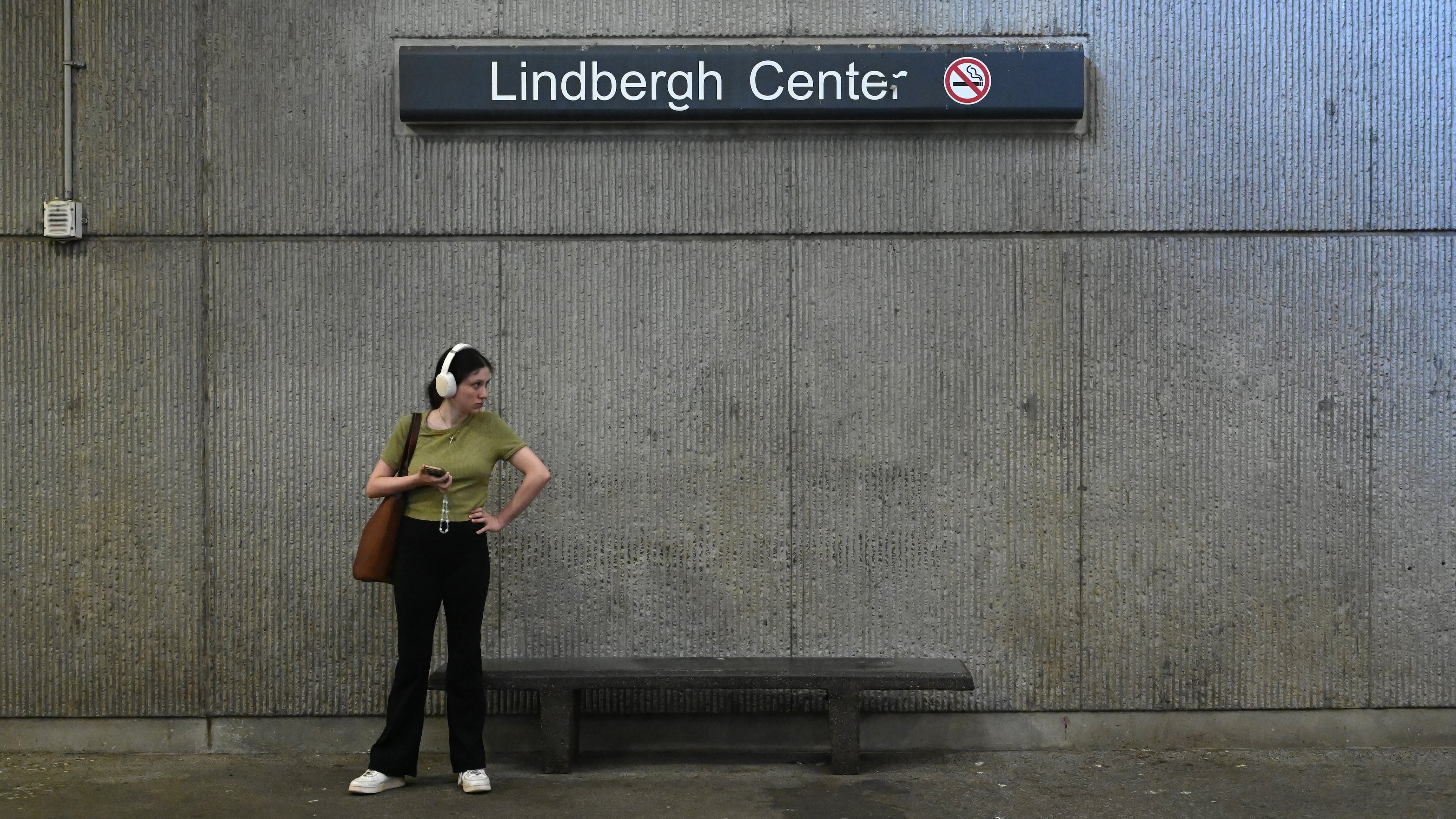
The Clifton Corridor bus rapid transit project could take between 13 and 18 years to complete if a new Armour Yards MARTA station is chosen as the northern terminus — significantly longer than if the route were to end at Lindbergh Center as planned.
That’s according to a new feasibility study by MARTA, which went back to the drawing board last year in light of a push by Atlanta Mayor Andre Dickens to put both BRT and a new train station at Armour Yards, a mostly industrial site that’s seen as ripe for redevelopment given its proximity to the Atlanta Beltline.
Armour Yards is “viable but presents notable risks,” MARTA officials concluded. It could add between six and 10 years to the BRT project’s timeline.
“Based on the technical analysis, MARTA recommends retaining Lindbergh as the terminus of Clifton Corridor BRT,” says a draft copy of a Dec. 10, 2025, report, which was obtained by The Atlanta Journal-Constitution. “This does not preclude future opportunities to advance the infill station or a BRT connection to Armour Yards.”
The report was shared in December with members of the committee that oversees More MARTA projects. The group, which includes officials from the transit agency, the city and the Beltline, is expected to recommend a route for approval by the MARTA Board of Directors this year and is engaged in a larger discussion about reprioritizing many Atlanta transit projects.
The Clifton Corridor is one of the metro’s largest employment centers not currently accessible by high-speed transit. It holds Emory University, the VA Medical Center and the Centers for Disease Control and Prevention, to name a few.
Solutions to the accessibility issue have been discussed for years, and the desire for improved transit was a large motivating factor in Emory’s push for annexation into Atlanta.
In surveys after the More MARTA sales tax was approved in 2016, residents ranked the Clifton Corridor project second in priority after Beltline light rail.
The 4-mile light rail line was labeled a top priority in 2018 when the transit agency finalized its More MARTA project list, but cost concerns resulted in the project being changed from light rail to a rapid bus line in 2023. At the time, BRT was estimated to cost $1.3 billion, compared to $2.9 billion for light rail.
The plan has been in the preliminary design stage since then. The first phase of construction is slated to build a route stretching from Lindbergh Center to the VA Medical Center, with potential future extensions to Decatur and Avondale.

Armour Yards became a possibility instead of Lindbergh Center after Dickens named it as one of four potential new MARTA station locations. It’s mostly industrial today, home to MARTA and Norfolk Southern rail yards. SweetWater Brewing Co., the District NightClub and other businesses are also in Armour Yards, though, and officials see significantly more opportunity for redevelopment on the site given its proximity to the Beltline.
A MARTA spokesperson said the agency has not made a final recommendation.
“MARTA is still getting stakeholder input from city of Atlanta and Atlanta Beltline, Inc. prior to finalizing the study,” spokesperson Stephany Fisher said in a statement. “Recommendations will be shared with the public as part of the extensive public engagement process we undertake with all projects.”
A spokesperson for the mayor’s office did not answer questions about whether the city still supports Armour Yards as an endpoint in light of the feasibility study and MARTA’s recommendation. Michael Smith said Atlanta officials are reviewing “data, timelines and available funding” to assess project viability for all proposed projects.
“Our collective goal should be to prioritize transit-dependent riders,” Smith said. “We will share our assessment with the Atlanta City Council, the MARTA board and the public at large in the near future.”
The feasibility study estimates one Armour Yards route would serve 540 transit-dependent riders, while another would serve 450. The Lindbergh route is estimated to serve 530. Smith would not say if the city has a preference for any particular route, or if it views those estimates as meaningful differences.
City Councilmember Alex Wan, whose district includes the Clifton Corridor, said he supports the study’s recommendation to stick with Lindbergh Center. But he said the community has waited long enough that any decision represents progress.
“All things being equal, I’d certainly want to pick the one that is delivered sooner rather than later,” Wan said in an interview. “Clifton Corridor has been grinding for decades now. So to a certain degree, six additional years is not ideal, but knowing that we’re moving toward that and we’ve started the shot clock, that is a positive thing.
“I just want the shot clock to start.”
A 2018 feasibility study identified several challenges to a potential new rail station on the site, including height limitations and the need to relocate existing CSX rail lines. MARTA officials announced last May they were studying the issue further to see how it could fit with BRT.
Notes from the More MARTA committee meetings indicate MARTA hired VHB, a civil engineering firm in Atlanta, to do the feasibility study and received the report in September. MARTA denied an AJC public records request for the study, citing an exemption in the open records law that allows agencies to withhold feasibility studies for in-progress projects.
The AJC then obtained two versions of the feasibility study from another source. Those versions are both dated in December 2025 and were shared with officials from the city and the Beltline.
The study looked only at the northern end of the BRT route and mapped three possible courses extending from the intersection of Cheshire Bridge and Faulkner roads. Two end at Armour Yards and one ends at Lindbergh Center.
One Armour Yards route, dubbed the “busway” option, would travel mostly in bus-only lanes along the CSX corridor. The Lindbergh option would take the same route before crossing Peachtree Creek and heading north.
The second Armour Yards route would operate largely in mixed traffic along Cheshire Bridge Road and would add a stop at Piedmont Circle.
The nature of the existing rail yard creates challenges for all of the options, the report noted. Both Armour Yards options have limited pedestrian access. The busway option would require building two new bridges, while the Lindbergh option would require building three.
Lindbergh and the busway option are the most expensive, with the segments estimated to cost $111 million and $123 million, respectively. The mixed traffic option would be the least expensive at $40 million.
The main thing in Lindbergh’s favor: There’s already a train station there, and it’s surrounded by transit-oriented development.
“Project readiness is also a critical factor. Lindbergh is operational today and ready for BRT integration, while a new (train) station would add significant schedule risk,” the second draft states.
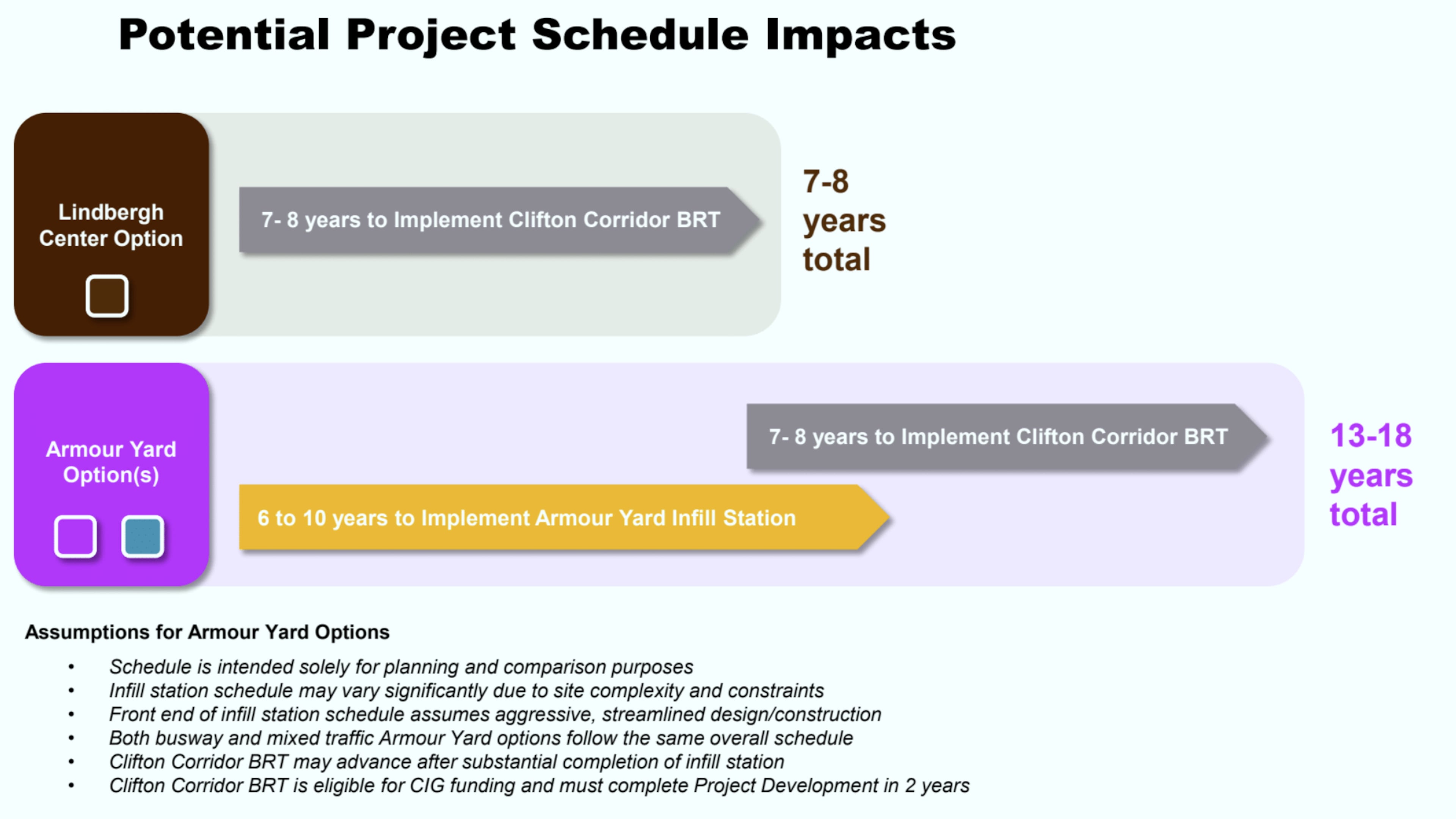
Part of that risk involves the lack of funding for the new station. Although the two projects are separate, BRT can advance only “after substantial completion of the (train) station,” the third draft states. The BRT project would be delayed if train station construction is held up in search of funding.
There’s currently no dedicated funding source for Armour Yards or any of the proposed new stations. One potential source could be through an extension of the city’s tax allocation districts, which is what the Dickens administration has proposed. More MARTA money could also be used, depending on the committee and the MARTA board’s decisions around project prioritization.
The BRT project is competitive for federal funding — three other rapid bus route projects from MARTA have received grants — but adding a train station to the scope would lower the project’s competitiveness when it comes to cost-effectiveness, the second draft notes.
The goal is to make a decision this year on the endpoint and route. Public engagement will begin later this year, Fisher said.
About the Author

Sara Gregory covers transportation for The Atlanta Journal-Constitution. Previously, she covered local government in DeKalb County. A Charlotte native, she joined the AJC in 2023 after working at newspapers in South Carolina and Virginia.