A lawsuit and a video create new problems for Morris Brown College
For Morris Brown College, the timing could not be much worse.
On the same week an independent evaluation team visited campus to determine if Morris Brown should keep its accreditation — and the vital federal funding that comes with it — the school was sued by a former member of its own board of trustees. In a complaint filed in Fulton County Superior Court on Wednesday, Nzinga Shaw claims the college did not pay her for her work as interim president.
It’s a position Shaw held only briefly, a result of president Kevin E. James’ abrupt firing last month. A week later, he was reinstated with little explanation.
His mysterious termination has led to anger and speculation among the historically Black college’s proud alumni base. And on Thursday, a video of a man appearing to be James began to circulate on social media — raising more questions about the embattled president.
In it, the man looks at the camera and describes the possibility of hiring a woman as his executive assistant. But he questions whether that individual would “be able to handle” a part of his anatomy.
It is unclear who the video was sent to. It includes a date of Dec. 20, 2019, roughly nine months after James took over the Morris Brown presidency.
The Atlanta Journal-Constitution sent a copy of the video to the school on Jan. 30, roughly one week before it became public. The version obtained by the AJC was low-quality, making the timestamp indiscernible. Morris Brown initially questioned the video’s authenticity and asked if James was employed by Morris Brown at the time the video was shot. The college did not issue a statement, and James did not respond when asked to explain the video’s context.
Morris Brown provided a statement Thursday evening, hours after the video had surfaced on social media and gained more than 200,000 views.
“Morris Brown College is aware of a video circulating publicly that depicts a comment made by Dr. James in a social setting,” the school said. “While the video is limited in context and edited, the Board of Trustees takes concerns related to conduct, professionalism, and respect for others seriously, regardless of the setting, particularly when they involve individuals in positions of leadership.”
After viewing the video on social media, Jeffery Miller, an alum who previously served on the board of trustees, called it a “sad day” for the school. “Our students, faculty, staff and Alumni deserve better,” Miller said in a text message.
Regarding the Shaw lawsuit, Morris Brown said it cannot comment on pending litigation.
The developments come at a crucial time for the school, which is trying to convince the Transnational Association of Christian Colleges and Schools that Morris Brown should keep its accreditation. If TRACS and its on-site evaluation team are unpersuaded, the college could be in peril once again.
James’ tenure has largely been well-regarded by the college’s alumni base, which nearly saw the school close after it lost its accreditation in late 2002. But it got its accreditation back in 2022 under James’ leadership.
Things seemed to be going smoothly at the college, with enrollment steadily increasing — the school aimed to double it from 400 to 800 over the next five years.
But a few weeks ago, James posted on social media that he had been removed as president. Shaw was announced as interim president. Many alumni were angry and confused by the move. That confusion intensified a week later when James was reinstated after the college said his removal did not “adhere to established governance standards.”
The lawsuit complaint says Shaw, a former Atlanta Hawks executive, “accepted reputational and career risk tied to a publicly announced leadership position during a controversial transition.”
“Defendant’s failure to provide the promised contract and Defendant’s refusal to compensate plaintiff created an injustice,” the lawsuit says.
Shaw resigned from the board to take the interim role. She is seeking unspecified compensatory damages.
In a Jan. 29 letter obtained by the AJC, Shaw’s attorney demanded Morris Brown pay $400,000 to avoid litigation. That sum, according to the letter, represents “the reasonable value of her commitment to serve as a crisis manager and Interim President.”

Meanwhile, there are concerns that James has acted inappropriately in his role. A recent petition by an official at a nearby HBCU demands that James resign, citing “credible complaints raised by a growing number (of) women & students as well as serious concerns related to conduct, leadership judgment, and workplace safety …”
Its author is Candace Bazemore, director of digital strategy at Morehouse College. In an open letter, Bazemore wrote that women at Morris Brown have experienced intimidation, retaliation and efforts to silence them when they speak out. The board’s decision to reinstate James, she wrote, sent a message: “The safety, dignity, and credibility of Black women are secondary to the preservation of power.”
Morris Brown’s Thursday statement mentioned “additional allegations” reported by media outlets.
“While no formal complaints or reports related to these matters have been submitted through established reporting or governance channels, the Board takes all such concerns seriously and will ensure an independent review. The well-being of Morris Brown College’s students, faculty, staff, and broader community remains the Board’s highest priority,” it said.
Asked two weeks ago if he would like to comment on the allegations he’s facing, James responded in a text message: “I will speak soon once I’m able.”
The firing and rehiring of James brought the school increased attention at an inconvenient time. With the TRACS visit scheduled, Morris Brown has tried to weather the storm.
Last week, it put out a news release announcing it had received a $700,000 federal grant for safety enhancements. The release also noted a $50,000 donation from Atlanta rap legend T.I. On Monday, the school said it had completed a successful external audit of its finances, as required by TRACS.
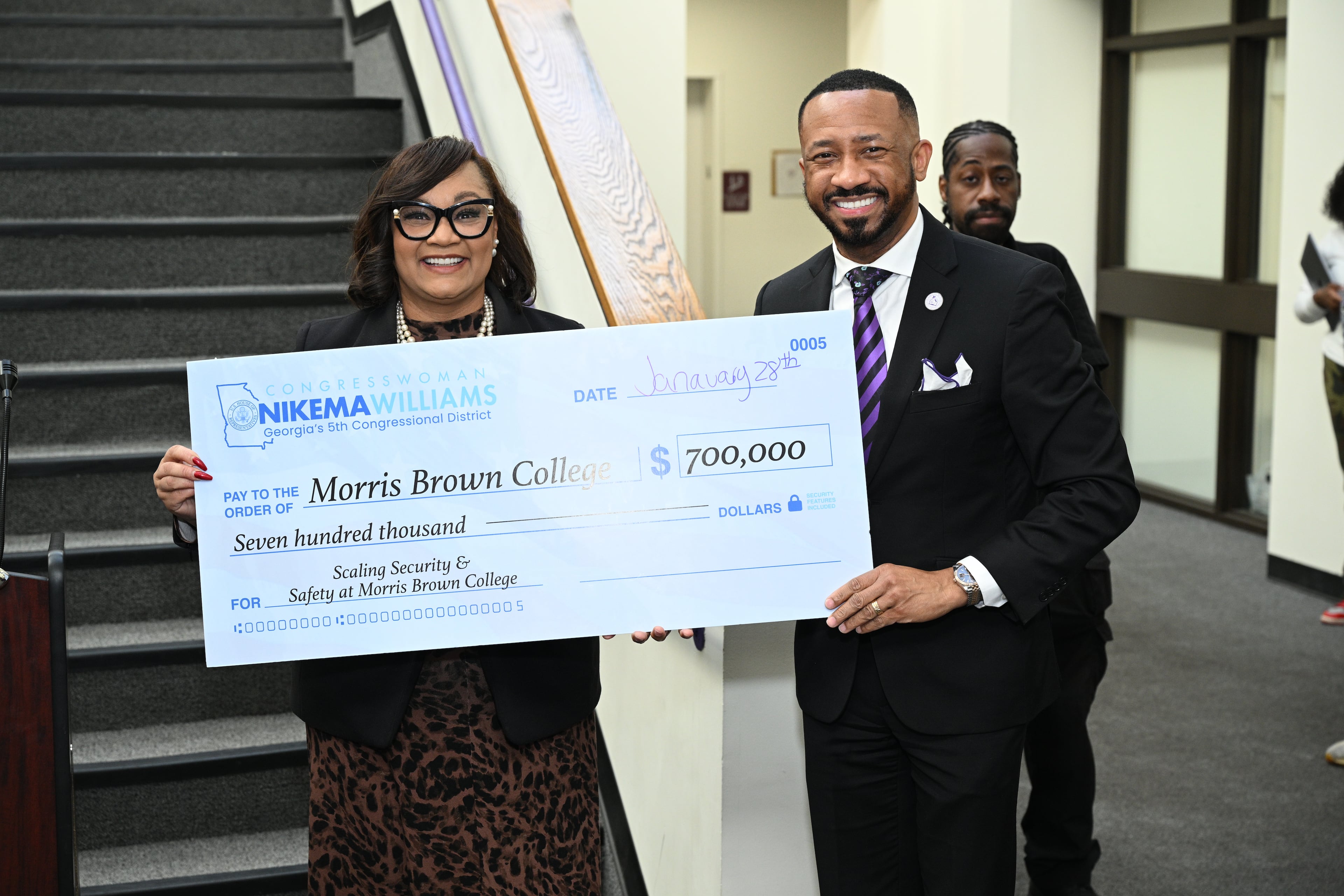
“This outcome signals to stakeholders trustworthiness and transparency, indicating reliable financial health and strong internal controls,” the school said in a news release. Neither announcement addressed James’ firing.
The AJC’s repeated efforts to contact current board members have been unsuccessful. When James was reinstated on Jan. 20, the AJC visited the college seeking to interview the president and students; it was told by security that reporters were not permitted on the premises and was then escorted off campus.
At least one alum has cautioned fellow alumni against speaking publicly as the accreditation review plays out. “The work of accreditation demands stability, cooperation, and a unified posture. Disruptive actions — however well-intended — can undermine the very future we are trying to protect,” Rev. Herman “Skip” Mason Jr. wrote in a Jan. 21 letter addressed to alumni on social media. “Let me be clear, your concerns are real. They are not negated, dismissed, or minimized. But this moment requires discipline, patience, and collective wisdom.”
It is not clear what concerns Mason, president of the neighboring Interdenominational Theological Center, was referring to. He did not respond to request for comment.
In an interview with the AJC, Bazemore said she personally experienced questionable behavior from James on Jan. 9, days before he was terminated. While stopped in a parking lot on the Morris Brown campus, with her car window rolled down, James drove past her, leaned out his window and “hit on me,” she said.
“This man is out of control. Like, what are you doing, sir? I was absolutely flabbergasted,” Bazemore said. “This isn’t your little pond where you can catch whatever you can get. You are held to a higher account because of the role and the level of integrity it requires.”
A Clark Atlanta University graduate who has taken classes at Morris Brown, Bazemore said she believes in the school and has no personal vendetta against James. But his conduct, she said, damages all HBCUs.
“Beyond that, I’m actually friends with people who he’s harassed, including co-workers,” she said. Her letter, signed “on behalf of women who were told to stay quiet,” urges other women to share their stories.
TRACS President Timothy W. Eaton declined the AJC’s request to attend any portions of the on-site evaluation, which concludes on Friday.
“Your presence would compromise the confidentiality of the review, which will not become official until the institution has been given due process to correct errors of fact, develop a plan to remediate any determinations of possible non-compliance, and appear before the TRACS Accrediting Commission for final reporting by the institution, Commission questioning, and voting,” he wrote.
— Staff writer Jozsef Papp contributed to this article.
About the Author