Georgia chimp center has a plushie-loving resident like Punch the monkey

Punch, a 6-month-old Japanese macaque, has captured the hearts of millions online.
In viral videos from the Ichikawa City Zoo, the little monkey is shown cuddling and dragging around an orange stuffed orangutan from Ikea as a replacement for the mother who abandoned him.
The videos have resonated with millions of viewers on social media, who are flooding the comment sections with supportive messages and love for the little primate. After being abandoned by his mother, the older monkeys in his surrogate community were unwelcoming until recently, with new videos showing him slowly being accepted into the group.
Punch isn’t the only primate with an emotional support plushie. In fact, plenty of the chimpanzees at Project Chimps, a sanctuary in North Georgia that cares for former research chimpanzees, grow attached to toys or blankets, executive director Ali Crumpacker said in a phone call with The Atlanta Journal-Constitution.
Primates and their emotional support plushies
New chimps are offered lots of toys when they arrive at the facility, Crumpacker said. Some gravitate toward balls, blankets or stuffed animals, but for Lizzy, a 36-year-old female chimpanzee, the Grinch stole her heart.
“She just grabbed the Grinch doll and has never let it go. So we’ve had to get replacement Grinch dolls, and when one gets dirty, she won’t give it to us unless we have a clean one to swap it out,” Crumpacker said.
Her love for the Grinch makes it especially easy to identify Lizzy, since she‘s often clutching the fuzzy green toy or can be found grooming it. Crumpacker said she’ll accept most Grinch toys, but she definitely has a favorite brand.
It’s impossible to say why Lizzy is so attached to the toy since she can’t explain herself. But it’s known that chimps see in full color, so Crumpacker said some residents gravitate toward colorful toys.
“You could do all sorts of psychology studies on it and still not come with any good answers,” she added.
What can happen when a primate loses its family?
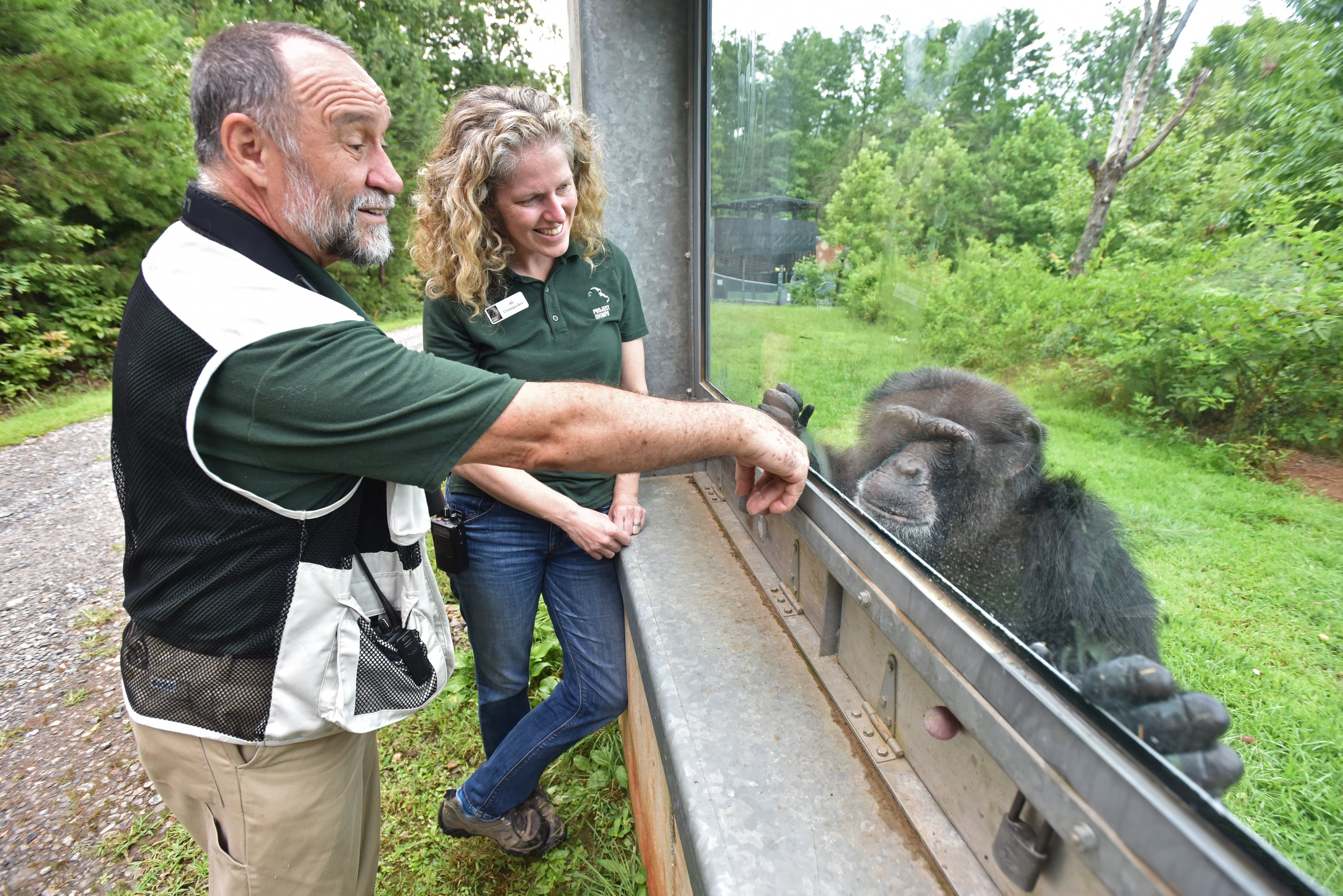
Almost all of the chimpanzees at Project Chimp were taken away from their mothers to be raised by humans, whether for medical testing or because their parents also grew up without parents and never learned how to raise a baby.
While none were explicitly abandoned by their mothers like Punch, it’s still important to settle them into social groups.
Monkeys like Punch and chimpanzees like Lizzy are quite different from each other, but “all primates are social creatures,” Crumpacker said. It varies across the species on what the social dynamics are, “but none of them want to be alone.”
In the wild, chimps might stay with their mothers until they’re teenagers, she said, so being pulled away at just a couple months old and raised around humans can have “huge” ramifications.
“Long-term effects of that is they don’t have the best social skills of communicating with other chimps,” she said, and also can’t recognize their family members.
Before chimps were even retired from medical research in 2015, it was outlawed for them to be “individually housed,” she added, which means that all of Project Chimps’ chimpanzees lived in some kind of social group, “but it’s almost like living in a boarding school program.”

When they were at research facilities, they were only exposed to chimpanzees similar to them in age and gender, so Project Chimps had to introduce them to members of the opposite gender and help them navigate the different age groups and social structures
They do occasionally see misfit chimps, who like Punch have a hard time fitting into their groups, but Crumpacker said they can move them around to different social groups.
For example, Project Chimps has one young male who was recently moved into a new group with a stronger male role model, she said. The new alpha male immediately understood how to teach the younger chimpanzee how to behave.
For those who would like to get a closer look at Project Chimps’ chimpanzees, including residents like Lizzy, keep an eye out for Discovery Days coming up in May, where attendees can learn about the chimpanzees and walk around their sanctuary.
About the Author

Olivia Wakim is a digital content producer on the food and dining team. She joined the AJC as an intern in 2023 after graduating from the University of Georgia with a journalism degree. While in school, she reported for The Red & Black, Grady Newsource and the Marietta Daily Journal.