Wishing Mercedes-Benz Stadium’s beautiful World Cup field were permanent
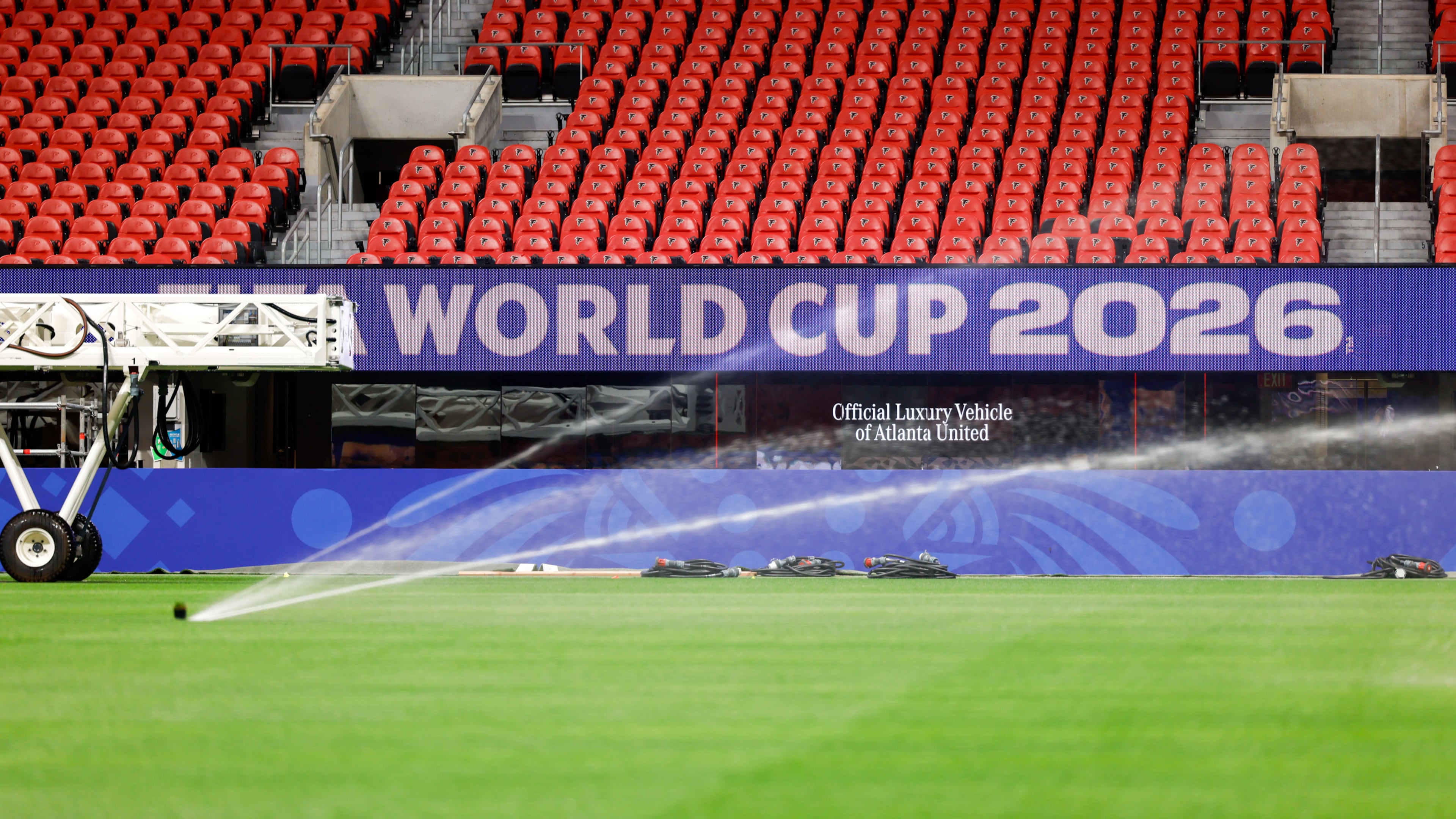

The greenest, lushest grass this side of Augusta National Golf Club lay before assembled media members at Mercedes-Benz Stadium on Thursday. The expanse of sod rested pool-table flat, begging to be wiggled on like a golden retriever.
It was an awe-inspiring rectangle of emerald, an aura of flora. Uniform in color, evenly cut and not a dandelion to be found.
Mercedes-Benz Stadium has three-plus weeks before it hosts its first World Cup match, but the natural-grass field — which FIFA gave media a sneak peek — appeared in fine shape for competition.
“I’m very confident this playing surface will be excellent for this tournament,” said Stuart Wilson, FIFA’s caretaker for the playing surface.
Some World Cup turf facts:
It is Kentucky bluegrass mixed with perennial ryegrass and injected with artificial fibers to aid durability. It arrived by truck last week from Green Valley Turf in Littleton, Colorado. Beneath it is a gravel base and a system to maintain proper moisture levels.
As Spain and Cape Verde await to christen the sod June 15 in the first of eight World Cup matches to be played in Atlanta, the blades of grass have been mowed daily to a height of 1.1 inches (27 millimeters) with plans to trim them down to 0.9 inches (23 millimeters) for competition, as per FIFA’s specifications.
The field is on a daily schedule of mowing, feeding, watering and exposure to artificial grow lights. To protect this most pristine of lawns, FIFA will keep the retractable roof closed throughout the tournament lest Atlanta’s humidity spawn a turf disease.
“It’s not easy growing grass in an indoor environment,” said Wilson, a Londoner who also oversaw the grass at MBS for last summer’s Club World Cup.
So exacting are FIFA and Wilson that he has a tool he uses to measure the field’s traction, a studded plate used with a torque wrench that mimics a player twisting on one foot.
Like World Cup visitors to Atlanta, the grass’s stay is temporary. It will be removed after the final World Cup match at the stadium, a July 15 semifinal, and artificial turf will be reinstalled for Arthur Blank’s Falcons and Atlanta United.
Seeing this beautiful field in this world-class stadium, a familiar question welled:
Why couldn’t this $1.8 billion marvel have been built to use natural grass instead of artificial turf?
Perhaps it was too much to ask of Atlanta’s reigning billionaire philanthropist. But couldn’t the engineering brainpower that enabled its most inspired element — the eight-panel retractable roof that opens and closes like a camera shutter — also been harnessed to create a system for an organic field beneath it?
Two NFL venues with retractable roofs — Las Vegas’ Allegiant Stadium and Arizona’s State Farm Stadium — have such features, both holding grass fields on trays that roll out of the stadium and into direct sunlight.
Coincidentally, when the Falcons play in Madrid in November, they’ll play in a soccer stadium with the most advanced retractable grass field in the world. Bernabéu Stadium’s field is sectioned in trays that can be lowered underground.
If you’re wondering, the engineering company for the Bernabéu project (Sener) claims that its components can be easily adapted to “virtually any stadium in the world,” including those that are already built.
However, for MBS, it wouldn’t be quite as simple as tapping the good folks at Sener, if retrofitting a football stadium with an underground field-storage system could be considered simple.
Being able to retract the MBS field would be helpful for staging concerts and other events, but another issue would be how much that grass field would be used. The Falcons share the stadium with Atlanta United. Beyond that, multiple college football games are staged there, as are the GHSA football state championships.
Mercedes-Benz will be known as Atlanta Stadium for 2026 World Cup
Starting in 2028, Blank’s new professional women’s soccer team will play there, too. That would be a lot of wear on a grass field.
Still, the World Cup, for which seven NFL stadiums (including MBS) with artificial turf have installed grass, has raised the volume on calls for franchises to do equally for their own players.
Recently, NFL Players Association executive director JC Tretter said on the “Not Just Football” podcast that, in a poll of 1,700 NFL players, 92% preferred grass. Among them is Falcons All-Pro guard (and NFLPA team rep) Chris Lindstrom, who unhesitatingly chose grass when asked his preference after an offseason team workout earlier this week in Flowery Branch.
Lindstrom praised the grass at the Falcons’ practice fields.
“I wish we had it in all 32 stadiums,” he said.
In 2024, Blank defended the stadium’s artificial turf, pointing out that injury rates for players on grass vs. turf were identical and that “we’ve had virtually no complaints” about it.
Earlier this year, though, in the NFLPA’s annual report card that was obtained by ESPN, Falcons players gave the MBS field a C-. The grade was behind all but two of the stadiums with grass fields and seven of the 17 teams with artificial home fields.
That could not have sat well with Blank, who lives by the credo “the best or nothing.” After the Falcons received a D for the locker room and a C- for the weight room on the 2023 report card (grades that dropped to F for both a year later), Blank renovated both spaces. In this year’s assessment, the weight room got an A and the locker room a B.
Is there a solution?
I can think of someone with the drive and the means to find one.
You can now get my column sent straight to your inbox. Sign up for my newsletter here.