
These 2 Georgia football strengths led to season-ending loss to Ole Miss
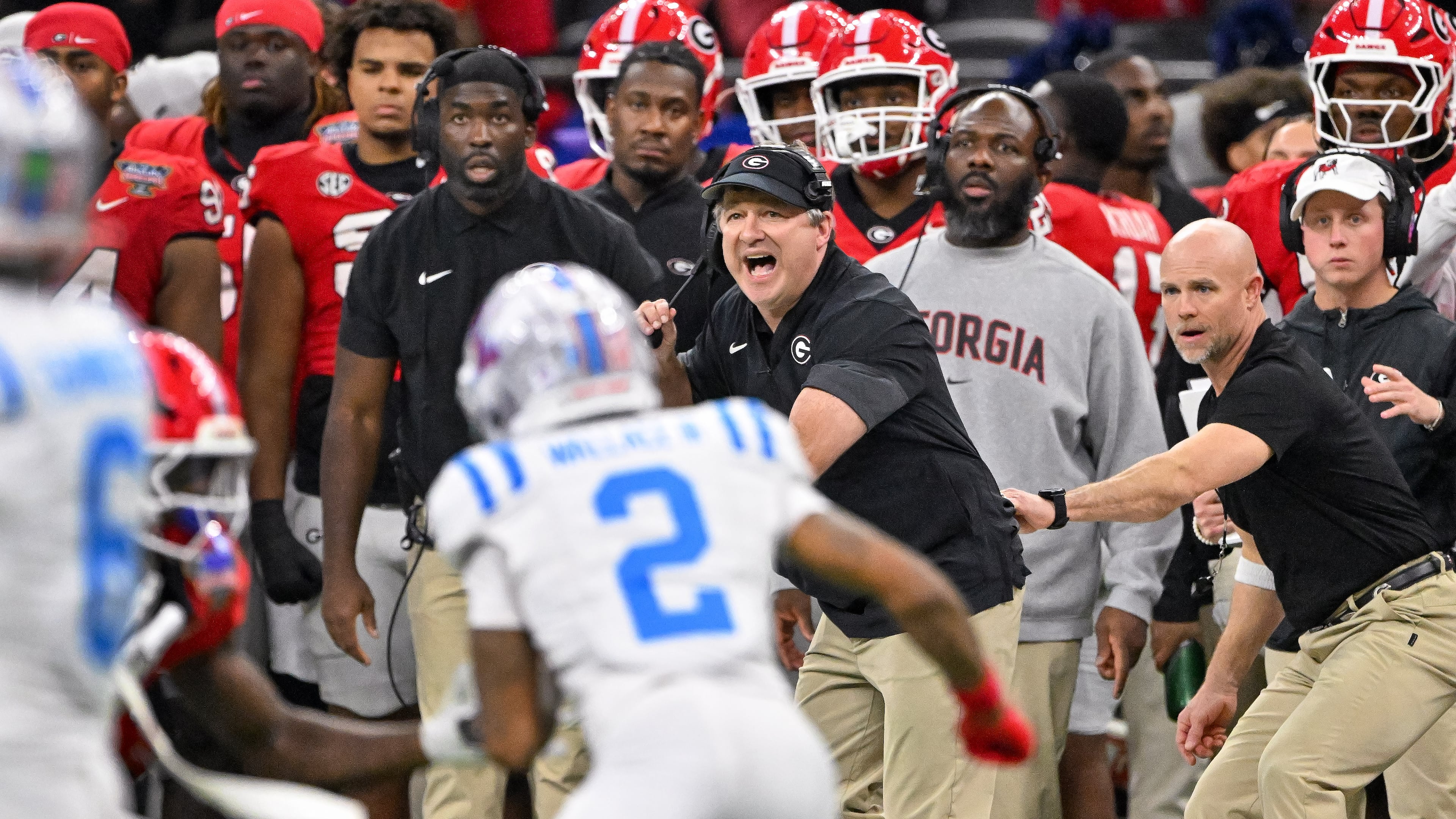
ATHENS — From a statistical standpoint, the two things Georgia did best were convert on fourth down and score touchdowns in the red zone.
Entering the Ole Miss game, the Bulldogs ranked first nationally in the former category and second in the latter.
But those two areas would go on to play a large role in ending Georgia’s season in the 39-34 loss to Ole Miss.
The decision to go for it when facing a fourth-and-2 from its own 33-yard line in the fourth quarter was a disaster.
Center Malachi Toliver snapped the ball after the offense had rushed on the field to replace the Georgia punt team. It was a play that Georgia had run multiple times this season, including successfully against Mississippi State and Texas.
One key difference, though, was that Drew Bobo was the center in those wins. Toliver was starting in place of Bobo after the All-SEC center suffered a foot injury against Georgia Tech.
“The ball was not supposed to be snapped in that situation,” Smart said. “But that was on us as coaches. It was on me and our guys. It’s not on the players. And Gunner [Stockton] and those guys did a nice job executing it. But we did feel like we had lost momentum at that point, and the book says we needed to go for it.
“There’s probably another way I would like to have gone for it, but we did not execute the situation really well there.”
Toliver snapped the ball, with left tackle Monroe Freeling slow to react on the play. He failed to pick up a blitzer off the edge, leaving Gunner Stockton with no chance to do much of anything. Stockton fumbled the ball on the ensuing hit.
Ole Miss would get the ball at the Georgia 23-yard line and score two plays later to go up, 34-24.
“We didn’t execute, so in hindsight, it didn’t work,” Smart said. “But that did not cost us the game, let me assure you.”
Yet Georgia still had a chance to win the game. After a quick Georgia touchdown and Ole Miss three-and-out on the next two drives, Georgia drove into the red zone trailing 34-31. A pass interference penalty gave Georgia first-and-goal at the 8-yard line with 1:13 remaining.
Stockton gained 5 yards on first down before Chauncey Bowens lost three yards on a second-down run. That gave Georgia the ball at the Ole Miss six-yard line. It’s important to note those two plays forced Ole Miss to call their final two timeouts.
With 1:04 remaining in the game, Smart faced a tricky choice. He could elect to run the ball, shortening the contest. In the event Georgia didn’t score a touchdown and converted the short field goal, the Ole Miss offense would have had roughly 20 seconds remaining when it took the field.
But Smart opted to be aggressive in the situation, instead hoping a Stockton pass would put Georgia up, 38-34. Smart did not want to play for overtime and saw the third-down play as a two-point conversion opportunity.
“I liked the call, I liked the play, and I liked going to win the game,” Smart said. “I feel like if we scored there and we kicked it, we’re up, and they’ve got to score a touchdown to beat us. I’m like, I’ll take that every time with our defense in two minutes. So, I liked the plays there. I mean, if we run it and don’t get it, then I’m sitting here playing for a tie, and I don’t love that, or playing for overtime.”
Stockton fired what was an incomplete pass to Oscar Delp. A review of the play briefly showed Colbie Young get open on an in-breaking route, while Zachariah Branch was working his back into the center of the field.
The incomplete pass saved Ole Miss at least 40 seconds of game time. A sack on the play would have been a more favorable outcome, given what transpired next.
Peyton Woodring knocked home a 23-yard field goal to tie the game with 56 remaining.
On the next drive, Ole Miss quarterback Trinidad Chambliss would find wide receiver De’Zhaun Stribling open for a 40-yard gain to put Ole Miss into field goal range. With six seconds remaining, Ole Miss kicker Lucas Carneiro knocked home the game-winning 47-yard field goal.
“We play man-to-man. This guy’s really good at throwing the ball. You can think that they might run the ball there, because if they don’t get a completion there, we’re getting the ball back, and they’re looking at it,” Smart said. “They played to win the game, and we played to win the game.
“We didn’t play to go to overtime, because a lot of people would have said, Oh, third and 5, let’s just run it and milk the clock out or they’ll call timeout. They went for it, and they made a good play,” he added.
While many could argue that playing for overtime would have been the smarter decision, the red zone stats show it might not have been.
Georgia had five trips to the red zone, kicking two field goals while scoring three touchdowns. Ole Miss conversely scored touchdowns on all four of its trips to red zone. Only twice this season did Ole Miss score a touchdown on every trip it took to the red zone. Both came against Georgia.
The Bulldogs left eight points on the field by not scoring touchdowns. In a game Georgia lost by five, that proved to be the difference between a trip to the Fiesta Bowl and a season-ending defeat.
That those two areas, which Georgia excelled at all season, led to its undoing makes the season-ending defeat all the more crushing for Georgia.
“I am proud of our team,” Smart said. “I’m sick that we lost, and there’s things I would love to go back and do differently. But I’m just so proud of the way our guys competed when down 10, and just didn’t finish it.”
,
About the Author

Connor Riley has been covering the University of Georgia since 2014 before moving to DawgNation full-time before the 2018 season. He helps in all areas of the site such as team coverage, recruiting, video production, social media and podcasting. He graduated from the University of Georgia in 2016.