Trump endorses Collins in runoff, shaking up Georgia’s U.S. Senate race
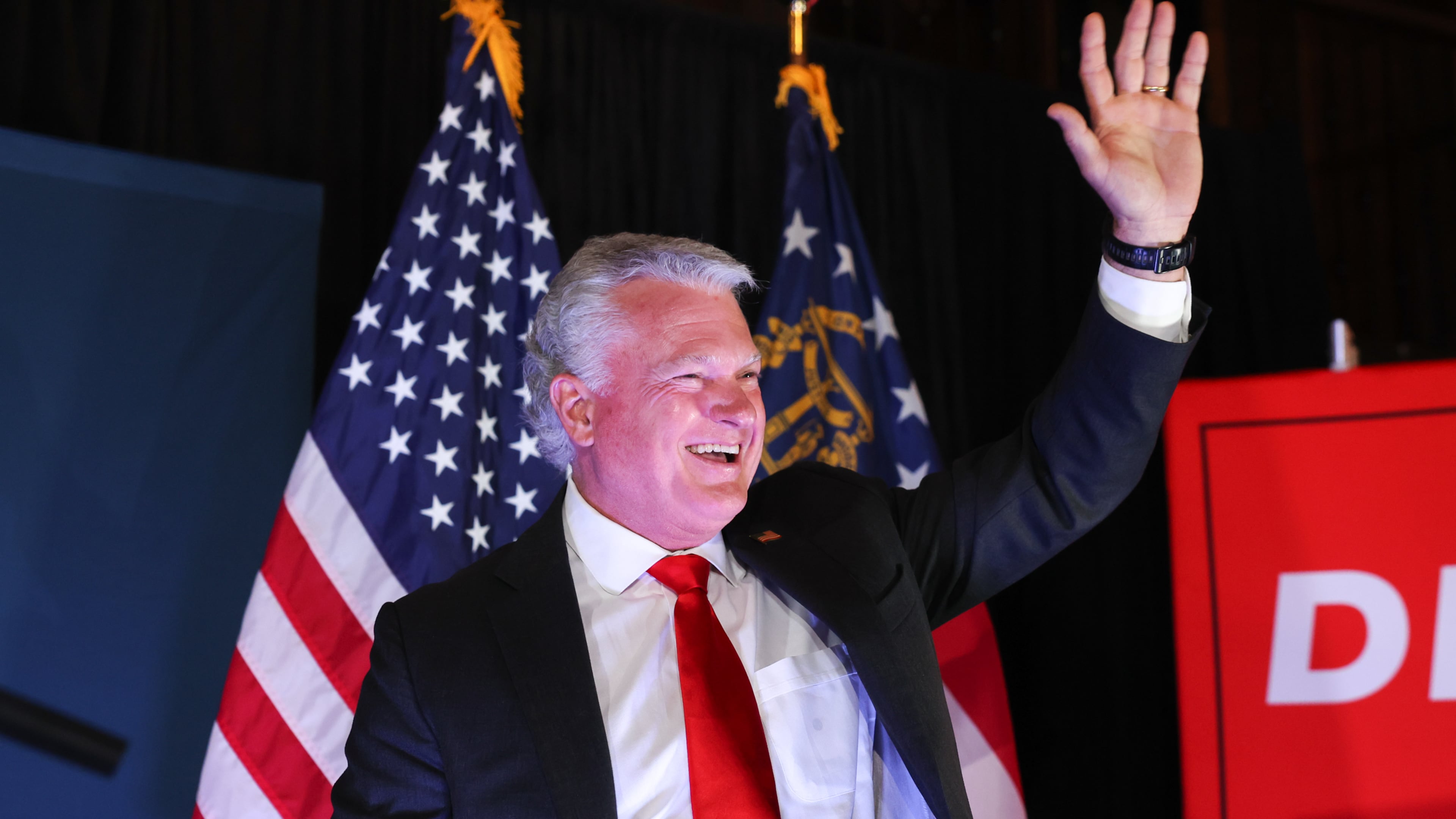
President Donald Trump endorsed U.S. Rep. Mike Collins on Sunday in Georgia’s Republican U.S. Senate runoff, undercutting Gov. Brian Kemp’s high-stakes gamble on former football coach Derek Dooley just days before the runoff.
The endorsement is a significant setback to Dooley, whose viability depended in part on persuading Trump to stay neutral while Kemp rallied establishment Republicans behind the political newcomer.
Instead, Trump sided with Collins, a two-term congressman who branded himself as a “MAGA warrior” and built his campaign around unwavering loyalty to the president and his agenda. It cemented the Tuesday runoff as another test of Trump’s dominance over the GOP.
“I’ve always said that President Trump has this just impeccable ability to put his thumb on the scale at the right time,” Collins told supporters at a stop in Woodstock after the president called him a “WARRIOR and a WINNER” on social media.
Kemp and other Dooley allies spent months lobbying Trump and White House officials to remain on the sidelines in a race against Democratic incumbent U.S. Sen. Jon Ossoff.
The governor made multiple visits and calls to the White House on Dooley’s behalf over the last year, telling The Atlanta Journal-Constitution that he’s maintained a steady line of communication with the president and his aides.
Dooley also positioned himself as a Trump ally, arguing he could advance the president’s agenda without the political baggage Collins would carry into a general election against Ossoff — an argument he repeated after Trump’s decision.
“A vote for Mike Collins is a vote for Jon Ossoff,” he said on social media, “but a vote for me is a vote for the people of Georgia.”
Collins has framed his first-place finish in the May primary as proof that he was the party’s choice and that Republicans should now consolidate behind him to defeat Ossoff.
His campaign also moved quickly to contain an internal crisis after top aide Brandon Phillips posted a vulgar social media comment about the wife of a rival operative. Collins dismissed Phillips and apologized for the “despicable and unauthorized” remark. Days later, Collins tapped several strategists with ties to Trump to replace him.
Trump still dominates Georgia’s GOP electorate. An April AJC poll of likely Republican primary voters showed 81% approved of his presidency, compared with 12% who disapproved. Every major GOP candidate in marquee races embraced Trump and his agenda, and those who ran closest to him were rewarded by primary voters.
Trump’s decision now threatens one of the most tortured relationships in recent Georgia political history. The president waged a yearslong feud against Kemp after the governor refused to help overturn Trump’s 2020 defeat in Georgia, a rupture that led Trump to unsuccessfully campaign to oust his onetime ally in 2022.
But the two Republicans have been in a detente since late 2024 when the president unleashed a 10-minute tirade against the governor at an Atlanta rally. Both camps worked to negotiate a peace deal, and Kemp later deployed his political operation to boost Trump.
Now the 2020 fight is back at the center of Georgia Republican politics, if it ever really left.
Trump took a swipe at Dooley on Sunday, criticizing him for acknowledging he didn’t vote in 2016 or 2020 and saying “that I lost Georgia in 2020 when, in actuality, the facts have now proven that I won by a lot!”
Dooley has acknowledged on the campaign trail that “the president lost Georgia” while often saying Georgia Republicans passed a 2021 voting overhaul to address election concerns.
Collins, meanwhile, has never backed away from his claims that the election was “rigged,” and he aired an ad criticizing the “federal hijacking” of the election during his 2022 congressional bid.
There is no evidence of widespread fraud, and three tallies — an Election Day machine count, a hand-count audit and a machine recount — upheld Joe Biden’s narrow victory in Georgia.
‘A record of results’
For Kemp, the setback carried echoes of another bruising U.S. Senate fight.
In 2019, he tapped business executive Kelly Loeffler for an open Senate seat over Trump’s objections, after the president vented frustration at a private meeting that he wasn’t more involved in the selection and declined to endorse Kemp’s pick.
Kemp’s decision touched off a bitter GOP clash between Loeffler and then-U.S. Rep. Doug Collins. Loeffler went on to lose to Democrat Raphael Warnock in a 2021 runoff but was tapped by Trump to a Cabinet-level post last year.
That history helped shape Kemp’s approach to Dooley. Rather than frame the former football coach as an anti-Trump alternative, Kemp cast him as a pro-Trump outsider with fewer vulnerabilities against Ossoff.
After passing on a Senate run himself, the term-limited governor argued that only a political outsider like Dooley without a long voting record could defeat Ossoff, one of the nation’s most formidable Democratic incumbents.
On the trail, Kemp and Dooley also repeatedly invoked a pending House Ethics Committee probe involving allegations that Collins and Phillips misused public dollars. Collins has dismissed the investigation as a “nothing burger.”
“It takes an outsider that doesn’t have to worry about defending their political record,” Kemp said repeatedly on the campaign trail alongside Dooley.
Collins has offered a sharply different argument, contending that Republicans cannot oust Ossoff with anyone but a battle-tested political bruiser.
One of Trump’s most visible allies over two terms in Congress, Collins sponsored the Laken Riley Act, the first bill Trump signed in his second term, and cultivated a national following among conservative activists through combative social media posts and hard-line immigration stances.
“You don’t beat Jon Ossoff with no record,” Collins said after advancing to the runoff. “You win by having a record of results.”
Ossoff, meanwhile, has relished the GOP infighting as he and former Atlanta Mayor Keisha Lance Bottoms, his party’s nominee for governor, work to present a united Democratic front.
At a recent campaign event, Ossoff told The Atlanta Journal-Constitution that Trump’s hesitancy to pick a favorite has only strengthened his reelection effort.
“The president has probably done Georgia Democrats a favor by refusing to clear the field in this Republican race,” he said. “Because now they go to overtime while we get to work united.”
Armed with Trump’s endorsement, Collins on Sunday moved to claim the mantle as the GOP’s consensus pick and turn the runoff’s final stretch toward Ossoff.
“Georgians deserve a U.S. Senator who will fight for them every day to deliver real results, and that’s exactly what I’m going to do,” he said. “It starts with firing Jon Ossoff in November. Let’s go get it!”