The runup to the runoffs: In Georgia, the GOP’s Trump test is back

Four years ago, Donald Trump’s Georgia vendetta flopped.
His hand-picked challengers were crushed by Gov. Brian Kemp and other Republican incumbents he deemed insufficiently loyal after the 2020 election. Tuesday’s vote showed how much has changed.
Trump, of course, is now back in the White House. And in Georgia, he is once again dominating the political terrain.
Every Republican who advanced in the top statewide races ran by embracing his agenda, his posture or his brand. Every Democrat ran by warning that Trump’s grip on politics is a threat to democracy, voting rights and the future of the state.
That makes the biggest question across the ballot one of electability: Which candidates can survive their own party’s voters and still win in November?
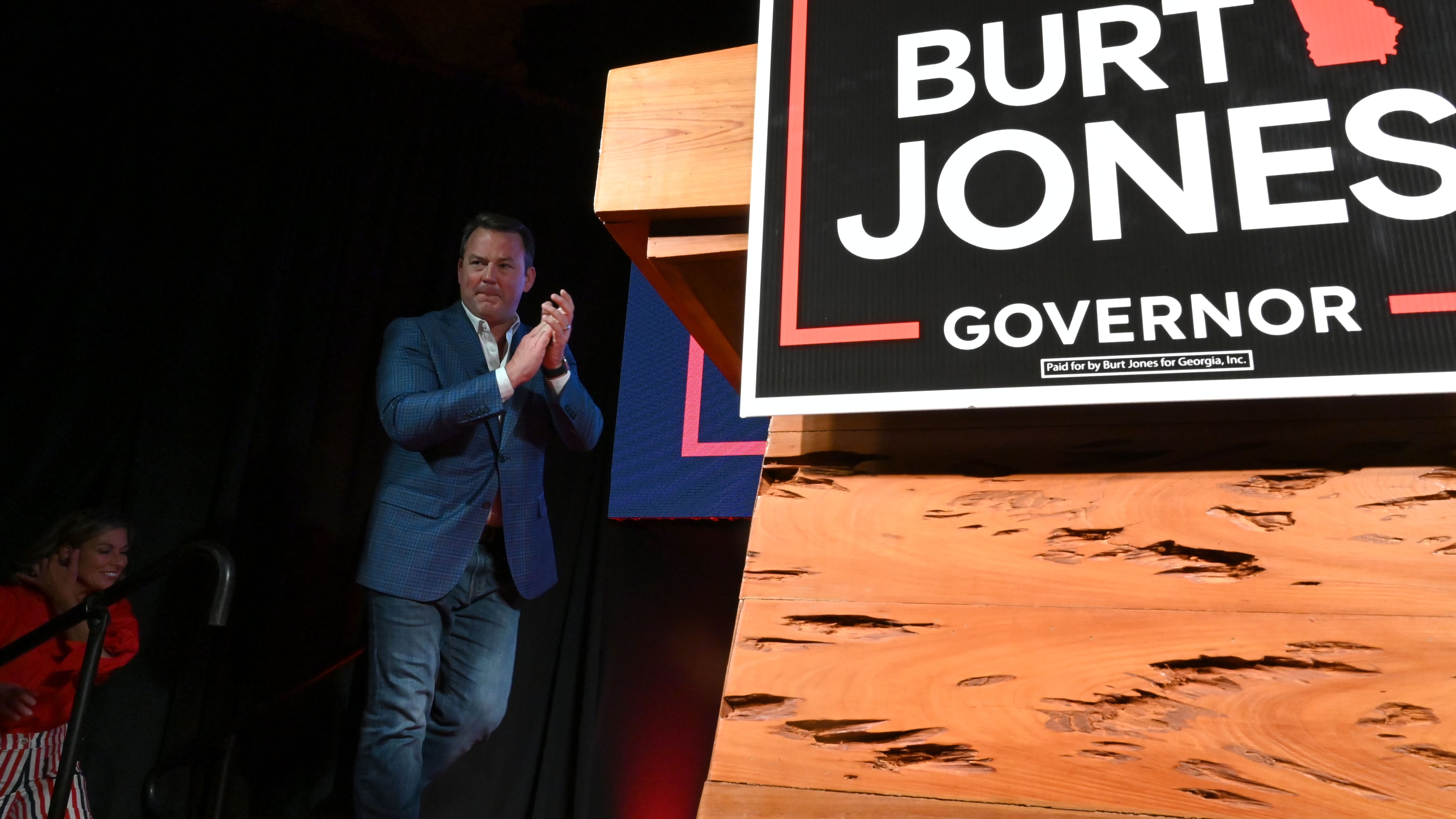
In the race for governor, Trump-backed Lt. Gov. Burt Jones battled billionaire Rick Jackson, who surged into a runoff with a wave of cash and a promise to be the president’s favorite governor. The more mainstream Republicans floundered.

The U.S. Senate race offered another version of the same test. U.S. Rep. Mike Collins outpaced U.S. Rep. Buddy Carter in a fight between two self-styled MAGA warriors. Collins advanced to a runoff with former football coach Derek Dooley, who carved out an outsider lane with Kemp’s help.
But even the governor’s chosen candidate embraced Trump’s agenda, no small feat given Kemp’s sordid history with the president. And Kemp, who told the AJC his once-icy relationship with Trump has thawed, personally appealed to Trump to back Dooley.
Georgia Votes: Primary elections
Democratic Governor: Keisha Lance Bottoms stuns rivals with outright primary win
Republican Governor: Rick Jackson, Burt Jones head to a runoff
Republican Senate: Collins, Dooley advance to runoff
Supreme Court: Justices defeat election challenges from attorneys
U.S. House: Jasmine Clark wins Democratic primary to succeed late U.S. Rep. David Scott
Election results: See who won and lost
Live updates: Reactions. analysis and key things to watch
Photos: Scenes from the 2026 Georgia Primary
Complete coverage: Georgia votes
That was a far different dynamic than 2022, when Trump was out of power and seeking revenge against Kemp and other Georgia Republicans who refused to help him overturn his defeat.
Now, Georgia Republicans are not trying to move past Trump. They are instead pressing to figure out who can best carry his banner without losing the voters who turned Georgia into the nation’s premier battleground.
It’s a delicate balancing act, and it was on display Monday at a steakhouse near a Kennesaw airfield, where Jackson ended his fly-around tour and downplayed questions about whether Trump’s endorsement would give Jones an edge in a runoff.
Instead, he said his rags-to-riches story, from a childhood in foster care to life as a wealthy philanthropist, would contrast sharply with Jones’ privileged upbringing.
“There’s a difference when you’ve actually earned things and done things in your life instead of being given things your whole life,” Jackson said. “He didn’t know who I was from that standpoint. But I think they like the aspects of Trump as an outsider. As a non-politician who gets things done, who can’t be bought. And that’s who I am.”
Jones now must prove Trump’s endorsement can consolidate a party where Jackson is preparing to spend many more millions of dollars to cast himself as Trump “with a Southern tone.” The lieutenant governor’s campaign has done everything it can to remind Republicans he’s the Trump-backed conservative, and he used his Tuesday speech to declare “Georgia’s not for sale.”
Jackson, meanwhile, has to hope Trump softens his long-standing support for Jones, or at least refrains from attacking him. He told the AJC he’s confident “people are more interested in a person that’s like Trump from a business standpoint” than someone endorsed by him.
A different chase for Trump’s favor is already shaping the U.S. Senate runoff for the right to take on incumbent Democratic U.S. Sen. Jon Ossoff.
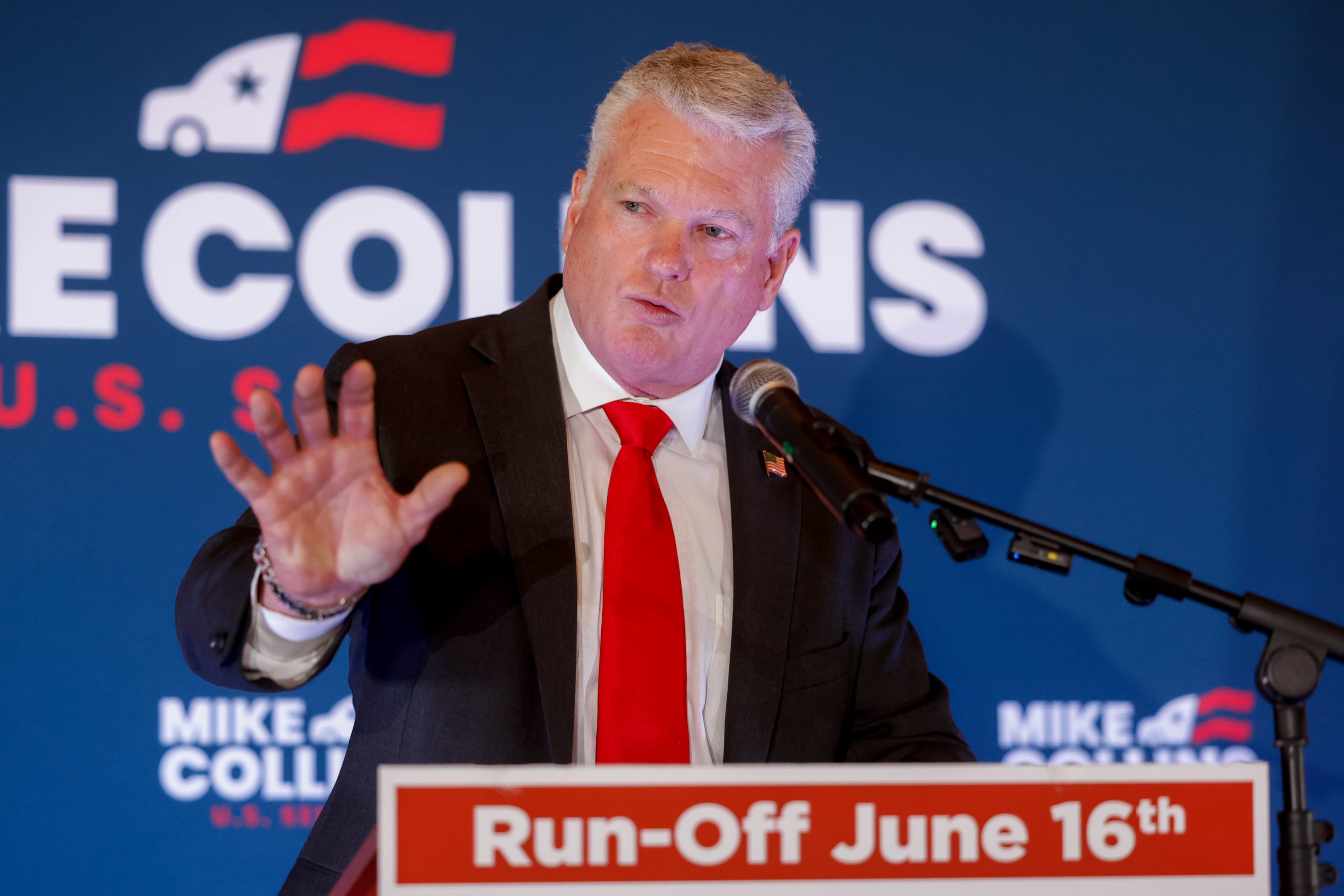
Collins has long cast himself as a MAGA warrior, and his campaign took aim at Carter in part because it saw Dooley as the better matchup — and the more likely path to winning Trump’s endorsement.
Meanwhile, Dooley’s supporters hope Kemp’s June special session push to overhaul Georgia’s political maps for the 2028 cycle will help bolster his case with the president.
Elsewhere on the ballot, Republicans seen as out of step with Trump paid a political price. Secretary of State Brad Raffensperger, who refused Trump’s request to “find” votes to overturn Georgia’s 2020 election results, finished a distant third in the governor’s race. And Gabriel Sterling, Raffensperger’s former deputy and another outspoken critic of Trump’s election falsehoods, placed fourth in the Republican contest to succeed him.
Yet Trump’s shadow carries real risk. He remains the quintessential double-edged sword heading into the midterms.
An Atlanta Journal-Constitution poll showed Trump’s approval rating at an abysmal level among likely Democratic primary voters, while he remained overwhelmingly popular with likely GOP voters, at 81%. But even that figure is below the heights he reached among Georgia Republicans during his first term as president, and 11% of GOP primary voters strongly disapprove of his second term.
That tension may help explain one of the more striking findings during Georgia’s early voting period: Georgians who cast GOP ballots in the 2022 primary crossed over to vote in this year’s Democratic primary at roughly four times the rate of Democrats who crossed the other way.
Attorney General Chris Carr, who finished a distant fourth in the Republican race for governor, said in an interview that the warning signs for his party are mounting. Republicans, he added, have ignored too many “canaries in the coal mine” already this decade.
“You better have a candidate that appeals to that independent voter that could be as much as 10 or 15% of the vote in 2026,” he said.
Democrats are banking that Trump has already supercharged their voters, giving them a sharper message heading into November. Former Atlanta Mayor Keisha Lance Bottoms won the party’s nomination for governor with a message vowing to fiercely oppose the president and his agenda.
“I am a fighter, and I could not rest knowing that people across this state needed someone to stand in the gap and fight on their behalf,” she told supporters in downtown Atlanta. “Georgians sent a clear message tonight that they want a fighter.”
In Middle Georgia, outside a polling station at a Lutheran church in Macon, voter David Dickey said his motivation to cast a ballot was to “save the Constitution.”
“To me, it is vote for and elect Democrats to counter Trump’s influence, especially in Congress,” the 77-year-old said, adding: “The possibility is, and what I’m fully hoping for, is enough people are angry at Trump and angry at the Republicans to vote Democratic.”
And in the liberal Grant Park neighborhood in Atlanta, Garland Edgerton said minority communities’ voices have been minimized and need more economic resources and support.
“They’re trying to push us back to ‘50s and the ‘60s,” said Edgerton. “They’re trying to take things away from minorities, make us seem insignificant when we should have more of a voice than what we do.”
Now comes a new round of Republican runoffs that will test whether Trump’s influence is enough to unify conservatives, or whether it gives Ossoff and Bottoms an opening.
Tuesday didn’t settle Georgia’s 2026 election, but it clarified the fight ahead. Republicans are testing which version of Trump-era politics can win. Democrats are testing whether opposition to Trump can still unite their voters.
And Georgia, once again, is where both theories collide.
Staff writers Riley Bunch, Lautaro Grinspan and Joe Kovac Jr. contributed to this report.