Georgia Democrats sense a ‘huge’ midterm opening. Can they finally seize it?
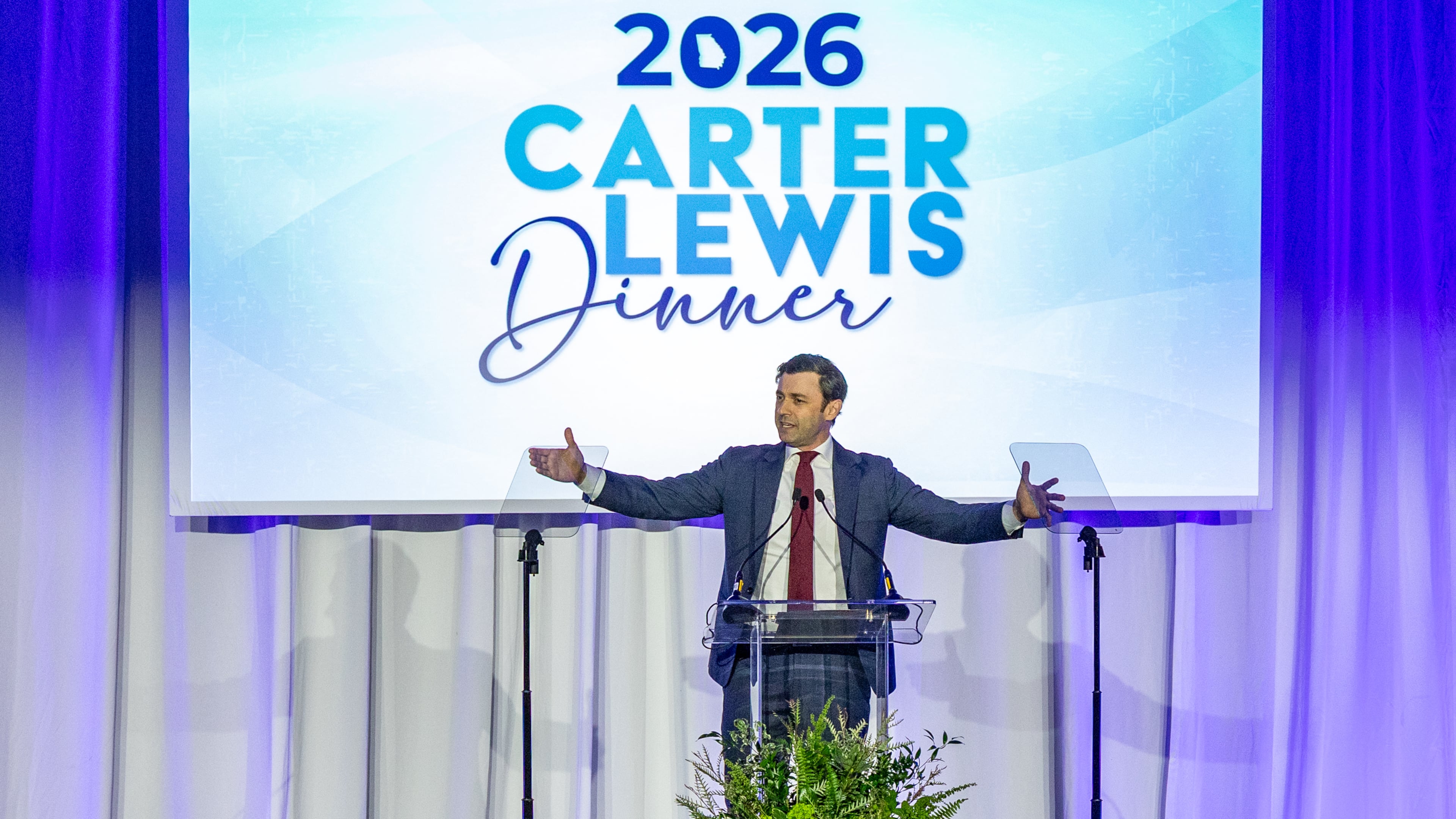
One after another, the avatars of Democratic success in Georgia took the stage Saturday and were greeted like conquering heroes by hundreds of party faithful at the annual Carter-Lewis gala.
There was the tech whiz who flipped a GOP-held Georgia House seat last year, the military veteran who made startling gains in Marjorie Taylor Greene’s district last week and the two U.S. senators who helped pave their way.
And above all, there was a challenge.
“Our success over the past year does not mean it is a lock for November. It’s a cracked door. Y’all, we’ve got our foot in that cracked door, and it’s time to bust that door down,” said Democratic Party of Georgia chair Charlie Bailey. “And whether we do that depends entirely on what we do right now.”
President Donald Trump’s approval ratings are sagging. Republicans are increasingly uneasy about their chances of unseating U.S. Sen. Jon Ossoff. Democrats flipped two Public Service Commission seats last year, clawed away a GOP-friendly state House district and, just last week, cut the Republican margin dramatically in the state’s most conservative congressional district.
But beneath the cheers loomed the core question that could define Georgia’s 2026 elections: Can Democrats capitalize on a cycle that seems to be tilting in their favor?
Recent Georgia history demands they answer that cautiously. Democrats have been giddy before — in just about every election cycle since Gov. Roy Barnes’ stunning defeat in 2002 helped usher in the GOP’s modern dominance in Georgia.
The last time Democrats felt this kind of momentum was in 2022, when they entered the midterms convinced the environment favored them. They were still riding the afterglow of their 2020 breakthroughs, victories that flipped control of the U.S. Senate and helped seal Joe Biden’s win.
Stacey Abrams and U.S. Sen. Raphael Warnock helmed a ticket filled with rising Democratic stars. Republicans were engulfed in bitter warfare between Trump-aligned candidates and the more establishment wing led by Gov. Brian Kemp, Attorney General Chris Carr and Secretary of State Brad Raffensperger.
That cycle ended with the Republican trio triumphant, dashing hopes of an Abrams ascendancy. The lone Democratic victory was Warnock’s win over scandal-plagued GOP U.S. Senate nominee Herschel Walker.
This time, Kemp is a lame-duck governor no longer anchoring the GOP ticket. And Republicans are locked in a costly and punishing clash for governor, alongside a three-way Senate fight with no runaway GOP favorite.
At the same time, poll after poll shows that while Trump maintains a near-lock on the GOP base, independents and other middle-of-the-road voters are souring on his domestic and foreign policy agenda.
“There are some flashing yellow lights in terms of Republicans’ performance moving forward,” GOP strategist Stephen Lawson said. “We’ve got to talk about affordability, we’ve got to talk about kitchen-table issues. Clearly, the political environment, given the president’s approval ratings, is going to be something to keep an eye on.”
Warning signs
The evidence is becoming harder for Republicans to dismiss.
Last year’s Public Service Commission flips were a blaring warning sign in a cycle dominated by voter anxiety over affordability and utility costs.
And though Democrat Shawn Harris fell short last week in Georgia’s reddest district, his 12-point loss represented a remarkable 25-point swing in one of the most conservative corners of the state — instantly energizing Democrats who see signs that even deep-red territory may be softening at the margins.
“If all the trends continue and a Democrat can get 44% in the most conservative district in the state, the margins will surely be closer than usual in other Republican districts and even wider in Democratic districts in November,” Democratic strategist Fred Hicks said.
“That creates a huge window of opportunity for actual wins statewide for Democrats.”

Kentucky Gov. Andy Beshear, the Democratic Governors Association chair who has become a national symbol of Democratic success in red-state territory, offered a living example of what Democrats here hope to replicate at the packed gala in downtown Atlanta.
“The actions of the Trump administration are damaging,” he said, “but they are providing a huge opportunity for Democrats to go out and regain the trust of the American people to be the party of common sense.”
‘Repair the brokenness’
Still, Democrats know better than most that momentum is not the same as victory.
The ghosts of Georgia Democratic near-misses still loom large — including Abrams’ back-to-back losses in 2018 and 2022 despite enormous fundraising hauls and near-universal name recognition.
And even as some party leaders grow more optimistic about Ossoff’s chances, Republicans offered a fresh reminder of why they can’t be overconfident: a promised $44 million cash infusion to oust Ossoff by the Senate GOP’s top super PAC.
Georgia GOP Chair Josh McKoon is happy to let Democrats pore over the recent results and convince themselves that more independents and Republicans are drifting their way. He argues the calculus changes once the state’s marquee races are on the ballot.
“I certainly don’t think that it indicates that there’s going to be a lack of voter enthusiasm when the U.S. Senate is on the line and the governor’s office is on the line and the lieutenant governor’s office is on the line, and everything else that we have in November,” he said.

That’s why many Democratic veterans are already looking toward the harder task of rallying behind the candidates who can convert this opening into votes.
For Tharon Johnson, a veteran of campaigns ranging from Barack Obama’s White House bid to Georgia down-ballot races, Harris’ performance underscored a warning against one-size-fits-all Democrats.
“Shawn Harris showed us that there are some gettable Republicans out there with the right message,” Johnson said. “Trump is underwater right now. And his agenda is just not working for Georgians.”
But even Johnson quickly returns to the question that now hangs over the party.
“The challenge is: Can it last? Can we continue to make sure we nominate the right candidates like Shawn Harris who can go in districts like District 14 and not be the bogeyman?”
As for Ossoff, he previewed his playbook for the fall by framing the midterms as a direct check on Trump’s power. He said the election offered voters a chance to “repair the brokenness” of Trump’s agenda and “advance toward a new era of reform and progress and justice.”
“This is still the most competitive and crucial battleground state in the United States,” he said. “The time for worry is over, and now it’s time for work.”
Washington bureau chief Tia Mitchell and senior political columnist Patricia Murphy contributed to this report.
About the Author

Greg Bluestein is the Atlanta Journal Constitution's chief political reporter. He is also an author, TV analyst and co-host of the Politically Georgia podcast.


