Republican outsider’s $50M bet remakes Georgia governor’s race

Even before he descended from a glass elevator at his health care company’s headquarters, deliberately echoing Donald Trump’s gilded presidential launch, it was clear that Republican Rick Jackson remade Georgia’s race for governor.
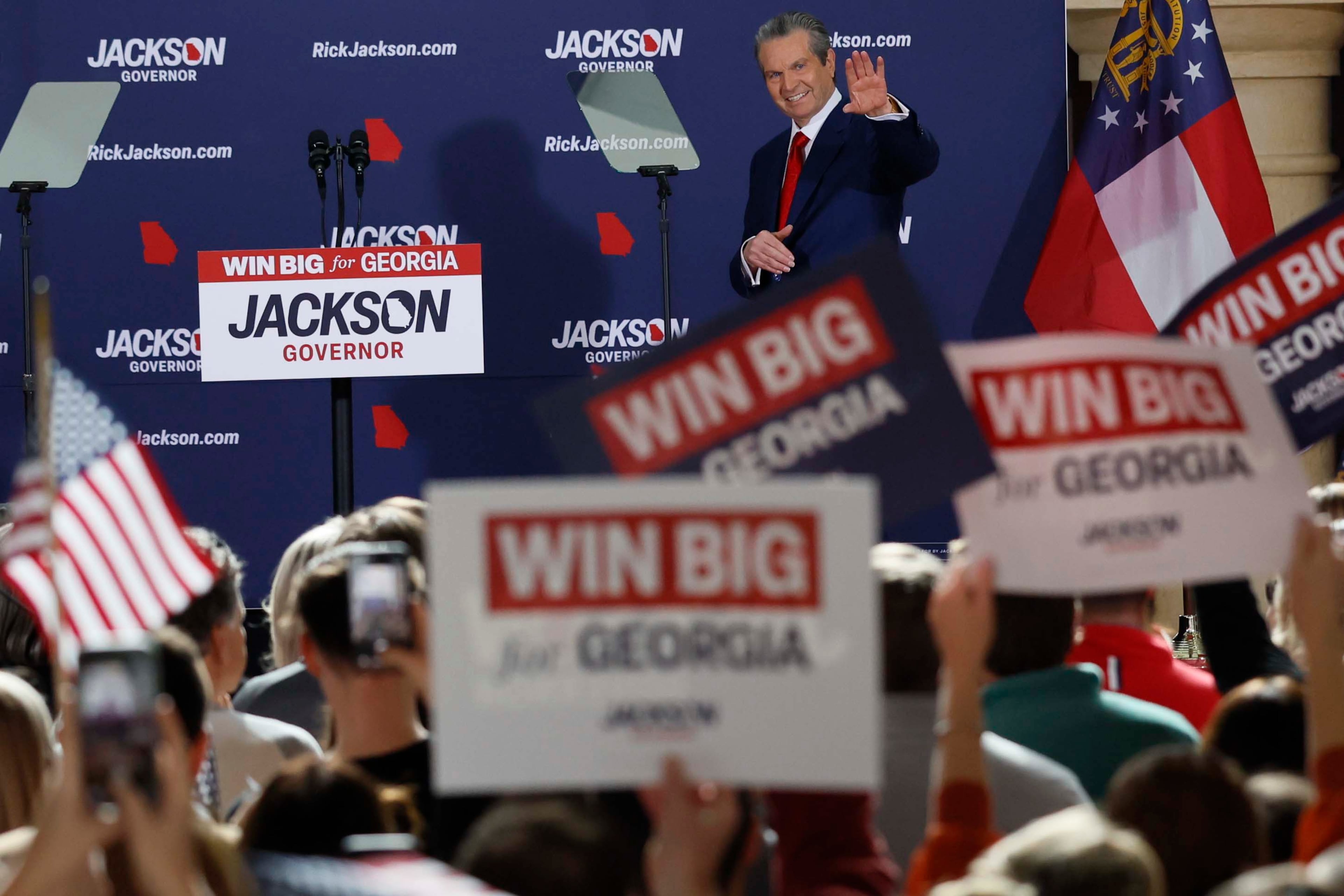
His surprise entrance, paired with a pledge to spend at least $50 million of his own fortune and a showy rally inside his Alpharetta corporate headquarters, was designed to send an unmistakable message: Jackson has the money, message and infrastructure to make himself a force.
Few doubt that he will. A smaller self-funded effort might have been dismissed as a curiosity. Jackson’s move is something else entirely — a direct challenge to Lt. Gov. Burt Jones, the Trump-backed contender who has led GOP primary polls for months and has already amassed more than $19 million.
Jackson, 71, wasted no time at his Wednesday rally at Jackson Healthcare’s opulent Alpharetta campus, calling Jones “a so-called front-runner who was weak as can be and as lazy as the day is long. He wants the title of governor, but not the job.”
If Jones were to win the nomination, he added to a crowd of hundreds of employees, “we would be risking losing his seat to a radical Democrat — or a Republican who acts like one. I wasn’t willing to sit and let that happen to our president or our great state.”

Before Jackson’s entry, the May primary seemed headed toward a predictable outcome, with Jones all but assured a runoff berth against either Secretary of State Brad Raffensperger — whose rejection of Trump’s 2020 election falsehoods has made him a GOP iconoclast — or Attorney General Chris Carr, who has pitched himself as a more traditional Republican.
Now, the math is far less certain. Jackson and Jones could both advance to a MAGA-tinged runoff, splitting the party’s core base. Or one could end up facing Raffensperger or Carr while the other is pushed aside. At this stage, even seasoned strategists are reluctant to guess.
Jackson, however, is nothing if not confident. The self-made billionaire is betting that his wealth, outsider status and Trump-aligned message can compensate for his lack of political experience.

He has already reserved more than $1 million in airtime, launching a minute-long introductory ad that lays out his core promises: aggressively deport immigrants living in the country illegally, cut Georgia’s income tax in half and freeze property taxes.
He even made a smaller, strategic ad buy in Washington, perhaps hoping his campaign breaks through to an audience of one in the White House.
“Like President Trump, I don’t owe anybody anything,” Jackson says in the ad. “And like you, I’m sick of career politicians.”
Big money
Georgia has seen wealthy self-funders before. Republican Guy Millner ran twice for governor and once for U.S. Senate in the 1990s, losing all three races. Michael Coles was the Democratic nominee for Senate in 1998, falling short against an incumbent.
More recently, candidates like Jones and U.S. Sen. Kelly Loeffler have opened their checkbooks to help finance their own statewide campaigns.
Jackson is pairing his financial firepower with a rags-to-riches biography that traces his childhood from foster care and housing projects to a billionaire’s boardroom.
And he’s leaned hard to the right in a Republican primary shaped by MAGA supporters. His opening message hits familiar targets like “woke” ideology and diversity, equity and inclusion.
His digital ads go further, branding Raffensperger a “Judas” for rejecting Trump’s push to overturn the 2020 election results — while Jackson casts himself as a billionaire everyman, borrowing a page from Trump’s own campaign playbook.
That underpins Jackson’s central pitch that he alone represents a true outsider. He is the only major contender on either side who has never held public office.
Jones’ campaign has largely responded with silence. But many of his supporters privately suspect Jackson financed the nearly $14 million anonymous ad blitz that has hammered the lieutenant governor for months. Jackson, through an aide, has denied any involvement.
The ‘forgotten’ Georgians
Campaigns on both sides of the aisle are now scrambling to account for a new and unpredictable force.
“For Republican candidates, they have to deal with a bomb thrower who has an unlimited arsenal of funds and who can claim the populist outsider lane that Republican primary voters love,” said veteran Democratic strategist Fred Hicks.
For Carr and Raffensperger, Jackson’s entry cuts both ways. Both still see a path, particularly if Jones and Jackson split the MAGA base. But they risk being drowned out if the race becomes a two-man contest defined by the biggest pro-Trump spenders.
Democrats, too, are recalibrating. Before, they could simply campaign against the GOP record, Hicks said. Now they must “contend with someone who can and will buy his own airtime and who is a blank slate.”
Publicly, Democrats have brushed Jackson aside as more of the same. Several candidates released statements arguing nothing has fundamentally changed in a GOP race already shaped by Trump’s agenda.

“They all line up behind Trump, they all repeat the same conservative talking points, and none of them are offering real solutions for working Georgia families who are falling further behind,” state Rep. David Wilkerson, a Powder Springs Democrat, said of the GOP field.
Still, Democrats aren’t dismissing the threat. Party leaders are strategizing how Jackson’s rise could change a general election campaign. And both parties are bracing for a costly showdown between Jackson and Jones, who already wrote himself a $10 million check and can tap his family’s prodigious wealth for more.
Jackson is leaning into what he views as a full-scale confrontation with the Georgia “political establishment.”
“Not only do I not need their money — I’ll spend whatever it takes to win this race, take away their power, give it back where it belongs to the people of Georgia,” he said. “Especially the hard-working men and women who have been forgotten and left in the shadows for too long — just like I was.”
About the Authors

Greg Bluestein is the Atlanta Journal Constitution's chief political reporter. He is also an author, TV analyst and co-host of the Politically Georgia podcast.

Patricia Murphy is the AJC's senior political columnist. She was previously a nationally syndicated columnist for CQ Roll Call, national political reporter for the Daily Beast and Politics Daily, and wrote for The Washington Post and Garden & Gun. She graduated from Vanderbilt and holds a master’s degree in journalism from Columbia University.


