Homeless people shelter at MARTA stations. A program helps them find housing.

For more than two decades, Jeffrey Pendleton worked jobs that paid enough to support himself and family members.
But a series of setbacks unfolded soon after he moved from Florida to Georgia for a new job in 2017. His mother died, the new work position was difficult, his dog died, he made a poor business decision, a longtime close friend died, his other dog died, a former partner died, his last living grandparent died and then he briefly went to jail.
The 53-year-old, whose family jokingly nicknamed the “bank of Jeff,” found himself on a MARTA train in 2024 with no home and nowhere to go.
“I didn’t lean on people. I was the one that people leaned on, so it wasn’t a role that I could very easily slip into,” Pendleton recently told The Atlanta Journal-Constitution.
He is one of more than 6,000 people who have gotten a second chance at finding steadiness through MARTA HOPE, a program that provides services to homeless people taking shelter at stations, bus stops and trains.
Since its launch nearly six years ago, supporters said HOPE has filled a critical need by addressing safety concerns from locals and tourists while helping the most vulnerable, especially as Atlanta prepares for a visitor surge during this summer’s World Cup.
The work, carried out through a partnership with the nonprofit Hope Atlanta, requires a small part — $634,000 — of this year’s $652 million MARTA operating budget, mostly funded through sales tax.
Driving around Atlanta, it’s hard to miss individuals sleeping at bus stops with their belongings. Take the train and you’ll often see homeless people riding back and forth to pass the day or taking refuge from the cold and rain.
At South Downtown, a commercial neighborhood between the Garnett and Five Points stations, homeless people inside and near the stations can deter patrons from going to businesses. Brianna Jackson, CEO of the organization Heart of South Downtown, described MARTA HOPE as a necessity.
“Getting this right now is incredible for the perception of Atlanta on the world stage, but not just for the World Cup. We want downtown to have a resurgence,” she said.
MARTA properties are home to some who have nowhere else to go. It’s a temporary roof over their heads, a means to reach possible work and a safer option than the outdoors when shelters are full or closed.
The HOPE program is one answer to this problem.
“MARTA got the right people in the right place at the right time,” said lead case manager Vinson Allen while standing on the platform at the Ashby station.

How MARTA HOPE helps
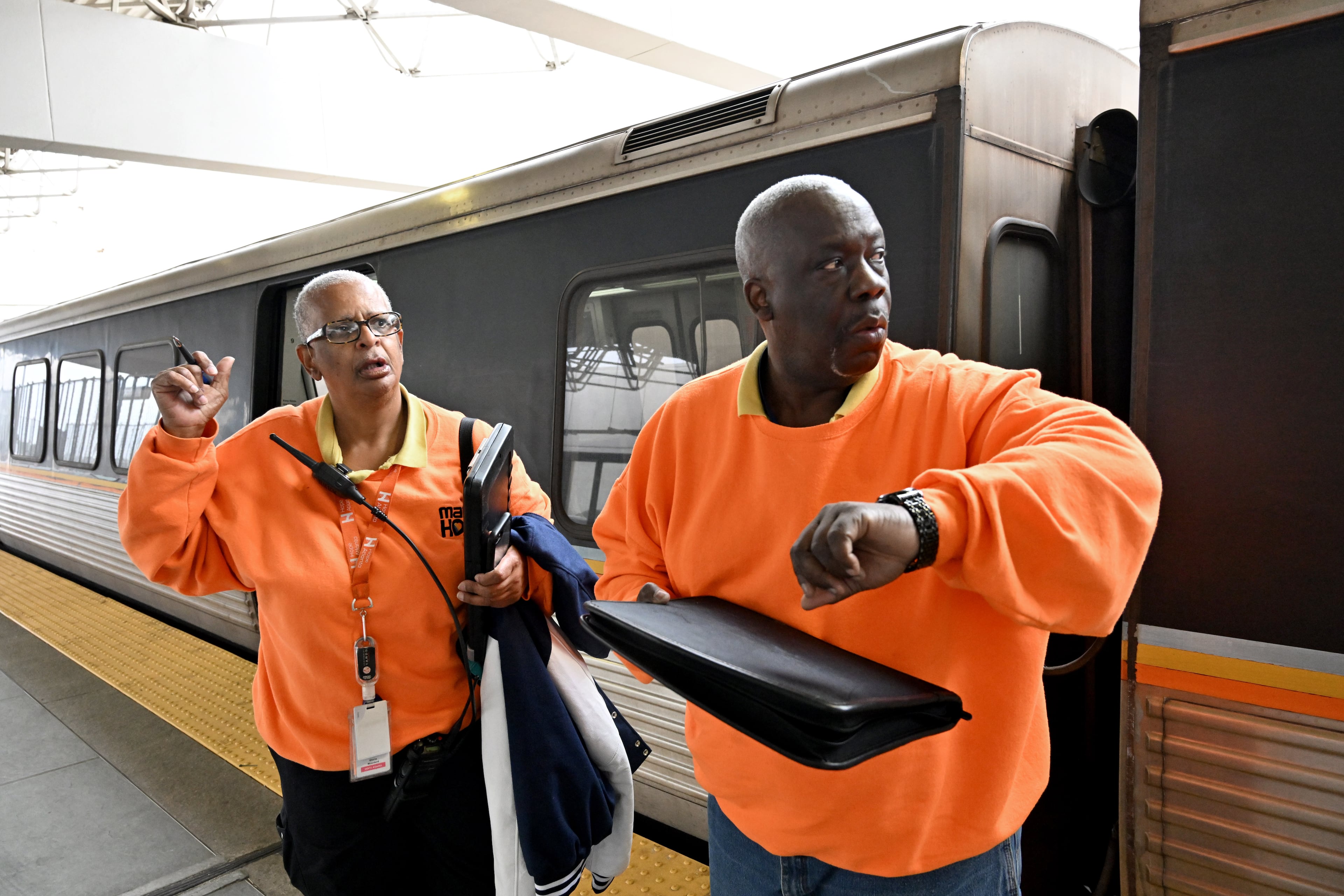
At just about every station, you might notice Allen and Gloria Woodard checking on anyone who looks like they may need services. The two have been employed by MARTA HOPE since its inception in August 2020.
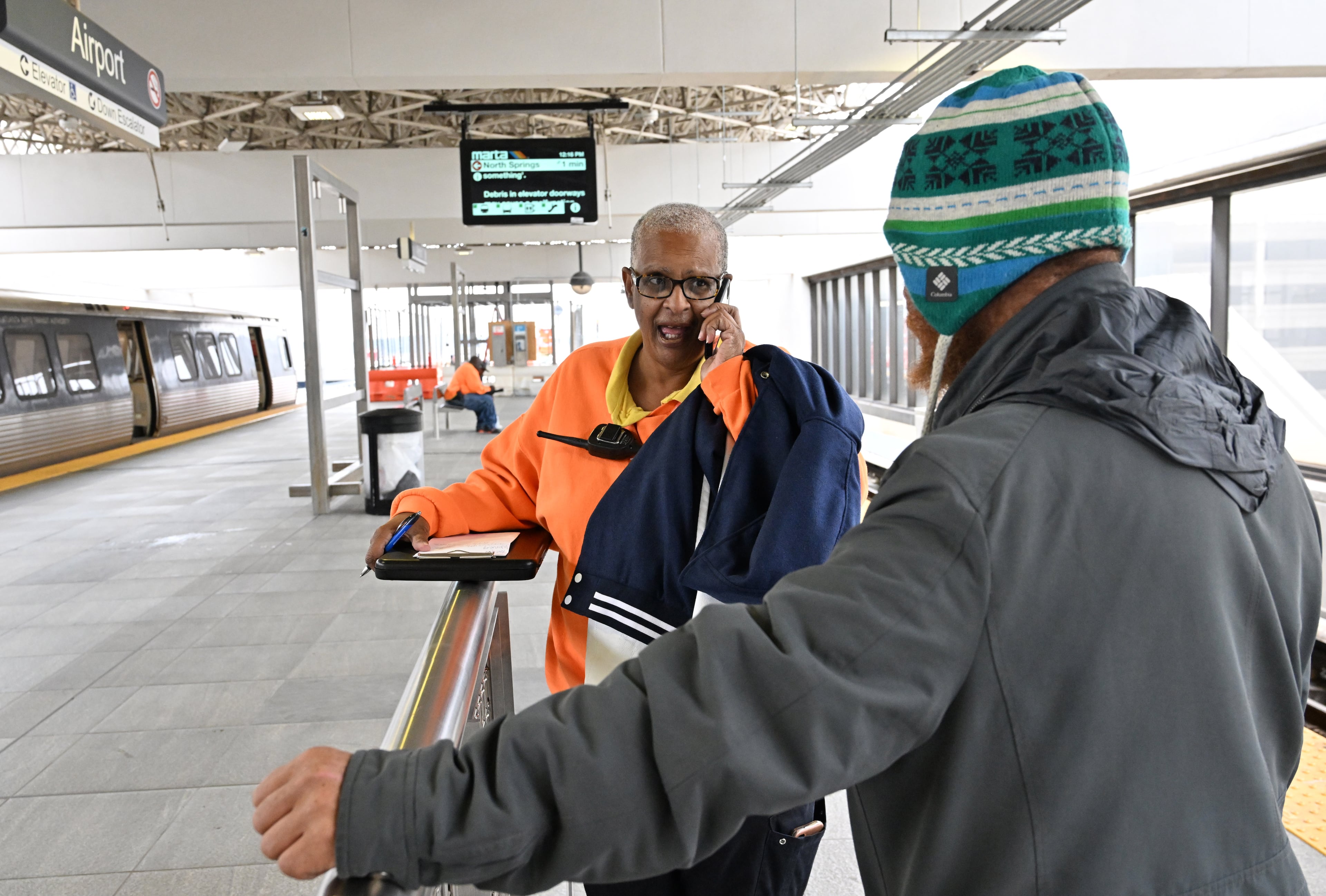
On a recent Tuesday morning, they started their shifts at the Ashby station in northwest Atlanta, where their office is located. Carrying pens, a radio and a binder full of paperwork, the pair headed east on the Blue line, then south on the Red line to the Hartsfield-Jackson Atlanta International Airport where the track ends. There, Allen and Woodard began to “walk the train,” as they call it.

Trains stay at the Airport station for about five minutes. That’s plenty of time for them to board and check the railcars to see if anyone needs help. They look for signs of homelessness, such as people who don’t disembark, who carry items someone doesn’t typically ride with and who are sleeping.
During a span of about 40 minutes at the station, the two approached more than 20 people. Most turned down services, while others were familiar faces already receiving help. But three people sat down with Allen and Woodard to go over options and were referred to a shelter for that night.
“We meet people where they are, and we do not have any reservations, because it’s not a crime to be homeless,” Allen said.
The program primarily provides referrals for shelters and other assistance. But its five case managers may also work one-on-one with individuals over months to help them regain stability.
HOPE, which stands for “Homeless Outreach and Proactive Engagement,” maintains five sponsored beds at Gateway Center for men and five beds at the Salvation Army on Marietta Street for women. Allen said those beds are reserved for people who sign up for the program, such as Pendleton, and who are serious about turning their situation around. However, anyone can be referred to a shelter and other services.
Stories of homelessness
Pendleton slept underneath an overpass near his former Lindbergh apartment and spent some days riding MARTA. While sitting at the Doraville station one day in mid-2024, he noticed a woman boisterously asking if anyone needed help.
“When she’s yelling that out, walking along, she turned and glanced back at the same moment I was kind of looking at her, so I immediately looked away, tried to kind of blow her off, and she kept walking,” Pendleton recounted. “And then I thought to myself, ‘What in the hell are you doing?’”
He ran after the woman, got on the train and asked for help. That woman was Woodard and for the next 90 days, Pendleton stayed at the Gateway Center and met with her every Tuesday morning. They talked about job prospects and what Pendleton was doing to get back on his feet.

Pendleton eventually wrote Woodward a thank-you letter. That message of gratitude got him an opportunity to share his story with several MARTA board members. He then applied for a job with Hope Atlanta and, a year ago, got work helping homeless people who take shelter at the airport.
“I really had come to a decision where the next part of my life and career wasn’t going to be focused on making money. It was going to be focused on primarily making a difference,” said Pendleton, who now has a place to live.
His story is not unique.
According to Partners for HOME, the organization helping the city of Atlanta implement homelessness policies, on a single night in January 2025, nearly 2,900 people were identified as homeless in Atlanta and just over 35% of them were not staying at a shelter. The 2020 snapshot count identified 3,240 people, nearly 30% of whom were unsheltered on a single January night.
Godfrey Rolle, 76, stays at Gateway Center while waiting for Social Security assistance to kick in. He’s been homeless for about two years. For the past few months, he’s received services from Hope Atlanta, MARTA’s partner, after running into a case manager while walking around downtown.
After being diagnosed with Stage 4 lung cancer, Rolle said he came from Philadelphia in 2023 to get treatment at Grady Memorial Hospital. He had spent his life working as an HVAC technician and said he had money saved.

But he didn’t expect the rounds of radiation to last so long. Next thing he knew, he was out of money. He’s still in treatment and recently had surgery to remove prostate cancer.
“I got so much now to be thankful for, even though this battle I’m still going through right now,” Rolle said.
Public perception
The program doesn’t have a quota of how many people it aims to serve simply because the goal is to help as many as possible, said Adam Hawkins. He oversees the effort and is the director of outreach and emergency services at Hope Atlanta.
Within any given month last year, he said the program’s case managers interacted with 700-1,000 homeless people on MARTA properties.
“I wish every one of those people wanted services and they would trust us. Unfortunately, it’s a much smaller percentage of people who actually let us help,” said Hawkins, who was homeless for about two years after he graduated from the University of Georgia and moved to San Francisco.
“We’re not trying to police and punish. It’s really about helping people get into housing or programs that will support them.”
Jackson, who runs the nonprofit that advocates for business owners in South Downtown, described that stretch along Broad and Mitchell streets near Mercedes-Benz Stadium as Atlanta’s “front porch.” She wants to revitalize an area that’s long been plagued by poverty and homelessness.
Because of MARTA HOPE, Jackson said she has seen fewer homeless people wandering in front of stores and restaurants, though foot traffic tends to ebb and flow with the weather.

Jackson said before HOPE, train stations functioned as shelters because people were not being connected to housing and other resources. She described the program as a “critical” need and hopes that, with time, ridership will increase as locals and tourists feel safer.
“We want them to be able to use a safe public transit system like MARTA and feel comfortable doing that, and (not) like they’re going to be harassed for money … (or) it’s unsafe because someone is having a mental health challenge or crisis. It only takes one bad perception or one time for that to happen and you’re not going to come back,” Jackson said.
Hopeful impact
Rail ridership dropped significantly in 2020 because of the COVID-19 pandemic and has rebounded since as places reopened and commuters returned to offices, data from the Federal Transit Administration shows. In 2020, the year the homeless program began, MARTA reported about 24 million passenger trips. In 2025, that number stood at nearly 30 million.
Despite that uptick, the data shows a system still fighting to regain its pre-pandemic footing. In 2019, there were nearly 62 million passenger trips, down from nearly 64 million in 2018 and 67 million in 2017. The highest rail ridership MARTA has reported, according to FTA data that goes back to 2002, was 86 million in 2008.
While MARTA HOPE was created with the goal of helping homeless people rather than increasing ridership, closer ties between social services and law enforcement can make those who previously felt unsafe feel more comfortable using public transportation.
Case mangers like Allen are collaborating with MARTA police more often, he said, motivated in part by the upcoming World Cup.
Allen said police will contact him to assist any homeless person riding the train, bus or hanging out on property. When someone falls asleep at a station or on a train, an officer can be present when waking them up in case they startle. Recently, MARTA has begun making announcements on trains to tell passengers sleeping is prohibited. Allen said that has encouraged patrons to flag down case managers about sleeping homeless people.
Despite the desire to help everyone in need, case managers face the daily and slow process of trying to build trust. For Allen, the mission is defined by patience: knowing that a “no” today is not a “no” forever.
“They turn us down today, but we don’t give up, because eventually they’ll come back and ask for our services. So, we always leave a door open,” he said.
By the numbers
Approximately 6,100 people have received services from MARTA HOPE since its inception.
Help is given on a case-by-case basis. Here is how the agency said clients were served:
- Roughly 1,698 people were sheltered through the program.
- Nearly 4,700 people were referred to other critical resources such as the Supplemental Nutrition Assistance Program (SNAP) or the Social Security Administration.
- Over 139 people were placed into permanent housing.
- Over 107 people were reconnected with their families.
- Over 121 people were connected to the Georgia Works job program.
- Over 230 homeless veterans received social services.
If you encounter a homeless person taking refuge at a MARTA station, train, bus or other property you can call 404-848-5309, 404-848-6300 or flag a MARTA police officer.
Correction
This story has been updated to reflect the correct location of the Salvation Army where MARTA HOPE maintains sponsored beds.
MARTA at a crossroads
MARTA is in the midst of significant changes. In 2026, the transit agency plans to launch new train cars, a redesigned bus network, the region’s first rapid bus line and a new fare system — all while searching for a new general manager and CEO to lead the organization full-time.
A long history: MARTA was meant to go more places. Here’s why it doesn’t.
MARTA and race: Riding the color line: How race built Atlanta’s MARTA system
Fresh start: Critics of MARTA CEO see departure as chance for fresh start
New trains: MARTA chief says new train cars give smooth, quiet ride
Stalled projects: Eastside Beltline light rail work secretly halted last year
Tale of two cities: Same start, different finish: Comparing the Seattle transit system to MARTA
About the Author