What do Lil Jon, Jimmy Carter and 13 Grammys have in common? Kabir Sehgal.

At Norcross’ Tree Sound Studios in mid-March, nearly two weeks before Kabir Sehgal drops a new lo-fi album, the Atlanta producer is busy working on a completely different project: a blues EP.
Inside, Sehgal (who’s on bass), along with other musicians are recording a take of “This Little Light of Mine” that is unrecognizable upon first listen. But, later, it emerges as a pleasant, folksy twist on an American gospel hymn. As the other performers migrate from the performance space to the control room to hear the recording, Sehgal hangs back.
He opts to take pictures of the now-empty live room on his phone, as if he’s brainstorming something grander.
“We’re just figuring it out,” Sehgal said in a meek tone.
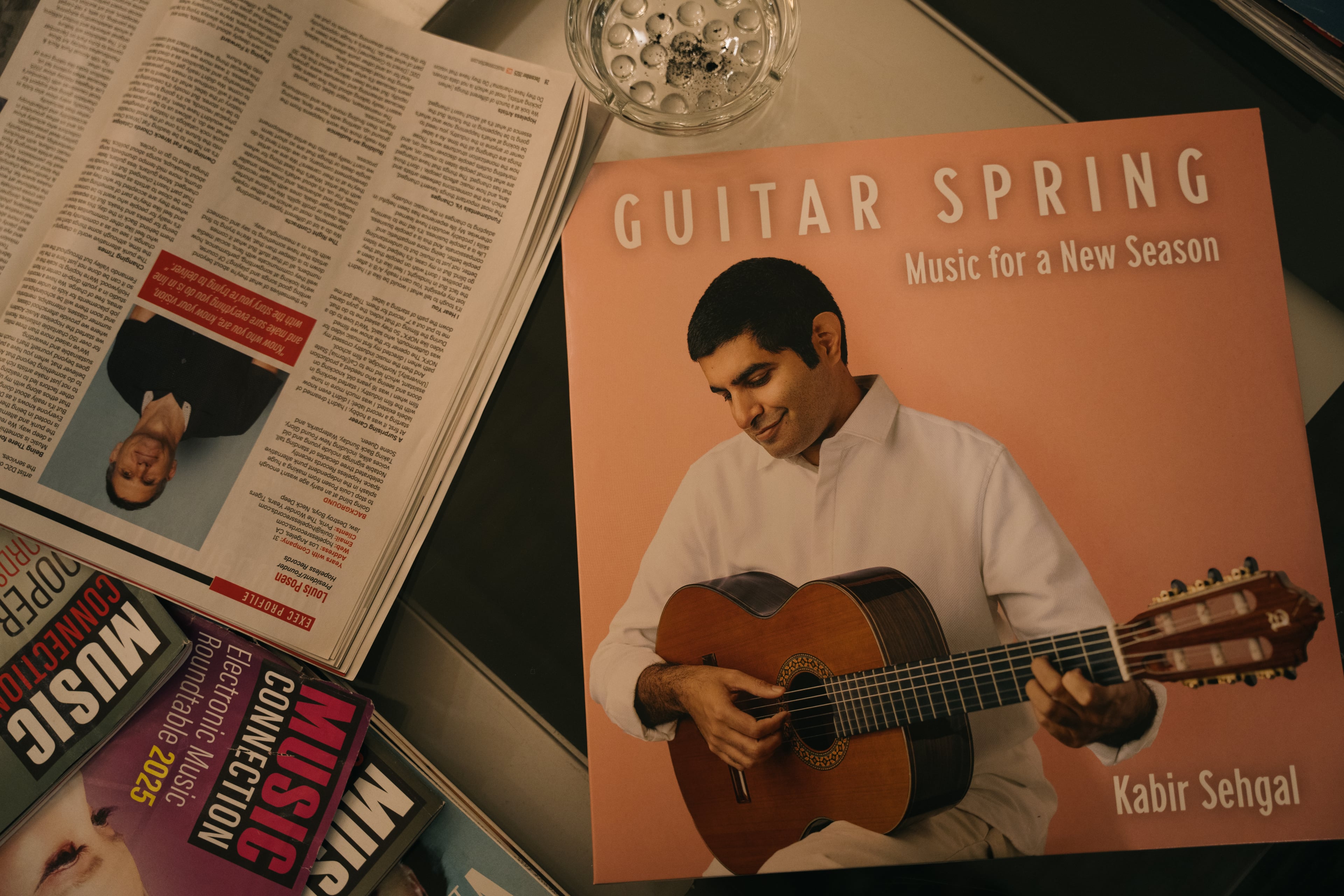
His casual, unassuming nature can only temporarily hide the wealth of curiosity steering a multi-disciplinary career that would make even the most multi-disciplined among us envious. With multiple Emmy-winning projects and New York Times bestsellers under his belt in over a decade, Sehgal has a hefty network of collaborators: crunk maestro Lil Jon, late civil rights leader and Georgia congressman John Lewis, former President Jimmy Carter and, yes, the Dalai Lama.
But underneath an impressive resume with an equally impressive guest list lies a relentless fuel to make music that’s just as momentous. His latest album, “Stars and Static,” is an ode to America’s 250th anniversary, which he’ll celebrate again with the blues EP this summer.
“When I think about projects, I think in milestones,” the 41-year-old said.
Part geography, part biography

The full name of Sehgal’s recent album, released March 26, is “Stars and Static 2026: Textured Takes on 250 Years of America, Lo-Fi Vol. 2.” It’s the second in a series of releases reflecting Sehgal’s latest obsession: (you guessed it) lo-fi music. The first iteration, “Bells and Beats: Retro Reflections on the Holidays,” dropped last fall.
Over the last year, he was drawn to the intricate, secluded quality of lo-fi music, especially that of the late Japanese producer Nujabes — so much so that he’d listen to it on his daily walks and watch YouTube tutorials for it.
“I’m in my hermetic phase of being by myself and making my own music, playing all the instruments myself, mixing it myself, recording.”
Across 10 tracks, “Stars and Static” creates mini worlds out of patriotic hymns, quite literally. Each song includes a field recording captured by Sehgal. Locations featured on the album range from Naples, Italy, to Selma, Alabama. The latter is the site of the project’s rendition of “We Shall Overcome,” including a posthumous recording of the late congressman John Lewis. His contributions were informally recorded by Sehgal (during breakfast at a hotel) while the pair visited Selma in 2017.
On the song, Lewis recites a 2015 speech from former President Barack Obama. The speech commemorated the 50th anniversary of Selma’s “Bloody Sunday.” The moniker references the 1965 event where Alabama state troopers brutally attacked more than 600 marchers, with Lewis among the leaders, mobilizing for civil rights.
“It’s easy to lose hope, but when you hear from him, ‘Keep hope alive,’ it’s not just a platitude. It’s really like a principle,” Sehgal noted.

Hope is an underlying theme of the album. Sehgal began thinking about the project last year — wanting to make something that honored the country’s history and its people.
Hope is also what guides him today, even when prompted to consider those who may feel hopeless living in the same country he celebrates.
“I’d rather live here than anywhere else in the world. Like we have our challenges, definitely our challenges (Sehgal lists AI as a primary one) but this is a place (where) I can make a project like this.”
Diane Durrett is inspired by Sehgal. A singer and president of the Atlanta Chapter of the Recording Academy, Durrett is a vocalist on Sehgal’s forthcoming blues EP, tentatively titled “Blues 250.”
“He’s very insightful,” Durrett said of Sehgal. “I think he takes time to really meditate and think about what he’s doing.”
For Sehgal, that approach to music is “part geography, part biography,” — weaving all of his experiences throughout his decorated career.
“It’s mix of where I’ve been and maybe where I’m headed.”
Music is the message
Excellence is in Sehgal’s bloodline. His mom is Surishtha Sehgal, an author (who’s written children’s books with her Kabir) and retired Georgia State University psychology professor. His dad is R.K. Sehgal, the retired chairperson and CEO of engineering firm Law Companies. Raised in Sandy Springs and Buckhead, Sehgal attended Lovett High School, where he played bass in jazz band.
After school and during weekends, Sehgal and some his band mates would play small gigs across the city.
When he was a child, “my parents would always bring home Indian ghazal music (known for its poetic, emotive style), said Sehgal, a first-generation Indian-American. “I grew up hearing Indian meditation music in India as a kid, and there’s actually an improvisational aspect to that kind of music. But jazz is right from the source, right from the heart because it’s improvisational, and that, to me, was very inspiring.”

Yet, he prioritized a career in business, following in his father’s footsteps. At Dartmouth College, he studied “music and computers.” He later attended the London School of Economics, eventually living in New York City and serving as vice president of emerging marketing equities for JPMorgan Chase.
Simultaneously, he sought a commission in the U.S. Navy Reserve because he felt like he needed to “do something else.”
Still, music remained a constant — whether that was producing or composing.
“I knew (music) was my passion because after work, I would want to make music. I feel like my job didn’t start until I was at home working on the music.”
Thirteen Grammy Awards and too many albums to count (as lead artist and producer) later, the practice is even more established. For the last five years, Sehgal has made music full-time, under the flag of his Tiger Turn production company.
His first Grammy arrived in 2015 for producing “The Offense of the Drum,” an album by legendary New York-based jazz musician Arturo O’Farrill and the Afro Latin Jazz Orchestra. The project won best Latin jazz album that year.
O’Farrill met Sehgal while he was a student and bass player at Dartmouth. Since then, the pair has worked on roughly a dozen projects.
“He does so many things, and he does so many things well,” O’Farrill said. “He’s also a believer in truth and love. … I really believe that the artist has a responsibility as a journalist to tell the story of our time, and Kabir understands that.”
Sehgal’s most recent Grammy wins came last year: best audiobook for producing Jimmy Carter’s “Last Sundays in Plains: A Centennial Celebration” and best large jazz ensemble album, for producing “Bianca Reimagined: Music For Paws And Persistence.”

Former Atlanta mayor Andrew Young noticed Sehgal’s limitless creativity at a young age. Young, a former U.N. ambassador, previously worked for Law Companies following his mayoral terms, forging a close relationship with Sehgal’s dad. Young is Kabir Sehgal’s godfather.
“Even in fourth and fifth grade, he was always starting something new and mastering it and then moving on,” Young said.
In 2010, the pair co-wrote “Walk in My Shoes: Conversations Between a Civil Rights Legend and his Godson on the Journey Ahead.”
“The amazing thing is, as much as we talk, we don’t necessarily have to agree in the beginning,” Young said. “In fact, we usually start far apart, and by the time we end up (agreeing), which may take a day or 15 minutes, may sometimes take two or three weeks, but we usually come to a place where we’re thinking alike from different perspectives. I think that’s one of the things that enriches democracy.”
Whether it’s making meditation projects with Lil Jon or working with esteemed world leaders, Sehgal understands his privilege of having such relationships and his family’s pedigree. That’s why he tries his best to share as much as he can.
“You don’t sit on (those connections). You document them, and you pass it on.”

At any given time, he has 10 to 15 projects in motion. But he isn’t burdened by the weight of them. Instead, his curiosity functions as a proper cushion for all.
When he’s not working, he’s meditating every morning, reading, going on walks and “brushing up” on his Hindi.
Other projects in the works include another collaboration with Lil Jon, a “whisper project” pegged to Earth Day, on which the rapper meditates to the sound of nature. Sehgal will also release another children’s book in the fall.
Future goals? Working on more Indian music and possibly a dream collaboration with Post Malone — still driven by the same concerted effort to make the message as stately as the music.
“I make art music,” Sehgal said. “I don’t make commercial music. It’s like, this is art at the end of the day. It’s music that may not sell out stadiums, but it’s a commentary on where we are as a country and where we’re headed.”
About the Author

DeAsia is a music and culture reporter for The Atlanta Journal-Constitution. She focuses on the intersection of arts, culture and diverse communities, as well as how emerging social trends are being expressed through the lens of the Atlanta aesthetic. DeAsia's work can be seen in Pitchfork, Essence, Teen Vogue, Elle and more.