New robotic tech at Emory unblocks blood vessels with a pinprick
For years, Ronnie Kite planned his days around bathroom breaks and endured nights of interrupted sleep because of an enlarged prostate. Facing a surgery that meant hospitalization and weeks of recovery, he learned about a less invasive procedure that promised a faster return to normal life.
Interventional radiologists at Emory Healthcare recently introduced a new robotic technology, which they believe more precisely treats conditions such as Kite’s. Five days after his procedure, the 58-year-old Temple resident won a game with his amateur hockey team and soon after, went on to win a championship.
“There was no pain,” said Kite, a former canine handler for the Cobb County Sheriff’s Office. “I felt like two days after (the procedure) I could have done anything. It was almost as simple as going for a doctor’s visit and they give you a shot or they take blood. They put a bandage on it, and you go home.”
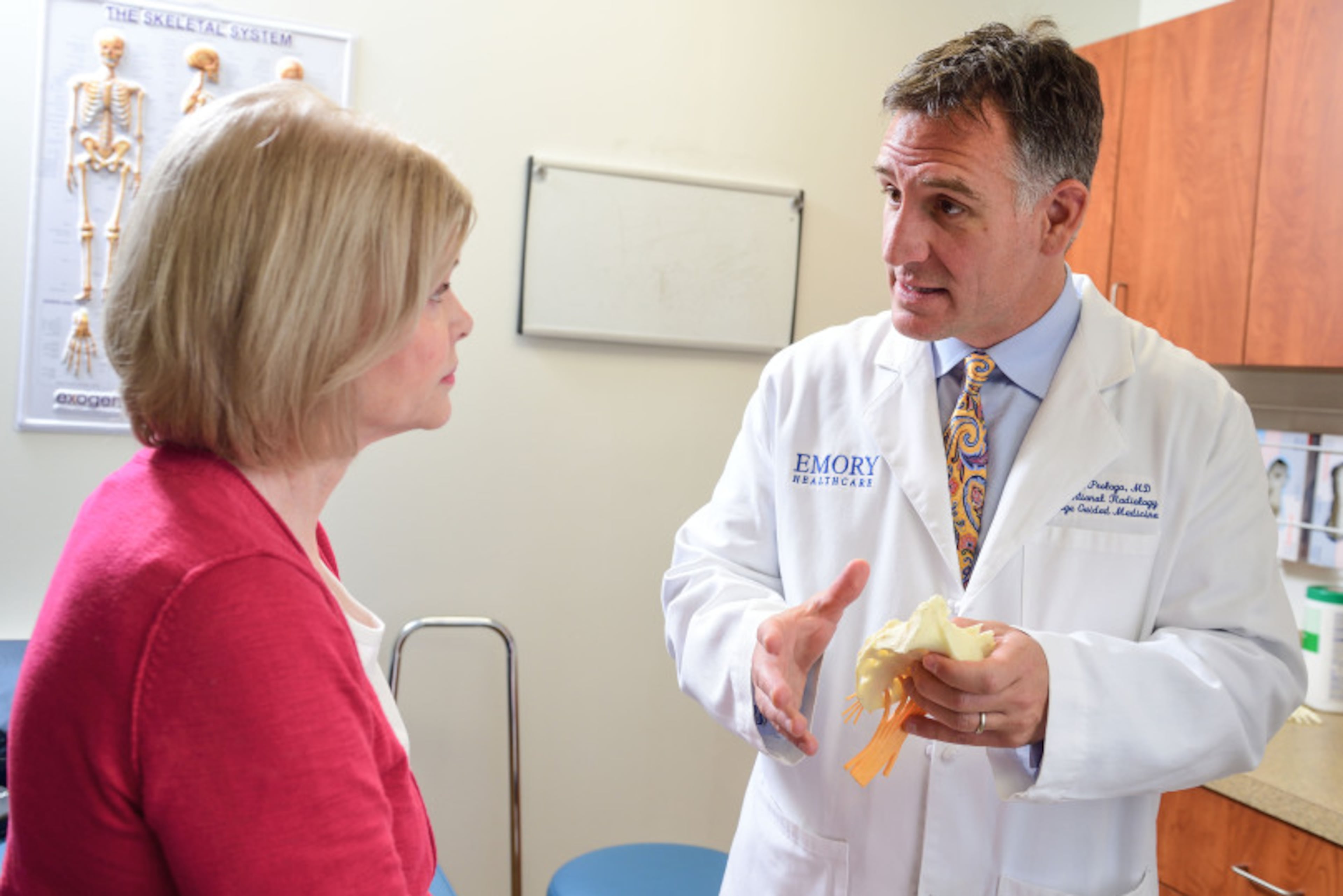
Emory is the first to use the technology to better navigate blockages in the arteries and stop them through a simple pinhole incision or needle stick, said Dr. David Prologo, Emory division director for interventional radiology. So far, the procedure has been used to treat enlarged prostates, arthritis, liver cancer and other complications without the need for surgery.
When patients have arthritis in their knee, for instance, they typically receive injections or have knee replacement surgery, Prologo explained.
“What we can do in interventional radiology is stop the progression of arthritis instead, simply through a pinhole, a needle stick in your wrist or your groin. And that, in and of itself, is magical because there’s no other way to stop the progression of the arthritis,” he said. The procedure also eliminates the patient’s pain and leads to a faster recovery than surgery, he added.
Interventional radiologists previously guided such procedures by hand, which wasn’t as accurate and was more strenuous for the doctor. In recent months, Emory University Hospital was selected as the first medical center to adopt the new robotic technology.
Microbot Medical developed the Liberty endovascular robotic system, approved by the U.S. Food and Drug Administration in September. Emory has since performed a dozen procedures using the technology, mostly for arthritis. Interventional radiologists also used the Liberty robotic system to deliver chemotherapy to a liver tumor without damaging surrounding tissue, said Prologo.
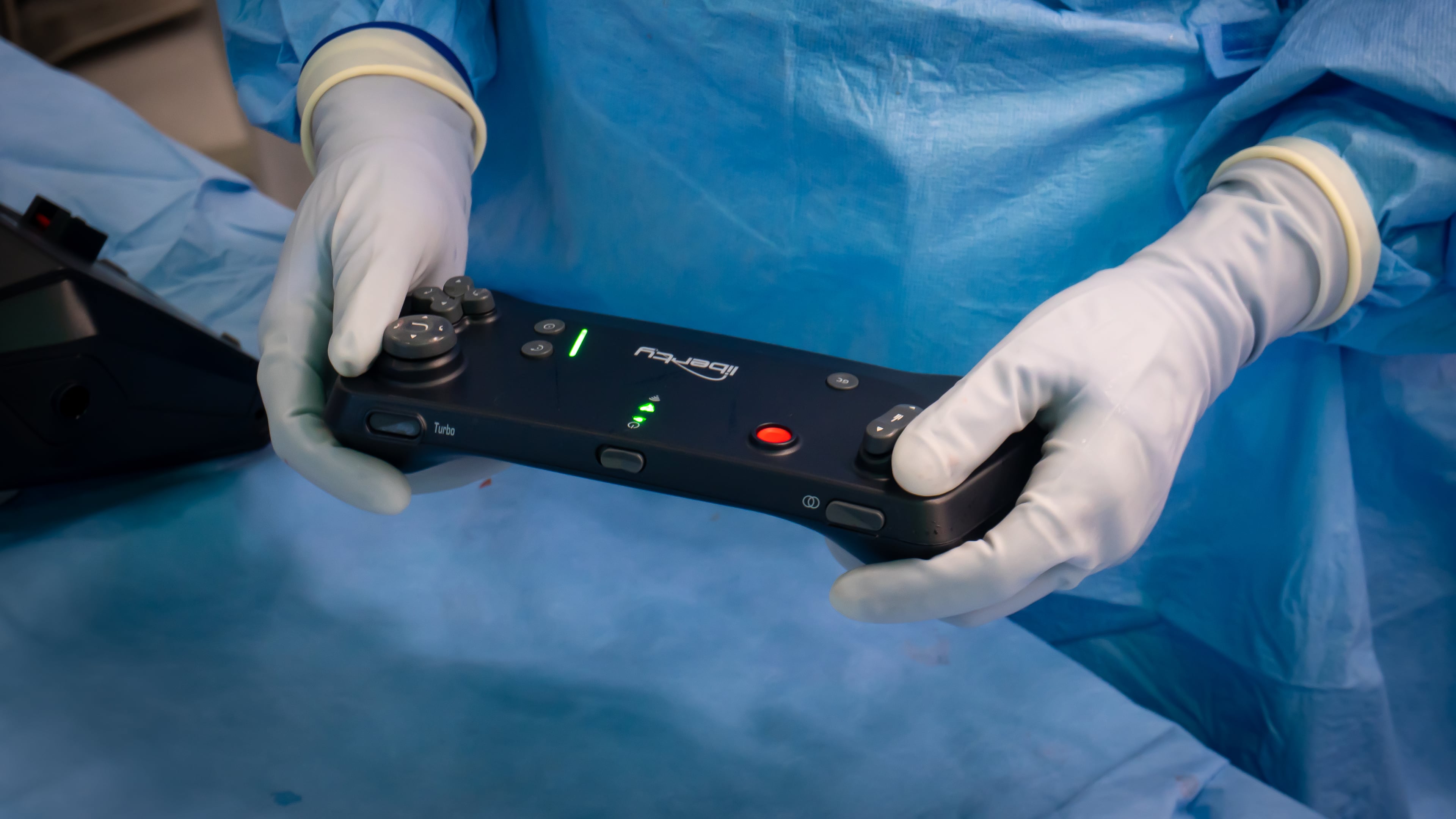
The robot is basically a hand-held controller, which could be mistaken for a video game joystick. The interventionalist can guide a small wire to a precise spot to treat the condition.
“We then ‘walk’ or slide a small rubber tube (microcatheter) over that wire to the same destination.” The wire is later removed to deliver medicine through the catheter, he explained.
“Holding the controller allows us to secure the wire without touching it, just by looking at a screen and driving the wire with the robot.”
The technology allows interventional radiologists to more precisely treat patient’s medical conditions, potentially reducing their radiation exposure and the physical strain of standing over a patient for hours.
At this point, operators can control the device next to the patient or behind a lead wall. But eventually, experts hope robotics can advance for more remote use — whether between facilities within a health system or in rural areas without access to these procedures.
Interventional radiologists also are beginning to use Liberty for treating other medical conditions such as trauma, fibroids and kidney cancer.
“We drive that wire inside a blood vessel so we can block that blood vessel, not just to stop the cancer.” The same technique can be used to stop a patient from bleeding or cutting off the supply of blood to fibroids, he said. “We will treat kidney cancer through the same mechanism.”
Robotics have long been used for surgeries, but their use inside the blood vessels by interventional radiologists is relatively new, Prologo said.
“The evolution of medicine, in general, is toward less invasiveness, and technology is giving us the ability to do procedures less invasively..”
Other academic medical centers already are taking notice. Massachusetts General Hospital, which is associated with Harvard Medical School, is hoping to learn from Emory’s experience with the technology.
“We want to make sure that if we use this device, it will make the procedure faster and more accurate,” said Dr. Raul N. Uppot, chief of interventional radiology at Mass General Brigham, whose division used the technology as part of a recent clinical trial.
“This was unique because it was one of the first times I had seen a device that’s used for angiography, where you’re manipulating a catheter inside the blood vessel. It’s unique because it’s slipping a small catheter through a long length of the blood vessel towards a specific area.”
For Kite, who was unaware of alternatives to traditional prostate surgery, the new robotic procedure at Emory was a huge relief. He said it spared him weeks of recovery, as well as the pain, side effects, and medication that often come with surgery.
“I wish I would have done it sooner,” he said.
Roni Robbins has been a journalist for nearly four decades. This is her second stint as a freelance reporter for the AJC. She also freelances for Medscape, where she was an editor. Her writing has appeared in WebMD, HuffPost, Forbes, the New York Daily News, BioPharma Dive, MNN, Adweek, Healthline and others. She’s also the author of the award-winning novel, “Hands of Gold: One Man’s Quest to Find the Silver Lining in Misfortune.”