Go green: Restraint is key to showcasing fleeting produce of spring

The arrival of spring green vegetables in the farmers market casts off any last remnants of winter. Boxed in between bossy brassicas and sassy summer vegetables, spring vegetables are demure, more subtle. They appear stealth-like on the scene for a brief window, a bright spot of verdant life after a dreary winter, a quick burst of youthful green — and then they disappear.
Well, very little fully disappears with our worldwide agriculture systems, but if you want ingredients to taste their absolute best, you need to eat in season as close to the harvest locale as possible. Building your menus around seasonal produce is a healthy way to support local agriculture, nourish the body, and eat well on a budget.
After months of “rooting around,” spring is a time to indulge in delicate, light produce. The most successful celebration of spring green vegetables lies with heightened simplicity. My approach is to do as little as possible to really good ingredients and not mess them up by over-complicating them with a kitchen sink of different flavors.
Restraint is key to showcasing these fleeting spring favorites. You simply won’t believe how luscious a member of the lowly onion family can be until you taste it chilled and bathed in vinaigrette or that, given the limited number of ingredients in the fava bean recipe, you will be able to taste the citrus undertones in the sage. Cooking crisp sugar snap peas is a waste of heat when they are so sweet and tender; try them instead raw in a leafless salad. Asparagus and mushrooms belong under the heading “what grows together, goes together” and further seal their marriage under a blanket of creamy, cheesy eggs.
Go green — and simple — with Chilled Classic Leeks Vinaigrette pungent with Dijon mustard; Fava Bean Toasts, truly a labor of love; bright and crisp Sugar Snap Pea Salad with Pecans and Mint; and celebrate the springtime duo of asparagus and mushrooms with an Asparagus, Mushroom and Sausage Gratin.
Virginia Willis is an Atlanta-based Food Network Kitchen chef, James Beard Award-winning food writer and author of seven cookbooks. Follow her at virginiawillis.com.
RECIPES
Mindful simplicity is the secret to celebrating the season’s produce. Streamlined technique and a short list of ingredients reveal crispy, silky, creamy and toothsome textures that allow spring vegetables to shine.

Chilled Classic Leeks Vinaigrette
This French bistro favorite is easy to make. Make a double batch to have extra on hand for lunch on a hot day. Make sure to save the green leafy stems for stock.
- 6 leeks
- 4 cups water
- Coarse salt and freshly ground white pepper
- 2 bay leaves, preferably fresh
- 1 tablespoon Dijon mustard
- 1 shallot, finely chopped
- 2 tablespoons white wine vinegar
- 1/2 cup canola or grapeseed oil
- Trim off leek tops where they turn dark green, and the bottoms just above the roots. Spilt the leeks almost in half horizontally. Rinse the leeks extremely well in cold running water; dirt may hide in between the leaves, so check carefully. Reshape the leeks and tie with kitchen twine at each end. Or, you don’t have to. You can simply simmer them gently without stirring, but you do risk the chance of them separating.
- Set aside a colander or a baking sheet lined with a clean kitchen towel. Place the cleaned leeks in a single layer in a 2-quart saucepan and cover with water. Season with salt and pepper. Add the fresh bay leaves. Bring the liquid to a boil, reduce heat to simmer and cook until tender, 30 to 45 minutes.
- Meanwhile, prepare the Dijon vinaigrette: Combine the mustard, shallot, and white wine vinegar. Whisk in the oil until smooth. Taste and adjust for seasoning with salt and pepper. Set aside.
- Remove the leeks from the cooking liquid. (Reserve the liquid for another use.) Using a slotted spoon or fish spatula, transfer them to the colander or the prepared baking sheet lined with a kitchen towel to drain. Pat dry.
- Place the leeks in a shallow dish and pour the Dijon vinaigrette on top. Turn to coat. Refrigerate until chilled, about 30 minutes. Taste and adjust for seasoning with salt and pepper and serve immediately. Serves 2-4.
Nutritional information
Per serving: Per serving, based on 2: 651 calories (percent of calories from fat, 74), 4 grams protein, 39 grams carbohydrates, 5 grams fiber, 55 grams total fat (4 grams saturated), no cholesterol, 198 milligrams sodium.
Sugar Snap Pea Salad with Pecans and Mint
The undoubted star of this show are the peas. You can toast your pecans if you wish, but I love that I can toss this together in an instant and prefer the undertone of green in the untoasted pecan.
- 8 ounces sugar snap peas, sliced on the diagonal into 1-inch pieces
- 1/4 cup pecans, chopped
- 2 tablespoons sunflower oil, preferably cold-pressed
- Zest and juice of 1 lemon
- 1 teaspoon low-sodium soy sauce
- 1/4 cup whole mint leaves
- Pinch cayenne pepper, optional
- Sea salt and freshly ground black pepper
- Place all the ingredients in a bowl and stir to combine. Taste and adjust for seasoning with salt and pepper. Store in a covered container in the refrigerator for up to 2 days. Serves 4-6.
Nutritional information
Per serving: Per serving, based on 4: 137 calories (percent of calories from fat, 74), 3 grams protein, 7 grams carbohydrates, 3 grams fiber, 12 grams total fat (1 gram saturated), no cholesterol, 77 milligrams sodium.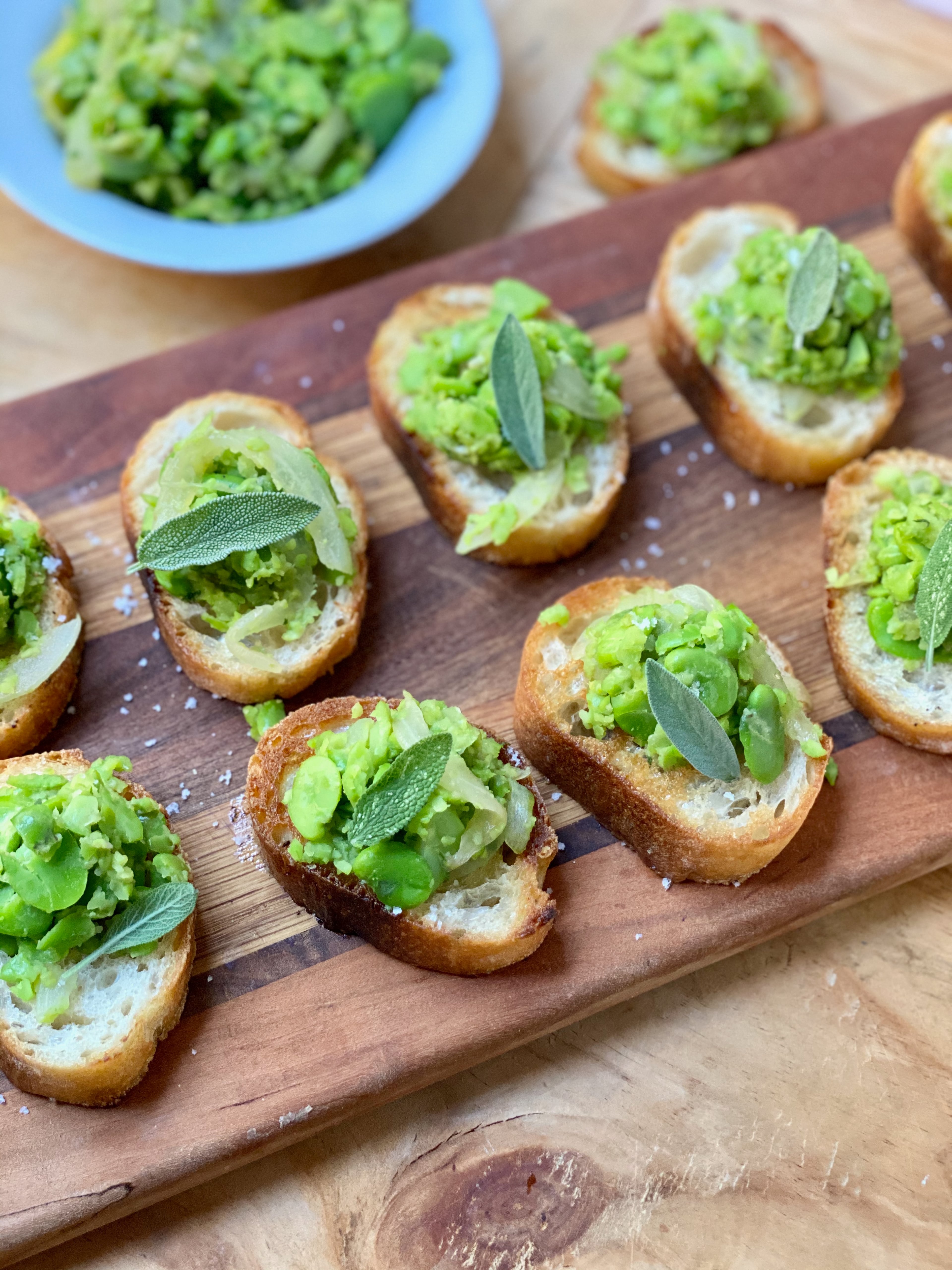
Fava Bean Toasts
Fava beans are one of those spring vegetables that evoke great feelings. They indicate some level of urban sophistication, if only by a psychological thriller. Fava beans are grassy, rich, and need to shine on their own. They are also a ton of work to get any quantity — hence, a manageable amount of green buttery goodness paired with lemony sage as seen with these toasts is the perfect celebration.
- 1 baguette, sliced 1/2-inch thick
- 2 tablespoons extra-virgin olive oil, or more, if desired; divided
- 1 clove garlic, halved
- 2 1/2 pounds fava beans, in the pod (or 1 cup prepared fava beans, English peas or edamame)
- A quarter of an onion, thinly sliced
- Coarse salt and freshly ground black pepper
- 1 teaspoon chopped fresh sage, plus more for garnish
- Position an oven rack 4 inches below the broiler element and turn on the broiler setting.
- While the broiler heats, make the toasts: Arrange the baguette slices on a baking sheet and brush on one side with some of the olive oil (a total of 1 tablespoon). Broil until brown, 2 to 3 minutes. Turn the toasts and broil the other side. Remove the toasts from the oven and while warm, rub one side of each toast with the cut surfaces of the garlic clove. (Don’t overdo it.) Transfer to a rack to cool.
- Remove the beans from the fava bean pods.
- Prepare an ice bath by filling a large bowl with ice water. Set aside.
- Fill a wide, shallow saucepan with water and bring to a boil. Add the beans and cook for 1 minute. Drain in a colander; transfer the colander to a bowl of ice-cold water. The beans are now ready to peel. This can be a bit time-consuming, but the skins should slip off fairly easily by pinching between your thumb and forefinger. You should have about 1 cup of shelled beans.
- In the same pot, heat 1 tablespoon of olive oil over medium heat. Add the onion and cook over medium to medium low heat until clear and translucent, about 3 minutes. Try not to let them turn golden. Add the shelled fava beans, and 1/4 cup water. Season with salt and pepper. Cook, stirring occasionally, until the beans are tender enough to mash, 5 to 7 minutes. (If you are subbing out for fava beans with peas or edamame, both may take 2 to 3 minutes longer.) Mash until it reaches your desired smoothness. Add the sage and any additional oil, if you wish. Taste and adjust for seasoning with salt and pepper.
- Spread the fava bean mixture on toasts and garnish with additional sage. Sprinkle with sea salt. Serve immediately. Makes 24 toasts.
Nutritional information
Per serving: Per toast: 114 calories (percent of calories from fat, 14), 4 grams protein, 20 grams carbohydrates, 1 gram fiber, 2 grams total fat (trace saturated fat), no cholesterol, 209 milligrams sodium.
Asparagus, Mushroom and Sausage Gratin
This is one of those dishes that could be breakfast, lunch or dinner. Baked in the skillet, it’s a one-dish wonder, or transfer it to a separate casserole and it becomes brunch-worthy. Serve it with a salad and it becomes a complete meal.
- 1/2 tablespoon olive oil, plus more for coating baking dish
- 1 pound asparagus, stem ends trimmed
- Coarse kosher salt and freshly ground black pepper
- 1/2 pound Italian turkey sausage
- 12 ounces sliced mixed mushrooms such as oyster, shiitake and cremini
- 6 large eggs
- 1/4 cup milk
- 3 green onions, chopped
- 3/4 cup grated mozzarella, divided
- 1/4 teaspoon cayenne pepper, optional
- 1/4 cup grated Parmesan
- Heat the oven to 375 degrees. You can bake this gratin in a casserole baking dish or an ovenproof skillet. If you want to bake in a casserole, drizzle a gratin or casserole baking dish with 1/2 tablespoon olive oil and brush to coat. Set aside.
- Line a rimmed baking sheet with a nonstick silicone baking sheet or a piece of aluminum foil. Scatter the asparagus in a single layer. Drizzle with 1/2 tablespoon olive oil. Season with salt and pepper. Transfer to the oven to fully cook, about 10 minutes, depending on the size of the asparagus.
- Meanwhile, heat a large skillet over medium-high heat. Add the sausage and mushrooms. Season with salt and pepper and cook until the sausage is cooked, and mushrooms are tender, reducing the heat if necessary, 8 to 10 minutes. (It’s important the vegetables are well-cooked, and the mixture is nearly dry, so they do not exude moisture into the eggs.)
- In a separate bowl, whisk together the eggs, milk, green onions, half the mozzarella, and the cayenne pepper. If preparing in the skillet, remove from the heat and pour the egg mixture over the sausage and mushrooms. If preparing in a separate dish, transfer sausage-mushroom mixture to the prepared baking dish. Pour egg mixture over the sausage. Top with remaining mozzarella. Transfer to the oven and cook until the eggs are set and an instant read thermometer reads 160 degrees, about 18 to 20 minutes.
- Remove from the oven and switch the oven setting to broil. Add the cooked asparagus to the top of the gratin, lining the stalks in a row, and top with Parmesan cheese. Return to the oven and broil until the cheese is bubbly and the asparagus is blistered, 3 to 5 minutes, depending on the strength of your broiler. Set aside to cool slightly, about 5 minutes. Cut using a serrated knife into sections and serve immediately. Serves 8.
Nutritional information
Per serving: Per serving: 178 calories (percent of calories from fat, 50), 16 grams protein, 6 grams carbohydrates, 2 grams fiber, 10 grams total fat (4 grams saturated), 172 milligrams cholesterol, 331 milligrams sodium.Read more stories like this by liking Atlanta Restaurant Scene on Facebook, following @ATLDiningNews on Twitter and @ajcdining on Instagram.