RECIPES: A taste of Bengali cuisine, by way of Atlanta

Sukanya Kar Bhowmik came to the United States in 2011, when her husband, Sayan, was transferred from his job in Kolkata, India, to New Jersey.
Like many who settle far from home, Kar Bhowmik, a native of Agartala, Tripura, India, stayed close to her Bengali heritage by preparing traditional dishes she learned from her mother and grandmother. She says Bengali food is shaped by the country’s lush rice paddies, winding rivers and abundant rainfall. “Fish often takes center stage in our meals. As I explore traditional Bengali recipes, it amazes me how the dishes are gourmet in taste but inexpensive because they use what is readily available at home.”

After moving to Atlanta with her husband and young daughter, she volunteered a few times for Chow Club, a dinner club offering pop-up dinners of international food prepared by home cooks and rising chefs. Each month, a different chef prepares specialties from their home country. Volunteers help behind the scenes with plating and serving, and the chef comes out between courses to explain the origin of the dishes and perhaps ingredients that are unfamiliar to those enjoying the meal.
In 2023, the time was right for Kar Bhowmik, a home cook, to step into the role of chef and prepare a meal of Bengali specialties for the more than 100 Chow Club guests who gathered on two February evenings.
A Chow Club meal is made up of many small courses, and Kar Bhowmik‘s menu followed the pattern. A starter of dal puri was followed by a cup of soup of Bengali yellow split dal, and then a thali-like plate of bottle gourd with shrimp curry, dry Bombay duck curry, jackfruit curry, bottle gourd peel stir-fry and steamed rice. An elephant apple chutney was next and then dessert, sweet cottage cheese dumplings.
“I was excited to share my culture through my food. It’s a way we connect with each other, and a way we gain trust. And as we eat the food of different cultures, we find there are a lot of similarities. I may call it by a different name, or you may cook it in a different way, but we can understand the connections,” Kar Bhowmik said.
RECIPES
Sukanya Kar Bhowmik shared the recipes for three Bengali seafood specialties, two of which she served at her Chow Club dinner. The recipes are lengthy but not difficult, as the length comes from the many spices used in Bengali cooking, spices which give the dishes the name of “curry.” Each is served over rice, and Kar Bhowmik says either basmati or jasmine rice would be traditional.
Ingredients and possible substitutions
Please note where substitutions are suggested, they will bring a different nuance to the dishes. Kar Bhowmik buys her Bangladeshi groceries at Indian Bazaar on North Shallowford Road in Dunwoody and Bangladeshi Grocery Plus on Buford Highway in Doraville.
• Asafoetida, also called hing, is powder made from the tap root of a member of the celery family. It’s commonly used in savory dishes and Indian pickles, and has a distinctly pungent aroma and a sulfur-like flavor similar to alliums like garlic and onions. A mix of garlic powder and onion powder can be substituted.
• Black nigella seeds, also called kalonji or black cumin, are the seeds of the nigella plant and its beautiful blue or white flowers. Black sesame seeds or other dark seeds may be substituted to duplicate the look, but not the flavor.
• Bottle gourd, also known as calabash and called lauki in India, is a long pale green gourd with an edible but slightly tough skin. Frugal Bengali cooks sliver the skin and make a stir-fry by tossing it with matchsticks of potato and sauteing it in mustard oil along with nigella seeds, green finger chiles, poppy seeds and turmeric and seasoning it with curry powder. Zucchini can be used as a substitute for the bottle gourd flesh.

• Dry Bombay duck is a small fish, also called dried loitta, that is sun-dried to preserve it. It is a staple of Bengali cuisine and is available at some Bangladeshi grocery stores and widely available online.
• Garlic paste and ginger paste are available in the produce department of most grocery stores.
• Garam masala is a spice blend and each brand will vary just as curry powders do. Bengali garam masala is a blend of green cardamom, cinnamon and cloves. Most traditional grocery stores will have one or two varieties of garam masala available, each with different spices which may include coriander, cumin or black pepper. You can make your own Bengali garam masala by mixing equal parts ground cardamom, cinnamon and cloves.
• Ghee is clarified butter and is now widely available in grocery and natural food stores. You may also make your own by melting butter and reserving the clear fat, discarding the milk solids that sink to the bottom.
• Green finger chiles are moderately hot. Serrano peppers have a similar level of heat and could be substituted.
• Indian bay leaves are called tej patta, and the flavor is reminiscent of cinnamon and cloves, not at all like the vegetal flavor of American bay leaves. You may substitute a 2-inch piece of cinnamon stick.
• Indian red chili powder is made of powdered hot red chile peppers and packs a major punch. It is hot, but the heat doesn’t linger. Cayenne can be substituted, but the heat from cayenne tends to linger more in the throat, so consider reducing the quantity.
• Mustard oil is pressed from black mustard seeds and is commonly used for cooking and pickling. It is bright yellow and has a high smoke point and a mild mustard sharpness. It can sometimes be found in the international section of grocery stores. Vegetable oil can be substituted.
• Panch phoron is also called “Indian five spice” and is a mix of mustard, cumin, fennel, fenugreek and black nigella seeds. To substitute, use equal quantities of the seeds.

Chitol Macher Muithya (Bengali Fish Curry)
This dish of fish dumplings cooked in spicy onion-tomato gravy is a Bengali specialty made from chitol, a fish that is also called Indian featherback.
Here in the States, we can purchase frozen minced flesh of chitol from Bangladeshi grocers specializing in seafood, or substitute the flesh of a mild fish like tilapia or snapper.
As is traditional, this recipe is very spicy. Lower the heat by lowering the amounts of Indian red chili powder and fresh green finger chiles. You may see similar recipes that prepare the dumplings using mashed potatoes. Kar Bhowmik finds dumplings made without potatoes to be lighter and healthier.
- For the dumplings:
- 4 cups water
- 2 teaspoons Indian red chili powder, or to taste, divided
- 1 teaspoon turmeric, divided
- 1/2 teaspoon plus pinch salt, divided
- 1 pound finely chopped flesh from a white fish such as chitol, tilapia or snapper
- 4 chopped green finger chiles, or to taste
- 1 1/2 teaspoons garlic paste
- 1 1/2 teaspoons ginger paste
- 1 teaspoon granulated sugar
- 1 teaspoon ground cumin
- 1 teaspoon Bengali garam masala
- 1/2 cup minced onion
- Mustard oil
- Make the dumplings: In a medium saucepan, combine water, 1/2 teaspoon Indian red chili powder and 1/2 teaspoon turmeric. Add 1/2 teaspoon salt. Bring water to a boil.
- While water is coming to a boil, in a medium bowl, combine minced fish with chopped chiles, remaining 1 1/2 teaspoons Indian red chili powder, remaining 1/2 teaspoon turmeric and a pinch of salt. Stir in garlic paste and ginger paste and mix well. Stir in sugar, cumin and Bengali garam masala. Add onion and mix lightly. Form the mixture into balls the size of a pingpong ball. You should have about 20 balls. Carefully drop the balls, a few at a time, into the boiling water. When the balls begin to float, after about 1 minute, use a slotted spoon to remove them from the water and drain on a paper towel-lined plate. Be careful not to overcook as that will make the balls tough. Continue cooking balls until all are done. Reserve the cooking liquid for the gravy.
- In a 12-inch skillet, heat 1/4-inch mustard oil over medium-high heat. Add the cooked balls and saute until they are golden on all sides, about 3 minutes. Drain on paper towel-lined plate and set aside. Keep the skillet and mustard oil for making the gravy.
Nutritional information
Per serving: Per serving, without rice: 283 calories (percent of calories from fat, 17), 28 grams protein, 34 grams carbohydrates, 12 grams total sugars, 6 grams fiber, 6 grams total fat (3 grams saturated), 64 milligrams cholesterol, 737 milligrams sodium.- For the gravy:
- 1 1/2 teaspoons garlic paste
- 1 1/2 teaspoons ginger paste
- 1 teaspoon turmeric
- 1 teaspoon Indian red chili powder, or to taste
- 1 teaspoon ground cumin
- 1 teaspoon ground coriander
- 1 teaspoon salt
- 1 teaspoon Bengali garam masala, divided
- 1 cup 1-inch cubes peeled Yukon gold or red skin potatoes
- 1 (3-inch) cinnamon stick
- 2 Indian bay leaves or 1 (2-inch) cinnamon stick
- 3/4 teaspoon dry red pepper flakes
- 1/2 teaspoon cumin seeds
- 2 green cardamom pods
- Pinch of asafoetida
- 1 cup minced onion
- 1/3 cup chopped tomato
- Chopped green finger chiles, to taste
- Reserved liquid from cooking the dumplings
- 1 tablespoon ghee
- Chopped cilantro, for garnish
- Basmati or jasmine rice, for serving
- Make the gravy: Prepare a curry paste by stirring together garlic paste, ginger paste, turmeric, Indian red chili powder, cumin, coriander, salt and 1/2 teaspoon Bengali garam masala. Set aside.
- In the skillet used to saute the dumplings, reheat mustard oil over medium-high heat. Add potatoes and fry 2 minutes, stirring frequently. Add cinnamon stick, Indian bay leaves, red pepper flakes, cumin seeds, cardamom pods and asafoetida. Cook 30 seconds, then stir in onion and cook until potatoes are golden brown, about 4 minutes. Add tomatoes, chopped green finger chiles and prepared curry paste. Reduce heat to low and cook 5 minutes or until tomatoes have completely softened, stirring constantly. Stir in the liquid from cooking the dumplings and taste for seasoning, adding more spices or salt if desired. Return heat to medium-high and cook until potatoes are completely soft and have begun to thicken the stock, about 2 minutes. Turn the heat to low, add the reserved dumplings and cook 2 minutes or until the dumplings are heated through. Stir in ghee and remaining 1/2 teaspoon Bengali garam masala and remove from heat. Remove cinnamon stick, Indian bay leaves and cardamom pods. Garnish with cilantro and serve over rice.
Nutritional information
Nutritional information not available

Loitta Shurkir Jhal (Dry Bombay Duck Curry)
This recipe gets its curious name from the dried fish called “dry Bombay duck” that is used. There is no duck in the recipe, and there are many theories about how the fish got this name. The dry Bombay duck fresh out of the package has a very pungent odor, which dissipates as it is soaked. The cooked dry Bombay duck is not fishy tasting at all. If you prefer, make this delicious curry with 1-inch chunks of a meaty fish such as bass or mahi-mahi, adding them at the end and cooking, covered, until the fish is cooked through.
- 1/2 pound dry Bombay duck
- Mustard oil
- 1 teaspoon panch phoron
- 1/3 cup diced onion
- 5 minced garlic cloves
- 1 cup 1/2-inch cubes peeled Yukon gold or red skin potatoes
- 1 cup 1-by-1/2-inch rectangles eggplant, with peel
- 1/2 cup 1/2-inch cubes daikon radish
- 1/2 cup snow peas
- 1/2 cup sliced cauliflower florets
- 1/2 cup diced tomato
- 4 green finger chiles, or to taste
- 2 teaspoons turmeric
- 2 teaspoons Indian red chili powder
- 1 teaspoon ground cumin
- Salt
- Cilantro leaves, for garnish
- Basmati or jasmine rice, for serving
- Remove the dry Bombay duck from its package and submerge in a large bowl of warm water for 5 minutes. Drain off water. Using kitchen scissors, cut off heads and tails and discard, then return fish to the bowl and add room temperature water to cover. Soak 10 minutes, drain, and repeat 2 more times. Once the fish has finished soaking, carefully check each fish for any fins. Remove and discard. Use scissors to cut the now softened fish into 1-inch pieces. Set aside.
- In a large skillet with a lid, heat 1/4-inch mustard oil over medium-high heat. Add panch phoron and heat until fragrant, about 20 seconds. Add onion and garlic and saute until translucent, about 2 minutes. Add potatoes, eggplant, radish, snow peas, cauliflower, tomato and chiles. Stir in turmeric, Indian red chili powder and cumin. Add a generous pinch of salt. Cover the skillet and cook, stirring occasionally, until the vegetables are all tender, 10 to 15 minutes. Remove lid, add reserved fish and stir gently to keep from breaking the fish pieces. Cook over low heat for 2 minutes or until fish is heated through. Remove from heat, sprinkle with cilantro and serve over rice.
Nutritional information
Per serving: Per serving, without rice: 171 calories (percent of calories from fat, 26), 14 grams protein, 19 grams carbohydrates, 4 grams total sugars, 4 grams fiber, 5 grams total fat (2 grams saturated), 44 milligrams cholesterol, 105 milligrams sodium.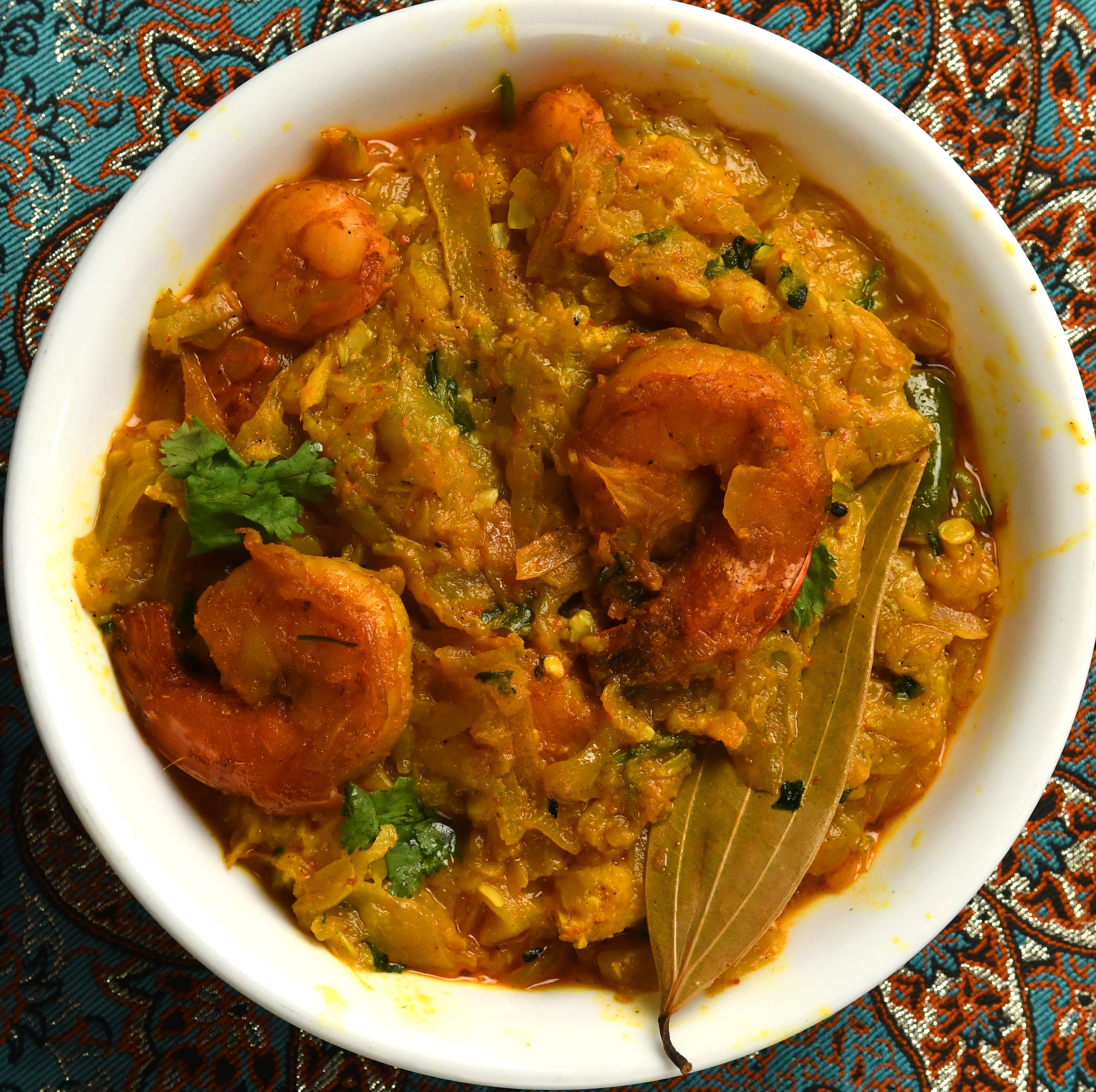
Lau Chingri (Bottle Gourd Curry with Shrimp)
When preparing this dish for her family, Kar Bhowmik uses unpeeled shrimp, and everyone happily consumes the shrimp along with their peel and tails.
- 1/2 pound medium shrimp, peeled if desired
- 1 teaspoon turmeric
- Pinch salt, plus more to taste
- 3 tablespoons mustard oil
- 1 tablespoon ghee
- 4 green finger chiles, or to taste
- 2 Indian bay leaves or 1 (2-inch) cinnamon stick
- 1/2 teaspoon nigella seeds
- 6 cups 1-inch pieces peeled bottle gourd or zucchini
- 1 tablespoon ginger paste
- 1 tablespoon granulated sugar
- Cilantro leaves, for garnish
- Basmati or jasmine rice, for serving
- In a medium bowl, toss shrimp with turmeric and a pinch of salt.
- In a large skillet with a lid, heat mustard oil over medium-high heat. Add shrimp and saute until they just begin to cook through, about 3 minutes. Remove shrimp from oil and set aside. Do not drain shrimp.
- Add ghee to the mustard oil in the skillet and add green finger chiles, Indian bay leaves and nigella seeds. Cook over medium-high heat 30 seconds, then add bottle gourd, ginger paste and sugar. Reduce heat to medium, cover skillet and cook 10 minutes, stirring occasionally. Remove lid and continue cooking and stirring until most of the liquid has evaporated, about 5 minutes. Taste for seasoning, adding salt if needed. Add shrimp, stir to combine and cook 2 minutes or until shrimp has heated through. Remove from heat, sprinkle with cilantro and serve over rice.
Nutritional information
Per serving: Per serving, without rice: 177 calories (percent of calories from fat, 56), 10 grams protein, 10 grams carbohydrates, 8 grams total sugars, 2 grams fiber, 11 grams total fat (1 gram saturated), 72 milligrams cholesterol, 337 milligrams sodium.Sign up for the AJC Food and Dining Newsletter
Read more stories like this by liking Atlanta Restaurant Scene on Facebook, following @ATLDiningNews on Twitter and @ajcdining on Instagram.