
Even a once-skeptical NBA scout likes Onsi Saleh’s plan for Hawks
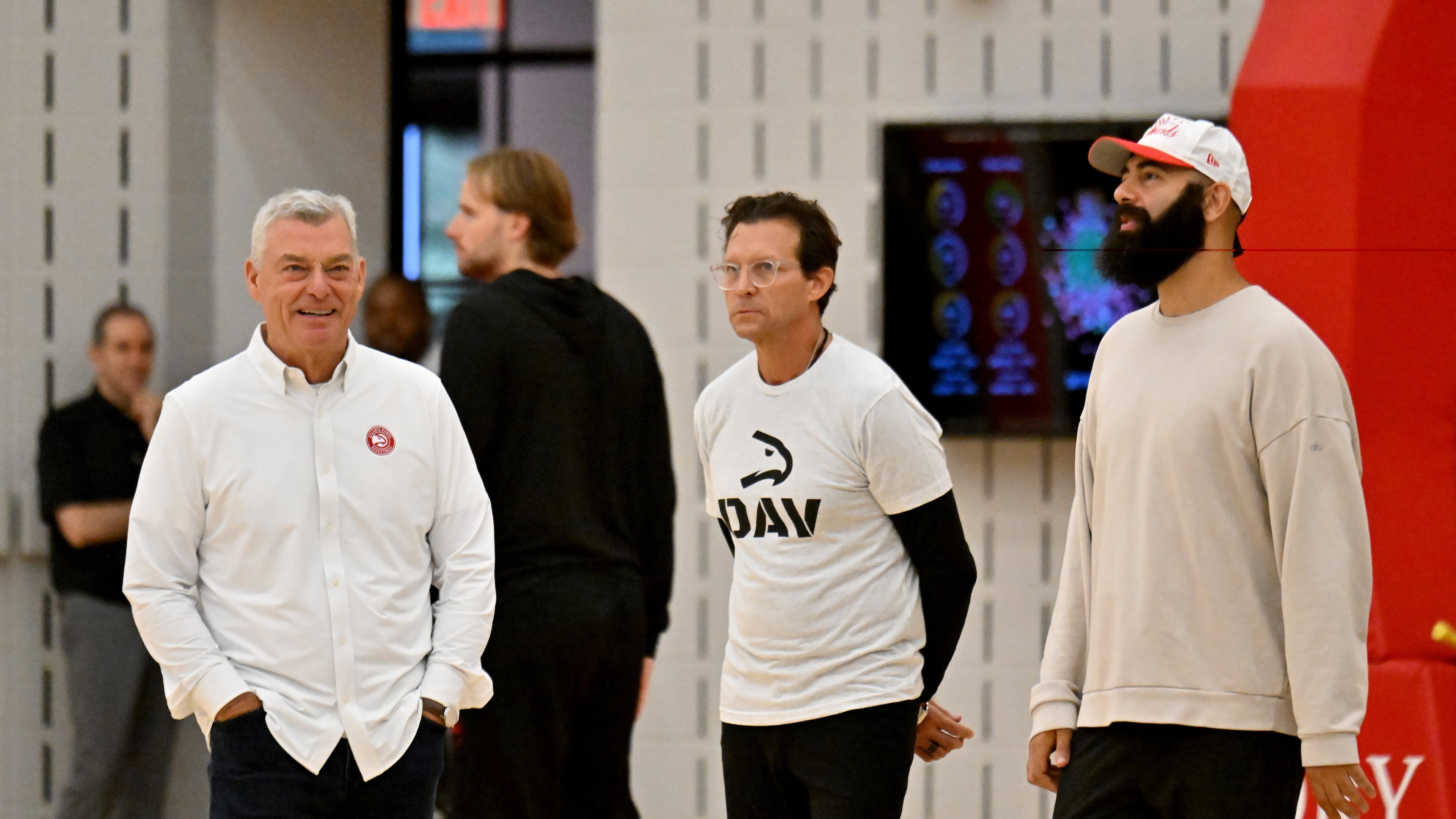
From elsewhere within the NBA, it’s quite clear what the Hawks have done this season.
“They’ve picked a path,” an NBA scout told The Atlanta Journal-Constitution. “I think that’s the biggest thing.”
In recent years, the scout often cast an uncertain eye on the Hawks’ operations, skeptical about the franchise’s ability to win with All-Star guard Trae Young as the centerpiece. But first-year general manager Onsi Saleh traded Young in January to Washington after seven-plus dazzling — but ultimately unsatisfying — seasons.
And just before the trade deadline, Saleh unloaded Kristaps Porzingis — the high-level post player whom the Hawks traded for this past offseason to pair with Young, only for injuries to sideline both. Porzingis was sent to Golden State.
“I think they’re going all in on chemistry over absolute talent,” the scout said. “Trae was a better player than what they had, but not necessarily a winning player.”
As the Hawks reassemble after the All-Star break, they have a remade roster that highlights forward Jalen Johnson, the newly minted All-Star. Via trades, the roster includes six players — guards CJ McCollum, Gabe Vincent and Buddy Hield, forwards Jonathan Kuminga and Corey Kispert and center Jock Landale — who weren’t Hawks a little more than a month ago.
“You either have to go all in and build around Trae or you’ve got to go all in with the young guys and start to build it together, and it looks like they’ve done that,” the scout said. “They’ve made sure that almost everyone they’ve brought in has been a shooting piece, except for Kuminga.”
Kispert, Hield and McCollum each has a career 3-point shooting percentages of 38% or higher, and Landale has shot 40% from 3-point range over the past three seasons.
It is yet another pivot to the future that the fan base will live through — albeit one that does appear set on a firmer foundation. With his role expanded after the injuries to Young and Porzingis, Johnson has emerged as a nightly triple-double threat.
The injury to Young proved a serendipitous opportunity to test whether Johnson, a dominant transition player, also could be a hub of the offense. A primary initiator of the half-court offense, he has answered that question by averaging 8.2 assists per game (fourth in the NBA) to go along with 23.2 points (22nd) and 10.6 rebounds (seventh).
He forms a trio with Dyson Daniels and Nickeil Alexander-Walker that has some runway and a ceiling to reach. Daniels’ 3-point shooting has mysteriously deserted him, but he has otherwise continued his superior defensive play and has developed as a point guard. In a more prominent role in his first season with the Hawks, Alexander-Walker is having a career year in his seventh season in the NBA.
The three are young (average age: 24.8 years) and cap-friendly (they’ll occupy roughly 41.9% of the Hawks’ cap next year). Johnson and Daniels are signed through 2029-30, and Alexander-Walker’s deal runs through 2027-28, with a player option for 2028-29.
Compare that with Young and Porzingis (average age: 29.5). Porzingis’ deal expires this season, and Young’s contract has a player option for next season. Before their trades, they swallowed up 49.9% of the cap.
The Hawks took a swing at the Young-Porzingis pairing, moved on when injuries kept it from materializing and kept their cap situation tidy in the process. Trades netted the expiring contracts of McCollum, Vincent, Landale and potentially Kuminga (he has a club option for next year) and will give Saleh more room to maneuver in the offseason.
Not to mention the potentially enormous prize that awaits the Hawks in the draft. Holding Milwaukee’s or New Orleans’ first-round pick with no protections, the Hawks could hold a 14% chance of landing the first pick and a 52.1% chance of getting a top-four pick in a draft, according to Tankathon. The draft is said to be potentially the best this decade. Saleh also has amassed a collection of second-round picks.
“I like the fact that they’ve picked a path that makes sense for long-term growth,” the scout said. “You’ve got some future assets; you’ve got some flexibility with the salary cap coming up.”
Coming out of the All-Star break, the Hawks have 26 regular-season games to tinker more with the lineup and figure out what they want to keep or discard. Kuminga, a supremely athletic wing, is particularly intriguing.
“You could argue that they could upgrade at center over (Onyeka) Okongwu or they could keep it as is and try to get an upgrade over (Zaccharie) Risacher, with, like, a big, long defensive 3-and-D (wing) that kind of makes sense for their group,” the scout said. “But I think they could go either direction there. And they’ll have to rebuild a little bit of the bench in the offseason.”
After nearly a decade full of Hawks futility, Saleh’s vision of a consistent contender might be difficult to believe in. And, at the least, it looks like the plan has promise.
You can now get my column sent straight to your inbox. Sign up for my newsletter here.
Correction
This story has been updated to correct Hawks salary cap details.
About the Author

Ken Sugiura is a sports columnist at the Atlanta Journal-Constitution. Formerly the Georgia Tech beat reporter, Sugiura started at the AJC in 1998 and has covered a variety of beats, mostly within sports.


