Answering questions about Yastrzemski, Suarez, Braves offseason
The Braves have done what they said they would this offseason, parting with their wealth to acquire players and not office complexes.
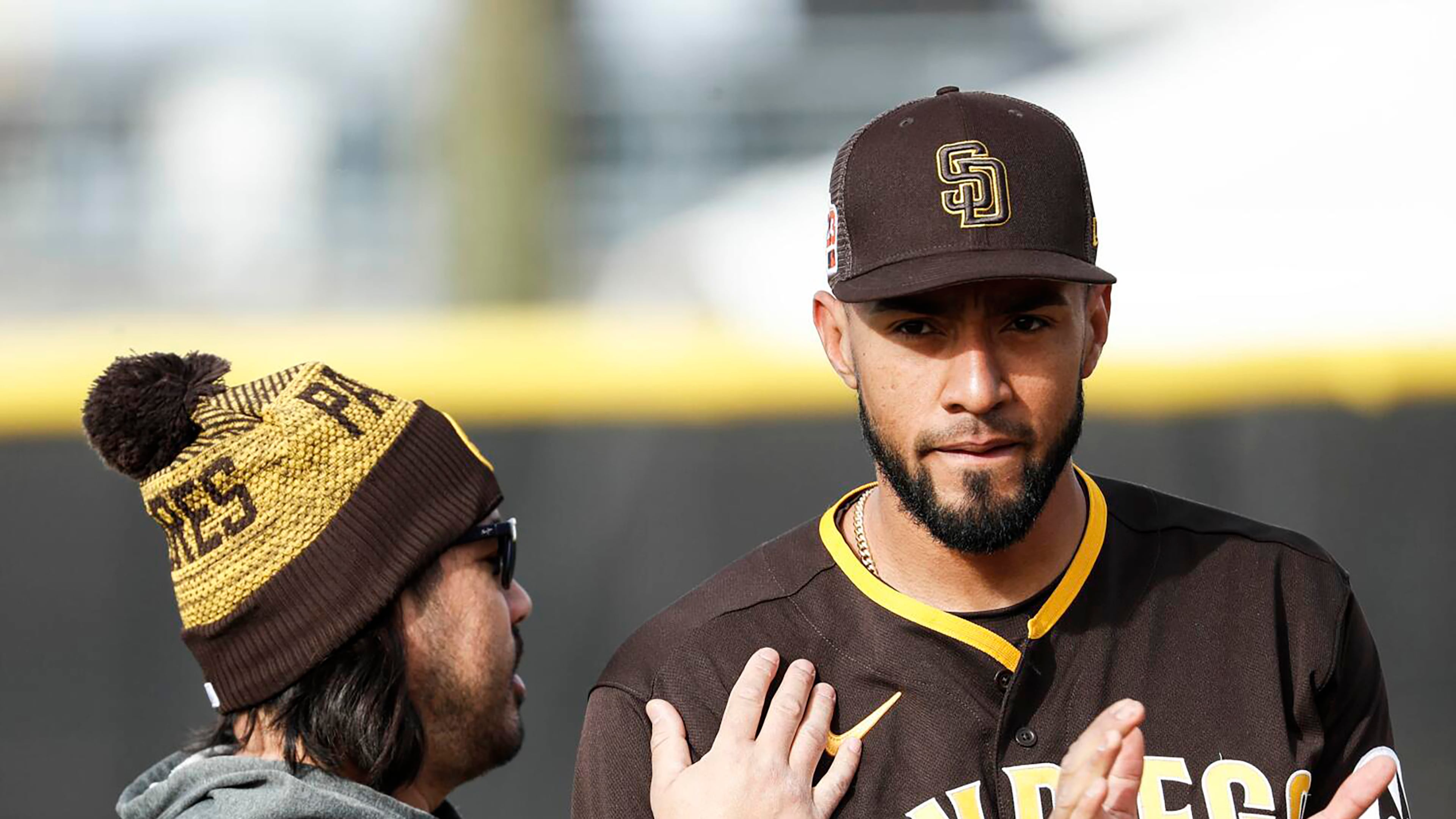
The signings this week of two-time All-Star reliever Robert Suarez and outfielder Mike Yastrzemski are additions that, while not jaw-dropping, are smart and indicate the Braves’ willingness to spend this offseason, as they said they intended to do after last year’s belly flop.
Look at this way: On last year’s opening day roster, the player who roughly equated to Yastrzemski (yes, a grandson of the Hall of Famer Carl Yastrzemski) was either Bryan De La Cruz or Jarred Kelenic.
De La Cruz was on a one-year contract worth $860,000. Kelenic also was on a one-year deal, his worth $2.3 million.
Yastrzemski signed a two-year contract worth $23 million.
Similarly, the second most expensive bullpen arm after Raisel Iglesias when last year began was making $7 million (Pierce Johnson). Suarez’s deal is worth $45 million over three years.
Rather than shopping in the bargain bin, president of baseball operations and general manager Alex Anthopoulos spent aggressively to meet two needs that were part of the club’s downfall in 2025.
With the Yastrzemski and Suarez signings, the Braves exceeded their 2025 spending, according to Spotrac, having $227 million in allocated payroll for 2026 compared with $220 million for last year. But they still have room to be in the top five in MLB, an objective that team chairman Terry McGuirk indicated the club could each. (Last year’s No. 5 team spent $255 million.)
Other offseason matters to ponder:
What will Suarez’s role be?
He likely will serve as the eighth-inning setup man for Iglesias.
While the 34-year-old Suarez (he turns 35 in March) was a closer for the Padres — he led the National League in saves in 2025 with 40 with a .904 WHIP — he’s expected to cede that role to Iglesias, who had a rough start to last season before finishing in more typical form. (A 6.75 ERA in his first 25 appearances, and a 1.25 in his final 45.)
But, with two more years on his deal and Iglesias (who turns 36 in January) on a one-year contract, it’s conceivable that Suarez could move to the closer role in 2027.
What about Yastrzemski?
Particularly as catcher Sean Murphy rehabilitates the labral tear in his right hip, Yastrzemski could start in left field against right-handers while the switch-hitting Jurickson Profar serves as DH.
For his career, the left-handed Yastrzemski has shown proficiency against righties — .809 OPS and homering every 20.5 at-bats — and is a plus outfielder. As an example, that’s in the same neighborhood as third baseman Austin Riley’s overall career numbers — .826 OPS and a homer every 18.6 at-bats.
After Murphy returns, Yastrzemski’s role could shift, as new manager Walt Weiss may want to spread the DH spot among catchers Murphy and Drake Baldwin and the other two outfielders, Ronald Acuña Jr. and Michael Harris II. In that case, Yastrzemski’s versatility (he can cover all three outfield spots) could serve the Braves well.
With the ability to cover the DH at-bats with multiple players, it would seem that Marcell Ozuna’s days in a Braves uniform are finished after six largely productive seasons.
Will they sign a starting pitcher?
With encouraging health updates from injured starters Spencer Schwellenbach (fractured elbow), Grant Holmes (partially torn UCL), Reynaldo López (shoulder) and Spencer Strider (going into second season after UCL surgery), it appears increasingly likely that they will not. Holmes and López’s cases in particular were question marks when the offseason began, but their progress seems to have softened the team’s perceived need for starting pitching help.
That quartet plus ace Chris Sale along with potential starters Hurston Waldrep and Bryce Elder give the Braves seven starting options, which they could deem sufficient.
It would be reasonable to expect that last season’s health disaster — when all five members of the starting rotation to begin the season ended up on the injured list simultaneously — will not happen again.
What about shortstop?
It would not be a surprise if Mauricio Dubón, whom the Braves acquired in a trade with the Astros (for Nick Allen) as a versatile backup, proves to be the everyday shortstop.
He is not as capable at the plate as Ha-Seong Kim, the top free agent on the market at that position who finished 2026 in a Braves uniform, but not by a margin that renders Dubón an unworthy option.
For instance, Dubón’s OPS over the past three seasons is .677. Kim’s is .716. Dubón will make $6.1 million. Still on the market, Kim could command three times that, although the bet on Kim is that he will be more productive after recovering from his shoulder injury. (After finishing his season with the Braves, Kim declined a $16 million player option to stay with the club, electing free agency.)
It would be great for the Braves if it could happen, but they don’t seem likely to force it.
What else could the Braves do?
Continuing to build the bullpen would make sense. With Joe Jiménez’s health a question mark, the Braves have Iglesias, Suarez, Aaron Bummer, Dylan Lee and then an allotment of relievers that are uncertainties.
Pierce Johnson and Tyler Kinley, both of whom had their club options for 2026 declined, could be re-signed at lower price tags. Johnson was effective in two-plus seasons (2.91 ERA), and Kinley was effective in a brief stint after being received in a trade-deadline deal from Colorado. (A 0.72 ERA in 25 innings.)
About the Author

Ken Sugiura is a sports columnist at the Atlanta Journal-Constitution. Formerly the Georgia Tech beat reporter, Sugiura started at the AJC in 1998 and has covered a variety of beats, mostly within sports.


