Georgia’s midterm voters are worlds apart. But neither group can decide.
Georgia’s midterm voters are living in different political worlds.
One party embraces a Donald Trump-led comeback. The other sees a country in free fall.
And yet voters in both the Democratic and Republican primaries are defined by a shared feeling of uncertainty. They know what they oppose, but many have not yet decided who should lead them forward.
The split is stark. Among likely Republican primary voters, 81% approve of Trump’s job performance in the latest Atlanta Journal-Constitution poll. Most expect the economy to improve. They’re broadly confident about Georgia’s trajectory.
Democrats are almost the inverse: 95% disapprove of Trump, while 89% say the nation is headed in the wrong direction. They’re deeply pessimistic about the economy.
What unites them, and what makes the midterm cycle so volatile, is a shared lack of consensus over their party’s standard-bearers. About a third of voters in both parties haven’t made up their minds in the marquee races for governor and U.S. Senate.
That’s not typical for a midterm this close to Election Day. At this stage in 2022, only 15% of likely GOP voters were undecided in the race between Gov. Brian Kemp and his GOP challenger, former U.S. Sen. David Perdue. Democrats consolidated behind Stacey Abrams during her second bid for governor and U.S. Sen. Raphael Warnock.
This time is different. The Republican primary for governor is a dead heat, with 30% of likely voters still unsettled, despite more than $100 million spent just on the airwaves to promote some candidates and tear down others.
On the Democratic side, former Atlanta Mayor Keisha Lance Bottoms has consolidated support. But a third of likely voters are still shopping for contenders. (Support for U.S. Sen. Jon Ossoff, running unopposed in his primary, remains high.)
And in the GOP race against Ossoff, more voters remain undecided than support any of the three well-known Republicans seeking to oust him.

That uncertainty will, of course, fade for those who turn out to the polls. More than 200,000 Georgians have already cast ballots. More will make their choices before the May 19 primary.
Trey Hood, the University of Georgia political science professor who conducted the poll, said some voters are only now tuning in. Others are paying attention but still weighing their options.
“There are also many high-profile open seats in this election cycle,” said Hood, referring to down-ticket races and five open U.S. House seats that will remake the state’s congressional delegation.
“With no incumbent, primary voters will have a harder time figuring out who to vote for without this cue.”
An uncertain GOP moment
The difference in how each party is navigating that uncertainty is telling.
Inside the GOP primary, Trump isn’t a liability. He’s the center of the political universe.
Among likely Republican primary voters, 81% approve of his job performance — including 60% who strongly approve.
Though that’s fallen slightly from the last AJC poll in October, GOP voters still overwhelmingly like his handling of the economy, immigration and law enforcement.
Every Republican on the ballot — even those like Secretary of State Brad Raffensperger who have feuded with him in the past — is running toward him.
Lt. Gov. Burt Jones has Trump’s endorsement and won’t let anyone forget it. Billionaire Rick Jackson is trying to outflank the field on MAGA issues, telling voters he’s “late to the Trump train, but nobody supports him more than I do now.”
In the Senate race, U.S. Reps. Buddy Carter and Mike Collins are both competing to embody the Trump-era GOP, while former football coach Derek Dooley promises to fulfill the president’s agenda while also trying to turn Washington itself into the enemy.
That means the GOP uncertainty isn’t just over how tightly to hug Trump. It’s also about who can carry his message most effectively.
“I want someone who is going to follow through on the policies this administration is putting in place,” said Rich Hintze, an undecided Republican who stopped by a campaign event in Acworth this week for Collins.
Then, he added: “I want someone who is backing the president but will also remember the Georgians who put him there.”
For Ruth Connelly, a researcher from Tyrone who still hasn’t made up her mind in key races, that means focusing on Trump’s fiscal policies more than culture-war debates.
“A lot of people may get hung up on social issues, but those are more secondary to my main issue: How do I stretch my paycheck to take care of the two people who matter most, my daughter and my son?”
Democratic crosscurrents
Democrats face a different puzzle. Their voters are just as unified — but in opposition.
Some 92% of likely Democratic primary voters strongly disapprove of Trump. About the same proportion disapproves of his handling of the economy. That anti-Trump intensity is part of the glue holding the party together.
But the poll suggests it may not be enough. Democratic voters are anxious about inflation and the cost of living. They’re skeptical about the country’s direction. They want someone who can oppose Trump but who also has an alternative vision for growing jobs and bringing down the cost of living.
Bottoms leads the primary for Georgia’s top job with roughly 39%. But that means roughly 61% of likely Democratic voters are either voting for someone else or undecided.
Her rivals — former Lt. Gov. Geoff Duncan, ex-state Sen. Jason Esteves and former DeKalb CEO Michael Thurmond — are all positioned as alternatives, each arguing the party needs a different kind of nominee.
Bottoms hopes to consolidate support as the primary tightens. But if she can’t push past 50% on May 19, she’s headed to an unpredictable runoff.
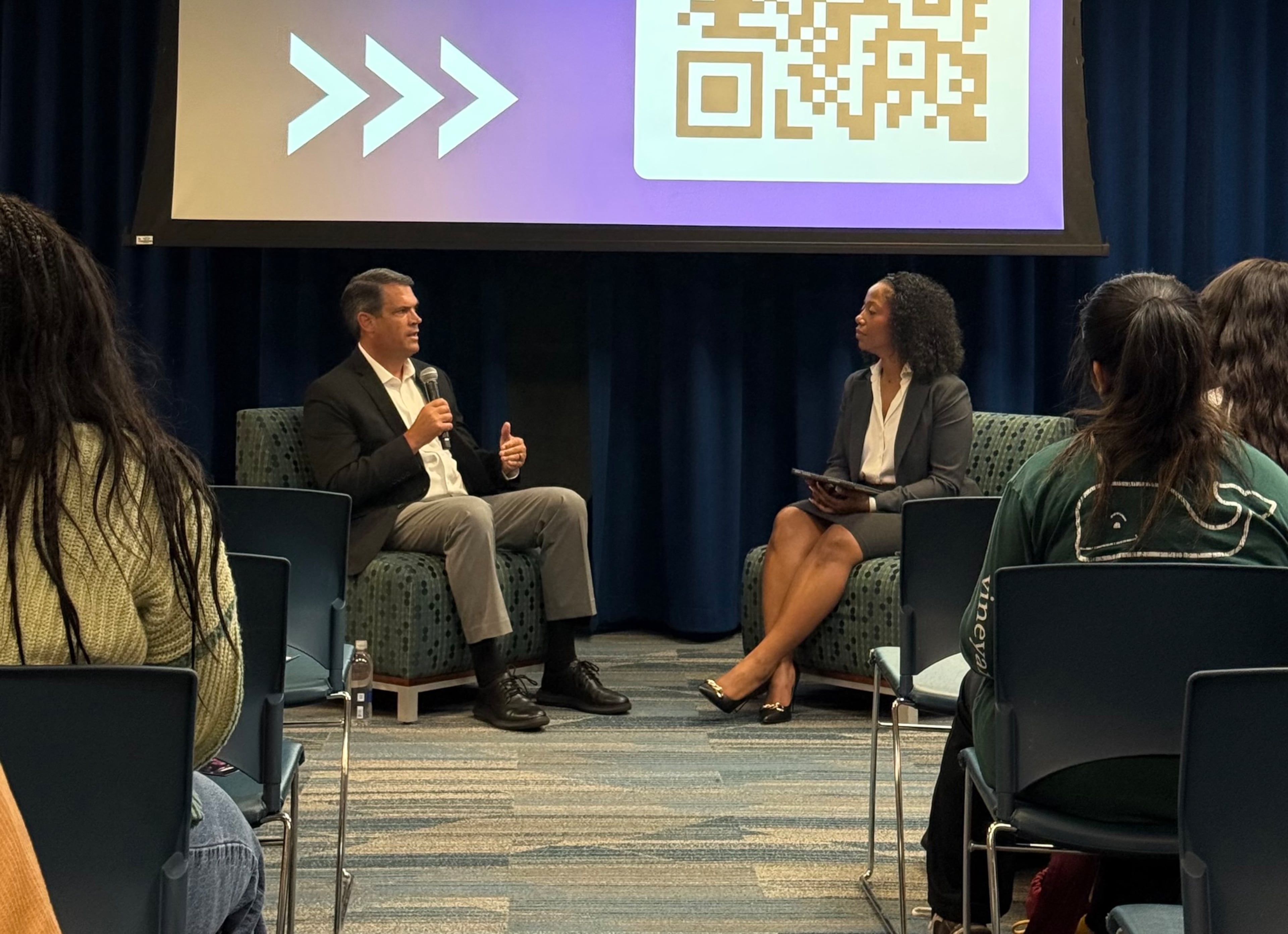
Angel Gutierrez is among the roughly one-third of Democratic primary voters who still haven’t settled on a candidate. After an event this week for Duncan at Georgia State University, he said he’s open to voting for the ex-Republican but still not sold on the idea.
“The fact that he was willing to get expelled from his party speaks volumes to me, but it’s hard to get past his record as a Republican,” he said. “I’m going to try to hear more of them out, hear who is the most genuine.”
That’s a word that keeps coming up for Terrence McCrae, a fellow Georgia State University student. He’s also doing what he knows many others may not have time for: researching the candidates.
“I want authenticity. I want a track record of excellence,” McCrae said. “This is the first primary I’m voting in, and I want to make my vote count.”