Big wins, surprises and signals from Georgia’s primary night
Today’s newsletter highlights:
- An ex-GOP U.S. House candidate, and convicted Jan. 6 defendant, wins a state Senate nomination.
- With the help of an outgoing Republican, Senate Democrats advanced a resolution to curb Iran strikes.
- The state Supreme Court vacates a more than $3.7 million order against some of Rick Jackson’s companies.
Primary takeaways

The dust is hardly settling on a wild primary night, and there’s plenty to unpack.
Start with our coverage of the marquee races for Republican Senate, Republican governor and Democratic governor. Then dig into the down-ticket contests, including two closely watched Georgia Supreme Court races that drew national attention.
A few takeaways:
Turnout surge. Democratic turnout soared. Democrats led Republicans in early voting and even edged them out on election day, translating frustration into signs of enthusiasm. But the night also showed turnout alone doesn’t guarantee electoral gains.
Supreme Court surprise. Democrats hoped soaring turnout would spell trouble for two Georgia Supreme Court justices targeted by party-backed challengers. The state Democratic Party put unprecedented resources behind their effort, running a seven-figure ad campaign and coordinated ground game designed to upend normally sleepy — and officially nonpartisan — judicial elections. Instead, Justice Sarah Warren walloped former state Sen. Jen Jordan, while Justice Charlie Bethel held off Miracle Rankin. Whether the results were a referendum on politicizing the judiciary, the power of incumbency or something else, institutionalists are celebrating. And it’s a reminder of just how difficult it is to mobilize voters over down-ticket races they’re used to largely ignoring.
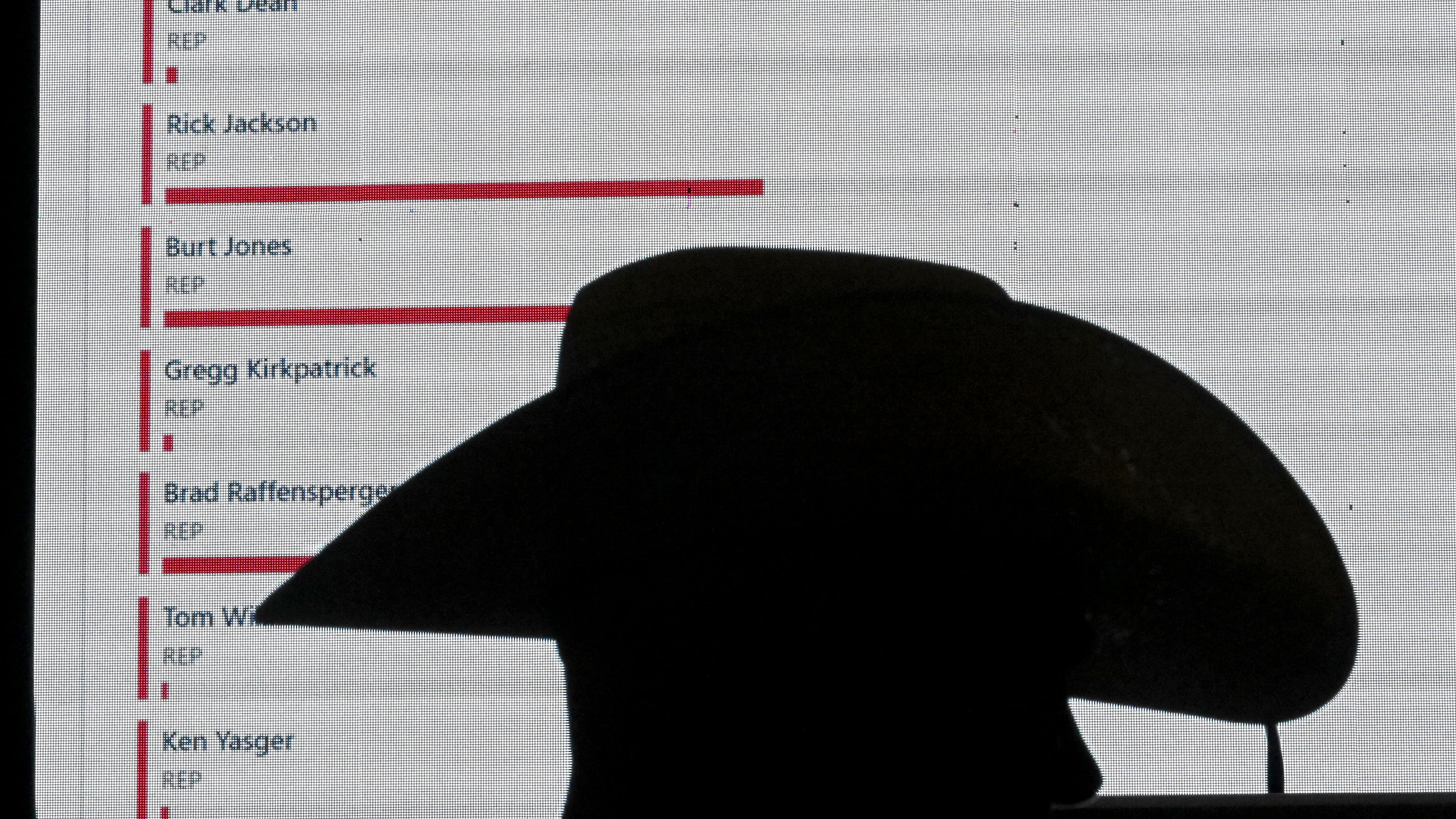
The duality of Rick Jackson. Billionaire Rick Jackson spent more than $83 million of his own money and still finished second, a staggering fact Lt. Gov. Burt Jones and his allies will hammer through the runoff. Just consider this news release headline: “Billionaire Blows Astronomical Amount of Money.”
It was no doubt an impressive showing by Jones, who dominated much of rural Georgia and held his own in more densely populated parts of the state saturated by ads.
But Jackson has a counterpoint: He came from nowhere, with little name recognition, to force a head-to-head contest with a Trump-backed rival in less than four months. And he’s ready to spend plenty more. He’s already snapped up airtime, while Jones has nearly a dozen events around the state planned in the next two weeks and has already laid out a debate challenge.
Black women “tsunami.” Former Atlanta mayor Keisha Lance Bottoms becomes the third Black woman in a row to win the Democratic nomination for governor, following Stacey Abrams’ victories in 2018 and 2022. Black women are the heart of Georgia’s Democratic electorate, and they broke decisively for her. Down the ballot, state Rep. Tanya Miller easily bested a rival for the attorney general nod. And former TV judge Penny Brown Reynolds was the leading vote-getter in the race for secretary of state.
Then there’s Fulton County, where Black women dominated local elections. “It wasn’t even a wave,” said Democratic strategist Fred Hicks. “It was a Black woman tsunami in Fulton County and no one was spared.”
No Atlanta problem. To say Bottoms’ victory was dominant is an understatement. She led her three top rivals in nearly all of Georgia’s 159 counties. And she tallied big gains in metro Atlanta, undercutting critics’ claims that the voters who knew her best were most skeptical of her campaign. She won about 50% of the vote in Fulton County, bested former DeKalb County chief executive Michael Thurmond on his home turf and posted hefty margins in the surrounding suburbs. She even carried some precincts in Buckhead, where angry activists upset by her leadership style started a breakaway movement. She has a clear mandate from her party to lead, joining U.S. Sen. Jon Ossoff atop the ticket.
Kemp still has some juice. Had political newcomer Derek Dooley not made it to a runoff in the U.S. Senate contest, it would have raised serious doubts about the ongoing value of Gov. Brian Kemp’s political clout as his second term winds down.
But Dooley, who is a lifelong friend of Kemp’s, managed to get 30% of the vote Tuesday to go into overtime with U.S. Rep. Mike Collins, who wound up with 40%.
Collins said his first-place finish proved Kemp doesn’t have the sway he thought he did.
“Looking at the result tonight, it shows that nominees are not picked on West Paces Ferry,” he said, referencing the street of the Governor’s Mansion.
A blow to the mainstream. Notwithstanding Dooley’s outsider bid, other more mainstream candidates withered. Secretary of State Brad Raffensperger’s lone bright spot was carrying deep-blue DeKalb County. Attorney General Chris Carr hardly cracked double digits. Former Lt. Gov. Geoff Duncan finished as an afterthought, his plan to win over swing voters with his political conversion in tatters. Even Thurmond, who has long pledged outreach to the middle of the electorate, struggled in his home county.
Things to know

Good morning! Here are three things to know for today:
- Catch up on all of the primary news by reading through our live updates from Tuesday.
- Georgia Supreme Court candidates Charlie Bethel and Sarah Hawkins Warren held onto their seats on Tuesday after defeating a pair of Democratic-backed challengers, the AJC’s Rosie Manins reports.
- Former U.S. Rep. Marjorie Taylor Greene resigned from Congress rather than face the wrath of President Donald Trump in a GOP primary. Kentucky U.S. Rep. Thomas Massie’s loss on Tuesday shows what she was trying to avoid.
Jan. 6 candidate

A former Republican U.S. House candidate who spent time in jail for his part in storming the U.S. Capitol in 2021 has won the Republican nomination for a Columbus-based state Senate seat.
Chuck Hand was sentenced to 20 days in jail and six months of probation after pleading guilty to a misdemeanor charge in 2023 for illegally demonstrating at the Capitol. Hand ran for Congress a year later, where he stormed off the stage minutes into a televised Atlanta Press Club debate with opponent Wayne Johnson.
Hand lost the primary to Johnson, who would go on to lose to Democratic U.S. Rep. Sanford Bishop.
Hand, who was unopposed on Tuesday, will now face Democratic state Rep. Tremaine “Teddy” Reese in the general election in Senate District 15. Reese hopes to replace state Sen. Ed Harbison, D-Columbus, who declined to seek reelection after more than three decades at the state Legislature. Reese defeated Harbison’s son, Edward Harbison, in Tuesday’s primary.
Court winner

Jackson was already a winner on Tuesday hours before he advanced to a runoff in the Republican race for governor.
The Georgia Supreme Court issued an order Tuesday morning vacating a more than $3.7 million judgment against some of Jackson’s companies.
The dispute originated from a real estate development joint venture between companies owned by Jackson and Mark Stevenson. An arbitrator sided partly with Jackson and partly with Stevenson, but the net result was Jackson’s companies had to pay Stevenson’s companies $3.7 million.
The Supreme Court vacated the order and sent the case back to the Court of Appeals.
AI voter
Kalindi Parikh said she wasn’t sure who to support in the Democratic primary for governor on Tuesday. But she knew her top priority was to back gun control measures. So, she turned to artificial intelligence to help her decide.
“I honestly asked ChatGPT,” she told our AJC colleague Lautaro Grinspan. “I asked, ‘Can you go through the candidates and see who most supports gun control?’ And it said, ‘Esteves for governor.’”
Esteves finished second to Bottoms in the primary, but did not get enough support to make it into a runoff.
Listen up

On today’s “Politically Georgia” podcast, we break down the results of Tuesday’s primary election results.
You can listen and subscribe to “Politically Georgia” for free on Apple Podcasts, Spotify, YouTube or wherever you get your podcasts.
Have a question or comment for the show? Email us at politicallygeorgia@ajc.com or give us a call at 770-810-5297 and you could be featured on a future episode.
Voting rights fallout

Members of the Congressional Black Caucus this week tanked a bill favored by universities with top-ranked athletic programs, and it all goes back to the U.S. Supreme Court ruling weakening the Voting Rights Act.
The CBC members, all of them Democrats, say colleges with powerhouse athletics had been leaning on them to support the SCORE Act, a bill that would create national standards for how much student athletes can make for use of their name, image and likeness. But those same institutions have been silent in the weeks since the Supreme Court ruling, which led to some states quickly moving to redraw maps eliminating seats held by Black lawmakers.
The CBC announced this week its members were opposing the SCORE Act, and without them on board House Republican leaders said they no longer had the votes to pass the bill.
Georgia U.S. Reps. Sanford Bishop, Hank Johnson and Lucy McBath were among the CBC members who attended a Tuesday news conference publicizing their stance. Among the speakers was NAACP President and CEO Derrick Johnson, who said Black athletes should avoid signing to play for universities in states that are redistricting as a result of the court’s ruling.
Kemp scheduled a special session for June 17 to draw new maps for 2028 that could eliminate one or more Black-held congressional seats.
“We are calling on athletes who are coming out of high school not to attend any state-funded school of states that have moved to minimize our right to vote to minimize our ability to elect candidates of our choice and states that are seeking to create a sharecropping reality, whether that state be Missouri or Mississippi, whether that state is South Carolina, Georgia, Alabama, Louisiana, Texas, or Florida,” Johnson said.
Today in Washington
- President Donald Trump will deliver the commencement address at the U.S. Coast Guard Academy.
- The House will hold votes around lunchtime, including possible reconsideration of a war powers resolution limiting strikes in Iran.
- The Senate will vote on more Trump nominations.
War powers resolution
With the help of an outgoing Republican, Senate Democrats successfully advanced a war powers resolution that could limit further strikes in Iran.
The Senate voted 50-47 on Tuesday to proceed to debate on the measure. Pennsylvania U.S. Sen. John Fetterman was the only Democrat to oppose the measure.
U.S. Sen. Bill Cassidy of Louisiana, who lost his primary last week after Trump endorsed a challenger, was among the four Republicans who supported moving forward on the resolution.
The others were Kentucky’s Rand Paul, Alaska’s Lisa Murkowski and Maine’s Susan Collins.
Three Republicans were absent for the vote. If no votes change and those three oppose the resolution when it comes to the floor for a final vote, it will fail 50-50. Even if the resolution passes the Senate, it would move to the House where Republicans have voted down similar measures in recent weeks.
Shoutouts

Today’s birthday:
- Columbia County Superior Court Judge Barry Fleming, a former state representative.
Want a birthday shoutout in the Politically Georgia newsletter? There’s a form for that. It’s not just birthdays. We’re also interested in new jobs, engagements, birth announcements, etc.
Before you go

More than 2 million voters cast ballots in Tuesday’s primary, according to voter participation files posted this morning by the Georgia Secretary of State’s Office.
That’ll do it for us today. As always, you can send your best scoops, gossip and insider information to greg.bluestein@ajc.com, tia.mitchell@ajc.com, patricia.murphy@ajc.com and adam.beam@ajc.com.
Correction
May 21, 2026This story has been updated to correct that two candidates were running for the Georgia Supreme Court.