The Rick Jackson-Burt Jones slugfest: half-truths, whoppers and a lot of B.S.
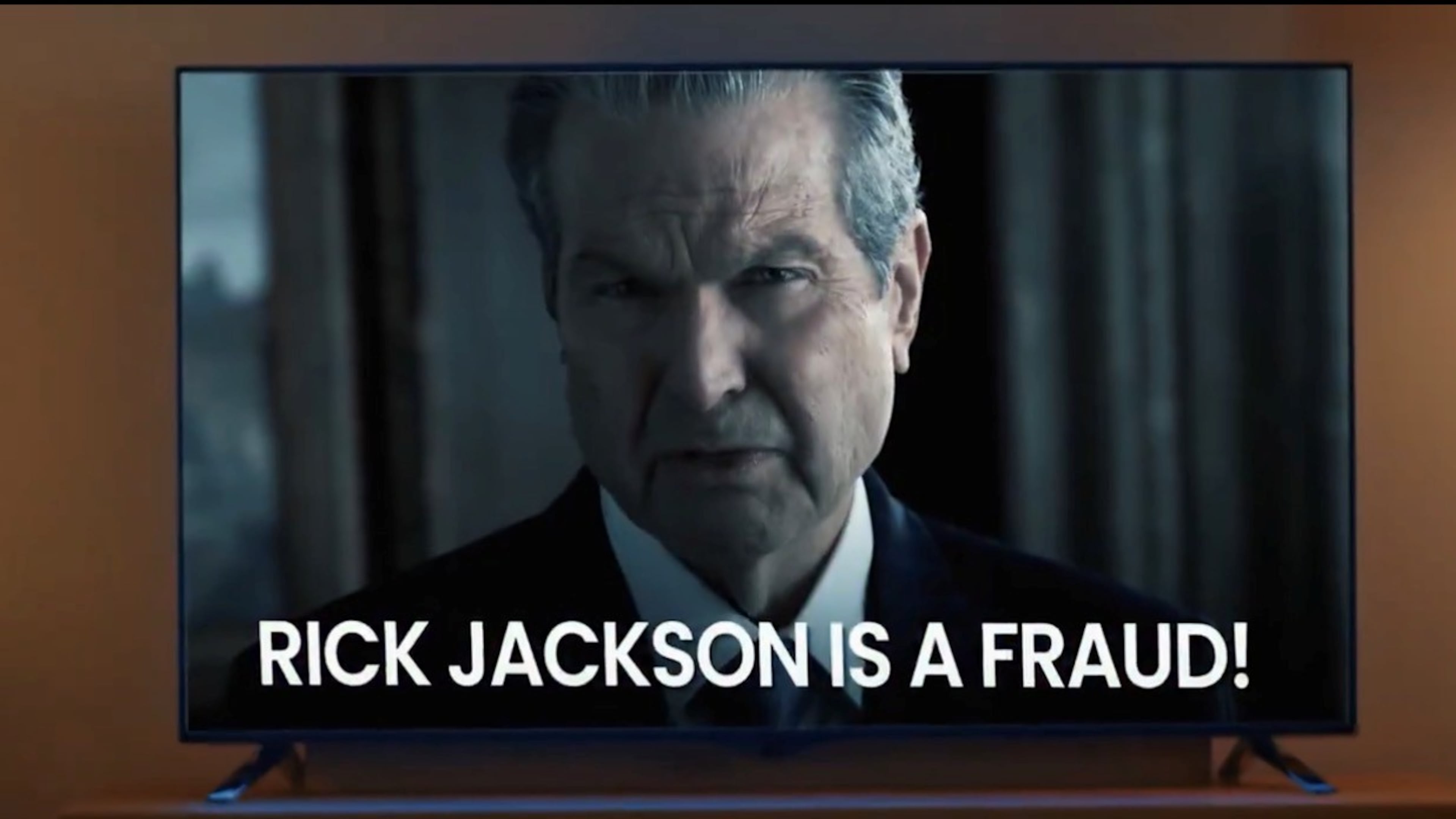
What do you get when you cross a billionaire with a millionaire in the Georgia GOP primary for governor?
In 2026, you get a daily, almost hourly deluge of negative TV ads, mailers and billboards from billionaire first-time candidate Rick Jackson and millionaire Burt Jones — the lieutenant governor who looked like Republicans’ presumptive nominee for governor until Jackson unexpectedly jumped into the race.
Avoiding the sludge will be almost impossible for Georgia voters, with nearly $90 million in ads reserved between the two campaigns through the May primary. Sorting out what’s true from what’s not may be the best a Georgian can hope for until the storm passes.
But even that won’t be easy. In the last week, Jackson has continued his onslaught of ads against Jones accusing him of self-dealing, while Jones has called Jackson a “false prophet” and posed with a literal bottle of “B.S.” in South Georgia, saying he had finally figured out what Jackson is selling with his campaign.
“I want y’all to look at that right here, it’s pure, 100%, right here what it says right here,” Jones said, pointing to the bottle of steak seasoning, whose name we can’t publish, other than to say it was sourced from a place called “Big Cock Ranch.”
Did I mention this is a campaign for governor, not social chair of a fraternity house?
The “B.S.” that Jones is referring to is a hurricane of attack ads from Jackson that accuse Jones of pushing for state laws or regulations from his roles at the Capitol that would benefit his family businesses around the state.
A well-publicized example came when Jones lobbied for a bill in 2023 that will make it easier for one of his family businesses to build a new hospital in his hometown. Another Jackson ad hits Jones for a plan from the same business, Interstate Health Systems, to build data centers next to the hospital, an accusation that Jones said is “all made up.”
“My opponent has spent literally $20 million trying to make you believe that I own a data center or my family owns one or whatever,” Jones said, showing a video of an empty field that he said is the property in question. “It’s just lies, lies, lies.”
The truth is that Jones does not currently own a data center on his family’s property in Jackson. But Interstate Health Systems filed a very real rezoning application in late 2025 to modify the proposed use for the massive mixed-use development “to consist of approximately 11 million square feet of data center(s),” along with medical office space, a hospital and assorted commercial businesses.
Jones’ spokesperson said that it is Rick Jackson, not Jones, who has heavily invested in a data center in Texas, and that there is not currently a contract for a data center on the Jones-owned property south of Atlanta. It could, she said, eventually be used for something other than data centers. But the application makes it clear that the plan makes way for data centers, if they come.
Jackson has been stung by Jones’ ads, too. One of the most blistering attacks on Jackson has a toe dipped in fact, but is also not what you’d call the whole truth.
The attack started with a social media post from Jones in March accusing Jackson of making his fortune “recruiting for Planned Parenthood” and “helping doctors perform transgender procedures on minors.”
A subsequent TV ad from Jones said Jackson “helped staff gender transition procedures on prisoners.”
That enraged the anti-abortion, anti-trans Jackson so much he filed a defamation suit against Jones the next day, calling the lieutenant governor “a desperate man who ran out of honest options.”
Like Jones, Jackson has called the attacks on him a “stone-cold lie.” But the ads are making enough of an impact that Jackson was recently asked about them by a voter at a campaign stop in Winder.
“In almost every lie, there is a scintilla of truth that wraps around that lie,” the voter said. “So what is the scintilla?”
Jackson explained that the jobs described in the Jones attack ads were posted on LocumTenens.com, a free, self-service job board like Monster.com that Jackson Healthcare operates for health care job openings around the country. His company does not screen or get paid for the ads.
But Planned Parenthood has used the job board to advertise at least two openings, while Washington state’s Department of Corrections once posted an ad for its chief medical officer. That second job ad is relevant because it is the root of the Jones TV ad about transgender prisoners, since Washington state has provided transgender medical care in its prisons since a legal settlement required it to do so. But was Jackson really getting rich “staffing transgender surgeries?”
“There’s zero percent truth to that at all,” Jackson said in Winder. “It was totally made up because, I guess some polling person said that this would be great.”
It’s no mystery why Jones and Jackson are going after each other the way they are. There’s only one ticket out of the primary, and they’ve both come too far to turn back now.
But the danger for them, and for Republicans in general, is that, regardless of what is true and what isn’t, the Jackson and Jones campaigns seem hell-bent on destroying each other — even if it kills them both.
Voters I talk to want to hear what the candidates are for, not just who they’re against. But that’s not coming through for most Georgians right now.
Instead, in the battle of bottomless bank accounts, the arms race of negative ads between Jackson and Jones is veering toward mutually assured destruction. If you’ve ever studied history, you know nobody wins in that scenario. And that’s the truth.
About the Author

Patricia Murphy is the AJC's senior political columnist. She was previously a nationally syndicated columnist for CQ Roll Call, national political reporter for the Daily Beast and Politics Daily, and wrote for The Washington Post and Garden & Gun. She graduated from Vanderbilt and holds a master’s degree in journalism from Columbia University.


