Black market for unapproved weight-loss drug thrives in Georgia


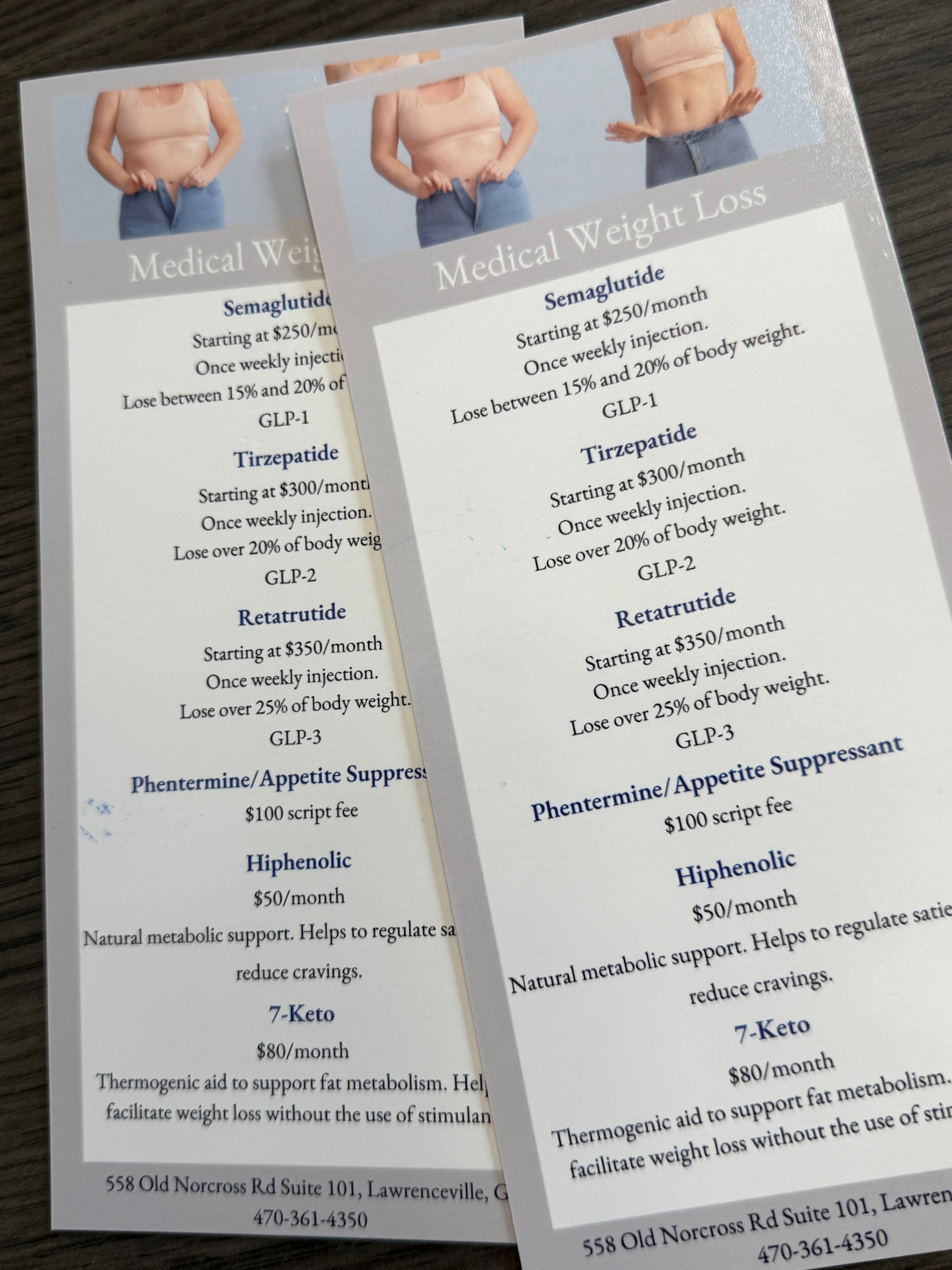
At the Balanced Bodies Anti-Aging Clinic in Lawrenceville, patients can choose their weight-loss plan from a card at the front counter that lists both the drugs and the cost of the weekly injections.
The options, subject to a provider’s approval, include the well-known GLP-1 drugs semaglutide and tirzepatide as well as one that’s supposedly the next big thing — retatrutide — although it comes with risks for those providing it as well as those using it.
The Food and Drug Administration hasn’t yet deemed retatrutide safe and effective or approved it for sale to the general public. What’s more, the company developing it, Eli Lilly, is aggressively seeking to stop the sale of knockoff versions, filing lawsuits and flagging regulators.
But the risks associated with retatrutide haven’t stopped Balanced Bodies nor more than a dozen other medical facilities in Georgia from circumventing the FDA process by selling it.
“Retatrutide is an amazing medicine,” said Dr. Kent Cohen, the co-owner and medical director at Balanced Bodies. “Our pharmaceutical companies are … U.S. pharmaceutical compounders. They’re putting it out and we’re buying it from them. It’s not illegal. We’re not doing anything illegal by buying it. The state of Georgia has not come out and said, `Retatrutide is illegal unless you get it from Eli Lilly.’”
Retatrutide is in the final phase of Eli Lilly’s clinical trials and isn’t expected to be submitted for FDA approval until next year. That means it can’t yet be prescribed or dispensed by physicians except in certain rare cases, and what’s available outside of those trials and the rare cases are facsimiles produced by compounding pharmacies.
The danger, experts warn, is that those substances could contain contaminants or altered forms of the active ingredient and likely were produced by unlicensed manufacturers in China and other foreign countries. The lucrative black market for the drug has in effect turned those willing to try it into another set of test subjects, but without the controls required for clinical trials.
Risky Medicine
An AJC series examining how Georgia became a haven for unproven treatments
Part 1: Welcome to Georgia, where questionable therapies flourish with little oversight
Tennessee cracked down on a questionable therapy. Georgia gave its doctors a home.
Part 2: Desperate patients seek cures, leave with debt and regret
Atlanta clinic promoting unconventional medicine has controversial history
Part 3: Underfunded Georgia medical board does little to stop doctors who cross the line
Why you will have problems checking out your Georgia doctor
Who’s providing alternative medicine in Georgia, and what they can, can’t do
“If you are part of the manufacturers’ clinical trials, that’s OK,” said Lea Winkles, a clinical professor of pharmacy practice in Mercer University’s College of Pharmacy. “You are receiving the manufacturer’s product. But most of these pharmacies or other outsourcing facilities that are compounding with retatrutide, they’re most likely receiving their active ingredient from some place offshore. So then you have questions about safety of the product, because it’s not FDA approved.”
Retatrutide has caught the attention of regulators from Georgia’s medical and pharmacy boards, but they have done nothing so far to stop the sales.
The upshot is a situation that once again illustrates how in Georgia anything goes when it comes to costly and unproven medical treatments, as the AJC has found in a continuing investigation of how well the state protects patients.

Assessing what should be done is “sort of the $100,000 question,” Winkles said. “There’s a gray area, and some additional guidance and decisions need to be made (to understand) under whose regulatory body this falls.”
A drug in development
The early word is that patients on retatrutide can lose about 28% of their body weight over two years. That compares to an average reported range for GLP-1 drugs of 5% to 20%.
Like the GLP-1s, retatrutide is part of the class of substances known as peptides — chemicals that trigger hormones in the body. However, retatrutide differs from the GLP-1s in that it’s a so-called “triple agonist,” meaning it targets three areas of the brain that control appetite.
Winkles said the fact that the clinical trials for retatrutide have reached Phase 3, the final step before a drug is submitted for FDA approval, means it has cleared a number of hurdles. Yet even in Phase 3, it can’t be viewed as risk-free, she said.
“It’s probably considered generally safe,” she said. “But until we have all the data to look at collectively, there’s always a potential, even if it’s approved, that something unfortunate could happen. I think (in dispensing compounded versions of the drug) we’re sort of increasing that potential or risk before we’ve gotten all the way through the process, and I’m not sure the general public understands that.”
The FDA has received more than 70 adverse event reports involving retatrutide since 2024, the vast majority reported this year. Reports are made by healthcare professionals, patients and consumers. The most common problem cited has been nausea and vomiting. But the count includes four deaths this year and 40 other cases deemed serious, with 24 requiring hospitalizations. Information in the reports has not been verified, however, and does not indicate that the drug caused the reaction.
In online chat rooms, users have also noted headaches, dizziness and elevated heart rates.
Eli Lilly, for its part, has taken a hard line against those making or selling versions of the drug. It has issued a series of public statements asserting that retatrutide can’t be legally sold to consumers nor produced by compounding pharmacies. It also has filed lawsuits against businesses believed to be making or selling the drug.
The lawsuits so far have targeted online sellers in Texas and Louisiana, a Texas-based compounding pharmacy, a weight-loss clinic in Arizona and med spas in California and Texas. In addition to seeking injunctions to stop the sale or manufacture of retatrutide, the lawsuits have asked that the defendants be required to disgorge all profits from the drug.
“Anyone purporting to sell retatrutide to consumers — including medical spas, wellness clinics and online sellers — is breaking the law,” the company said in a statement for The Atlanta Journal-Constitution. “We have referred hundreds of black market retratrutide sellers to regulators and law enforcement and call on them, as well as companies whose services enable black market sales, to take decisive action to fight this urgent threat to public health.”
`Say hello to Reta’
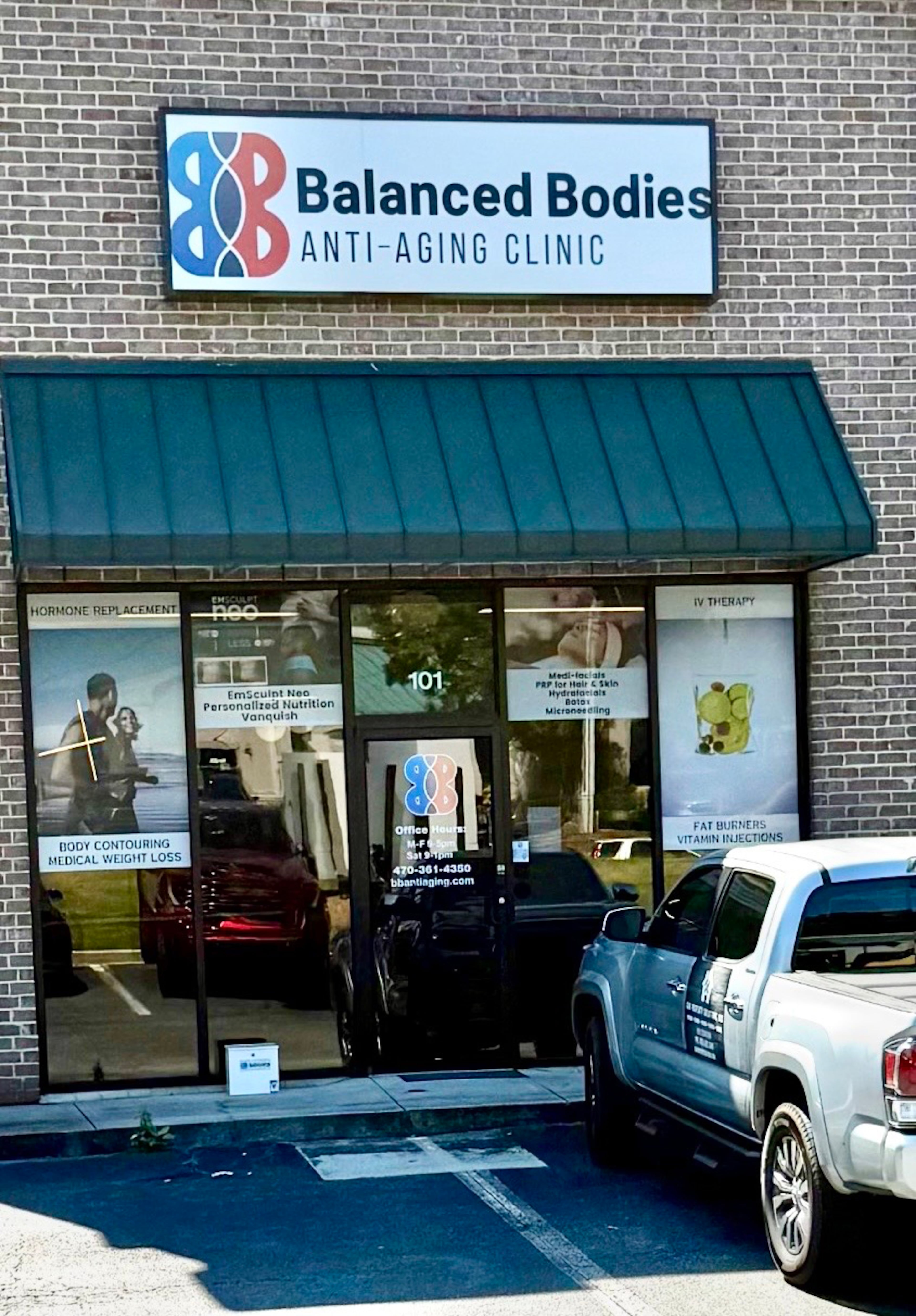
All told, the AJC identified 17 medical facilities in Georgia that have claimed on their websites, social media pages and other forms of promotional material that they can provide retatrutide.
It’s a mixed bag of med spas and wellness and weight-loss clinics throughout the state, with nearly half, the AJC found, showing physicians as their owners or medical directors.
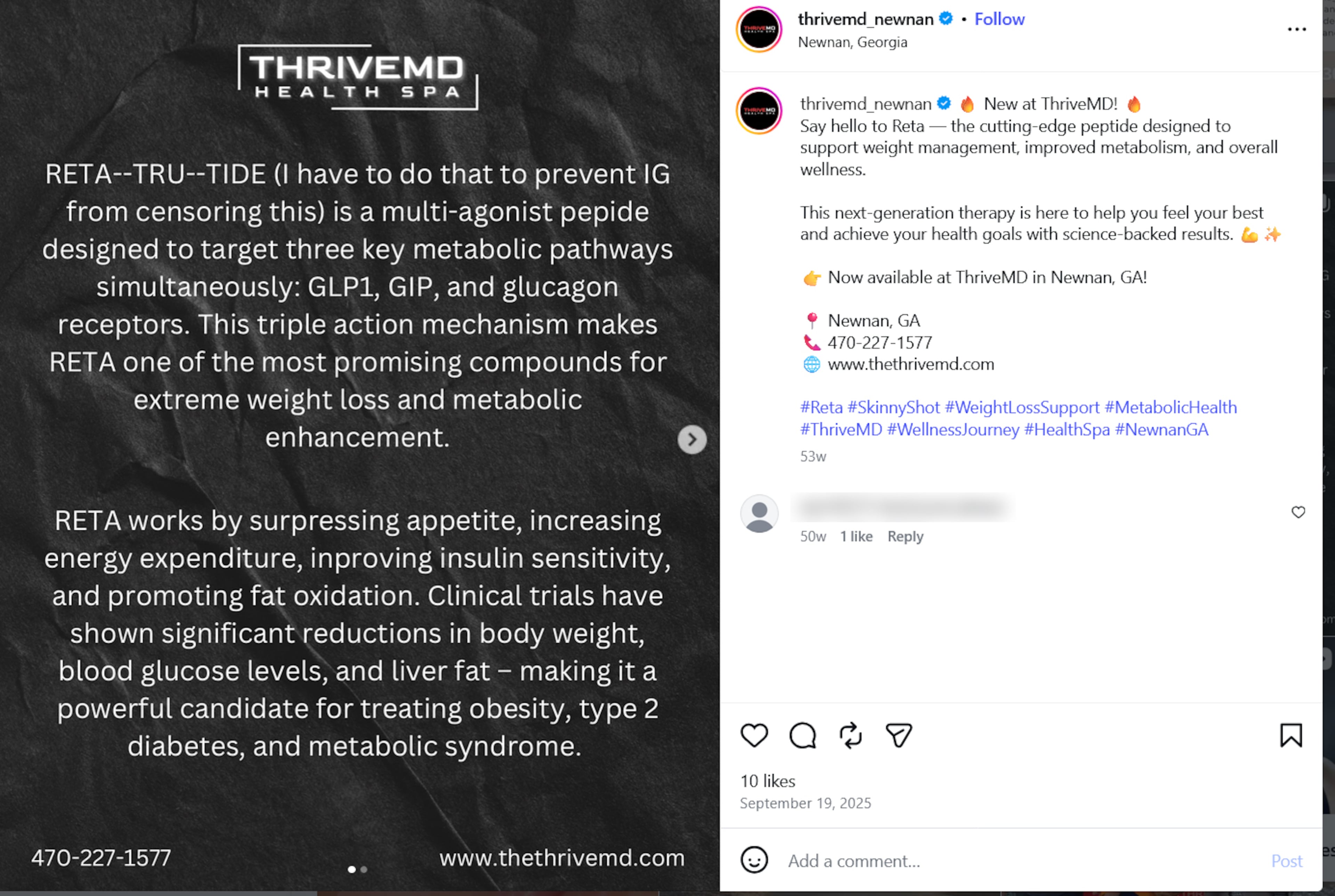
“Say hello to Reta — the cutting-edge peptide designed to support weight management, improved metabolism and overall wellness,” ThriveMD Health Spa in Newnan announced on Instagram in September of last year.
On its website, the business listed the price as $120 for a single 3 milligram injection, $460 for a one-month supply and $880 for two months.
Camila Zicarelli said she got retatrutide from ThriveMD and used it for six months this year before stopping because she’d met her weight-loss goal. She said she received the first injection at the spa. After that, she received packages with syringes and vials of the drug through the mail, she said. She estimated the total cost as $1,200.
As an investigational drug not yet approved by the FDA, retatrutide isn’t covered by insurance.
Zicarelli, 27, said she knew retatrutide isn’t FDA approved but felt confident in taking it because of friends who spoke positively of their experiences.
“It made me a bit nauseous at first, but once I lowered the dosage a week or two later, I was fine,” she said.
In late September, just days after the AJC reached out for comment for this story, ThriveMD shut down its website and moved out of its space in Newnan’s Ashley Park shopping district.
In a brief interview, the spa’s founder and co-owner, Benjamin Baugh, said the business would continue operating in another form but declined to provide details. He said it had stopped dispensing retatrutide before it closed. He said the reason was a limited demand for the drug and not Eli Lilly’s statements about the legality of selling it.
“Eli Lilly’s not the law,” he said. “They don’t want us to (sell it). But it’s not illegal.”
Baugh, who apparently has no medical background, said he was unwilling to answer more questions when asked where the spa had obtained the version of retatrutide it had been selling.
A med spa in Rome, Lotus Health and Wellness Oasis, has been equally straightforward in touting the availability of retatrutide, noting at one point on its website that “most patients notice gradual, meaningful changes” during their first three months on the drug. The website didn’t show the cost of the injections.
The spa’s office manager, Jennifer Kilgore, said the facility contracted with a company that provides telehealth as well as a compounded version of retatrutide. She declined to identify the company.
According to Kilgore, patients are seen by the telehealth physicians before being put on retatrutide. Patients also sign waivers acknowledging that they know the drug hasn’t been approved by the FDA, she said.
Only a “handful” of the spa’s patients have tried the drug, she said, but all have been “pretty much positive about it.”
Shortly after the AJC spoke to Kilgore, Lotus Health removed all mention of retatrutide from its website.
A regulatory dilemma
That retatrutide is so easily available in Georgia is yet another window into how lax regulatory oversight has made the state a haven for unproven treatments and therapies, a topic explored by the AJC in its Risky Medicine series earlier this year.
In a March 2025 letter to the Federation of State Medical Boards, the National Council of State Boards of Nursing and the National Association of Boards of Pharmacy, the FDA sought to provide regulatory guidance by stating that because it hasn’t approved retatrutide, compounding pharmacies can’t create compounds using it.
The FDA also has issued multiple warning letters to compounders using retatrutide, stating that they are violating federal law and noting that failure to address violations can result in legal actions, including seizure of products.
At least one state has cracked down. In 2025, the Ohio Board of Pharmacy suspended the drug distribution license of a Cleveland-area spa for purchasing retatrutide and other weight-loss drugs from what the board called “unlicensed manufacturers in China and the Amazon website.”
The board also issued a statement on retatrutide in which it warned that “licensees found to be compounding, selling, ordering, administrating or otherwise facilitating the distribution of this unapproved drug may be subject to immediate licensure suspension.”
Georgia officials have struggled with the issue, mainly because much of the black market for retatrutide involves med spas, which aren’t licensed by the state or subject to any form of specific regulation.
However, in an email to the AJC, the Georgia Composite Medical Board’s executive director, Jason Jones, acknowledged that a physician who dispenses or compounds retatrutide “outside of an FDA-authorized clinical trial” could be subject to disciplinary action by the board.
Jones’ email also noted that retatrutide cannot be lawfully used in compounding under federal regulations and that the Georgia Board of Pharmacy prohibits “commercial copies” of drugs unless there’s a valid need for a specific patient or a shortage.
“As these cases become more common, we are educating physicians about their obligations,” Jones said.
He added that the board is exploring the implementation of a “collaborative process” with the pharmacy board and the Georgia Drugs and Narcotics Agency “to ensure physicians comply with all applicable medical and pharmacy rules.”
The suburban market
Balanced Bodies is a compelling example of how the black market for retatrutide has taken hold in Georgia, in large measure because the med spa chain is all over metro Atlanta, particularly the northern suburbs.
A board-certified and Emory-trained emergency room physician who for many years was affiliated with Northside Hospital, Cohen started Balanced Bodies 10 years ago with Tim Carrega, an advanced practice registered nurse. Since then, they have seen it grow to eight locations, several of which are franchises.
Cohen said he obtains retatrutide from compounding pharmacies that he’s come to trust after years of doing business with them. His suppliers are “legitimate compounders giving me legitimate medicine,” he said.

Before patients can start on the drug, they are required to sign consent forms showing they understand that it doesn’t have FDA approval, he said. They also receive a physical exam and are monitored from then on, he said.
“I don’t sign every chart, but I’m available to answer questions,” he said. “Believe me, I could show you phone calls all day from my clinics.”
The AJC learned that Balanced Bodies is dispensing retatrutide from a reader who got the drug at the Lawrenceville location and sent an email wondering how it could be legal.
The reader, a woman who asked not to be identified by name to protect her medical history, said she had been getting a GLP-1 drug, tirzepatide, at the clinic when she noticed retatrutide listed on the card at the counter. The card shows the drug available at a cost starting at $350 a month.
The woman said she was given one injection at the office and a second to take home. She paid $157 for the two 2 milligram injections, receiving a 15% discount for using the drug the first time.
Initially, she felt fine, she said. But she later developed a “raging” headache that she said made her wonder if she’d made a mistake.
“I’d never had a headache like that,” she said. “It woke me out of my sleep. I worried, `Am I having a stroke?’”
The woman said she gave herself the second injection but decided she would no longer take the drug after doing some additional research on it.
“I went ahead and took the second shot,” she said. “But as time went on, I thought, `Maybe I shouldn’t be taking this stuff because I don’t know what it is. It’s not even supposed to be on the market.’”
The woman provided the AJC with a photo of the syringe she took home as well as the label, which lists Cohen’s name. Although the doctor’s name is on the label, the woman said she got the medicine from someone she believed to be a physician assistant or an advanced practice registered nurse.
Informed of the woman’s comments, Cohen said he has seen a fair number of side effects from the GLP-1 drugs but very few with retatrutide.
“It’s pretty rare that we have anybody with problems with retatrutide,” he said.
As for Eli Lilly, he said: “Of course, they want to say it’s illegal. What’s their interest? You know these big pharmaceutical companies care about more than patient safety and patient health. They’re in it for the money. They’re in it to make their stockholders happy.”
In Cohen’s view, he has the high ground, offering a drug that, while not yet FDA approved, can make people healthier and, in fact, change their lives.
“As long as there’s enough data out there for all these drugs we use, all the peptides, including retatrutide, I feel confident,” he said. “I will risk my career on retatrutide. I know if I give a patient a medicine and there’s a bad effect or something happens, I’m liable. But I’m a believer in what I’m doing. I really think I’m doing the right thing.”