Tennessee cracked down on a questionable therapy. Georgia gave its doctors a home.


It started with a curious set of healthcare data and a question that pointed to Georgia.
Why were so many seniors in one corner of the state undergoing chelation, an IV therapy approved by the Food and Drug Administration strictly for the treatment of heavy metal poisoning?
The situation drew the attention of lawyers for the U.S. Department of Justice. In time, it led them to two doctors in Ringgold and a Medicare billing scheme with its roots in Georgia’s tolerance for physicians who push the envelope.
For years, the DOJ found, Drs. Charles Adams and Robert Burkich received millions of dollars in government funds by treating hundreds of elderly patients with chelation for arterial disease, high blood pressure, headaches, gastrointestinal ailments, fatigue and other conditions — and billing Medicare as if the patients had been diagnosed with heavy metal poisoning.
Some patients were chelated more than 100 times over a period of years, a far cry from the slow drip over five days recommended as the standard of care for those poisoned by lead or other forms of heavy metal.
Detailed in a pair of lawsuits — one against each physician — the findings shed light not only on the doctors’ billing practices but also on how Georgia’s hands-off attitude toward alternative medicine prompted Adams and Burkich to move their practices to the state from Tennessee so that they could use chelation however they see fit.
The two civil cases alleged the physicians violated the federal False Claims Act, which prohibits knowingly submitting false claims for payment to government agencies.
After a 2023 trial, a jury in Rome found Adams violated the act, leading U.S. District Judge William M. Ray II to impose a $27.6 million judgment that included damages and penalties.
Burkich settled with the government last year, agreeing to pay $700,000. While the settlement did not include a determination of liability, the DOJ said in its announcement that it would continue to pursue cases against those who commit acts of waste, fraud and abuse against the Medicare program.
All told, court records show, Adams and Burkich filed just more than 12,600 false Medicare claims for treating patients with chelation in the nine years between 2008 and 2017 and received reimbursements from the government totaling $4.6 million. At the time, no providers in the U.S. had submitted more bills to Medicare for chelation.
Risky Medicine
An AJC series examining how Georgia became a haven for unproven treatments
Part 1: Welcome to Georgia, where questionable therapies flourish with little oversight
Tennessee cracked down on a questionable therapy. Georgia gave its doctors a home.
Part 2: Desperate patients seek cures, leave with debt and regret
Atlanta clinic promoting unconventional medicine has controversial history
Part 3: Underfunded Georgia medical board does little to stop doctors who cross the line
Why you will have problems checking out your Georgia doctor
Who’s providing alternative medicine in Georgia, and what they can, can’t do
“We must assure patients and taxpayers that the care provided by federally funded healthcare programs is dictated by clinical needs, not fiscal greed,” Paul Brown, then-special agent in charge of FBI Atlanta, said when announcing Burkich’s settlement.
Beyond the billing issue, the lawsuits offered a revealing subtext, tracing the two doctors’ paths as each moved his practice from the Chattanooga, Tennessee, area to Ringgold, just over the state line in Georgia, to avoid a 2005 ruling by the Tennessee medical board restricting physicians to using chelation only in the FDA-approved manner.

Over and over, each testified that what brought them to Georgia was the belief that, as long as patients agree to a treatment, medical regulators should stay out of it.
Asked why he had moved his practice to Georgia, Burkich replied: “Because Georgia is a better state for giving patients the kind of care that they want. In other words, if a patient signs a consent form and they want chelation therapy or they want a specific type of therapy, we can give that to them without a medical board that says, ‘No, we don’t approve of that therapy.’”
Differing opinions
Except for their focus on chelation and their decisions to relocate to Georgia, Adams and Burkich have little in common. They are, in essence, competitors with very different personalities. However, at one point, they used the same billing agent, and both testified that the agent, located in Florida and recommended by doctors doing chelation there, assured them that the Medicare reimbursements were proper.
Although neither is accepting Medicare now, they still use chelation outside the FDA guidelines, justifying it on the basis of so-called “provoked” urine tests. The tests measure the metals excreted after an initial infusion of a chelating drug. If a test shows a level of “toxicity,” chelation is an appropriate treatment, both say.
Key takeaways
The FDA has approved chelation therapy for one thing: removing heavy metals from people in serious distress. So when Tennessee cracked down on physicians promoting the IV therapy as a cure-all, two doctors in the Chattanooga area moved their practices across the Georgia state line to Ringgold. There, they infused hundreds of elderly patients with a chelation chemical.
Georgia had nothing to say about that. Then, the doctors billed Medicare millions of dollars for the treatments, catching the attention of the U.S. Department of Justice. Now, after being sued by the feds for submitting fraudulent claims, the doctors are under orders to pay back the government. Yet, the Georgia medical board has remained silent.
The cases underscore the state’s hands-off attitude toward practitioners who promote alternative medicine treatments.
That, however, is not the opinion of medical toxicologists, who assert that such tests result in misleading diagnoses. Even healthy people excrete metals after receiving chelating drugs, according to guidelines published jointly by the American College of Medical Toxicology and the American Academy of Clinical Toxicology.
The guidelines also point out that chelating drugs can cause serious side effects “even when used for appropriately diagnosed metal intoxication.” The side effects, according to the guidelines, include a significant loss of calcium, kidney injury, elevated liver enzymes and deficiencies in essential minerals.
In fact, the most widely used chelating drug, EDTA, comes with a “black box” warning from the FDA stating that the drug is capable of producing toxic effects that can be fatal.
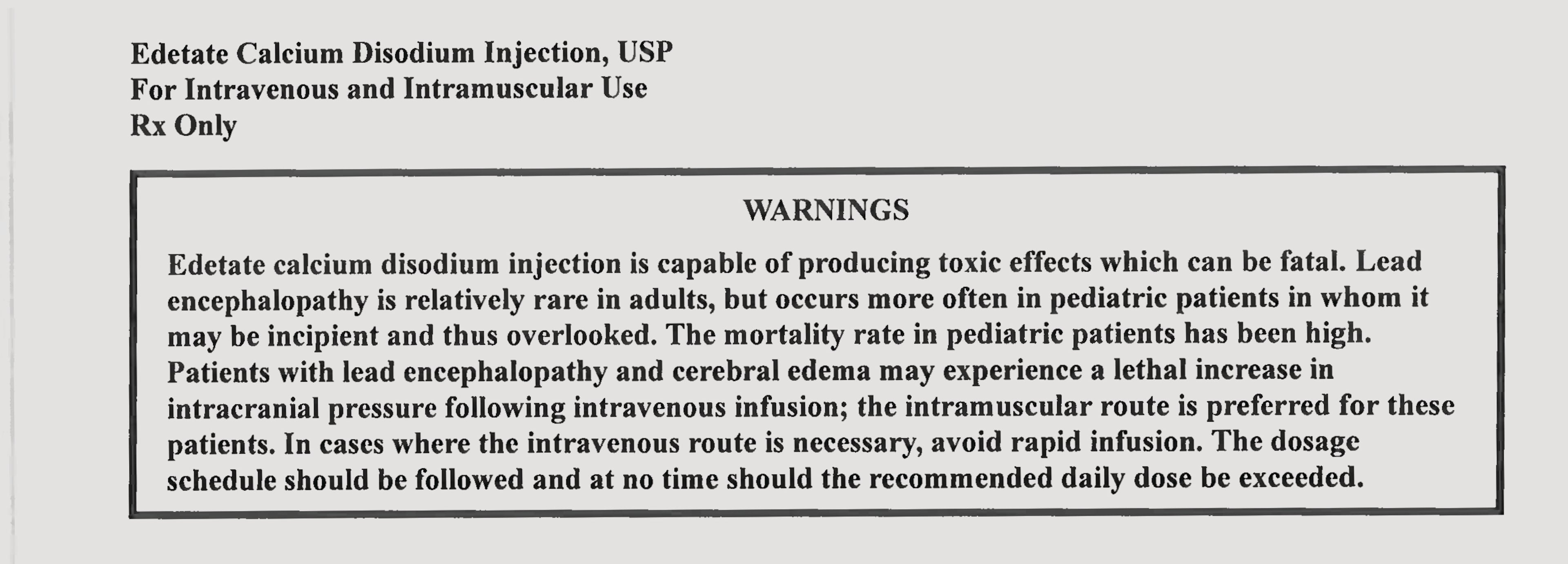
According to most experts, the determining factor for whether chelation should be administered is a blood test showing a lead level far beyond normal. For adults, that blood lead level is so rare that the Georgia Department of Public Health had reports of only 18 such cases in 2024.
Chelation without evidence of lead or other forms of heavy metal poisoning is “a treatment in search of a disease,” said Dr. Michael Kosnett, a medical toxicologist at the University of Colorado School of Public Health and a past president of the American College of Medical Toxicology.
“There’s no evidence that it’s effective,” he said. “And the very fact that you remove metal from the body by chelation doesn’t mean you’ve undone the harm and it doesn’t necessarily mean you’re going to improve the outcome in the future, with the exception of very severe poisonings.”
In using chelation as a general cure-all, Adams and Burkich are following a playbook widely accepted by practitioners of alternative medicine and, in interviews with The Atlanta Journal-Constitution, both made it clear they remain firmly in that camp.
Chelation therapy

A medical treatment that uses a prescription drug, EDTA, to remove heavy metals such as lead from the body. It is usually administered by a slow drip of IV infusions over the course of several hours on each visit.
Claims: It is widely touted by practitioners of alternative medicine as helping with Alzheimer’s, heart disease, Parkinson’s, cancer, fatigue — essentially whatever condition anyone may face, even for those who do not have high levels of metals.
Risks: Chelation can cause serious harm, including removing essential minerals the body needs, damaging kidneys and lowering blood calcium levels. The drop in calcium can lead to cardiac arrhythmia and death. There are also reports of headache, vomiting and pain.
Regulations: The FDA has not approved chelation for any condition other than heavy metal poisoning, typically documented by blood tests showing high concentrations. That typically means lead at a level seen only in cases of major exposure.
Red flag: Instead of using a blood test to check for heavy metal toxicity, being asked to take a provoked urine test, which experts say is not accurate.
According to Adams, even seemingly healthy people can benefit from chelation because they may have been harmed by aluminum from vaccines or exposure to lead when it was in gasoline.
“Getting those metals out makes the body work better,” he said. “It can fight better.”
Adams said he has undergone the procedure himself between 160 and 200 times, each time removing various metals that he contends affected his health.
Burkich offered a similar explanation. He said he believes the provoked urine tests are the “gold standard” and that repeated chelation treatments have allowed him to improve the health of his patients. In his own case, he said he has been chelated more than 300 times and benefited from it.
“People don’t come and sit for three to four hours with a needle in their arm because it’s fun,” he said. “That’s not why they do it. They do it because it gets them results.”
A devastating trial
For Adams, taking his case to trial put him in a particularly precarious position, as his practice was dissected in open court.
Testifying for the government, Dr. Travis Olives, a medical toxicologist from Minnesota, said he examined the medical records of 67 patients who visited Adams’ office and received chelation. None required the treatment, he testified.
The government also presented evidence that Adams had chelated at least five patients over 100 times each. One was a 68-year-old who was chelated 168 times over three years, resulting in Medicare payments to the doctor totaling $35,385.
When Adams was asked during a deposition why he’d chelated an 83-year-old female patient 36 times in 10 months, he replied: “Her call, she feels badly.”
Asked about a 63-year-old patient who’d been chelated 67 times after complaining of arm and neck pain, breathing problems, constipation and changes in mood, he noted that the patient was born in 1950 and therefore had driven a car when lead was in gasoline.
Although Burkich’s case didn’t go to trial, court records show he chelated a 69-year-old patient 286 times, a 74-year-old 207 times and a 79-year-old 188 times.
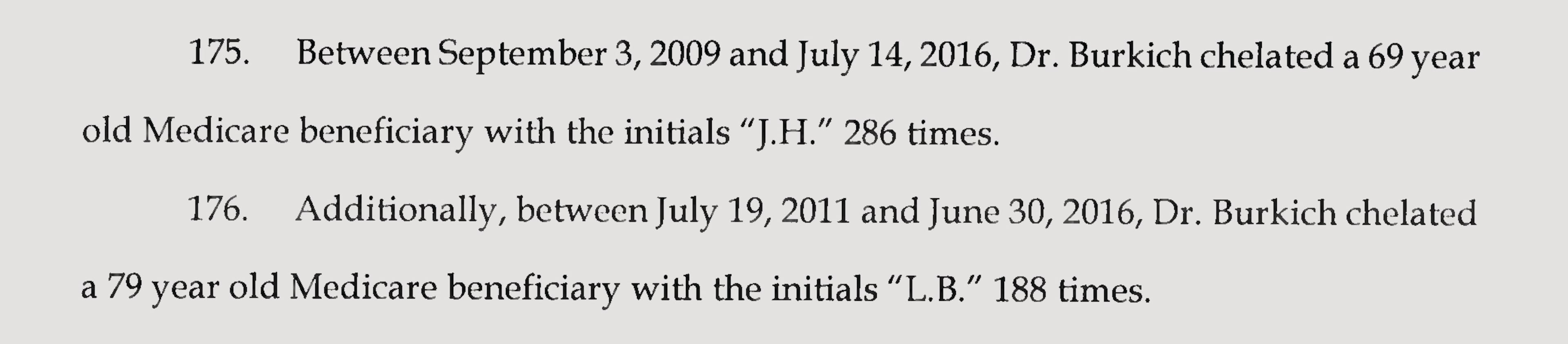
In depositions, Burkich testified that the things people routinely experience in daily life can make them candidates for chelation, even simply coming in contact with hair dye or makeup.
“I think if you’ve been around other people, then there’s a good chance you’ve been exposed to heavy metals,” he testified.
Asked about the guidelines for treating lead poisoning, Burkich testified: “This is left kind of loose. My feeling … is (it’s) a matter of looking at the patient, seeing, you know, as a physician you’ve been doing this a long time. You kind of get the … gestalt feel for it.”
Moving on
Even though in Georgia it’s a violation of medical board rules for physicians to fraudulently bill for services, neither Adams nor Burkich has been disciplined as a result of the government’s lawsuits.
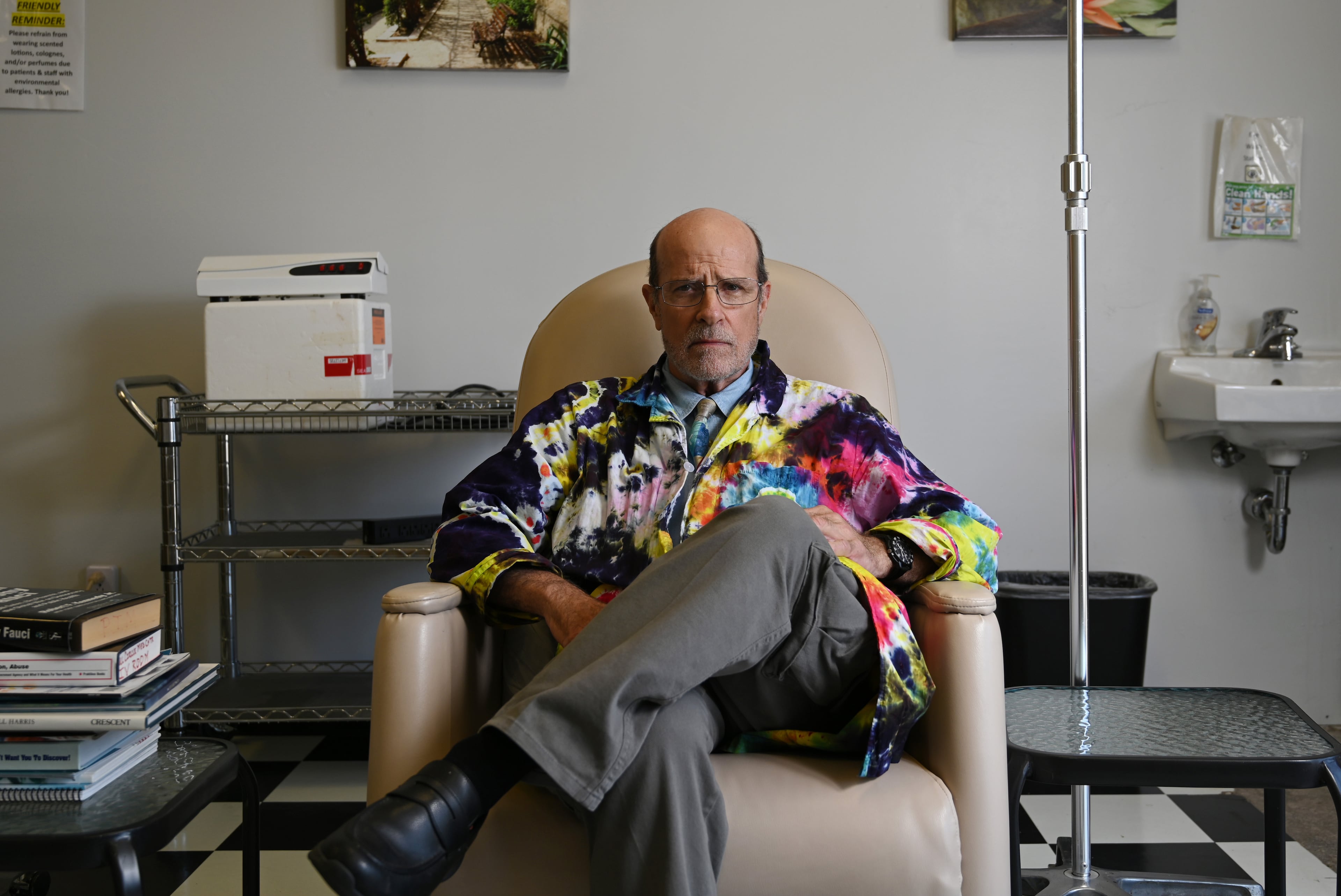
Today, Adams’ practice, Personal Integrative Medicine, is operating largely as it always has. In a large room with seven recliners and two rocking chairs, his patients receive chelation and other IV therapies, including the so-called “Myers’ Cocktail,” a mix of vitamins and minerals that, like chelation, isn’t approved by the FDA as a treatment for disease.
Still, he contends that his practice has suffered from the perception that he was criminally charged when, in fact, he was sued in civil court. The feds treated him as if were “a Mafioso,” he claims.
“All of a sudden, people are thinking, `He’s been scamming, skimming. He’s a criminal,’ even though there were no criminal charges,” he said. “That doesn’t help things.”
The judgment against him was affirmed by the U.S. Court of Appeals for the 11th Circuit in January. Meanwhile, the DOJ has initiated proceedings to garnish his bank and investment accounts.
Burkich has moved to Los Angeles and opened a practice in Beverly Hills. His Ringgold practice — Preventive Medicine, Anti-Aging and Chelation Therapy — remains open, and his daughter and son-in-law, both physicians, practice there, he said.
He said he agreed to a settlement, finalized in March 2025, not because of what happened when Adams went to trial, but because his case had reached a point where he didn’t see a better option.
“They more or less tried the case on social media, in the papers,” he said. “‘Doctor accused of Medicare fraud.’ How do you get a fair trial? … Sometimes the best thing to do is get the best outcome you can. It’s not so important to be right. It’s important to get the best outcome.”
Burkich, too, believes the government’s case cast him in an unfair light, making him look like someone harming patients when in his view just the opposite is true.
“I’ve been very disappointed with the legal system,” he said. “I’ve been very disappointed with the healthcare system. I mean, what happened to people doing for other people what they would want done for themselves? Why is that so complicated?”
About this investigation
Who’s watching out for patients in Georgia?
That was a driving question as reporters Carrie Teegardin and Danny Robbins set out to examine how the state was responding to practitioners touting unproven and disproven health treatments.
An initial step was to assess the extent of alternative medicine and “wellness” clinics across Georgia and learn who practices at them, what treatments they offer and what claims they make. Using web searches and public records, data analyst Phoebe Quinton compiled information on hundreds of such businesses.
The reporting team, led by editor Lois Norder, then researched the qualifications of the nearly 300 practitioners identified at the clinics, storefronts and mobile services. Was the provider really board certified? A bestselling author? A world-renowned cancer expert? Was the person pictured in the white coat and called “doctor” really a licensed physician?
That laid the groundwork for the next step: learning more about Georgia’s oversight of those businesses.
For that, the AJC relied on databases it created for all orders issued by the Georgia Composite Medical Board since 2018, malpractice verdicts and federal actions against doctors. The team also reviewed minutes of medical board meetings, medical licensing laws and board financial information.
That work raised the question of whether other states do more to protect patients and how they regulate alternative medicine. So the team studied medical practice laws in other states, actions by their medical boards involving alternative medicine and board orders for substandard care.
To gain a national assessment of medical board oversight, Quinton used the public file of the National Practitioner Data Bank to see how often the Georgia medical board imposed serious discipline compared with other states and how often the board imposed discipline of any kind on physicians with malpractice payouts.
Some of the most painstaking work involved the individual alternative medicine businesses highlighted in the series. The reporters relied not only on court and business records but also interviews with patients they identified, clinic owners and operators and public officials.