After Sarah: A devoted mother prepares her young family for life without her

It’s August 2025, and Sarah Eldridge wants to give her daughters certain lessons. She fires up the camera on her Mac laptop and, in her words, “yaps.” On this day, she tackles the wonders and dangers of the internet.
“I think that the internet can be an absolutely wonderful way to connect people, to learn new things,” she says, “but there’s also a lot of crap out there.” She encourages skepticism and tells her girls to seek out their dad with their questions. And she gives her husband of nine years a gentle jab. “Nobody knows everything,” she says, “as much as your dad sometimes likes to pretend that he does.”
Sarah and Steve’s daughters are 4 and 7. She talks to them in the video as if they are sitting with her at their kitchen table in Knoxville, Tenn., a microwave in the background, the girls’ art and toys spilling out of a nearby basket.
In this video, Sarah’s fingernails are painted purple from a recent home manicure with her daughters, Elena and Isabelle. At 41, Sarah sports a two-inch-long soft, spiked, punky hairdo. Silver patches poke through deep chestnut hair that, not long ago, bobbed in a ponytail on her long runs. She wears an oversize hoodie while the family cat, Lina, stirs in her lap; black ears and a tail pop up at the bottom of the frame.
“If you’re not paying for a product, either they’re trying to sell you something or, you, yourself, i.e., your data, are the product,” she says. Her sky-blue eyes, flecked with silver and hazel, narrow slightly, then relax. They’re intelligent and warm, but sharp at a glance.
“That’s maybe a little harsh,” she continues. “But I think it’s worth keeping in mind: Is something — a piece of media — trying to manipulate you?”
On the wall next to Sarah is a framed collage of family portraits taken when both girls were small enough to pick up in one arm. They were photographed in golden hour light, in a park near their home. In the pictures, Sarah wore an ash gray cardigan, her thick brunette hair shoulder-length; Elena, in a flowery dress, hugs her mom in one photo. Steve, in a trusty blue button down, beard closely trimmed, holds their youngest, Isabelle, who was not yet 2 at the time. They wear the blissful smiles of a young family with years of laughter and adventure ahead.

With those portraits looking down, Sarah asks her daughters to talk to family about what they see and do online. She warns of the dangers of AI, but encourages the kids to engage with information and communities online, and in the world.
Other instructional videos aim to help Elena and Isabelle navigate big feelings. In one, Sarah takes on sexual health, contraception and abortion, telling the girls that family members will help them get to a state with legal abortion, should they need one. Something stirs in Sarah as she speaks.
“I just don’t know, at this point, what the landscape is going to look like by the time you guys are of reproductive age,” she says. Her daughters will likely be adolescents before they watch this clip. The recordings cover existential fears of a world that Sarah won’t see.
Each is meant to start a conversation. When appropriate, Steve will show a video to the girls, and then talk about what Mom said. The recordings capture a piece of their mother, and what is important to her, in her voice. Sarah hopes that by discussing their feelings, her daughters’ connection to their father will deepen.
The videos will also help Sarah remain at the table after she’s gone.
The diagnosis
Sarah was diagnosed with triple negative metastatic breast cancer in spring 2024, after she discovered a lump in her right breast while she rubbed sunblock on before a swim. The biopsy, she says, left her breast feeling like “it had been slammed in a door.” She had a double mastectomy and then got an all clear. In late 2024, she returned to running and normal life with hopes for full remission. Pain returned in April 2025, and a scan revealed cancer had invaded bone in her right hip. Things were moving quickly. By late last summer, cancer had spread to a lung and then to her liver. Patients with Sarah’s diagnosis have an average life expectancy of two years. In early September, her oncologist estimated that she had three to six months to live.
Though she was once one of Knoxville’s top amateur athletes, she hung up her running shoes. As a German lit professor at the University of Tennessee-Knoxville, she planned to teach next spring. Instead, she handed her Ph.D. advisee to other professors at UT. She told me, using gallows humor, that she doesn’t want her academic reputation to conclude with, “My adviser died while I wrote my dissertation.”
She submitted a final journal article — it’s under peer review — and her colleagues celebrated the publication of her second academic book with a cake bearing the cover image. She also transferred bank accounts to Steve and canceled subscriptions to magazines and journals. God forbid an unpaid bill after she’s gone would ding Steve’s credit score.
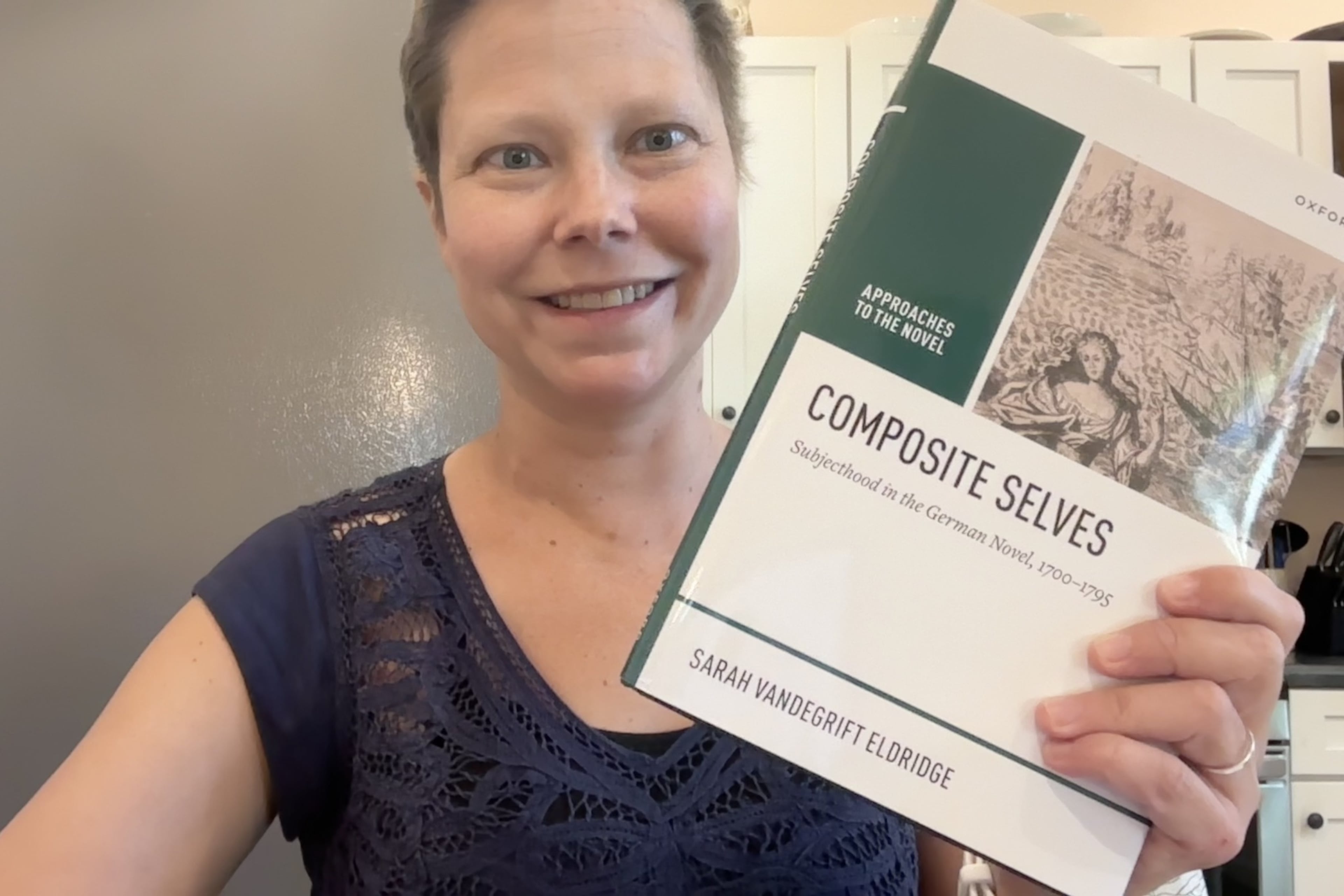
Life does not pause for bureaucracy. A cancer patient must handle the mundane as they wring out what’s left of their body, mind and human experience. Sarah spent late summer and fall curating her legacy, sharing joyful moments with her husband and children while cleaning out closets.
In a small ornate box, she collected keepsakes for Isabelle and Elena. She told her life story in a hardcover journal with 200 writing prompts. The introduction encouraged the writer to not hold back when answering questions, advice that Sarah, with her blunt, forthright style, didn’t really need. Her identical twin sister, Hannah, gave her the book. She and their brother Jonathan came to visit. Sunday dinners were spent with her parents in downtown Knoxville. And there’s the videos.
Sarah focused her messages on the children. But she didn’t want Steve to be alone — the subject of one such recording. And there is one video, she told me, that she couldn’t bear to watch.
Little experiences
It’s late August at the YMCA pool. Low 80s. Cumulus clouds cotton ball across the sky and cast patchy shade. A young couple, all abs and buns, sip drinks. A small girl dances under a fountain on a splash pad away from the eyes of her parents. Sarah wades into the water wearing a black one-piece, focused.
Her youngest, Isabelle, has ditched her water wings, but kept on the blue swimming mask. The child toes the edge above the 4-foot-deep marker while Sarah waits, arms outstretched, 3 feet away. “Jump in!” Isabelle hops, arms splayed upward, hits the water, and swims to Mom. Sarah holds the child a moment, then sends her to the pool ladder. Sarah moves a half step back. Jump, swim, rest. Over a half-hour, Sarah backs up 15 feet. It is play for Isabelle, but also swimming instruction.
Kids don’t comprehend how a parent’s body has changed. Most children think no further into the future than their next birthday. Sarah and Steve have been deliberate in how they approach her diagnosis with their daughters. As academics, they consulted with counselors and researched how to discuss death with kids. They told their girls that Mom is sick, but nothing of the end. Until then, they are filling time with experiences. Hopefully, their daughters will remember Sundays with Mom and Dad at the pool. Isabelle probably won’t recall fitting her tiny feet into her mom’s pair of Oofos flip-flops. Maybe they’ll remember the ice cream sandwiches.
“This is not an every-time-we-come-to-the-pool thing,” Sarah says as her daughters dig in. With a chocolate-smeared smile, Isabelle wraps herself in a towel and climbs up into her mom’s lap. Sarah holds Isabelle’s hand and cleans up her daughter with her other hand. When Sarah’s parents arrive, it’s time to show off for the grandparents. Isabelle slides off Sarah’s lap, flings the towel, pulls on her swimming mask, grabs her mom’s hand and tugs her toward the pool. Elena, done with her Neapolitan ice cream sandwich, runs after: “I’m coming!”
Building a life
Whether as a runner or an academic, Sarah has spent her life in training. In undergrad, she ran track at the University of Chicago, doing team workouts between classes. Later, at Princeton, faculty told her she wasn’t the star student — favorites there tended to be men, she says — but she earned her Ph.D. That work prepared her for an academic life with research, study grants, and tenure at Tennessee. In Knoxville, she became a sponsored runner. Both running and study plans provide structure, she says, with short-term targets toward larger goals.
In her early years at UT, she met Steve Johnston. A physicist living in Vancouver, Canada, Steve planned to work at UT and wanted to meet people in Knoxville beforehand. They connected on OK Cupid in 2014 and e-mailed each other over the months before his move. Steve’s profile was refreshing, Sarah says, mocking what single straight women know is typical in the East Tennessee dating pool: He wasn’t holding a dead deer or a fish in profile photos, and he wrote in full sentences. Steve learned in her messages that Sarah genuinely believed in the power of literature to cultivate empathy, help people think differently, and explore other parts of the world.
Through those emails they also got big questions about their values out of the way. Their political leanings aligned, both on the left. They weren’t churchgoers. They shared core values based on being good people, kind to all. Sarah showed Steve the importance of being socially active through the campus employee union. They found common ground in academia. Steve says Sarah got him to think about the greater university and the people who make it work, from janitors to the administration, broadening his scope beyond just his fellow nerds and experiments in the physics department.
When Steve came to Knoxville to apartment-hunt, Sarah showed him around the city, with its hundred-year-old homes, its revived downtown and breweries, the parks and greenways. They went for drinks a couple times, but Sarah cut dates short — saying that she had “calls from a friend.” Steve thought that was a backhanded way of ditching him, but she surprised him by making more plans. When he finally asked her about his confusion, she told Steve, bluntly, that she was actually helping friends in need and that if she didn’t want to go out with him, she would’ve said so.
Before long, he was sleeping at her place most nights. They dated for a couple years and decided to buy a house together, then got engaged. Sarah’s request: The ring should cost less than $300.
They married in the summer of 2016. Steve made Sarah want children for the first time. In 2018, Elena arrived, and Isabelle came three years later. Each parent earned tenure, ready to ride a career at Tennessee. That lasted for nearly a decade before cancer upended plans.

As they moved through their new reality, and Sarah began making videos for the kids, she explicitly told Steve that she does not want him to be alone. At 46, he should have decades ahead. They joked about how he might find another spouse. This, they agreed, is a sure thing: Steve could meet women simply by taking the girls to shop at Whole Foods.
“You can sort of see the moms, like, clocking him a bit,” Sarah says. She teases that anyone he meets will likely want another kid. “He’s like ‘Oh no,’” she told me. “It’s sort of a joke, it’s sort of awkward, but it is an expression of care for the person that you love, to be like, ‘I don’t want you to be alone forever just because I didn’t get to stick around.’”
When Steve asked her to make a video about him dating after she’s gone, she assumed the children would simply understand that he’s an adult and can do what he wants. “‘Oh, it’ll go without saying,’” she told him. No, he told her. I don’t think it will.
It was a tricky recording. As with the others, Sarah started with, “Hello, my darling girls …”
Sarah wanted to create space for her kids to feel their reactions to their dad dating. They’re entitled to their emotions. She asks them to not be “rude or disrespectful or unkind,” even if seeing Steve with someone else feels a little strange. Don’t “automatically dislike this person out of some sense of loyalty to me,” she tells them, “because that’s not at all how I feel about it.”
A companion holds your hand through life’s ups and downs, like Steve has done with Sarah. She wanted the same for Steve in the years to come.
“Of course, we seem old to you, I’m sure, but he’s hopefully got a lot of life ahead of him,” she tells the girls, “and I hope that he’s able to find someone to be a partner, to be a companion, maybe even to be a spouse in the way that he and I have been.”
Perhaps, if he remarries, Sarah says, closing the clip, “it will turn out that this person is another trusted adult whom you can go to, who will support you and who will love you.”
Always on the go
Sarah is barely flushed, light pink on her chest and cheeks, on a treadmill at Tennessee Sports Medicine. She retains the features of an endurance athlete, edges along her jawline and collarbones. She is light-footed, connected to the equipment by a pair of neoprene shorts zipped into a balloon around her waist that lifts her up and eases running’s impact on her hip bones.
Her pace is 9:30 per mile, a conversation pace. She is talking about Germany, where she did postdoctoral work and later studied as a Fulbright Scholar with Steve as newlyweds in 2016. She also ran her fastest half-marathon there.
That fall of 2016, Sarah, a rising star in the tiny world of academia in German literature, went overseas on the Fulbright to study travel writing from the 1700s at the Technical University of Dresden. Between research and time spent with Steve, Sarah found it hard to stay in peak running shape.
Dresden wasn’t her favorite place in Germany — she was more of a Berlin girl, with its gravitas and culture — but the city’s half-marathon in October 2016 became a high mark in her athletic career. The 13.1-mile race began on cobblestone streets in the city’s old town district, onward to neighborhoods with smooth asphalt, and then into a tunnel where her GPS watch lost connection. Her distance and pace figures were scrambled. She learned she was well ahead of her usual pace when she saw an official race clock near the finish. Bib number 22796 crossed the line at 1:28:45, smashing a personal record and placing ninth overall among women. She averaged 6:50 per mile.
Nearly a decade later, Sarah grins while recounting the best race of her life in a country she loves, which allows her to forget, for a while, her current situation: zipped into an Alter G treadmill as she holds on to what remains of her fitness.
Memories of that race are fun ones, she says. That version of her — young, sharp, recently married, fit and fast as hell — is how her work colleagues, running buddies, friends and family have come to know her. She is the pescatarian who loves to bake. An established academic with a promising career. Mother of two children with her sarcastic, smart and handsome husband. That version of Sarah does not square with the one who these days often walks, not runs.

Sometime in summer 2025, Sarah ran her last mile outdoors. She doesn’t remember exactly when, and admits, “oddly,” that she’s not upset by that. It’s her last race that’s memorable, a Thanksgiving Day turkey trot in 2024.
She posted a respectable 24:07 in the 5K, about 8 minutes a mile. But that’s not what she cherishes. That same day, Sarah did the kids’ run with Isabelle, one of her child’s first races.
Group support
Wrapped in a fleece jacket, Sarah sips white wine from a stemmed glass. She is in a Zoom meeting of the Metastatic Thrivers, a group of women who, like her, have the hardest form of breast cancer to treat. About a dozen join the call. Some, like Sarah, have young children. Others are older. They’re Black, white, Asian. Some are bald or wearing a hat or wig.
The moderator starts the meeting by reminding everyone that the gathering is a safe space. They are welcome to share, or listen, whatever works best for them.
Sarah notes the rare presence of a man, a journalist, who will listen but not disclose names or identifying details of the attendees. That spurs a conversation about how uncommon it is for men to have breast cancer. They agree they would welcome a guy who had it into the group.
It is October 2025, the days are getting shorter. And, for many of the women present, heavy. Statistically, most of them will die within a couple years. Their breast cancer lacks the three receptors that commonly cause cancer to grow and can be effectively targeted. For some, this could be their last Zoom meeting with the group.
One woman speaks about moving cross-country to the West Coast and maintaining access to treatment in a new place. Another from the mid-Atlantic says the effects of nearly 50 radiation sessions left her skin fried, and she’s allergic to the most effective creams to treat her discomfort. Others share what recent biopsies revealed.
Words and phrases like “unfair,” “Hail Mary,” and “one-in-20-worldwide” enter the chat. They commiserate over brain fog from chemo and painkillers. Some muse on the causes of cancer. Could it be the outcome of extreme stress? One woman says her cancer has spread to her brain. She got a craniotomy and is back at work while continuing treatment.
The women speak and listen with the familiarity of shared trauma. They reach into the far chambers of human empathy and explore corners of emotions beyond where mainstream discussions on cancer end.
Eventually, talk turns to new treatments. One woman says she is the first in the U.S. to join a clinical trial and drops a news release in the Zoom chat thread. Sarah, about to begin a clinical trial herself in Nashville, shares her prognosis from the oncologist. Time is short.
“I’m really hung up right now on the difference between three to six months,” she says. “Like, three months is dead before Christmas. Six months, I make it through not only Christmas, but also my younger daughter’s 5th birthday. I’d like to be there for that.”

When some chime in to say their doctors had been cautiously optimistic about treatments, Sarah brushes that aside. Her cancer has been so atypical that she doesn’t know what “cautiously optimistic” even means anymore. “Like, nothing has worked on it,” she says, frustrated. “So will this work? It feels really unfair.” She pauses, crunches her eyebrows. “Yeah, and you sort of exist in these two spaces at once, right?”
In one space, she’s preparing to leave. Canceling subscriptions, transferring accounts to her husband.
“I don’t want to say, ‘as easy on my family as possible,’ because I have accepted that there’s no way that this will be easy for my husband and my two young kids and my parents, any of this. But, you know, I got to try to get things ready so as not to make it worse.”
In the other space, she’s still in treatment.
“We’re still trying new things, right?” Sarah is one of only 100 patients in the trial. That makes her an outlier in the cancer world. One more distinction.
Sarah nods knowingly when a woman talks about her kids’ confusion when she was on bed rest and someone other than “Mom” took them to day care.
They turn to patient advocacy. A woman from Canada says that cancer diagnoses there fall into two buckets: A curative stage, for treatment, and a palliative stage for comfort at the end-of-life. The woman rejected the palliative stage that doctors tried to assign. When she needed a biopsy after her cancer returned, she was scheduled for one in a couple months. That can be a death sentence for triple-negative diagnoses. Instead, she showed up at a hospital the following day and wore them down. She got a biopsy the following week. The story grabs Sarah.
“Learning to selectively be a pain in the ass is a hugely important part of cancer treatment!” Sarah writes in the meeting’s chat thread.
She continues listening and sips wine. The woman who advocated for herself thanks everyone for letting her share. Sarah clicks a reaction that sends hearts floating up the screen.
After an hour or so, Sarah’s girls bounce into the frame with giggles and cuddles and climb up on her. Others on the call smile at the tender scene. Sarah hugs her girls, one at a time, kisses each on top of the head. Got to go, she tells the group. Bedtime. Time to tuck the kids in, time to go be a mom.
Showing up
Doe-eyed optimistic jargon around cancer bothers Sarah. She’s not a warrior, and she’s not on a journey. In September, at the small shop in the cancer ward at UT Medical Center, she ignores corny signs with inspirational babble and walks past the Bible quotes printed on T-shirts and oversize mugs. She and her family aren’t religious, though her girls attended a local Jewish preschool.
Sarah is OK with the idea that people might be praying for her, though.
“It feels like a form of care, right?” she says. “Like it may not be my belief system, but it’s also the case that nearly everybody who tells me that they’re praying for me is also doing other stuff, right? It’s not just thoughts and prayers. It’s, you know, thoughts and prayers and showing up.”
And “showing up” manifests in unique ways. One evening when Sarah says she’ll heat up dinner, Isabelle walks out to the porch, where friends drop off prepared dishes, to look for the meal.
“That, to me, is like, honestly, the perfect illustration of how well our friends and family have supported us,” Sarah says. “My 4-year-old thought dinner came from the porch, not from the kitchen.”
Some people have ghosted her — including the nanny who has been there since Elena was born. Sarah teaches her girls that there is dignity in all work, whatever form it takes. Day care workers and nannies are special. She and Steve pay when they cancel babysitting plans last minute. In that spirit of respect, Sarah had to tell their nanny about the diagnosis.
With the girls inside the house taking a German lesson, Sarah pulls the nanny outside to talk. The cancer is back and it’s terminal, she tells the middle-aged woman. The nanny begins to cry. Though Sarah has politely declined offers from others to pray over her, the nanny powers through. She raises her hands over Sarah, asks for mercy, and for the Holy Spirit to be alive in her treatment. Sarah, wide-eyed, has no choice but to let it happen.
In the weeks afterward, the nanny says she is too busy for the family. Sarah asks about her availability ahead of the school year. Will she be around to pick up Elena from school four days a week, like before? Excuses.
Eventually Sarah asks if she can be the reliable, stable presence her daughters need.
The woman tells Sarah she’s “too sensitive” to be with the girls four days a week with “your cancer situation.”
“I was just like, what in the actual f--- ?” Sarah says, recalling the moment. “Even if that’s true, don’t tell me that. Just tell me that you couldn’t get the hours.”
Elena sobbed when her parents told her that the nanny wouldn’t be taking care of her anymore.
The bright side, if any, is that the nanny left before Sarah’s cancer worsened, and they could line up someone else. Even so, Sarah couldn’t tell Elena the full reason why the nanny was gone. Because of cancer. Because of the long odds against Sarah living. Because some people just aren’t equipped to handle every situation. Perhaps the nanny had some personal trauma around cancer. Maybe she decided she wasn’t strong enough to watch someone die. The family won’t know. But, as well-meaning people sometimes do, the nanny managed to unintentionally give Sarah one more round of hell.
Oh, and I meant to ask you how you were doing, she texted one day. Because, you know, when I prayed over you, you went from pale … to tan and glowing. And I could just, I could just see it working.
Sarah’s body was breaking down, hurting in places that it shouldn’t for a 41-year-old. Now this indignity. This woman who they thought they knew, just created her own reality.
“Oh my God,’” Sarah said, reading the messages. This was her reply.
Look, I want to be really respectful of your belief system, but one of the things that’s really hard about this for me is that it doesn’t really actually matter what I look like, or feel like. I’m dying anyway, right?
Sarah says they texted a few more times, but the relationship faded away.
Working it all out
In late October at Tennessee Sports Medicine, Sarah receives a massage from athletic trainer Stephanie Smedley. She rubs salve along Sarah’s left obliques and asks about the last few days.
Sarah’s siblings are visiting. Her sister Hannah tidied up the house. They took her wedding dress to be cleaned and stored. Her daughters will like that, Sarah says. They went through her closet, filled up four bags for Goodwill. Then Hannah eyed the linen closet. Sarah told her sister to go for it.

The trainer and patient share a chummy rapport. When Sarah had knee surgery for a torn meniscus in her running prime, Stephanie helped her back on her feet. Stephanie will do that again, today.
They chat along. And at one point Stephanie pauses, carefully choosing words. “Is it hard trying to stay objective about everything?” she asks, “trying to think about things logically?”
It varies, Sarah says. She takes it day-to-day. The last couple of weeks were tough, handling “predeath bureaucracy.” She negotiated the Knox County Clerk’s Office paperwork to assign her car title to Steve. She is torn between doing work to make her departure easy on the family and “burying my head in the sand.”
Sarah doesn’t want to think, all of the time, about dying. She lightens up. “Hopefully, the vast majority of people, they’re not dying as fast as I am right now.”
Her siblings, psychotherapy and physical therapy all help. Pain meds and the antidepressant Lexapro let her function. But Sarah knows where it is.
“I think about it like there’s always a box in the back of my mind,” she says. “But I don’t always have to take it out and look at it.”
This creates “a weird bifurcation, to be, like, trotting about my daily life as though everything’s normal and, like, it’s not.”
She wants to keep her body functional. She hopes the trial will extend her run.
Stephanie asks if Sarah wants to jog.
“Weirdly, I’m just not feeling it today,” she says.
Training for races, Sarah could count on warming up and feeling better about running after a couple miles. But training-tired and cancer-tired are not the same. Even so, Stephanie has plans to get Sarah’s heart rate up with intervals. Sarah slides off the table.
Stephanie has Sarah do three rounds of three exercises. For the first movement, she grabs the flat side of a half yoga ball, round side on the floor, and slides her feet front and back behind her, alternating legs. She takes a short break and does lunges for a minute. Then 60 seconds of kettlebell swings. In the second round, Sarah labors. Movements shorten. In the third set, over the yoga ball, Stephanie encourages Sarah to keep form. After a minute, Sarah stands up, red-faced. This used to be easy. She looks to the ceiling, gulps air, exhales, looks down.
“I’m pathetic,” she says. Shoulders slouch. Arms drop. Stephanie steps into Sarah’s personal space, squares her up.
“Hey!” Stephanie says, between a bark and a chirp. “Look at me.” Sarah sets her pale eyes on the trainer. “You’re not pathetic. You’re killing it. OK? This is hard. It doesn’t matter who you are.” Sarah lets Stephanie in, and snaps out of it.
Sarah did 41 reps in that minute, one every 1.4 seconds.
Saying goodbye
“Hello, my darling girls …” Sarah says. She looks into the camera, the familiar background of the family kitchen behind her. This video, like the others, doesn’t follow a script. Unlike the others, it is more of a message than a lesson. It is the video she can’t bear to watch.
She wears a headwrap, bluish gray. Her hoodie, also blue, accentuates her eyes as she connects to her girls. Those eyes look tired, resigned to the inevitability of what doctors say is coming.
“Being your mom has been the privilege and the absolute joy of my life. It breaks my heart that I won’t get to stick around and see who you grow up to become. I know it’s going to be wonderful,” she says. “You’re wonderful already.”

Ever the educator, Sarah hoped to show her girls the world. To give them a sense of social justice and teach them about the damages of white supremacy and the patriarchy. “So many more things I can’t even think of right now,” she says, lifting her brows. “You know, none of those things were ever meant to be a single conversation or something I can do in one fell swoop.”
It’s impossible to pack her dreams for their lives into a 6-minute video.
“I guess all I can say is, stay curious.” She is not on the verge of tears, as one might imagine. Her eyes are wide with feeling. She speaks as though she’s run through these words a thousand times in her mind, to conjure the world where she wants her children to grow up.
She encourages them to use their imaginations and play. Look around and make friends in school, in the neighborhood and in the community. Sarah asks them to pursue good acts that they can do for people who are less fortunate or in circumstances beyond their control. She adds her hopes for the girls: that they will love to read, travel the world and see different cultures.
“I hope that you have love in your lives, no matter what that looks like,” she says, wishing for them both to have partners, and marriages — if they want — and a tight community of friends. She hopes they both have people who they can care for.
She addresses them individually. Elena, her “brilliant, loving, smart girl.” Sarah reminds her that not everything has to be perfect, “Let your bike go fast without making it stop.” It’s OK to fall down. “Sometimes you’ll pick yourself back up. You’re strong. I know you can do it. I have faith in you.”
Isabelle, “my sweet, affectionate, silly wild child.” Sarah doesn’t say the word, but shows a wince of regret. She apologizes to Isabelle for not having as much time with her. “I know it’s hard to be the youngest sometimes,” she says. “I want you to know that you are always worthy of love and attention, even when you’re not being silly.”
Your dad will always be there for you, she tells them, even when you disagree with him. Trust him. Aunts and uncles will teach you about art. You’ll travel to your dad’s home country of Canada. When you approach adolescence and womanhood, Aunt Hannah can guide you. There are “so many other people around the country and around the world who are going to look out for you and make sure that you’re OK,” she says.
“And I know that when I die, it’s going to be really sad.” Sarah pauses a beat. “And there’s nothing I can do to make that not be sad.” But, she reminds them, “it’s also OK to not be sad all the time.” Do not feel guilty about being happy, she says. Her voice cracks. “It’s OK to find moments … that are funny, moments of joy.”
“I just wish I could be there, to be there with you. I love you so much.”
Her love is never going away.
Postscript: Sarah died on Jan. 2, 2026, surrounded by family. A memorial scholarship created in her honor at UT hit a $25,000 endowment goal within a week. To learn more, and donate: https://giving.utk.edu/sarahveldridge.
About 200 people attended her Jan. 11 memorial service, and those who couldn’t make it in person sent notes to memorialize her. The service was held at the Communications Workers of America Local 3821 union hall, with plenty of snacks — two facts that would have brought her joy.
Gerald Witt is a journalist based in Knoxville, Tennessee. He spent August to December reporting this story, observing Sarah with co-workers at UT, during family time, and with her medical team. He sat with Sarah during chemo treatments and on Zoom calls and walked miles with her in her Knoxville neighborhood. She allowed him to see the videos she recorded for her daughters. Gerald is at work on a master’s degree in narrative nonfiction at the University of Georgia’s Grady College of Journalism and Mass Communication. Contact Gerald at gwittnews@gmail.com.

