For Georgia pre-K, 3-year-olds could be the next frontier


Georgia’s pre-K program was recently lauded as being one of the best and most far-reaching in the nation. One thing it’s missing: 3-year-olds.
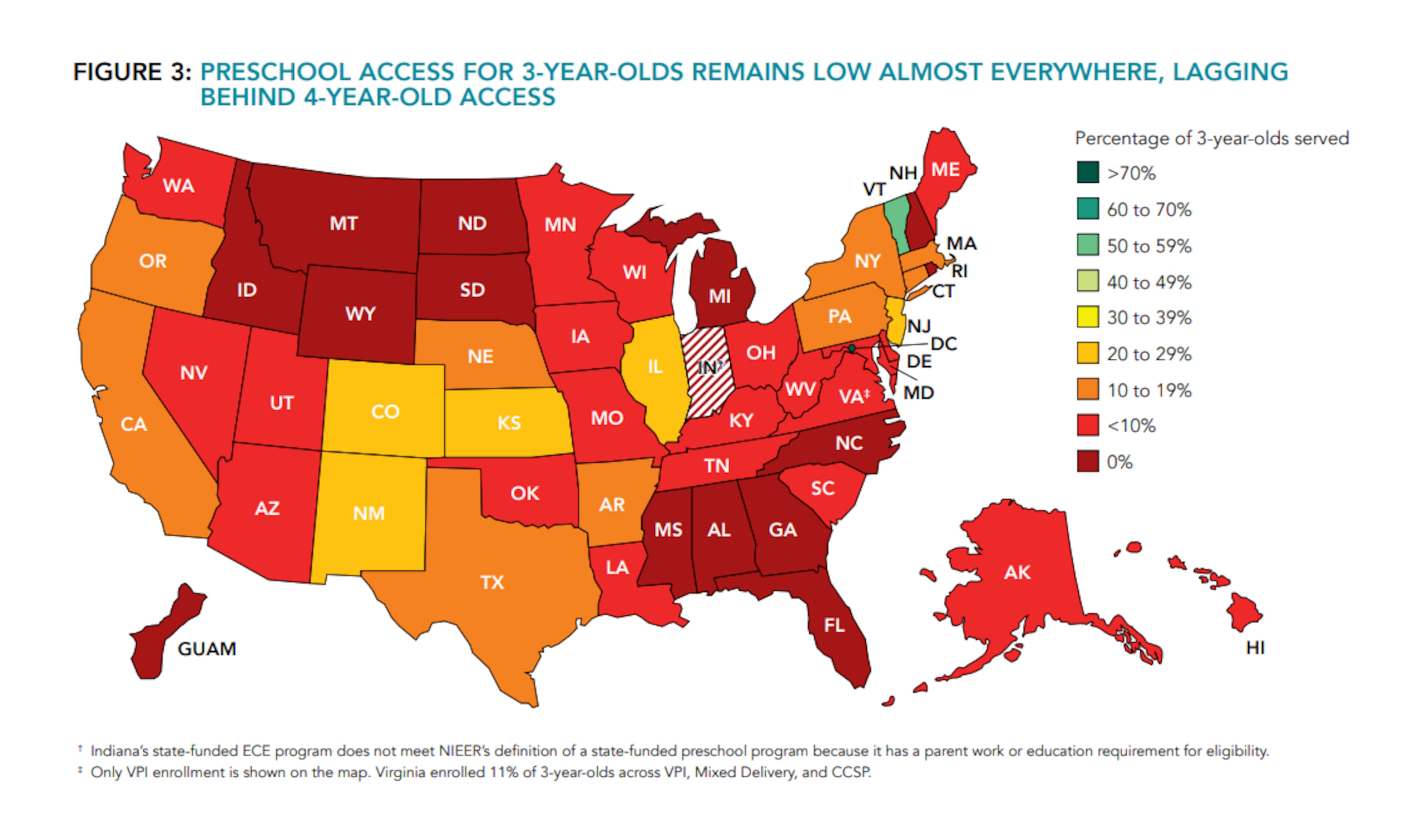
The state-funded preschool program has been around for 34 years. It gives all 4-year-olds in the state free access to pre-K, but serves zero 3-year-olds.
Some early-education advocates are hopeful for a change. Research shows pre-K can improve academic outcomes for students and help the economy by keeping parents in the workforce.
Amy Jacobs, the Georgia Department of Early Care and Learning commissioner, said expanding to 3-year-olds is always the dream.
“If the governor and the Legislature and the policymakers see fit to find the funding for it, we’re ready to go,” she said. “We think we have the perfect model for it.”

About 53% of the state’s 4-year-olds, or about 70,500, are enrolled in a state-funded program, according to the most recent data from the National Institute for Early Education Research, which studies state programs. Families can choose to go to a public school or a private provider for pre-K, depending on space.
Georgia ranks 10th in the nation for pre-K access for 4-year-olds, but is one of the worst states for access for 3-year-olds. Nationally, 9% of 3-year-olds are served by state-funded pre-K programs.
Infant and toddler care costly for many families
Free childcare options for infants and toddlers are few in Georgia. Federal funding largely supports about 4.600 students who attend Early Head Start between ages 0-3, or nearly 10,000 who start receiving special education services at age 3 or 4.
But the biggest bucket of funding is the Children and Parents Services Program, known as CAPS. It provides childcare scholarships to low-income families — but the combined state and federal funding falls far short of the need in Georgia. Only 7% of eligible children in the state receive the funding help, according to the Georgia Early Education Alliance for Ready Students. This year, the state has budgeted about $460 million for the program.

Childcare for infants and toddlers has long been a financial strain for families. In metro Atlanta, the average cost of infant care is close to $13,000 per year for one child. Tuition for infants exceeds the cost of in-state tuition at a four-year public college.
But providers say they are feeling the financial strain, too.
More than 40% of the state’s childcare programs report they expect to raise tuition in the next year, according to a survey released this month by Quality Care for Children. The organization supports providers and helps connect families to resources to pay for childcare. It surveyed almost 600 providers in the state, most of which cited food costs as a growing financial pressure.
Additionally, half the childcare programs in the survey report they aren’t able to meet the demand for infant and toddler care.
“There’s not enough money to really offset the inflation for families and for childcare providers,” said Ellyn Cochran, the president and CEO of Quality Care for Children. “Providers at this level aren’t able to charge the full cost of quality to all their families. … They end up charging what families can afford, not what it costs.”
More access for 3-year-olds still a long way off
An influx of state funding could help ease the strain for families and providers. Early education experts at the state and national levels say families and children in Georgia could benefit from it.
Some lawmakers think so, too: The bipartisan 2024 Senate Study Committee on Access to Affordable Child Care recommended that state officials consider expanding pre-K access to 3-year-olds.

Access to pre-K is a predictor of academic and future success. Further, a NIEER study of New Jersey’s pre-K program found students who started attending the state-funded program at age 3 had roughly twice the achievement gains as students who started at 4.
The potential academic benefits are a large part of why some public school systems in metro Atlanta have said they’re interested in adding more classes for 3-year-olds. But those offerings are likely years away.
The Georgia Lottery funds the state’s pre-K program. GEEARS recommends using that same funding source to expand access to 3-year-olds. The state spent roughly $580 million on its pre-K program this year.
GEEARS suggests Georgia take a phased approach to pre-K for 3-year-olds by first targeting high-needs communities, like those with low reading proficiency.
This would “promote kindergarten readiness, help alleviate many of the challenges families face affording early care and learning, and support parents’ participation in the workforce,” the organization said.
Cochran, who often meets with lawmakers to discuss access to childcare in the state, said she hasn’t heard much about expanding pre-K to 3-year-olds. The Atlanta Journal-Constitution asked the governor’s office about any interest in the idea, but did not receive a response by publication time.
But it’s a conversation that isn’t likely to go away, said NIEER founder and senior director W. Steven Barnett.
“We are seeing more of it,” he said. “We really hope that Georgia moves in that direction as well.”
