‘Serial Killer: The Exhibition’ at Pullman Yards explores human depravity

Jack the Ripper. “The Butcher of Plainfield.” Ted Bundy. John Wayne Gacy. Jeffrey Dahmer.
These are just five of 150 murderers featured in the sprawling new “Serial Killer: The Exhibition” at Pullman Yards in Kirkwood. After visits to Berlin, Paris and London, this exhibit’s first North American stop is Atlanta.
The producers, who hail from Italy, have attempted to allay fears they are glorifying the killers. “The exhibition maintains a strictly documentary, museum-based approach throughout, prioritizing historical context, evidence and expert analysis over shock, fiction or dramatization,” a news release notes.
The exhibition, recommended for people over 14, is a self-guided tour that takes about two hours. Tickets start at $40 through FeverUp.com. It will be open at least through early April but may run longer depending on demand.

It highlights serial killers from 25 countries in 42 dimly lit, shadow-filled rooms. Each is thematic, with titles of “Lust, Domination and Control,” “Killing for Profit,” “Killer Couples” and “Cannibal Killers.”
Killers are typically featured with their haunting black-and-white mug shots and highlights of their exploits below. Many have nicknames generated by the tabloid press over the years: “The Vampire of Paris.” “The Butcher of Montreal.” “The Trash Bag Killer.” “The Southside Slayer.”
There is Armin Meiwes’ actual freezer where he would keep human body parts, and a replica of a mannequin covered in human skin from Ed Gein, who inspired fictional film characters Norman Bates (“Psycho”), Leatherface (“The Texas Chainsaw Massacre”) and Buffalo Bill (“The Silence of the Lambs’).
But the exhibition avoids flashy animatronics or macabre interactive displays.
“You learn about the forensics, the legal aspects, the trials,” said Bill Kimberlin, a Florida-based clinical psychologist and consultant for the exhibition who has spent 30 years talking to death row inmates.
He was one of 60 international collectors, historians, criminologists and forensic specialists who helped put the exhibition together over the past decade.

John Borowski, a documentarian who specializes in serial killers and released a 2024 eight-part series on Gacy on Tubi and Amazon, was one of those 60, and he was on hand for the opening media event.
“I am happy they spent a lot of time focused on the victims,” he said. “Each room that talks about the killers includes a victims list. And at the end of the tour, there’s a wall honoring the victims.”
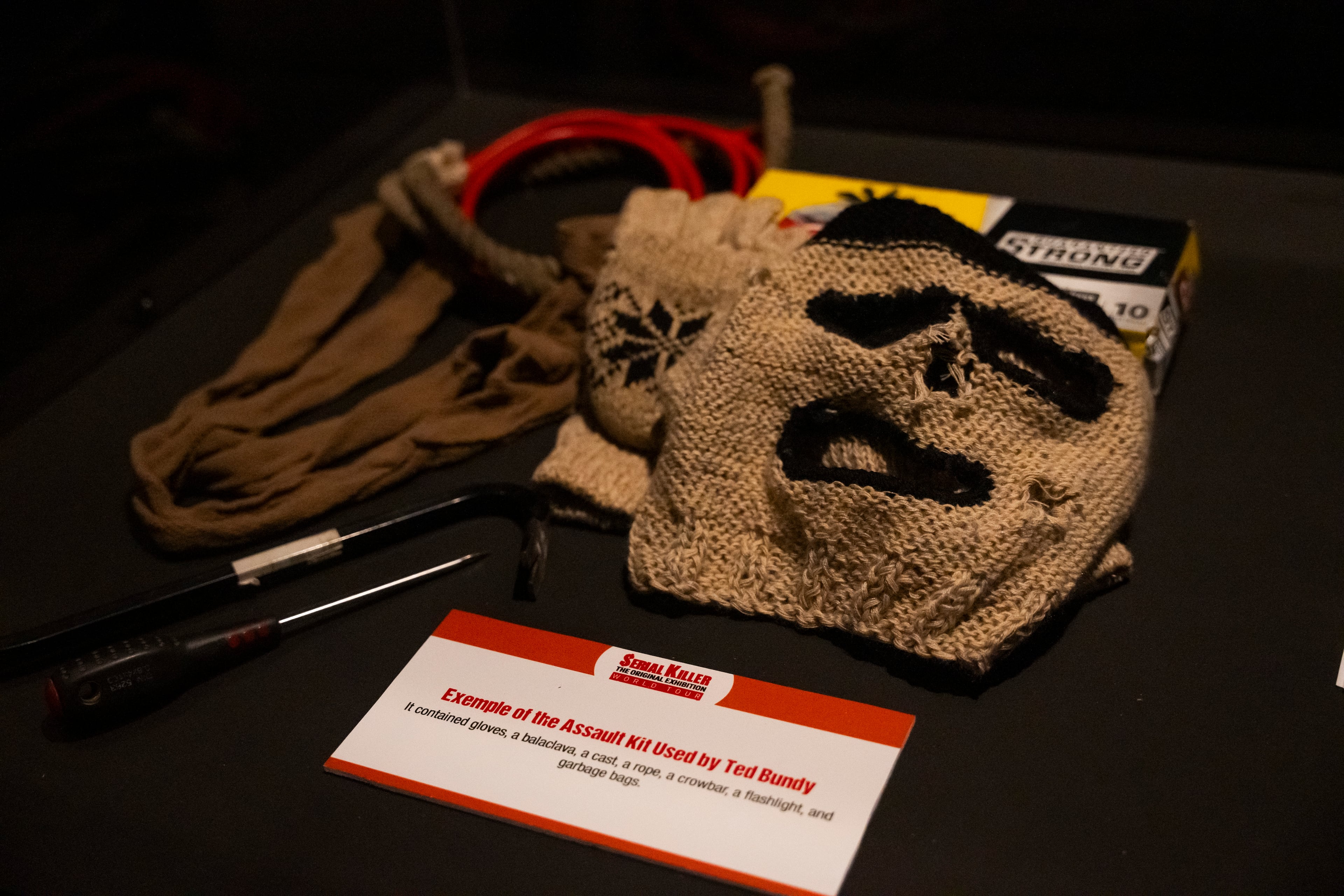
Kimberlin lent the exhibit nearly 200 items from death row inmates, such as letters and artwork. In all, the exhibit features more than 2,100 original artifacts, including Bundy’s dental mold, Gacy’s typewriter, Bob Berdella’s bone saw and Richard Chase’s dead rat he sent to the FBI.
“It’s easy to forget they are human beings,” Kimberlin said. “They don’t have scales or horns. It’s our job as a society to learn why they’re doing these things and hopefully prevent them in the future.”
Although a vast majority of the killers featured are white men, there are women and people of color in the mix.
And America has more documented serial killers than any other country. An entire room is devoted to dozens of them, an inordinate number who murdered in Ohio and Florida. “It’s the I-75 corridor between the two states,” Kimberlin said. “It’s easy to pick up victims and dump them off.”

Some serial killers go back centuries, such as the 16th-century Hungarian countess Elizabeth Bathory who killed dozens of girls, and Jesse Pomeroy, who butchered numerous young boys in the early 1870s. The rise of newspapers helped make British serial killer Jack the Ripper a worldwide name in the 1880s, Kimberlin said.
The term “serial killer” actually became popularized in media only after FBI profiler Robert Ressler coined it in the 1970s.
The prevalence of serial killers appeared to peak in the 1980s, based on FBI data, falling off sharply over the past 20 years, replaced by gun-toting mass murderers.
Kimberlin cites better forensic technology, surveillance cameras and GPS tracking. “It’s too difficult for them to stay undetected,” he said.
The most notorious serial killer case in Atlanta history was the child murders from 1979 to 1981. Currently, Wayne Williams is serving two life sentences for the murder of two adults but has never confessed to killing any children.

As a result, the exhibit chose not to highlight Williams or aggrandize the case. Instead, there is just one display briefly describing the crimes.
“We are in Atlanta, and we wanted to be sensitive to the victims’ families,” Kimberlin said.
IF YOU GO
“Serial Killer: The Exhibition”
10 a.m. with last entry at 7 p.m. on weekdays, 8 p.m. on weekends Wednesday-Sunday. $40 on weekdays, $45 on weekends. Pullman Yards, 225 Rogers St. NE, Atlanta, www.feverup.com
About the Author

Rodney Ho writes about entertainment for The Atlanta Journal-Constitution including TV, radio, film, comedy and all things in between. A native New Yorker, he has covered education at The Virginian-Pilot, small business for The Wall Street Journal and a host of beats at the AJC over 20-plus years. He loves tennis, pop culture & seeing live events.