RECIPES: Dig up new ways to bring root vegetables into spotlight
Root vegetables are superstars in the plant-forward movement and root-to-stem cooking. In season late fall through the winter months, root veggies are perfect for comforting dishes on cold winter nights. Beneath their less than glamorous exterior, they are surprisingly sweet when harvested small and young and are packed with earthy, rich flavors when older. Although versatile, inexpensive, and packed full of healthful benefits, root vegetables often wind up on the plate as a “same-old” side dish. It’s time to dig a little deeper with what they can do.
These underground treasures form the backbone of many favorite winter soups and stews. In high heat, their natural sugars caramelize, resulting in tender sweet nuggets, practically nature’s candy. They can be served hot, warm or cold and respond to a wide variety of culinary techniques. Root vegetables can be braised, roasted, stewed, fried, mashed, grilled and even served raw. While roasted root vegetables are a definite go-to this time of year, there’s so much more that can be done with them.
What we most often think of as a root vegetable comes from the taproot of a plant. A taproot is the primary underground root system of a plant. These vegetables include turnips, radishes, beets, carrots and parsnips.
However, in horticulture, there is no shortage of confusing terms. Specifics like bulb, corm, tuber, tuberous root, rhizome and taproot can be especially confusing, even for green-thumbed experts. Not all vegetables that grow underground are technically roots. Some are bulbs like fennel, onions and garlic. There are also rhizomes like ginger and turmeric, and corms such as celery root and water chestnuts. The underground scene of tubers versus tuberous roots is even more complicated. Tuberous roots and tubers (yes, they are different) include sweet potatoes, yucca, potatoes and yams.
Culinarily speaking, taproots are what we most think of when we use the term root vegetables — with incorrectly identified potatoes and sweet potatoes tossed into the vegetable bin for good measure.
No matter what you call them, vegetables that grow underground absorb nutrients from the soil to feed the plant in colder months. When we eat the roots, we are consuming the nutrients meant for the plant. Many root vegetables are also high in fiber, and some are members of the brassica family, an amazingly diverse group of vegetables that’s well-known for containing cancer-fighting antioxidant nutrients that help boost the immune system.
That’s not to say that root vegetables don’t have any dietary detractions. Some root vegetables are starchy and high in carbohydrates like potatoes. If you are trying to limit your carbs due to a health condition or trying to limit weight gain, you will need to take that into consideration. However, when you get to the root of the matter, they are not always to blame! We’re more likely to top spuds with bacon and sour cream; bathe carrots with butter and honey; and simmer turnip roots and greens with a hunk of salt pork or fat back. As the saying goes, “all things in moderation.”
And, if you “eat with the seasons,” you are more likely to benefit from their higher nutritional value and peak flavor. So grab some knobby, gnarly root vegetables and shake up your winter side dish repertoire with these recipes.
Virginia Willis is an Atlanta-based Food Network Kitchen chef, James Beard Award-winning food writer and author of seven cookbooks. Follow her at virginiawillis.com.
RECIPES
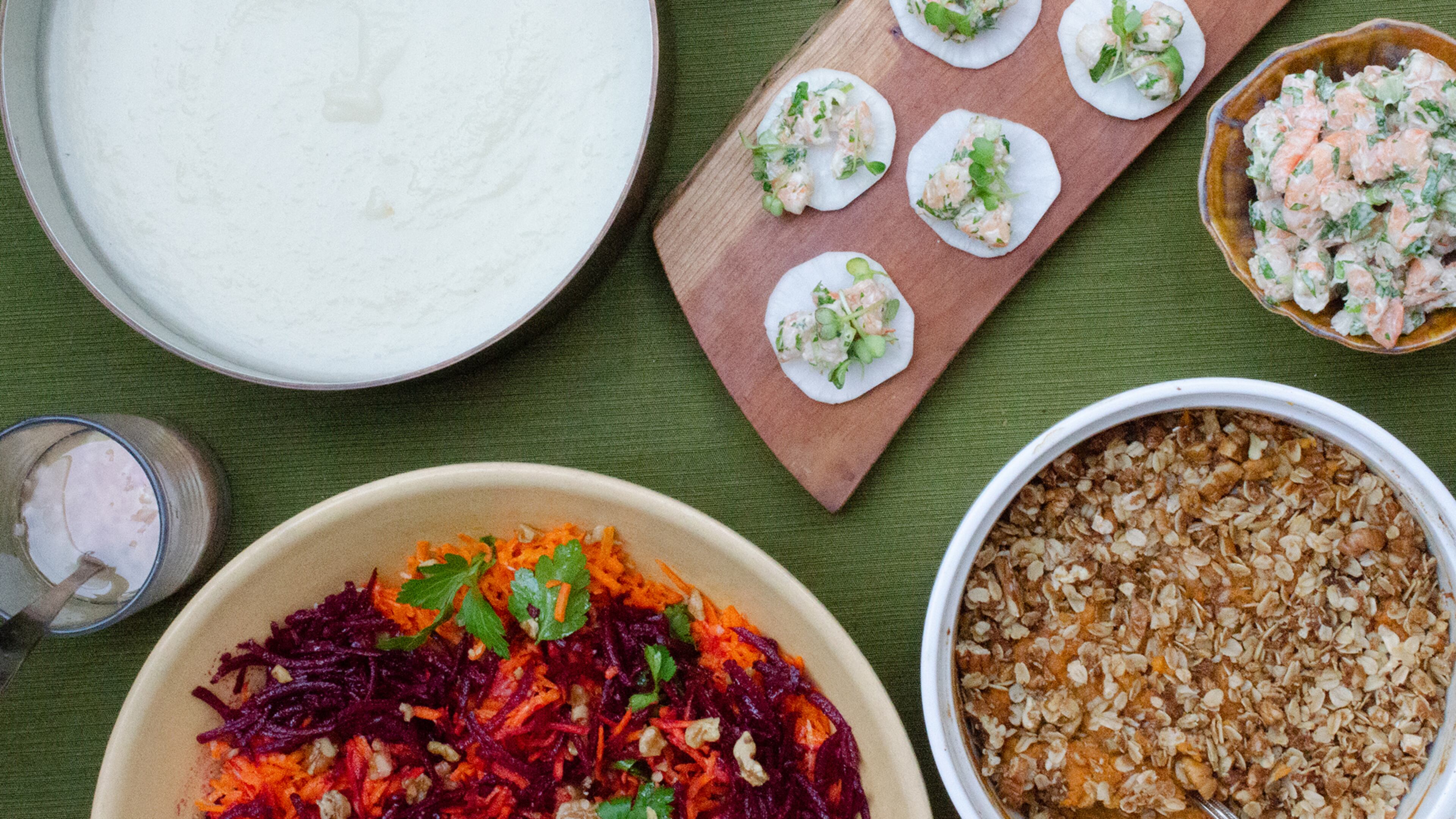
Root vegetables are in the spotlight, not on the side, with recipes for Daikon “Crostini” with Shrimp Salad, Turnip Soup with Chive Cream, Carrot and Beet Salad with Lemon Vinaigrette, and Sweet Potato Crisp.

Daikon “Crostini” with Shrimp Salad
Typically, boiled shrimp are cooked in a seasoned liquid then drained and rinsed under cold running water, effectively washing away some of the flavor. If you have time, a better way is to chill them in a portion of the flavorful cooking liquid, as outlined in this recipe. If time doesn’t permit, simply start with precooked shrimp.
Daikon is the Japanese name of the vegetable (from dai, meaning “large,” and kon, meaning “root”). In Asia, there are many different types of daikon, but we are most familiar with the long, white tubular root. A type of radish, daikon has a crisp texture with a slightly peppery bite. It works well in salads and slaws, and is often made into a quick pickle. Thinly sliced daikon makes for a great gluten-free vehicle for spreads and dips as with this shrimp salad “crostini.”
- 12 cups water
- 1 carrot, coarsely chopped
- 1 lemon, halved
- 1 onion, halved
- 2 bay leaves, preferably fresh
- 1 tablespoon coarse kosher salt, plus more to taste
- 1 pound large shrimp (21/25 count), shell-on
- 2 tablespoons chopped fresh parsley
- 2 tablespoons mayonnaise, or to taste
- 1 stalk celery, diced
- Freshly ground black pepper
- 1 large daikon, peeled and sliced 1/4-inch thick
- 30 radish sprouts or whole parsley leaves, for garnish
- Make a court bouillon for poaching the shrimp: In a large pot, combine the water, carrot, lemon, onion, bay leaves and 1 tablespoon salt. Bring to a boil over high heat, then decrease the heat to low. Simmer gently for about 10 minutes.
- Prepare an ice bath to cool the shrimp: Have ready a frozen freezer pack sealed in a heavy-duty plastic bag or a large heavy-duty sealable plastic bag filled with ice cubes. Transfer several cups of the court bouillon to a large heatproof bowl. Place the protected ice pack in the bowl of broth; move the pack around until the broth is well chilled (drain and add more ice to the bag as needed). Set aside.
- Cook the shrimp: Increase the heat to high and bring the remaining court bouillon to a rolling boil. Add the shrimp and boil until the shells are pink and the meat is white, 1 to 2 minutes. Do not overcook.
- Drain the shrimp in a colander or remove with a slotted spoon, then immediately transfer to the ice bath to stop the cooking process and chill, about 5 minutes.
- Prepare the salad: Peel, devein and coarsely chop the shrimp and set in a large bowl. Add the chopped parsley, mayonnaise and celery; stir to combine. Taste and adjust for seasoning with salt and pepper.
- To assemble: Place 1 generous teaspoon of shrimp salad on the center of a slice of daikon. Repeat with remaining shrimp salad and daikon slices. Garnish each “crostini” with radish sprouts. Serve immediately.
Nutritional information
Per serving: Per “crostini”: 18 calories (percent of calories from fat, 20), 2 grams protein, 1 gram carbohydrates, trace fiber, trace total fat (no saturated fat), 19 milligrams cholesterol, 329 milligrams sodium.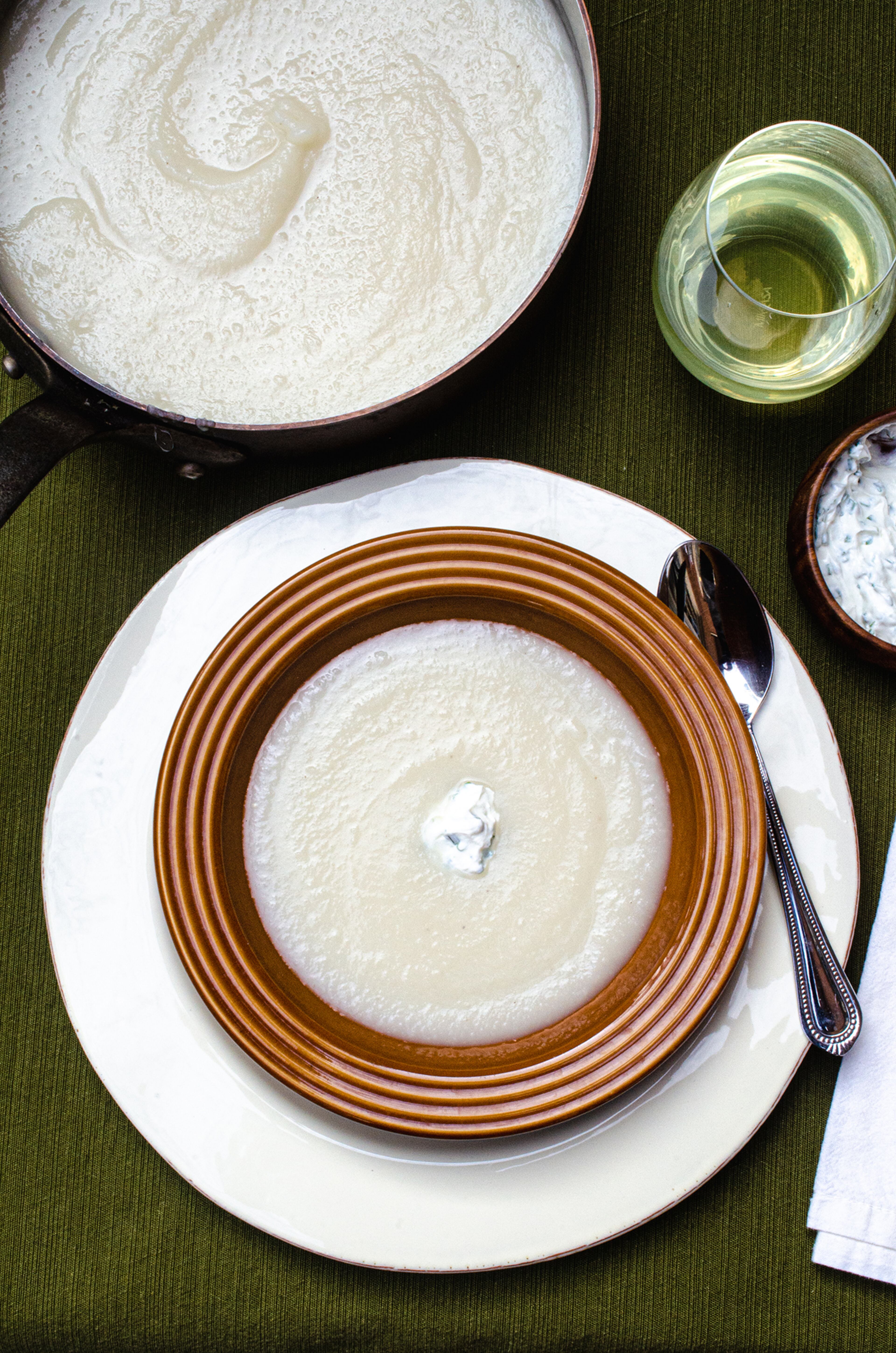
Turnip Soup with Chive Cream
White turnip roots are about the size of a baseball or slightly smaller and creamy white in color, often with a swipe of pale purple around the top. Smaller turnips, named Hakurei or Tokyo, are pure white. Once only found at farmers markets, these Japanese turnips are increasingly available at grocery stores. This soup uses old-fashioned white turnips for ease of preparation. The larger roots are easier to peel and chop than the smaller Japanese turnips.
- 1 tablespoon pure olive oil
- 1 onion, chopped
- 2 garlic cloves, finely chopped
- 2 pounds turnips, peeled and diced (about 6 medium)
- 1 Idaho potato, peeled and diced
- 1 bay leaf
- 4 cups homemade chicken stock or reduced-fat low-sodium chicken or vegetable broth, plus more if needed
- 1/2 cup sour cream or skyr
- 2 tablespoons freshly snipped chives
- Coarse kosher salt and freshly ground black pepper
- Heat the oil in a large pot over medium heat, then add the onion. Cook until the onion is translucent, 3 to 5 minutes. Add the garlic and cook until fragrant, 45 to 60 seconds. Add the turnips, potato, bay leaf and stock.
- Bring to a boil, then decrease the heat to maintain a simmer. Simmer until the vegetables are soft, about 30 minutes.
- Meanwhile, in a small bowl, combine the sour cream and chives. Season with salt and pepper. Set aside.
- Remove and discard the bay leaf from the soup. Using an immersion blender, puree the soup. (Alternatively, let soup cool a bit, then carefully fill a blender one-third to one-half full with soup. Remove or loosen the center cap from the lid of the blender. Cover the lid with a folded dishcloth and hold it down when blending. Repeat with the remaining batches.) Leave the vegetables coarse for a more rustic soup, or puree until smooth for a more elegant soup. Taste and adjust for seasoning with salt and pepper. Ladle into warmed bowls and top with a spoonful of chive cream. Serve immediately.
Nutritional information
Per serving: Per 1-cup serving soup with 1 tablespoon chive cream: 141 calories (percent of calories from fat, 35), 5 grams protein, 18 grams carbohydrates, 3 grams fiber, 6 grams total fat (2 grams saturated), 11 milligrams cholesterol, 254 milligrams sodium.
Carrot and Beet Salad with Lemon Vinaigrette
Try to use small beets for this recipe; they will be sweeter and more tender than large beets. You can use a food processor to shred the vegetables, but just make sure you shred the carrots first. To prevent the beets from staining the carrots, dress the beets before combining. The oil in the dressing seals in their red pigments, known as betalains, which don’t dissolve in oil and therefore do not discolor the carrots.
- 1 shallot, finely chopped
- 1 clove garlic, finely chopped
- Zest and juice of 1 lemon
- 1/2 cup walnut oil (can substitute with grapeseed or canola oil)
- Coarse salt and freshly ground black pepper
- 5 carrots, finely shredded
- 5 small to medium raw fresh beets, peeled and finely shredded
- 1/2 cup whole parsley leaves
- 1/4 cup finely chopped walnuts
- Make the dressing: In a small bowl, whisk together the shallot, garlic and lemon zest and juice. Add the walnut oil in a slow stream and blend until smooth. Season with salt and pepper. Set aside.
- Place the carrots and beets in separate bowls. Add half the dressing to the carrots and toss to coat. Add the remaining dressing to the beets and toss to coat. Taste each and adjust for seasoning with salt and pepper.
- Once the vegetables are separately dressed, they may be combined and served, or refrigerated and held separately for up to several hours before combining (you may either bring to room temperature or serve chilled). Garnish with parsley and walnuts. Serve immediately after the carrots and beets are combined.
Nutritional information
Per serving: Per 1-cup serving: 243 calories (percent of calories from fat, 76), 2 grams protein, 13 grams carbohydrates, 4 grams fiber, 22 grams total fat (2 grams saturated), no cholesterol, 81 milligrams sodium.
Sweet Potato Crisp
Most Southern sweet potato side dish recipes contain almost enough butter and sugar to be served as dessert, so I thought I’d take it one step further and make it one!
- For the sweet potatoes:
- 3-4 sweet potatoes, peeled and diced (about 5 cups or 2 pounds)
- 3 tablespoons water
- 3 tablespoons dark brown sugar, firmly packed
- 1 tablespoon unsalted butter
- 1/4 cup buttermilk
- 1 large egg, beaten
- 1 teaspoon pure vanilla extract
- 1/2 teaspoon ground cinnamon
- 1/4 teaspoon ground allspice
- 1/4 teaspoon fine sea salt
- For the crisp topping:
- 1/2 cup quick-cooking oatmeal
- 1/2 cup coarsely chopped pecans, hazelnuts or walnuts
- 3 tablespoons dark brown sugar, firmly packed
- 3 tablespoons unsalted butter, melted
- Ice cream, whipped cream or dessert topping, for serving
- Heat the oven to 350 degrees. Place potatoes in a microwave-safe baking dish. Add water and cover with a tight-fitting lid or plastic wrap. Microwave on high until tender, in 5 minute intervals, about 10 minutes.
- Meanwhile, prepare the topping: In a medium bowl, combine the oatmeal, nuts and 3 tablespoons brown sugar. Pour 3 tablespoons melted butter over mixture and stir to combine. Set aside.
- Drain the excess water from the potatoes, leaving them in the baking dish. Add 3 tablespoons brown sugar, 1 tablespoon butter, the buttermilk, egg, vanilla, cinnamon, allspice and salt. Mash potatoes with a potato masher until chunky. Clean the rim of the baking dish.
- Sprinkle reserved crumble topping evenly over sweet potatoes. Transfer to the oven and cook until fragrant and the topping is golden brown and the filling is puffed and risen, about 20 minutes. Remove from the oven and let cool slightly. Serve warm with ice cream, whipped cream or dessert topping.
Nutritional information
Per serving: Per serving: 359 calories (percent of calories from fat, 39), 6 grams protein, 51 grams carbohydrates, 6 grams fiber, 16 grams total fat (6 grams saturated), 52 milligrams cholesterol, 208 milligrams sodium.Sign up for the AJC Food and Dining Newsletter
Read more stories like this by liking Atlanta Restaurant Scene on Facebook, following @ATLDiningNews on Twitter and @ajcdining on Instagram.