
Japan to Falcons and back again: How Robert Prince became chief energy officer
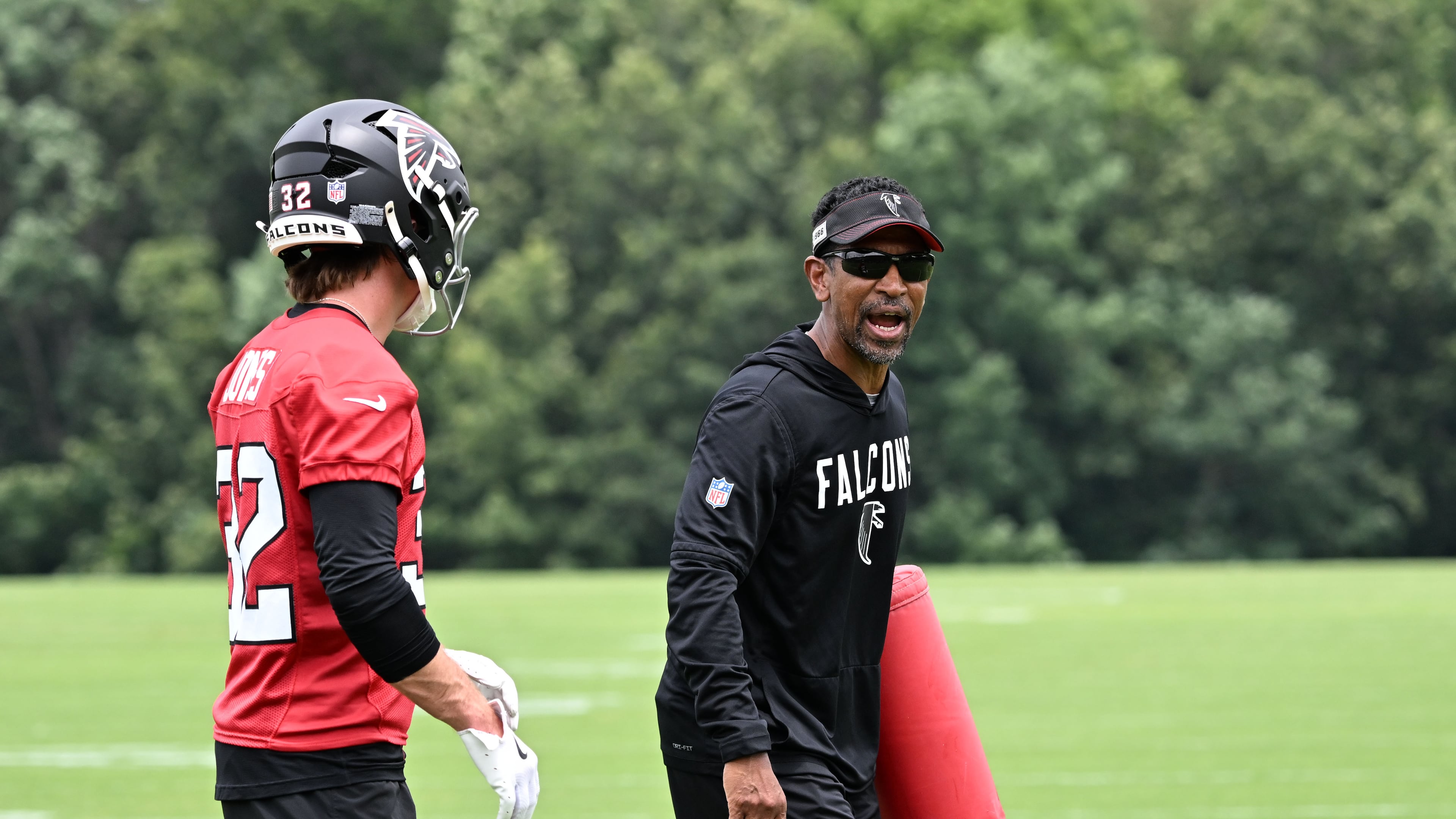

FLOWERY BRANCH — With his arms wide and his steps full of pep, Robert Prince took off toward the corner of the Falcons’ practice field like a kid racing to the ice cream truck on a hot summer day.
When he arrived, he jubilantly bounced around. He urgently clapped his hands at his star student, Drake London. And he showed no signs of his 61 years of age, his bevy of transpacific flights from his Japanese roots and decades of unheralded work that led to the moment — even on the final session of mandatory minicamp, the last day before summer vacation.
Prince, the Falcons wide receivers coach and third-oldest member of the team’s coaching staff, is a never-ending, unrelenting ball of energy.
“He just brings the juice out,” London said during OTAs. “The way I can explain it the best, I didn’t know how old he was, but he’s old. He doesn’t look old. He don’t run old. He don’t do none of that stuff.
“But he’s just happy to play ball every day and come out here.”
Later that same minicamp practice, Prince sprinted down the sideline, tongue out, rushing to celebrate with rookie receiver Zachariah Branch, who took a screen pass 80 yards to the end zone and raised his index finger over his mouth in a shushing symbol.
Nobody else felt like making the trip down the field. Prince always does.
“He brings the energy every day,” receiver Jahan Dotson said. “When it’s the fifth, sixth practice of OTAs and no one feels like going, he’s making sure we’re ready to go, making sure that guys are out here doing what they need to do.”
The Falcons enter this season with plenty of questions surrounding their receiving corps, which has an ace in London and a group of what-could-bes behind him.
Dotson, a first-round pick by the Washington Commanders in 2022, enters his fifth season searching for a breakthrough as a likely starter. Olamide Zaccheaus has seven years of experience under his belt, a stark contrast to Branch, his chief competitor for slot snaps. And there’s also the question of just how many targets exist with London, tight end Kyle Pitts and running back Bijan Robinson poised to dominate touches.
Prince is responsible for maximizing the Falcons’ receiving corps, no matter the form it takes. He’s been well-received thus far — and his energy is the driving force, as it always has been.
Japan to the U.S. — twice
Prince grew up across the Pacific Ocean. The son of an American father and Japanese mother, he hails from Okinawa, Japan, one of approximately 160 islands detached from the mainland. It’s popular — the chain of islands collects north of 1 million people — and is now home to more than 30 United States military bases.
For his first seven years, Prince lived off base in Japan. He became bilingual, speaking English at home and Japanese with his friends. In the house, his mother often spoke to him in Japanese and he’d answer in English.
It helped them both learn and proved important in 1972, when the family moved to San Bernardino, California, which Prince considers his home.
Prince grew into a standout on the gridiron at San Gorgonio High School, which he parlayed into a spot at San Bernardino Valley College. He later walked on at Humboldt State University, where he played receiver and ran track.
Once intent on moving home and using his degrees in mathematics and physical education to be a high school teacher and football coach, Prince took a graduate assistant job at Humboldt in 1989.
It proved to be the launching pad for his coaching career — and a return trip to Japan.
By the time he ventured to Orlando, Florida, for the annual American Football Coaches Association Convention in 1996, Prince was two years into his role as offensive coordinator at Fort Lewis College, a Division II school with just over 4,000 students enrolled at that time. He had stops at Montana State and Sacramento State in his past.
David Stant, the head coach of the Recruit Seagulls, a Japanese corporate team, needed a seat at the convention. There was a vacant one at Prince’s table.
“Hey, do you know anybody that can coach quarterbacks?” Stant asked the table.
Everybody pointed to Prince.
“I coach a team in Japan,” Stant said.
Prince, using what he remembered from his conversations with his mother, started talking in Japanese.
“Oh,” Stant said, “we should get together.”
So, in 1996, some 24 years after he left, Prince packed up his life and returned to Japan as an offensive coordinator.
The level of competition in the Japanese X-League was comparable to Division III, Prince said. The Recruit Seagulls’ biggest linemen tipped the scales at 250 pounds, though the team had solid skill-position players.
There were no culture and language barriers for Prince, and football wasn’t an issue either. Prince helped the Recruit Seagulls win their first league and national title in 1996, and he did so with strong communication.
“My Japanese, it came back pretty quickly,” Prince said.
Prince can still speak Japanese. “Drop me off in Japan for a day and I’ll be all right,” he says. He loves sushi, chicken yakisoba and all other types of Japanese cuisine.
But he loves living the American dream.
After his two-year stint with the Recruit Seagulls came to a close, Prince resumed his slow climb up the coaching ladder. Three years at Portland State. Three more at Boise State.
In 2004, nearing 40 years old, Prince finally got his break. And it came with the Falcons.
On the move
Before his first full-time NFL gig, Prince put his foot in the door with a pair of West Coast internships with the 49ers and Chargers coaching staffs. While in San Francisco, he made a strong impression on then-defensive coordinator Jim Mora.
So, when Mora became the Falcons head coach in 2004, he reached out to Prince.
“Hey, RP,” Mora said. “Do you want to come out to Atlanta?”
Prince affirmed. He went from Boise State’s passing game coordinator in 2003 to a Falcons offensive assistant from 2004-05, working with running backs and tight ends on Mora’s staff. In 2006, he became the assistant quarterbacks coach, where he oversaw Michael Vick’s final season in Atlanta.
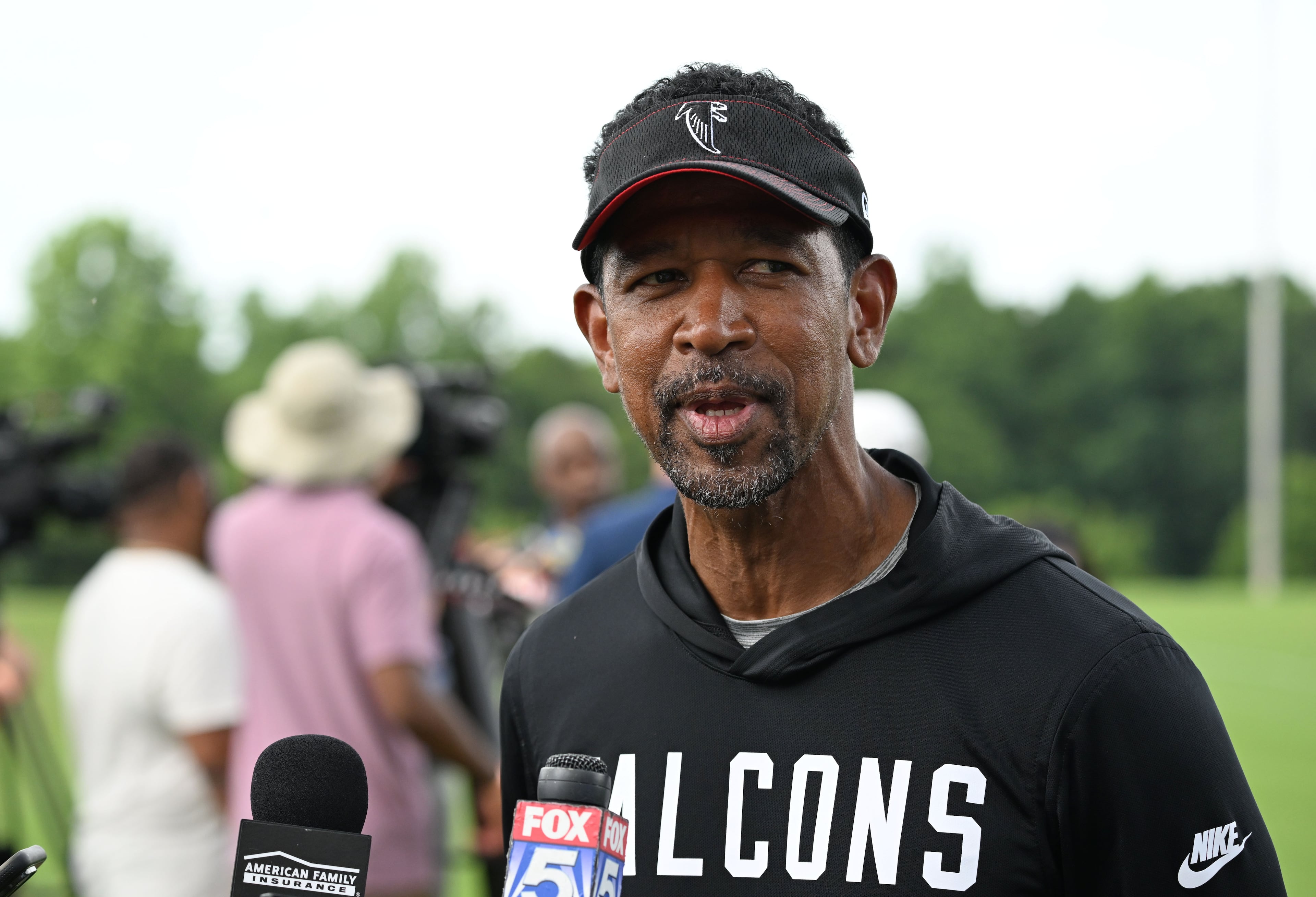
“It’s changed,” Prince said, smiling as he looked around at the team’s training facility. “There’s been additions to it.”
Prince’s life has changed in 20 years, too. He’s in his 19th season as an NFL coach, a career headlined by seven years as the Lions receivers coach and stints with the Seahawks, Texans, Cowboys and Dolphins in the same role.
In 2024, Prince won the Darryl Drake Memorial Wide Receiver Coach of the Year award, voted on annually by receiver coaches around the NFL.
But the past two years, Prince has fallen victim to the league’s dark side. The Cowboys didn’t retain coach Mike McCarthy after the 2024 season, and Prince hit the free-agent market. Less than two weeks later, the Dolphins hired him. Yet after Miami fired coach Mike McDaniel following the 2025 season, Prince again met uncertainty.
Prince was still under contract with the Dolphins, but the Falcons put in a request to speak with him, and Miami, which had the rights to deny Atlanta’s request, allowed the interview to happen.
Falcons coach Kevin Stefanski had no prior ties with Prince. But a recommendation from Chad O’Shea, who was Stefanski’s receivers coach with the Browns and now holds the same role with the Chiefs, proved crucial.
“(O’Shea) hit me up and he goes, ‘Hey, RP, I’m going to go to Kansas City, and I told Kevin that he should try to get you if he can,’” Prince said. “And then I said, ‘Yeah, that’s fine. I’ll talk to him.’”
The conversation led to a job, and the Falcons hired Prince (again) on Jan. 26. He hit the ground running and still hasn’t stopped — after all, that’s what he’s known to embody.
‘That dude’
While he was with the Lions, Prince earned a nickname from his players: CEO, or chief energy officer.
“I try to bring a little juice,” Prince said. “I was kind of the juice guy. I just have a little fun and try to put some energy into the practice.”
The nickname hasn’t caught on — yet — in the Falcons’ receiver room, but Dotson understands why it came about. Prince is their energy spark, he said, someone who runs and jumps around when the players aren’t feeling it.
Prince’s energy isn’t dependent on a cup of coffee or a nice day outside. He’s merely himself, driven by the perspective of his playing career and the desire to give his players an energetic coach who lets them know what’s happening.
“I try to coach the way I’d want to be coached,” Prince said. “I always tell the guys, ‘Hey, you’re going to know when I like it, and you’re going to know when I don’t like it.’”
Prince is more than an Energizer bunny.
While the ink hadn’t dried on London’s new four-year, $141 million contract signed June 8, the star receiver worked off to the side during an OTA practice. He wasn’t alone. While the rest of the team’s pass catchers went through the session without skipping a beat, Prince joined London for an extensive individual coaching session.
At one point, Prince played imaginary quarterback, explaining a concept to London. At another, Prince ran a complementary route alongside London to give him a better conceptual feel.
London walked back to their gathering spot. Prince was already there, ready to work. He didn’t stop jogging after finishing his route.
“It just kind of puts me in the mindset of like, why shouldn’t I be happy?” London said. “I’m youthful. I can run around and actually get to go play and put the helmet on. So, what’s the point of me being mad or coming out here sluggish?”
London added Prince is “freaking hilarious” and “that dude.” Dotson said he’s “truly great.” Both players complemented Prince’s intelligence, too.
Stefanski offered praise for another reason: the selflessness Prince instills in his players.
“I respect what Robert Prince is able to coach with our wide receivers — that mentality of, ‘We will do whatever it takes to help this team win,’” Stefanski said. “If that means blocking 100 times in a game, our guys will do that. If it means catching the ball 100 times a game, our guys are going to do that. Whatever it takes in a given game.”
Prince took the hard road to the NFL. Only 13 players — and one active, the Panthers’ Patrick Jones II — in league history are Japanese. There are no active head coaches with Japanese roots. He’s part of a small brotherhood who were born on the other side of the Pacific and reached football’s highest level.
And he never took any shortcuts, be it Division II or the Japanese X-League, to live the American dream.
It’s only fitting Prince nears the two-decade mark in the sport with the organization that jump-started his NFL career. Prince — arms wide, tongue out, legs churning faster by the step — certainly looks happy to be back in Atlanta.
And the Falcons receivers are glad he’s here, too.
“He always makes sure we’re prepared,” Dotson said. “Every time we step out here, he makes sure we know what we’re doing on the script, we got the proper footwork to every single route we’re going to run.
“So, he’s doing a great job, and I can’t wait to learn even more from him.”