‘Blood in the water.’ Why Republicans fear an upset in MTG’s backyard.

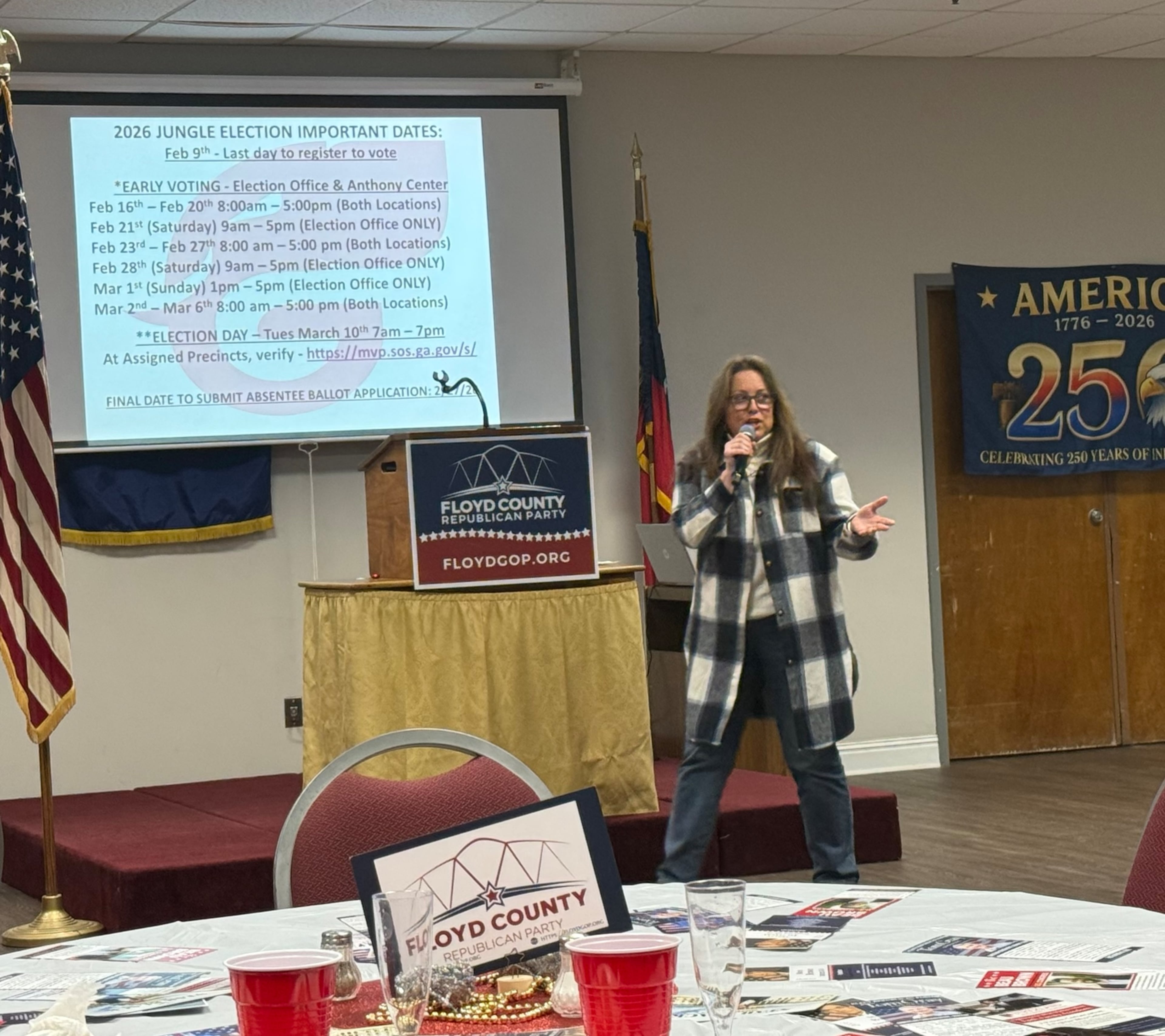
ROME, Ga. — Jackie Harling didn’t mince words at the most recent Floyd County GOP meeting.
Scanning a room packed with Republicans bracing for a messy scramble to succeed Marjorie Taylor Greene in northwest Georgia, the 14th District GOP chair outlined a prospect that not long ago would have drawn laughs.
“Let this sink in: When there’s so many Republican candidates on the ballot with a few Democrats, we could end up with a Democrat as our congressman.”
Yes, she and other activists know it sounds outrageous to think that Greene’s deep-red district could somehow flip blue. Before Greene’s sudden resignation, she won the district with 63% of the vote. Donald Trump carried it by an even larger margin.
But Harling’s words are no cheap scare tactic to gin up turnout ahead of a 21-candidate special election on March 10 to fill the remainder of Greene’s term.
Interviews with more than a dozen Republicans across the district show a party on edge — worried that Georgia’s fast-moving contest, voter fatigue, lingering unease over Trump, and — most of all — a fractured GOP field and a strong Democratic contender could put even this seat at risk.
Mickey Tuck, a local activist, embodies the unease. He’s torn between three or four of the leading GOP contenders and no fan of Greene, who he said did a “big disservice” to the district by abruptly resigning after feuding with Trump.
But he’s also convinced Democrats see an opening. In a free-for-all with so many names on the ballot, he said, they have a real shot at grabbing one of the runoff spots — and, however remote — an outside chance at landing both or even winning outright.
“Democrats smell blood in the water,” Tuck said. “And you know they’re going to come out and vote. We could very easily see a Democrat slip in there.”
Free for all
Voters in Greene’s district better get used to this chaotic scramble.
With no party primary to narrow the field, all the contenders will appear on the same March 10 special election ballot to fill Greene’s unexpired term. Since no candidate is expected to win a majority, an April 7 runoff between the top two finishers is expected.
And that’s only the start. A separate election for the full two-year term that starts in January 2027 will follow the traditional path: a crowded May party primary featuring many of the same contenders, a likely runoff and the November general election.
But this first contest is different — an all-party free-for-all with 16 Republicans, three Democrats, an independent and a Libertarian. (A 17th Republican, Christian Hurd, dropped out of the contest Sunday.) In a low-turnout race, even a small slice of support can be enough to reach a runoff. And with Republicans splintered, unified Democrats have the slimmest of openings.
“We Democrats are united and we have an infrastructure and a great candidate,” said Jack Zibluk, a media history teacher and a candidate for a state Senate special election in northwest Georgia.
More often than not, those hopes don’t pan out. When Jon Ossoff threatened to flip a GOP-held suburban Atlanta seat in a 2017 special election, Republicans pummeled him with attack ads to keep him under 50% in an 18-candidate race. The Democrat went on to lose a head-to-head runoff against Republican Karen Handel.

More recently, Democrats’ hopes of exploiting a crowded GOP field in a conservative-friendly Middle Georgia Senate special election fizzled when their candidate, LeMario Brown, fell well short of 50% and now enters a February runoff as a heavy underdog.
But surprises do happen. In 2014, Republican JaNice VanNess won a Democratic-held state Senate seat by just 84 votes. Then-Gov. Nathan Deal and other Republicans trumpeted it as proof that conservatives can win even in the bluest parts of the state.
‘Show up’
Though three Democrats are running, the party’s hopes rest on Shawn Harris, a retired U.S. Army brigadier general and rancher who won nearly 135,000 votes in 2024 — the best showing for a Democrat in the district since it was created in 2010.
After brushing off entreaties to switch parties, Harris is back — and is betting Republicans are too consumed with proving their loyalty to Trump to notice the ground shifting at home. He argues Greene turned the seat into a stage for national combat and that voters are left with little to show for it.

With a headquarters in Rome and much of his 2024 operation still in place, he said he’s handed out scores of “Republicans for Shawn” signs and trained hundreds of volunteers. He’s kept his focus on “affordability,” pledging votes to bring down the price of household goods and extend expiring healthcare subsidies.
“My message to voters is, at the end of the day, give me a chance, he said. “If you give me a chance you’ll see real results that affect you at the kitchen table.”
His candidacy has already rattled Republicans.
“It’s a very bleak prospect,” said Tuck. “If you look around Floyd County, Shawn Harris has more signs up than anybody. He’s got that big headquarters in Rome. And he’s doing town hall meetings all over the district while Republicans are fighting with each other.”
Complicating matters for Republicans is the lack of a clear standard-bearer. With 17 Republicans on the ballot, the party is splintered into rival camps — and even a few thousand votes could be enough to slip into a runoff.

The conventional wisdom is that former state Sen. Colton Moore, prosecutor Clayton Fuller and pastor Tom Gray are best positioned. But in a field this crowded, others can break through, too, as candidates like former Dalton City Councilman Nicky Lama and former 14th District GOP chair Jim Tully fight for a foothold.
For many voters, it’s dizzying. And it’s forcing Republicans to think less about the identity test of whether they want another Greene-style firebrand and more about how to keep a Democrat out.
Karen Lyn Dobson, a Rome Republican, said it felt like Greene “dropped a bomb in the middle of our district” when she stepped down. Now she sees only one way out: A Trump endorsement.
“We’re going to wait and see who Trump endorses. That’s what we the people will do,” Dobson said. “We will say who Trump endorses. And at that point that’s who we’ll back.”
Whether that happens is far from certain. Trump’s advisers have sounded out a string of contenders who made pilgrimages to the White House. But the president hasn’t taken sides — and neither he nor his allies have moved to clear the field. And Greene has said she won’t endorse a successor.
Back in December, the 14th District GOP issued a warning about the “danger” of complacency even in Greene’s backyard. Local Republicans say that risk is only growing.
Pam Peters, the Floyd County GOP chair, pointed to last year’s Public Service Commission races, when some MAGA voters, angry over rising energy prices, cast protest ballots for Democrats — while others simply stayed home.
“Republicans didn’t show up,” she said of the party’s blowout losses, urging activists to keep the election in mind even on their morning walks. “We need to be engaged.”
Harling has been doing her part. She’s been like a traveling salesman since she took over the job from Tully, who stepped down to run for the office — organizing forums, training volunteers and warning that even the safest-seeming district in Georgia can’t take anything for granted.
“If a Democrat takes Marjorie’s spot, I’m going to have a conniption,” Harling said. “We are the reddest district in Georgia. We are not going to have a Democrat representing us.”
About the Author

Greg Bluestein is the Atlanta Journal Constitution's chief political reporter. He is also an author, TV analyst and co-host of the Politically Georgia podcast.


