From loss to innovation: Georgia dad creates app to ease prenatal anxiety

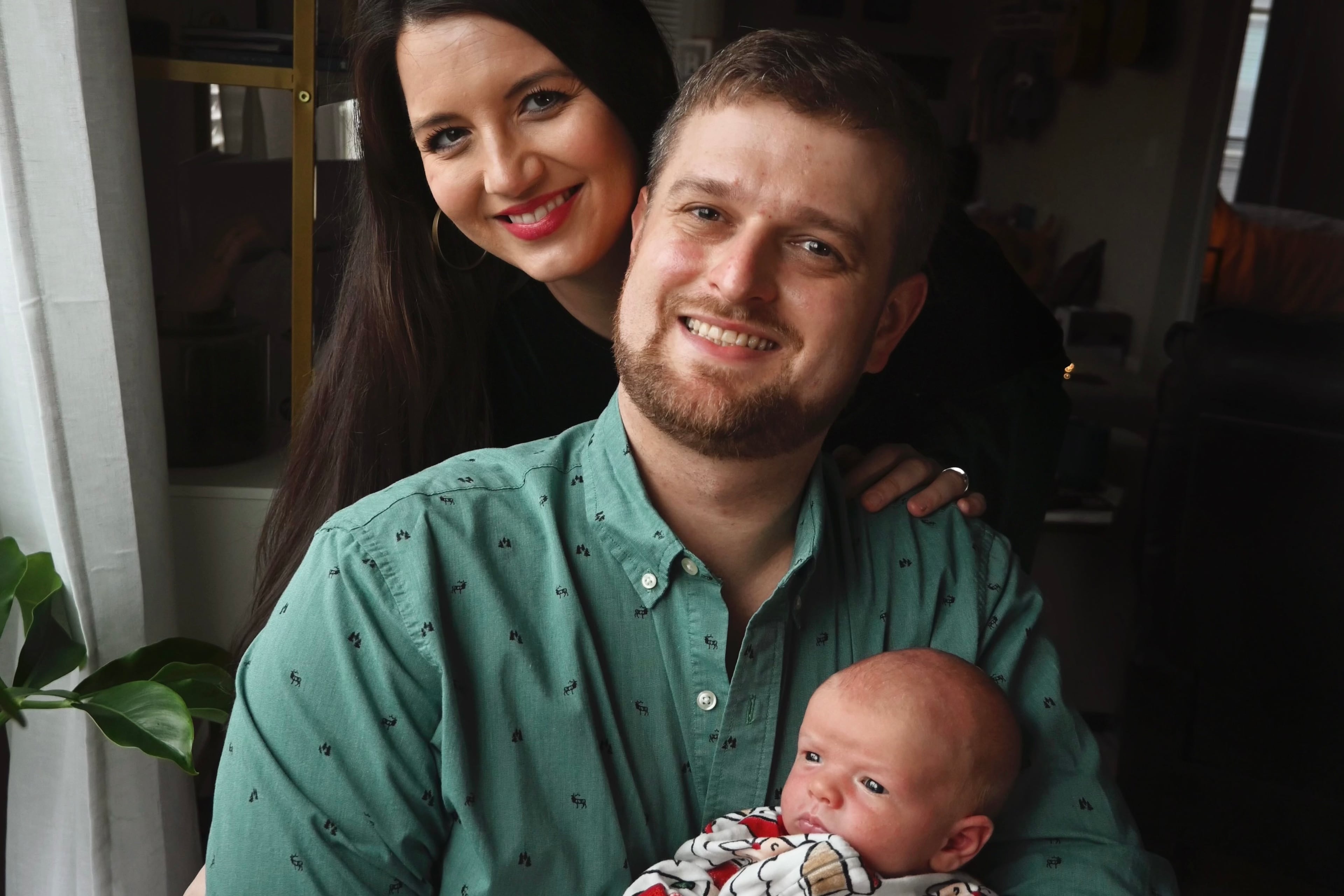
After two miscarriages, Elise Adams approached her third pregnancy with caution, closely watching for any sign of change between doctor visits. But the only at-home monitor that could confirm her baby’s heartbeat was difficult to use and did little to reassure her.
“Because of my previous experiences with the miscarriage, I had invasive thoughts. If anything wasn’t going exactly how the science said it was supposed to go, it was immediately worst-case scenario that I had lost the baby,” she shared.
Those feelings are not uncommon during pregnancy and the postpartum period.
About 1 in 5 birthing mothers experience a mental health condition immediately before or after the birth of their child, according to Peace for Moms in Georgia, a state-funded program that connects clinicians with psychiatrists who specialize in perinatal mental health. Perinatal anxiety and mood disorders are among the most common complications in pregnancy and the first year after delivery, according to the American College of Obstetricians & Gynecologists.
Seeing the gap firsthand
Motivated by Elise’s experience, her husband, Alex Adams, wanted to give expectant parents more reliable insight into a baby’s heartbeat between scheduled checkups. As an app inventor and assistant professor in Georgia Tech’s School of Interactive Computing, he knew there had to be a better way.
“I have my scientist hat on about half of the time, so I’m, like, looking at all the stuff that the doctor tells her to do and thinking why we don’t have more technology to help with this process,” he said.
This led him to create the mobile app DopFone. The app turns any smartphone into an at-home fetal Doppler heart rate monitor, capable of detecting signals caused by a fetal heartbeat and delivering immediate measurement to the parents.
Although the app requires more clinical testing and marketing approval from the U.S. Food and Drug Administration, the team say they hope it will eventually provide an affordable, accessible way for families to monitor fetal health from the comfort of their homes.
The fetal Doppler monitor currently on the market, which Elise used, is a handheld device that must be positioned precisely on the stomach to detect a heartbeat, she said. With Alex’s engineering background, he understood how much pressure to apply and exactly where to position it to pick up the soundwaves.
“I could never do it myself. I wasn’t getting it in the right spot, so it was really sensitive,” Elise said.
But beyond the technical challenges, Alex says the bigger issue is the gap in consistent, accessible monitoring between doctor visits.
“It’s a tall order to ask someone to wait for a month for your next doctor’s visit to see how your pregnancy is going, especially if you’re high risk or if you’ve had negative outcomes.”
Balancing access and anxiety
Dr. Anne Dunlop, an Emory University researcher, and family and preventive medicine doctor, said she saw the potential for the DopFone app when she learned about it at a recent artificial intelligence and health meeting.
“Increasingly patients are interested in self-monitoring,” Dunlop said, citing an explosion of devices that track heartrate, breathing, sleep and exercise. “The value of this could lie in giving a patient a greater sense of connection and reassurance between their prenatal care visits.”
Still, she’s concerned the app could increase anxiety for moms who might check for the baby’s heartbeat too frequently. “If a patient can’t find a heartbeat or misinterprets what they’re hearing, that uncertainty could escalate their distress rather than relieve it.”
But Dunlop emphasized these concerns don’t negate the technology’s promise.
“This technology is still investigational. It’s not ready to replace clinical evaluation, but the real potential lies in expanding access to information where patients have limited contact with clinicians.”
Dunlop said the app should be used in coordination with a patient’s medical care team and could be especially useful in areas with limited access to care.
That need is high in Georgia, where rates of preterm births, and infant and maternal mortality exceed the national average. The state has consistently earned an F from the March of Dimes, which works to improve the health of moms and babies. More than 40% of Georgia’s counties are considered maternity care deserts, lacking resources such as obstetric providers or facilities that offer childbirth services.
Early testing underway
Preclinical trials of DopFone are underway at the University of Washington School of Medicine, where Alex’s lead student on the project, Poojita Garg, is now pursuing her doctorate. Formal clinical trials are expected to begin in the next two years.
Looking ahead, Alex says the technology could help clinicians intervene earlier and potentially prevent complications during pregnancy — an approach he says can make a meaningful difference.
“Just being able to have measurements remotely will allow clinicians to actually be able to advise, ‘Maybe come in earlier for your next visit,’ as opposed to just waiting,” he said.
Roni Robbins has been a journalist for nearly four decades. This is her second stint as a freelance reporter for the AJC. She also freelances for Medscape, where she was an editor. Her writing has appeared in WebMD, HuffPost, Forbes, the New York Daily News, BioPharma Dive, MNN, Adweek, Healthline and others. She’s also the author of the award-winning novel, “Hands of Gold: One Man’s Quest to Find the Silver Lining in Misfortune.”