Gridlock Guy: Why driving faster won’t get you there quicker
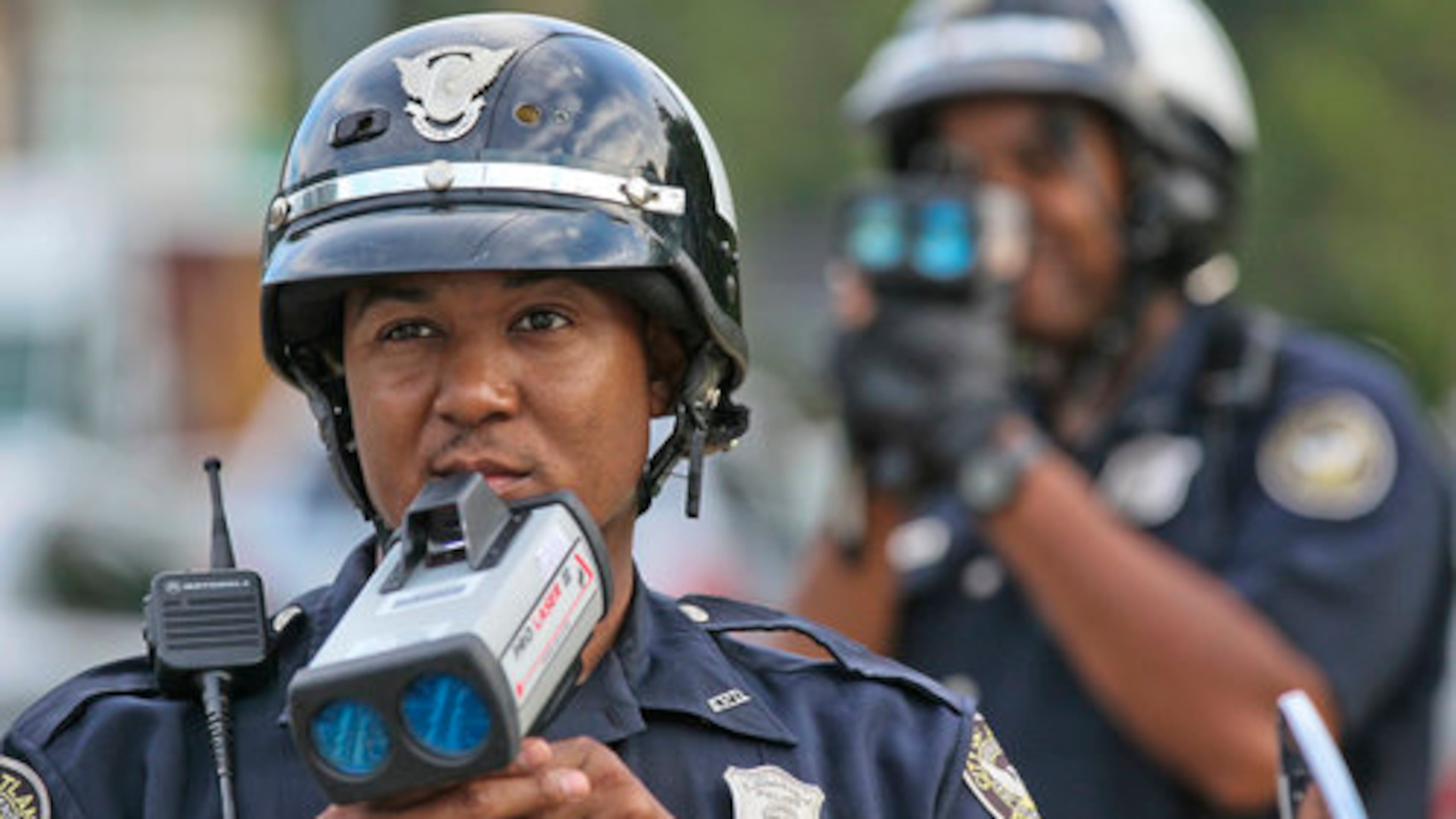
I have been open about having my share of speeding tickets over the years. My most recent, in 2020, prompted me to learn cruise control. The thing is, speeding doesn’t help us get to our destinations faster. What it does is make it more likely we won’t get there at all.
My brother, Stephen, sent me an Instagram Reel from lecturer Rory Sutherland that addressed this very issue. Sutherland, who co-authored the book “Transport for Humans,” spoke in the clip about how our measure of miles or kilometers per hour tricks us into thinking we are gaining equal amounts of time, the faster we go. Sutherland explained how if we measured our progress in minutes per 10 miles, we would more easily see that faster speeds yield diminishing returns.
Sutherland’s opinion is not a hot take in the highway safety world — it’s a known fact. Chuck Farmer, a senior researcher for the nonprofit Insurance Institute of Highway Safety, explains why.
“Say you’re going 40 miles an hour, that’s 10 miles every 15 minutes. You jump that up to 50 miles an hour, that’s 10 miles every 12 minutes. 60 miles an hour, that’s 10 miles every 10 minutes,” Farmer explained to 11Alive and The Atlanta Journal-Constitution. “And so you’re saving fewer and fewer minutes as you get up into those higher speed limits. And so, by the time you get up to jumping from 70 to 80, you’re maybe saving a minute, maybe a minute and a half. So the faster you go, the less it’s actually helping you.”
All factors taken into account, going faster actually hurts drivers’ odds of getting to their destinations.
The IIHS says that 29% of fatal crashes, nearly 12,000 in 2023, involved improper speeds. Added speed reduces reaction times and increases the chance a motorist will lose control. And, as we discussed in last week’s holiday safety column, other passengers and drivers, too, are at risk when someone chooses unsafe speeds.
“We’re still seeing 12, nearly 13,000 deaths a year where the police are coding speeding and they don’t get all of it. There’s probably more speeding than that,” Farmer said.
Vehicles also are not made to fully withstand those high speed hits either, Farmer shared. “When you get up to those 70, 80 miles an hour, you’re talking about a lot more energy. And it’s energy that probably even the best vehicles these days can’t handle.”
And he said that, as physics’ laws would state, those higher speeds mean higher force. “Going from 25 to 35 miles an hour, which is pretty low speed in our minds, you actually see a doubling of the kinetic energy.” This is why speed limits in school zones are 25 miles per hour, not 35. No, the government has not switched to the minutes-per-10-miles metric.
“And when you hit something, should you be so unfortunate, that energy’s gotta go somewhere. And if you’re hitting a pedestrian, it goes directly into that pedestrian. If you’re hitting a wall, some of that’s gonna be absorbed by the vehicle, but a lot of it’s gonna come back on you,” Farmer stated.
This phenomenon is demonstrated in a years-old video from IIHS, which compares the difference between a head-on crash in a 2010 Honda CRV at 40 mph and at 56 mph. Both are devastating, but the faster wreck completely collapses the SUV’s front end and ruptures the cockpit. The crash dummy’s head splits in half in the fast crash and it crumples underneath the steering wheel. It’s harrowing.
Farmer noted how innovations have also contributed to speeding. “[You] feel very insulated, very isolated in your vehicle,” he said. “And, as vehicles get more and more soundproof, more and more comfortable, so that you don’t really feel the roads. You don’t feel the bumps anymore, you don’t feel that you’re going that fast because the vehicle is so well designed. And so you don’t understand the risk that you’re putting yourself at when you go really fast.”
That takes me back to my 2020 speeding ticket. No, I wasn’t trying to go the speed limit on I-75 SB in Middle Georgia, but I wasn’t trying to do 19 over either. I barely felt it in the car we had just purchased. But that excuse did not work with the citing officer.
Speeding is dangerous and real, math shows that it shaves less time off ETAs, the higher the speedometer goes. And commuters are less likely to feel that fast sensation in their late model cars. Maybe the math will shift minds to a lower gear.
Doug Turnbull covers the traffic/transportation beat for WXIA-TV (11Alive). His reports appear on the 11Alive Morning News from 6 a.m. to 9 a.m. and on 11Alive.com. Email Doug at dturnbull@11alive.com.
About the Author