‘A lot of blame, but not enough action’: Atlanta leaders lack path to fix jail

Fulton County’s jail on Rice Street is teeming with prisoners and problems, and months after a federal monitor was tasked with tracking progress, there’s little to show for it. Whose fault is that?
City and county leaders each have a role to play in making changes that will bring the jail into compliance with the federal consent decree that followed a U.S. Department of Justice investigation finding conditions in the jail were “abhorrent” and unconstitutionally poor.
But they don’t agree on a path forward.
In public meetings, Sheriff Patrick Labat blames commissioners for withholding funding, saying he can’t afford repairs to the crumbling building nor pay packages to attract jailers to staff it.
Several commissioners, in turn, have blamed the sheriff for what they say is his mismanagement of the facility and staff.
Meanwhile, at least four more people have died in custody since the start of the year. Inside the jail, stabbings and beatings are commonplace, and one woman remains on life support after she was attacked by a cellmate, court filings show.
“We are not doing enough,” Fulton Commissioner Dana Barrett said. “There’s a lot of finger-pointing, a lot of blame, but not enough action.”

The overcrowded and notoriously dangerous jail is full of people whose charges run the gamut, from trespassing to murder. The state’s policy on cash bail means once they’re inside, many who might be eligible for bond can’t afford to get out and end up behind bars without a conviction for sometimes years.
What slows things down? Most of the inmates were arrested by the Atlanta Police Department, which has the option to send certain cases to diversion but may not use that program as much as it could, officials have said.
Inmates facing felony charges await prosecution by Fulton County District Attorney Fani Willis, who said earlier this year her office didn’t have the resources to process cases quickly. And once a case is in the judicial system, it can get stalled by complex litigation that clogs judges’ calendars and causes conflicts for defense attorneys.
Even the federal monitor tasked with tracking progress within the jail seems to think the problems are intractable. In a report earlier this year, the monitor noted that when Labat did authorize repairs to areas of the jail, the work was torn apart almost immediately when inmates were allowed to access the space again.
At the center of the question of solving the long-standing dysfunction inside Fulton County’s jail is which leaders are responsible, how each sees their role, and whether they will be able to forge any progress as consent order-mandated deadlines approach.
A civic game of hot potato
Technically, the job of running a jail falls to the county sheriff. Labat is hardly alone in dealing with issues of overcrowding and violence, and he’s not the only sheriff struggling to retain jail staffers. But he is the only sheriff in Georgia whose jail is subject to a federal consent decree.
Labat sees the problem as a financial one: He’s stuck with a building with walls that are crumbling so badly the pieces are used to make weapons. And his staff is stretched thin: On average, a Fulton jailer is tasked with monitoring 150 to 200 inmates at once.
That makes the job difficult and dangerous, and, Labat said, insufficiently compensated.
He’s struggling to compete with surrounding law enforcement agencies offering more attractive job perks. Immigration and Customs Enforcement, for example, is currently recruiting in Atlanta with promises of student loan forgiveness and an up-to $50,000 signing bonus.
Turnover at the jail is rampant, according to Labat, who said he recently lost 73 employees in fewer than 70 days. In June, he started requiring all law enforcement staff to take two shifts a week at the jail, which prompted resignations, he said.
In July 2024, he stood before the Fulton County Commission seeking funding for a new jail, a chance to start over. He frequently requests more money for overtime pay and additional funding for upgrades.
But a majority of commissioners denied his overtime request over the summer, citing the sheriff’s unwillingness to provide the quarterly staffing reports requested.
For Labat, it was personal. He says the commission is undermining his ability to make any changes that would clean up the mess at Rice Street.
“Right now we’re in the midst of a criminal justice failure,” he said. “The Board of Commissioners is not giving us what we need.”
Funding fights
The purse strings of Labat’s budget are controlled by the commission, led by Chairman Robb Pitts, who acknowledged the sheriff is in a tough spot. But ultimately, Labat is the person responsible for jail staffing and inmate safety, Pitts said. The chairman has also raised questions about whether funding previously allocated for overtime pay had been used wisely.
“I’m not going to sugarcoat it,” Pitts said of Rice Street’s reputation. “Our jail is supposedly one of the roughest, toughest in the country. … It’s no walk in the park.”
Instead of building a new jail, the commission narrowly passed Pitts’ $1.2 billion plan to renovate the existing facility, which includes a new building with additional beds for those with mental health needs and medical issues.
Pitts said an entirely new jail was never the answer.
“The county is responsible for the physical structure of the jail, not the management of the detainees,” he said.

Labat didn’t mince words when expressing frustration with the plan: “It is like being in a burning building and saying we’re going to build a fire station next door five years from now.”
Pitts doesn’t place all the blame for the jail’s woes on Labat’s shoulders, however. He said the main cause of the jailhouse violence is overcrowding, created in part by an inability to quickly process detainees and move their cases through the judicial system.
That, he said, is a function of the district attorney’s office and the judges assigned to these cases. Pitts also said there are people at Rice Street “who shouldn’t be there in the first place.”
They include those arrested for relatively minor offenses, people he said are likely ideal candidates for diversion or pretrial release.
Justice delayed
Willis has also asked for more funding, saying the DA’s office needs additional prosecutors to move through Fulton’s backlog of cases. She has said her office lacks the funds to hire enough staff to do case intake, processing everyone who has been arrested.
Despite that, a spokesman for Willis’ office said the case backlog is at a historic low, and that the district attorney has also strengthened the process for charging people with crimes.
“These reforms have made Fulton County safer and more just, contributing directly to our county’s reduction in crime,” spokesman Jeff DiSantis said in a statement.
Some people at Rice Street have been there for years awaiting trial, records show. At least two detainees have been in custody more than a decade after they were deemed incompetent to stand trial.
In requesting more funding from the commission a year ago, Willis warned that people inside the jail would continue to die. She also took direct shots at the commissioners themselves, blaming the board for conditions inside Rice Street.
DiSantis reiterated that in a statement to the AJC on Friday.
“Continued underinvestment in public safety by the County Commission, however – including in this office, the Public Defender, the courts, and the jail - threatens to reverse this progress,“ he said. ”That was made clear in the District Attorney’s letter almost a year ago and remains true today."
And until a felony case gets indicted by the DA’s office, Fulton County Superior Court Judge Robert McBurney said there’s nothing he nor his colleagues can do to speed things along or mitigate overcrowding problems at the jail.

“An unindicted case is not movable by a judge. It has not been assigned to a judge,” McBurney said. “There’s not a judge to move things along, to put pressure on the defense or on the prosecution.”
Data collected by Georgia’s Administrative Office of the Courts shows the judges who handle felony cases in Fulton are not overloaded compared to many of their counterparts around the state. On average, each of the 20 judges of the Fulton County Superior Court receives about 1,500 criminal and civil cases a year, just above the statewide average for Superior Court judges.
In 2024, there were 12,150 criminal cases filed in the court, which has the most judges by far of any Superior Court in Georgia.
McBurney said not all cases are weighted equally, however, and that Fulton needs 25 judges to manage its workload.
“The nature of the cases that arise in the Fulton circuit are generally more complex and time consuming than what arises in other circuits,” McBurney said, noting he and his colleagues plan to request a 21st judge during next year’s legislative session.
In terms of judicial workload, data from the AOC shows Fulton ranks fourth in the state in terms of needing another Superior Court judge, McBurney said.
In February, Fulton County announced it had cleared its backlog of court cases exacerbated by the coronavirus pandemic, using $81 million in federal funding. It said the three-year effort, dubbed Project ORCA, reduced the number of people in custody and shortened the average jail stay. Between May 2023 and December 2024, the portion of unindicted detainees in the county’s jail facilities dropped from 34% to 16%, the county said, adding its goal was to reach 10%.
But as of this fall, there were still more than 750 unindicted people in custody awaiting a decision by Willis’ office, according to the sheriff. Of those, more than 200 had been in jail for 90 days or more.
‘Obligated to arrest’
Activists have long called for police to make fewer arrests and divert cases in which defendants are charged with lower-level, nonviolent offenses.
Atlanta police Chief Darin Schierbaum said his department has diverted more than 1,070 cases so far this year, though advocates and judges argue officers could be diverting far more.
McBurney told the commission earlier this year that police officers brought in an average of three people per day to the diversion center from the time it opened in January through May 31.
According to data from the county, in October, an average of five people a day were sent to the diversion center from all the law enforcement agencies that use it, including the APD. That’s well below the 40 cases per day the facility is equipped to handle.
Schierbaum called the overcrowding at Rice Street a county issue and said he has no plans to reduce the number of arrests his officers make.
“We can’t just go flip a switch and say, ‘there’s gonna be less arrests today,’” Schierbaum said. “If someone has broken a law and there’s probable cause, we’re obligated to arrest.”
Tiffany Roberts, the director of public policy at the Southern Center for Human Rights, said the opposite is true.
“The Atlanta Police Department is primarily responsible for the population at the Fulton County Jail,” she said, citing a “police scorecard” released by a national criminal justice reform group showing APD arrests people for lower-level offenses at a higher clip than departments in other large cities.
“APD is the least progressive police department when it comes to encouraging officers to exercise their discretion in a way that doesn’t drive overcrowding,” she said.
And if city officials and the mayor don’t use their power to instruct the department to start doing things differently, Roberts said there isn’t a jail Fulton could build that won’t immediately be overcrowded.
Mark Spencer is a doctor and the executive director of an organization called Stop Criminalization Of Our Patients, or SCOOP, which opposed the proposal for a new jail.
“The criminal legal system is rewarded for its failure,” said Spencer, who regularly speaks at government meetings.
Instead of focusing on fixing the jail, policymakers should instead focus on the conditions in the community that lead to crime, he said. He called policing and incarceration “symptoms,” and said building a new jail would be like investing in a symptom of a sickness instead of a cure.
The people inside
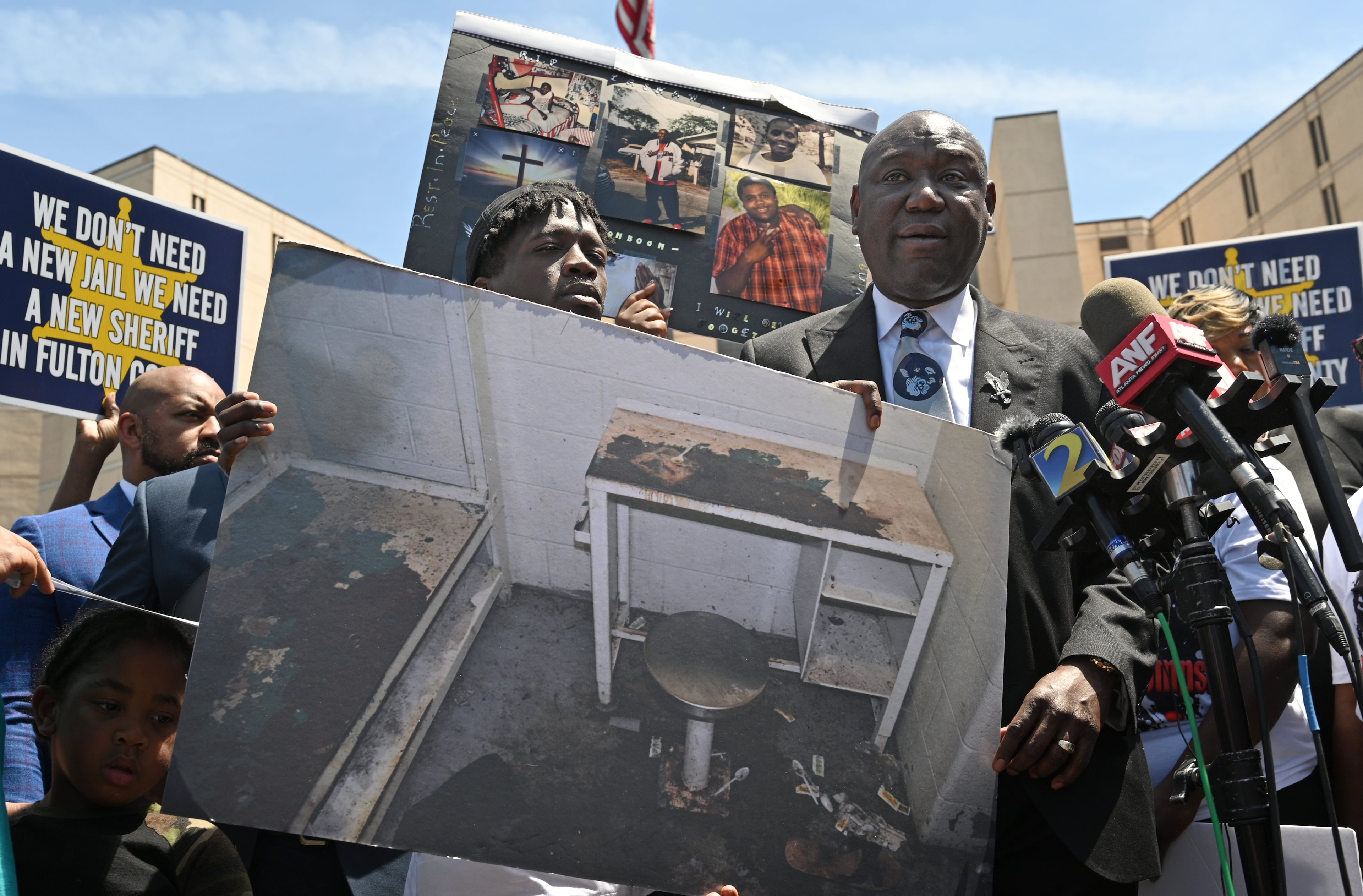
The Justice Department’s latest probe into conditions at Rice Street stemmed from the 2022 death of LaShawn Thompson, a homeless man whose body was found in the jail’s psychiatric wing covered in bed bugs.
Since then, there have been overdoses, illnesses, suicides, stabbings and beatings, according to lawsuits filed by current and former detainees.
Jailers and contractors have been charged with smuggling in contraband, and lawsuits allege the sheriff’s office does little, if anything, to separate violent and nonviolent offenders.
A spokesperson for the sheriff’s office said that’s not true.
“Every inmate is classified and then housed accordingly” based on their charges and history, Communications Director Natalie Ammons said.
All women detainees who don’t require medical or mental health care are held at the Atlanta City Detention Center. Some men are also housed there, officials said, but only those accused of nonviolent offenses.
Former Fulton County Deputy Quinton Coleman described his nearly two years working at Rice Street as “a nightmare.”
“Everybody has a weapon,” he told the AJC, and it’s “not uncommon” for a jailer to be on a floor by themselves.

Coleman said the problems at Rice Street are “a clear-cut leadership issue.”
People tasked with supervising detainees frequently lack the training necessary, he said. Additionally, members of rival gangs are often housed together, which he said is a recipe for jailhouse violence.
Roberts said although there’s always finger-pointing and blame over budgetary issues, few point to the violent culture within the jail. That, she said, begins and ends with Labat and his administration.
“He is not responsible for the volume of people in the jail,” Roberts said, but “few people talk about the actual culture of violence and depravity that can only come from the sheriff himself.”
— AJC staff writers Rosie Manins, Jozsef Papp and Alia Pharr contributed to this article.
— Editor’s note: This story was updated to include additional information about the way Fulton County’s superior court cases are weighted and the circuit’s plans to request another judge during the next legislative session.
About the Author


