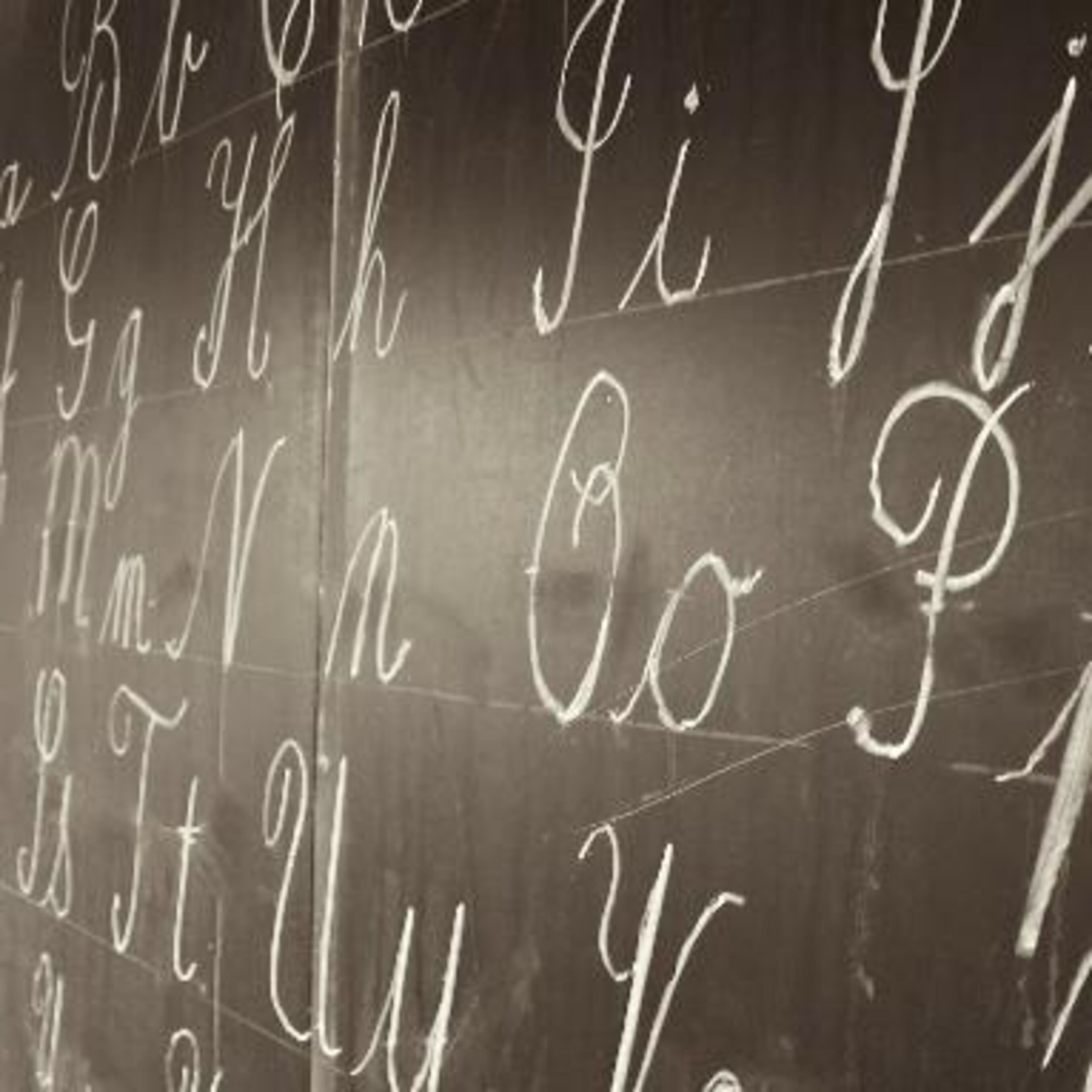
Cursive writing was becoming a lost art. Now, it’s back in Georgia schools.


Pencils at the ready on their lined paper, the fourth graders at Fifth Avenue Upper Elementary in Decatur tried to articulate why they’re learning to write in cursive.
“So we can learn more stuff and be fancy?” ventured one student. A series of carefully traced lowercase letters spanned the page in front of him, the loops and swoops and curlicues demonstrating his point.
He wasn’t wrong — cursive is much fancier than print lettering. It’s also one of those topics in education that’s emotionally charged, evoking stories that start with “Back in my day ...” and end with “What’s wrong with kids today?”
Is cursive a relic of the past or a skill vital to development? The state of Georgia says it’s the latter. Cursive instruction is required for third- through fifth-graders as of 2025, reviving the art that was on its way to being lost.
It comes with a host of benefits that go beyond style. Teachers say it supports the development of fine motor skills, helps their writing keep up with their thoughts, improves memory, lets students develop their own unique signatures, and allows them to interact with historic texts like the U.S. Constitution. And still, it wasn’t all that common in elementary classrooms before the state rewrote its academic standards.

The rise of technology may be to blame, said Kelly Causey, an assistant professor of education at Middle Georgia State University with more than 30 years of experience in teaching.
“I think what has happened over the years is with the increase in technology use, the development of new technologies, and the addition of so many things that have to get basically crammed into the elementary school day, cursive was one of those things that kind of got pushed out,” she said.
Now, with the rise of one-to-one technology in the classroom, the ubiquitous nature of cellphones and the increasing use of artificial intelligence, parents are pushing back on the idea that tech is king. They want their kids looking at fewer screens, said Fifth Avenue Upper Elementary’s Principal Derrick Thomas. Cursive writing can help.

“We haven’t heard a lot directly from parents in regards to cursive writing,” he said. “What we have heard is a lot of support in regards to us minimizing our use of devices, which is kind of a byproduct.”
But Causey stresses that it’s not an either-or situation. Skipping cursive instruction because of the advent of keyboards doesn’t make sense, nor would skipping instruction on typing.
“It would be like saying because we have calculators, we don’t have to teach number sense anymore,” she said. “We have to do both and we have to do them well.”
The campaign for cursive comes as some, particularly on social media, question its necessity. But educators and state leaders seem to have put the question to rest for now: More than half of U.S. states require the teaching of cursive writing, either through state academic standards or law, as of this year.
For students at Fifth Avenue Upper Elementary, which is one of more than 600 public schools in the state that were recognized this year for proficiency in cursive writing, learning the skill feels like a way to be prepared for the future.
“What if somebody writes a letter to you in cursive and then you didn’t know how to read cursive?” asked third grader Mira Gross, 8 (favorite letter to write in cursive: uppercase M). “What would you do if you don’t always have someone to help you?”

Eli Tolentino, a fourth grader at the school, said learning to write cursive was hard at first.
“I’ve been stuck with writing in print for a long time, so I have to remember all the ones that are different — like uppercase Q and lowercase J,” the 9-year-old said. But now, it’s a lot easier. “Print is basically cursive. You just have to connect them together.”
Eli reads a series of graphic novels about U.S. History where the characters sometimes write letters to each other in cursive, he said. He realized that he can now read those parts easily.
It’s part of growing up, said fifth-grade teacher Len DiGiacomo.
“I just think that they learn a more adult skill that has gone by the wayside,” he said. “Once they learn that skill, they kind of prefer it.”
The cursive test
If your cursive skills are a bit rusty, review each letter form in the guide below from the Iowa Reading Research Center. Then grab some paper and write out this sentence: “The quick brown fox jumps over the lazy dog.” Was it harder than you remember or second nature? Email a photo of your homework to cassidy.alexander@ajc.com.