Morehouse celebrates its new president and supercomputer
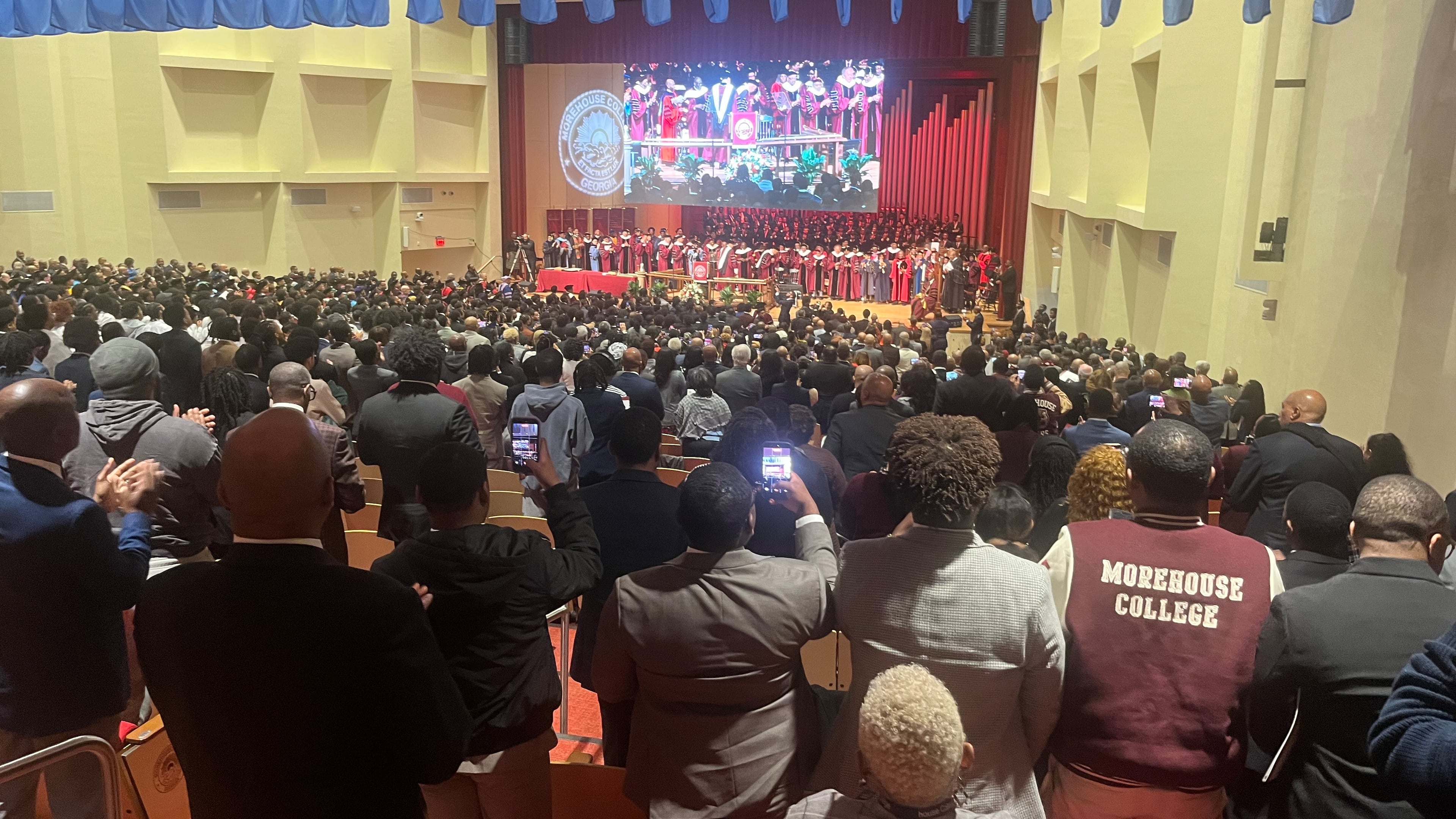
Valentine’s Day marked the 159th year anniversary of Morehouse College. Two days before, the historically Black college pronounced its love for its 13th president.
On Feb. 12, seven months after F. DuBois Bowman took over the role at his alma mater, the school held its inauguration ceremony to celebrate his return. In a packed Martin Luther King Jr. International Chapel, one speaker after another voiced their support for the man they hope will lead the college to great heights.
“I return home to my alma mater with clarity on the assignment,” Bowman told the crowd.
That’s not the only news from Morehouse this month. Get caught up on the HBCU and other Georgia universities in this edition of the AJC On Campus.
Super HBCU
Earlier last week, Morehouse celebrated another milestone, announcing that it received $5 million to build a supercomputer. The initial funding from a National Science Foundation grant will allow the Atlanta school to begin construction. Once completed, HBCUs across the nation will have the chance to access the machine’s capabilities.
“The supercomputer will push the boundaries of artificial intelligence, providing greater access to areas such as climate modeling, machine learning, and biomedical research,” the school said in a press release.
Bowman called the partnership with NSF and the University of Texas at Austin a “transformative project” that will position students and faculty to shape the future of science and technology.
Professor Kinnis Gosha told the AJC that many HBCUs and smaller universities lack certain research capabilities on their campuses. But when the Morehouse supercomputer is operational next year, students will be able “to do research at the same level of students at Georgia Tech or Georgia State University, so it really levels the playing field,” he said.
Emory’s presidential search
Just as Morehouse was celebrating its president, Emory University began looking for theirs.
On Feb. 17, its board of trustees announced that a search was underway to find a president for Georgia’s largest private university. The role has been occupied on an interim basis by Leah Ward Sears since September, following former president Gregory Fenves stepping down to become the university’s chancellor.
In the announcement, board chair Robert C. Goddard III said that Sears’ “steady leadership and thoughtful stewardship of the university throughout this transition have ensured we are exceptionally well positioned for the work ahead.”
This week, Goddard provided an update, saying that the presidential search committee had selected Russell Reynolds Associates, an executive search firm, to help it find the right person for the job.
“The selection committee is now organizing a series of listening sessions across the community and is in close communication with the leaders of Emory’s governing bodies to ensure broad and inclusive consultation,” said Goddard.
Autism research
Researchers from Emory are collaborating with experts at Georgia State University to embark on what GSU is calling, “the largest study ever conducted to investigate the causes of profound autism in children.”
Funded by a $21.9 million grant from the late Bernie Marcus and The Marcus Foundation, the study hopes to develop possible treatments for the developmental disorder.
“The goal is to enable precision medicine interventions that will accelerate learning, make symptoms less severe and improve response to treatment in children with profound autism, and possibly even prevent profound disability from emerging in the first place,” said lead researcher Ami Klin, director of the Marcus Autism Center.
Georgia Tech flying with Delta
The Delta Air Lines Foundation has committed $5 million for the construction of a new aerospace engineering building at Georgia Tech.
In a Wednesday media release, President Ángel Cabrera said the support, “will be key to the development of the talent, research, and innovation that will secure our state’s position as a global hub for aerospace technology.”
The building will be the new home of Tech’s aerospace engineering school, which is ranked No. 2 in the country by U.S. News & World Report.
EncROACHment
Late last month, Clayton State University received a letter from the Foundation for Individual Rights and Expression. It said that the school’s official Instagram account had blocked a student on the platform because he commented on a post, alleging that there was a cockroach infestation in a resident hall.
“(Y)’all wanna delete my comment but not the roaches,” wrote student Jaden Dorsey before he was blocked.
FIRE said the decision was a violation of the First Amendment. It asked that the public university respond to their letter by Feb. 13 to confirm it would unblock Dorsey. On Feb. 6, FIRE said that Dorsey had been unblocked.
“And thanks to his advocacy on social media, CSU had pest control spray every room in the building where he alleged the roach infestation took place,” Jack Whitten, a communications campaign specialist with FIRE, told the AJC in an email.
If you have any higher education tips or thoughts, email reporter Jason Armesto at jason.armesto@ajc.com.
About the Author