Rivian to boost EV production at planned Georgia plant, shrinks DOE loan


Electric vehicle maker Rivian announced Thursday it amended its multibillion-dollar federal construction loan, a deal that will reduce its borrowing by $2 billion. But the EV maker says the change will allow the company to expand the scope of its Georgia factory’s first phase.
The California-based automaker and the U.S. Department of Energy’s Office of Energy Dominance Financing agreed to reduce a previously awarded $6.6 billion loan to $4.5 billion, Rivian said in a news release. The amended loan allows for the first phase of Rivian’s future plant an hour east of Atlanta to have an annual capacity of 300,000 vehicles, a 50% increase from prior plans.
Until Thursday’s announcement, the project was slated to consist of two phases, each with a production capacity of 200,000. The amended schedule and site design increases the first phase’s capacity, allowing Rivian to ramp up its Georgia production efforts more quickly “while still providing significant room for future expansion in later phases,” the company said in a letter to shareholders.
The construction timeline, however, has not changed. Rivian officials said vertical construction at the 2,000-acre site in southern Morgan and Walton counties will kick into gear this summer. The factory’s first phase is expected to open in late 2028, assembling the brand’s new midsize SUV model called R2. The company also plans to build robotaxis as part of a partnership with Uber.
“We’re very excited to partner with the U.S. Department of Energy to grow our manufacturing footprint in Georgia,” Rivian founder and CEO RJ Scaringe said in the release.
“R2 dramatically expands our market opportunity,” Scaringe continued. “The thousands of dedicated people who will soon work in our Georgia plant will be instrumental to Rivian’s growth as we scale American manufacturing and work to ensure that the U.S. retains its leadership in innovation and technology.”
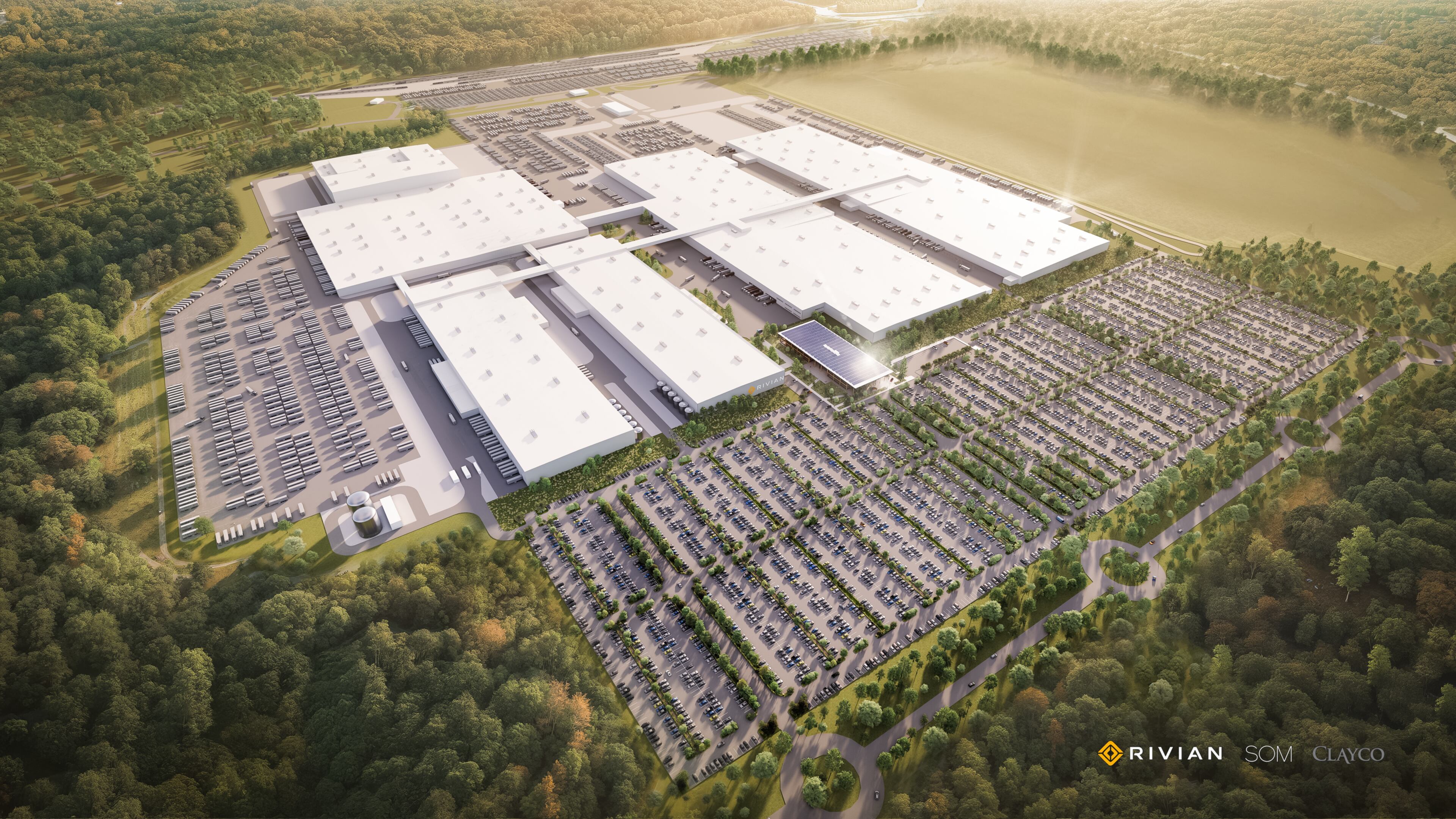
The Rivian project was the largest-ever jobs and investment deal in state history when it was announced by Gov. Brian Kemp in December 2021, surpassed only by the Hyundai Motor Group EV factory near Savannah. Rivian has pledged to invest $5 billion in the project, which will employ 7,500 workers.
But Hyundai opened first. Rivian paused the Georgia factory in March 2024 as a temporary cost-cutting measure and shifted initial production of R2 to its existing plant in Illinois. Despite the pause, Rivian said it remained committed to opening its Georgia factory, holding a groundbreaking ceremony with state officials in September.
The U.S. Department of Energy finalized the initial $6.6 billion construction loan with Rivian in early 2025, just as President Joe Biden prepared to exit the White House. Rivian had applied for the loan more than two years earlier, but it wasn’t approved until the waning months of Biden’s presidency among a wave of other clean energy-related loans.
The loan’s issuance faced criticism from some Republican leaders, raising questions about whether it could be clawed back, but Rivian officials emphasized that it was a done deal. The Trump Administration has taken action to renegotiate, reduce or cut previously issued loans for clean tech projects, including EV initiatives.
Rivian has also yet to turn a profit and has faced struggles in ramping up its vehicle production, although partnerships and joint ventures with Amazon, Volkswagen and Uber have buoyed the company’s balance sheet. Rivian ended the first quarter with $4.8 billion in cash reserves, and Rivian Chief Financial Officer Claire McDonough said another $2.6 billion through those partnerships is expected to add to that total this year.
During the first quarter, Rivian posted total revenue of $1.4 billion, a 11% increase from the same time last year. The automaker also posted a loss of $417 million, a 23% decrease the same time in 2025.
The DOE loan amendment announced Thursday reduces the loan’s principal to just over $4 billion along with $494 million in capitalized interest. Rivian expects to be able to first draw on the loan by early 2027.
“Preparations are underway for the development of the stamping press area, one of the most capital-intensive and technically demanding projects within the plant from a construction perspective,” Rivian said in the release. “Progress will accelerate this summer as the facility’s primary buildings begin to take shape.”
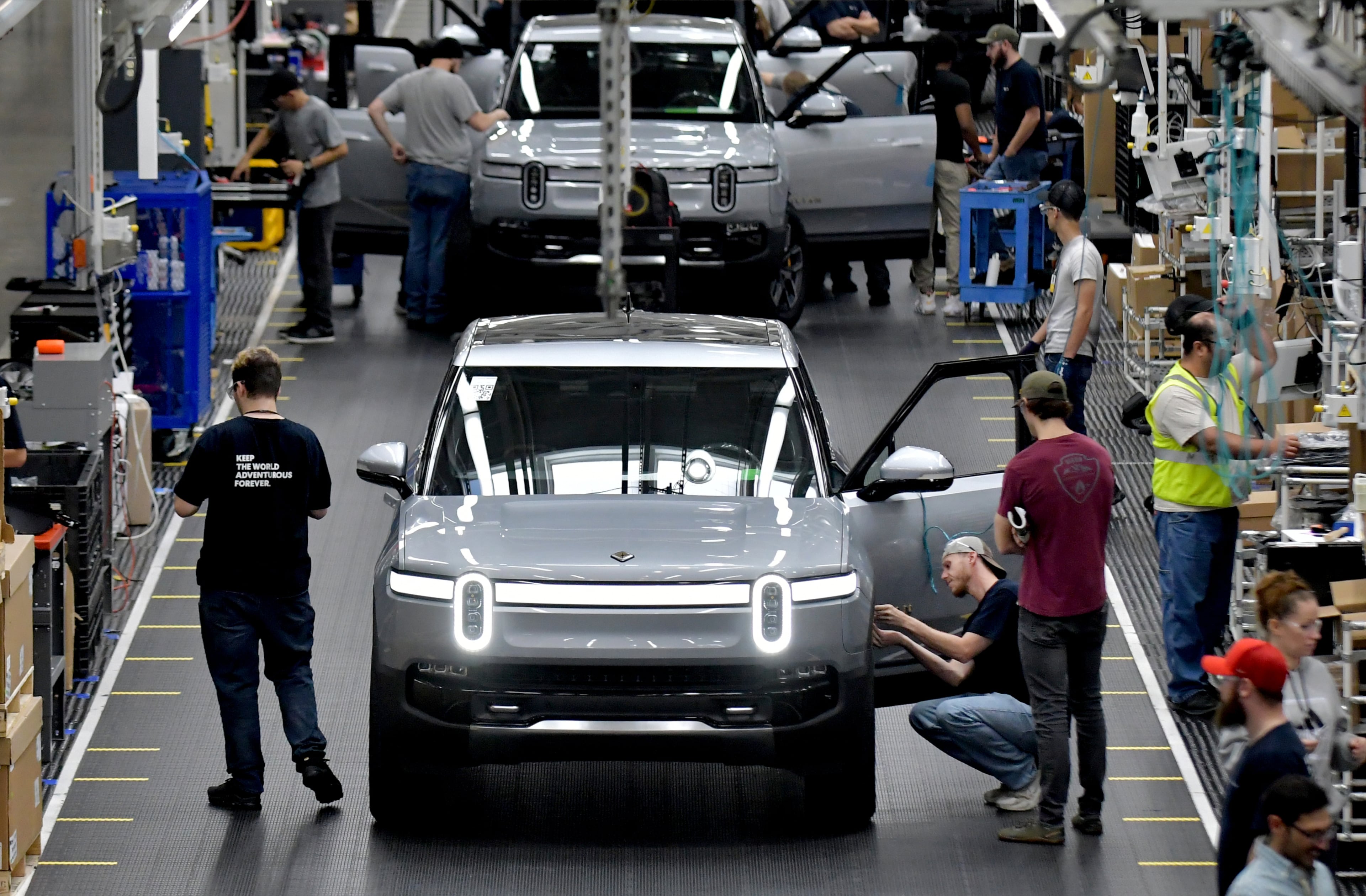
Rivian leadership is heavily betting on the R2 to appeal to a wider range of customers and bolster sales to become profitable. The first production R2s started rolling off Illinois production lines last week.
The R2 launch models start at $57,990. Two lower-priced versions are coming, including a single-motor version starting at $48,490.
The average new vehicle purchase price in the U.S. is currently about $50,000.
“I believe the R2 will be a game-changer for our customers and will be a key driver of our company’s long-term growth and profitability,” Scaringe said, arguing it fills an untapped niche for electric mid-size SUVs at lower prices. Rivian’s flagship R1T truck and R1S SUVs are luxury vehicles with starting prices of $72,990 for R1T and $76,990 for R1S.

McDonough added that the additional production capacity at the future Georgia plant will allow Rivian “to meaningfully scale in the future,” a critical step to becoming profitable. Scaringe told CNBC that any future expansion of the Georgia plant would be funded by the company.
When asked about the second phase and how that is no longer included in the DOE loan’s scope, McDonough said, “We’ll continue to be opportunistic as it pertains to our capital road map.”
It’s also unclear if the vision for the completed factory’s capacity, which was initially announced as 400,000 EVs, will change as a result of the altered first phase.
The company has made Georgia important to its future beyond just the factory. Rivian also selected Atlanta for its East Coast headquarters, leasing a 45,000-square-foot space along the Beltline. It is expected to employ 500 workers.
Cox Enterprises, which owns The Atlanta Journal-Constitution, also owns about a 3% stake in Rivian.