Atlanta’s industrial market starts to recover from its post-COVID hangover

Atlanta’s industrial market during the COVID-19 pandemic was like a raging party — it was boisterous, frenzied and everyone was invited.
As millions of people shifted more of their buying online, an unprecedented amount of new warehouse space was built, and tenants big and small rushed to get in on the action.
But then came the hangover.
Big companies hit the brakes on signing new leases even as developers were still building. Vacancies soared.
The number of industrial leases larger than 1 million square feet in metro Atlanta drastically decreased after 2022, according to data from real estate services firm JLL. Twelve such deals took place in 2021 and 2022, but only four were finalized in the two years that followed.
The sheer volume of available new warehouse space, rising rents and later the threat of tariffs and their effects on global trade combined to curb activity among large industrial users that typically invigorate markets, real estate experts said.
“Million square-footers were no longer invited to the party,” said Lisa Jebodhsingh, director of research for JLL.
That remained the case for much of 2025, but the year’s final few months showed signs of change.
Two deals that eclipsed 1 million square feet were signed in metro Atlanta during the fourth quarter, doubling last year’s total, according to JLL. The uptick has market experts optimistic that bulk users — think of them as industrial whales — are regaining confidence with their Atlanta area leasing decisions.
“The last two years when there was more economic uncertainty, there were a lot more smaller deals,” Jebodhsingh said. “But four deals (by million square-footers) is quite a positive uptick in activity.”
There’s another positive trend. metro Atlanta’s industrial market ended 2025 with a surge in positive absorption, a measure of whether a sector is growing or shrinking. When the number is positive, that means more space is being leased or absorbed than is being emptied.
Last year’s second quarter, which was on the heels of President Donald Trump launching his tariff campaign, was the only one to post negative net absorption since 2011, according to real estate services firm CBRE.
Joanna Blaesing, an industrial landlord broker at CBRE, credited the year-end recovery with the return of bulk users.
“We haven’t seen that level of bulk activity in a long time,” she said. “Having bulk users feel confident enough to make deals just helps the market overall.”
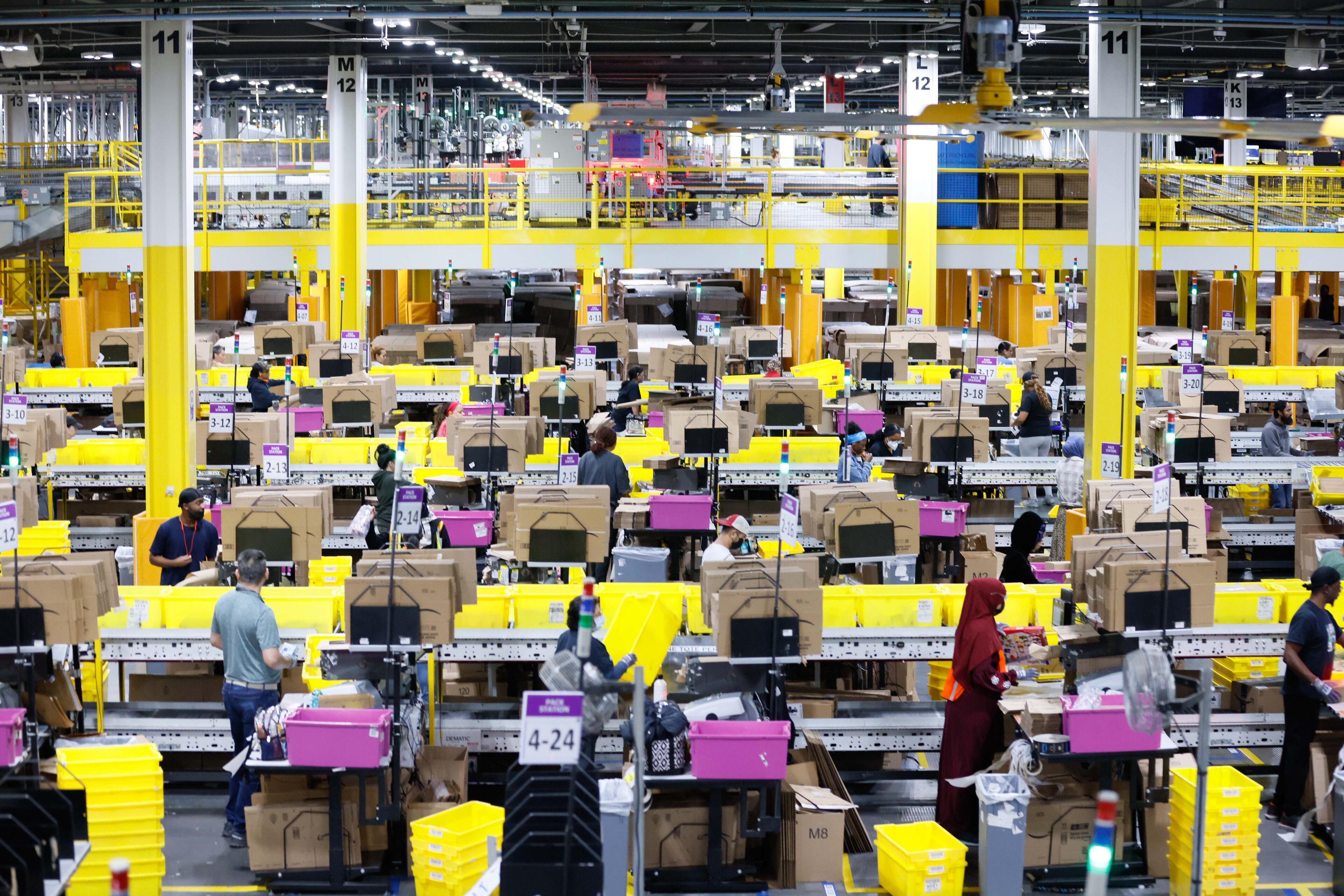
The 2020 COVID-19 shutdown roiled supply chains and generated unprecedented demand for more warehouses and shipping centers. By 2022, what would have been a typical year’s worth of warehouse space was starting construction every three months, and more projects kept increasing the backlog.
It will take time to absorb all of that new space, especially if companies are hesitant about the economic outlook for their projects or supply chains, said Jonathan Koes, who leads the Atlanta research team at real estate services firm Colliers. The shifting trend among large users places 2026 as a “recalibration year,” he said.
“It’s interesting how quickly it can turn,” Koes added. “It’s pretty easy to go from building too much to not enough.”
A big influence
Atlanta is the largest market in the Southeast for warehouses, distribution centers and manufacturing space.
That expansive footprint left the region exposed last year when Trump began levying tariffs against most American trade partners on April 2, or “Liberation Day”, as he called it. While the White House backed off its maximalist demands and sought to reach deals with embedded tariffs, its impact on industrial tenants was immediate.
“We had a tremendous amount of activity out of the gate (in 2025) across all size ranges for our space in Atlanta,” said Ryan Hoyt, executive managing director at JLL. “And then the tariffs hit, and I bet 75% if not more of our activity went on hold or died.”
Overall leasing activity in metro Atlanta last year dipped about 6% compared with 2024, which was seen as a bounce back year after so much new supply flooded the market the years prior, according to real estate services firm Cushman & Wakefield. Lisa Pittman, executive managing director in the firm’s Atlanta office, said the pullback in lease signings feels significant, but it’s closer to a realignment with historical norms.
“We were going 100 miles an hour,” Pittman said of the post-pandemic warehousing boom. “Now we’re back to 65. So that feels a lot slower, but it’s actually a pretty normal pace.”
This coincided with the region’s vacancy rate steadily increasing, ending 2025 at 9%. That’s more than double what it was in 2022, but Pittman emphasized that “historically anything under 10% for Atlanta is super healthy.” In contrast, the region’s office market set records for high vacancy rates in the wake of the pandemic, ending last year with a 25% vacancy rate.
The city’s large industrial leases have been an outlier, especially among Atlanta’s peer industrial markets.
Nearly all of the recent largest deals inked in the Atlanta area were renewals, according to CBRE, while only about 25% of other market’s large deals were renewals.
“Uncertainty pushed many tenants to renew rather than relocate, while landlords opened renewal talks much earlier than in past years,” Blaesing said. “That combination drove the unusually high share of large renewals in Atlanta. We expect the same this year, given the number of large leases that are expiring and those tenants needing to make renewal or extension decisions.”
Flight to quality
When decisions are being made, tenants and investors are opting for newer warehouses.
Buildings that are less than 15 years old have significantly higher absorption rates compared to older industrial properties in the Atlanta area, according to CBRE. The region’s collection of older warehouses has been in the red for the past three years.
It’s a real estate trend often called “flight to quality,” in which tenants are willing to pony up higher rents for high-end space that suits their needs. It’s been especially prominent in the office market, where companies see luxury spaces as an incentive to woo workers back to a physical workplace, but it’s starting to crop up in industrial spaces as well.
Boston-based real estate investment firm Marcus Partners paid $49 million at the end of last year to enter the Atlanta industrial market by buying a newer warehouse. It acquired Creekside Distribution Center in East Point, a nearly 539,000-square-foot building built in 2016 that was 77% leased when the deal closed Dec. 23, according to Fulton County records.
The building is one of the rare warehouses close to Atlanta that isn’t struggling with vacancy but has potential to snag new tenants without expensive renovations.

Andrew Dolinsky, partner of Marcus Partners, said the property aligns with his firm’s “strategy of acquiring well-located assets where operational execution and active leasing can drive long-term value.”
“This acquisition reflects our conviction in Atlanta as one of the premier industrial markets in the country and advances our ongoing Southeast expansion,” he continued in a news release.
With space available to lease, Creekside Distribution Center is among the industrial buildings waiting to see if the return of bulk tenants will spur any momentum. It’s something everyone invested in Atlanta’s industrial market will be watching this year.
“What we don’t know is if it’s a single wave or if this is the beginning of a nice trend,” Hoyt said.
About the Author

Zachary Hansen, a Georgia native, covers economic development and commercial real estate for the AJC. He's been with the newspaper since 2018 and enjoys diving into complex stories that affect people's lives.