In Mimi Plumb’s photos of the West, American anxieties glare like the sun
In Mimi Plumb’s photographs, drought and fire have consumed the California landscape. The suburbs have spread like a virus, replacing trees and foliage with concrete and stucco. And there is a growing economic gap that tests the durability of American democracy.
If that state of affairs sounds like just another day in 2026, you might be surprised to learn that San Francisco-based photographer Plumb, 72, the subject of “Blazing Light,” a new survey at the High Museum of Art curated by Gregory J. Harris, has been treating these topics since the 1970s.
“Blazing Light: Photographs by Mimi Plumb” references a 1961 Samuel Beckett play “Happy Days,” about a woman buried up to her neck in the earth as she tries to live despite her existential dilemma. That scenario offers distinct echoes of Plumb’s own situation growing up in California — the land of sprawl, fires, drought, earthquakes and enormous economic disparities. Plumb has had a front row view of unfolding cataclysms that have spread to other parts of the country.

“Blazing Light” looks at the evolution of Plumb’s career from the 1970s up to the present. The work charts the vantage of a young girl growing up in the redlined San Francisco suburb of Walnut Creek and her later years as an observer of the Bay Area’s punk rock scene in the 1980s. Plumb’s perspective has always been critical, incisive and in a long tradition of creatives looking beneath the West Coast dreamscape: John Steinbeck, Joan Didion, Nathanael West, James Ellroy.
“I have never thought of California as being this Eden,” said Plumb. In the photographer’s rendering California’s blinding sun feels apocalyptic instead of nourishing.
Plumb has been attuned to the world’s troubles since the tender age of 9 when she went to bed fretting about nuclear war. Her childhood and teenage years were marked by the assassination of John F. Kennedy, the Cuban missile crisis, three older brothers in the ‘60s protest hotbed of the University of California, Berkeley and living through an intense drought in the ‘70s.
“Those were just deeply searing moments,” said Plumb from her home in Berkeley where her black cat occasionally makes a dramatic, potentially foreboding appearance on her Zoom screen. “I felt that weight, and that’s not gone away.”
“Blazing Light” is arranged chronologically beginning with “The White Sky,” Plumb’s first body of work and her effort to convey the ennui of being a teenager growing up in the suburbs of San Francisco: the scorching sunshine, the architectural uniformity and kids smoking cigarettes or playing in urban wastelands of discarded car tires.
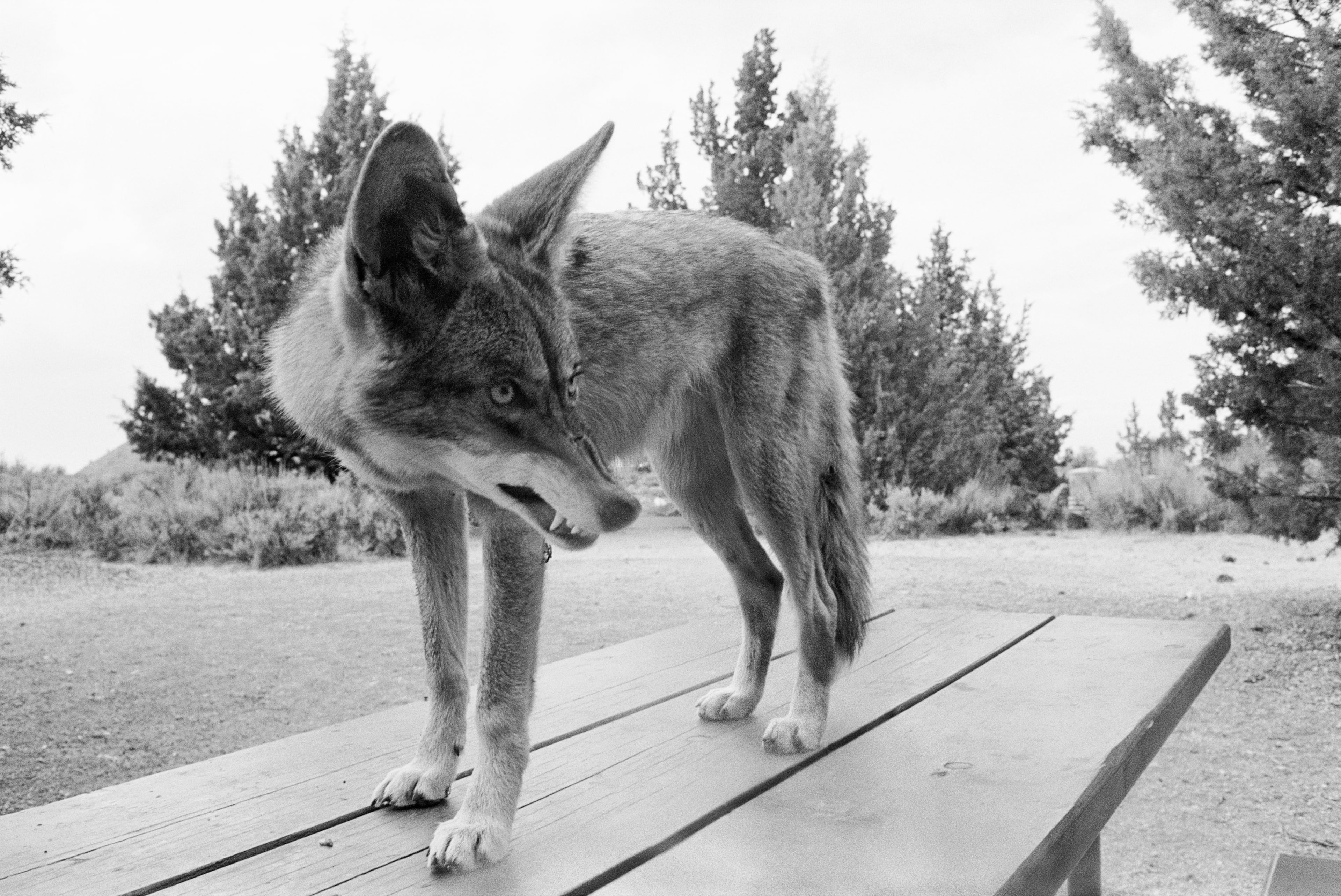
In one of the most arresting “White Sky” images “Coyote at the Park” (1976), a wiry coyote stands atop a wooden picnic table wearing a terrifying expression, its teeth bared. The image suggests a wilderness pushed to the margins and lashing out.
“All the pictures are made in the suburbs, around San Francisco and they have this sense of the waning optimism of the 1960s and how it’s kind of lingering into the 1970s,” said Harris.
“I always wanted to photograph what things felt like to me,” said Plumb explaining a vantage that some have described as documentary though she thinks of it more as personal, empathetic, invested.
“I wanted to get at what it felt like growing up in suburbia and growing up during that time. But I think also, one of the threads that really runs through it, through everything, is that anxiety that I felt as a child, and still feel today, and that has never really gone away.”
The next phase of the exhibition, “Landfall” and “The Golden City,” focus on California’s landscape and “how humans had degraded, devastated, tried to extract and exploit the natural world and had detrimental effects on it,” said Harris. The ennui of Ronald Reagan’s ‘80s and the fraying of the social safety net is another component.
Harris became aware of Plumb’s profound photographic legacy with the publication of her monograph “Landfall” in 2018. Plumb has been thrilled to see that work embraced by Gen Z and Millennials who have grown up with the specter of climate change.
“I’ve been surrounded by young people” since “Landfall’s” publication, she said. The book captured a 1980s America of wildfire-scorched homes and forests, an aggressive military buildup and a general malaise about the future under Reagan’s presidency.
Along with a 2022 Guggenheim Fellowship, the publication of “The Reservoir” in 2025 brought her work to an even larger audience in what the British Journal of Photography has described as “the rise and rise of Mimi Plumb.”
For High photography curator Harris, “Landfall” felt incredibly prescient.
“There was just this sense that the social fabric of our country was kind of unraveling, and there was just a great deal of tension and angst throughout the country. And I thought that Mimi’s pictures really spoke to that, even though, at that point they were, what, 30 years old.”
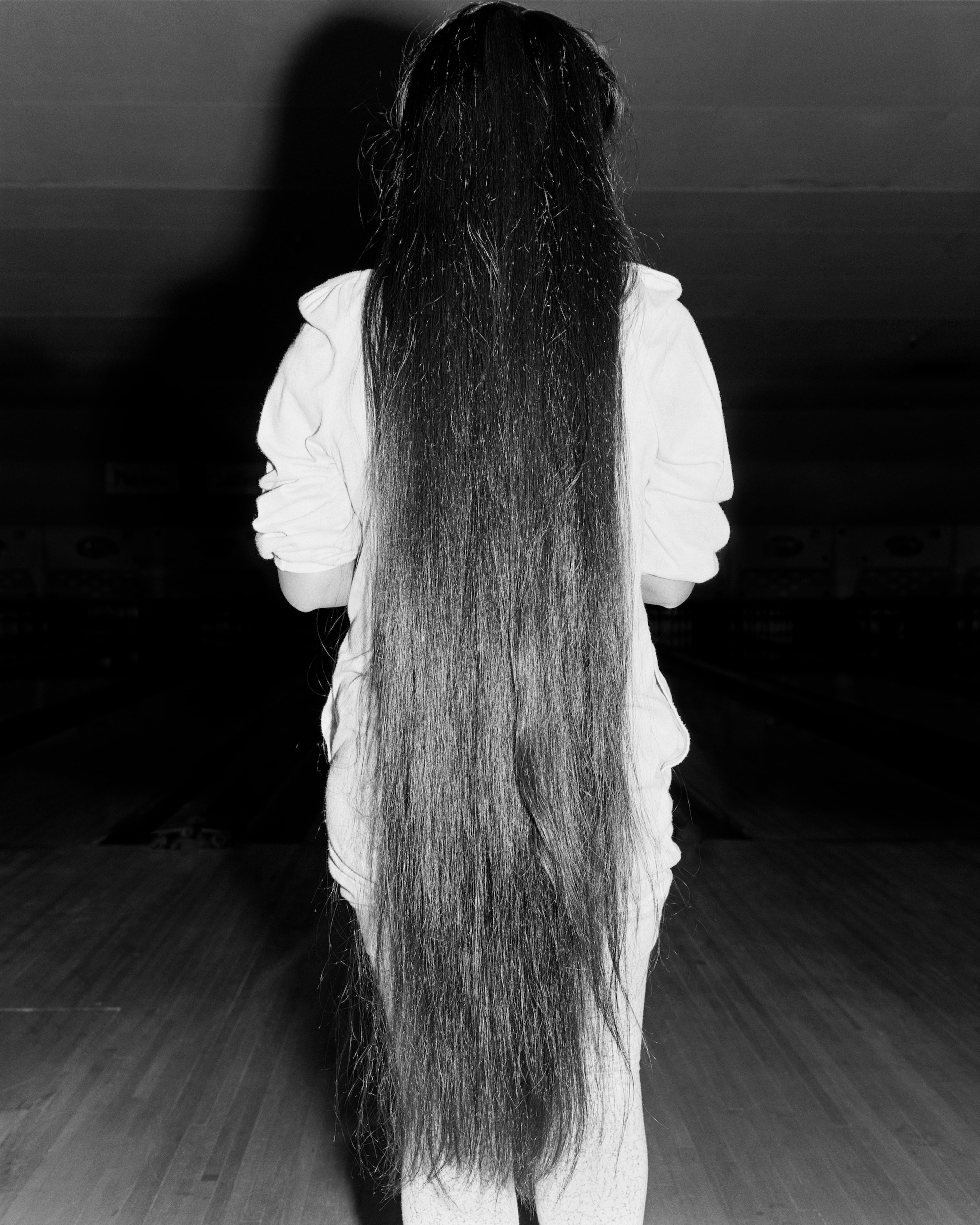
One of Plumb’s favorite images from the “Landfall” series is “Tang” (1987), of a young woman with long dark hair down to her knees, her back to us. It’s a friend of Plumb’s captured from behind as she hoists a bowling ball. But for Plumb it encapsulates the trepidation and anxiety she and her friends felt in the 1980s.
“She’s just looking out at this void. I mean, she doesn’t know what she’s looking at and what’s going to happen. And I think that that speaks to all of the work,” said Plumb.
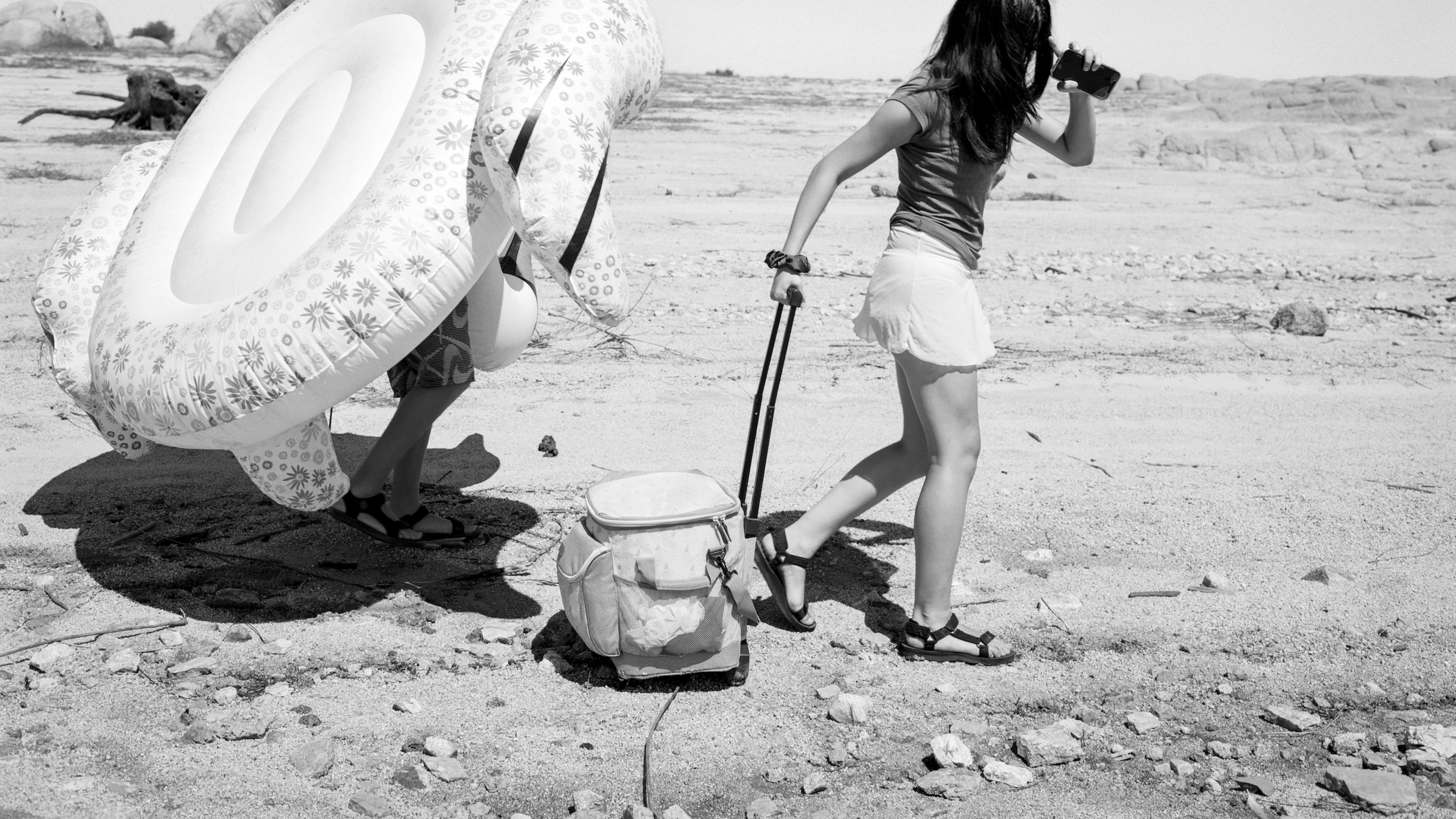
The most recent body of work on view at the High, “The Reservoir,” is perhaps Plumb’s most subtle. She captures the scene at a reservoir outside Sacramento, California, that exerts a zombielike pull on swimmers. It’s a parched landscape with a pitiless blinding white light that speaks to the environmental degradation captured in “Landfall.”
“People are kind of wandering aimlessly through this completely devastated landscape,” said Harris.
In Plumb’s image “Traveling to the Receding Lake II” a mother and child look like war refugees trucking across an alien desert landscape in search of water though, incongruously, carrying an inflatable pool float and tugging a cooler on wheels behind them.
“I see that as being a sort of continuation of my feeling like things are wrong, and look at what we’re doing to the environment,” said Plumb of her work in “The Reservoir” collection, “and this is what we could be looking at in the future.”
EXHIBIT PREVIEW
“Blazing Light: Photographs by Mimi Plumb”
Feb. 6-May 10. $23.50. High Museum of Art, 1280 Peachtree St., Atlanta, 770-733-4400. high.org.
Correction
This story has been updated to correct Mimi Plumb's age.


