‘Return of the King’ charts how Atlanta revived Ali’s boxing career
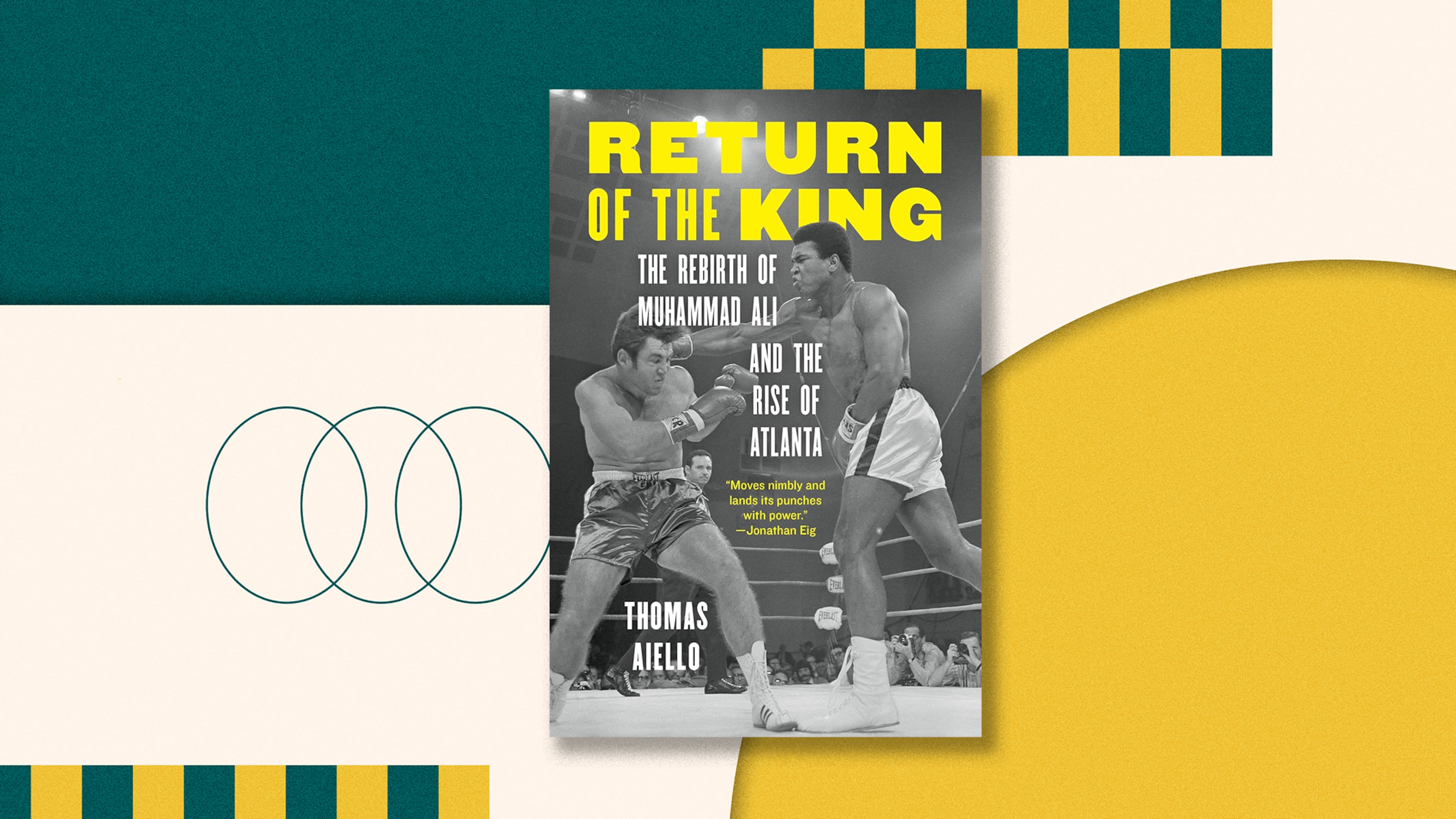
Gone for nearly a decade, Muhammad Ali is still “the Champ,” a mythical figure who once lived in human form. Yet, in Thomas Aiello’s “Return of the King,” an immersive, behind-the-scenes account of the 1970 Ali-Quarry fight in Atlanta, politician Leroy Johnson steps up as an unsung hero in his own right.
A smooth operator, Johnson changed the course of Atlanta’s history, actualizing the city as a “Black mecca,” Aiello contends, simply by engineering a sporting event no other municipality in America would touch.
To be sure, there wasn’t any such thing as “simply” when it came to staging a contest in the South featuring the man formerly known as Cassius Clay. His Nation of Islam name change alone infuriated relics of “massive resistance” still fuming over the Civil Rights Act of 1964.
Facing five years in prison for his refusal to fight in the Vietnam War, he was stripped of his crown and banned from the ring everywhere in the United States, except, as it turned out, Atlanta.
If Ali was formidable in-and-out of the ring, the cigar-toting Leroy Johnson fought equally well in his own bare-knuckles arena: Georgia politics. A Morehouse graduate, Johnson was elected in 1962 as “the first Black state senator in Georgia since 1870 and the only Black state senator in the South.”
A minority of one, Johnson endured every indignity the state Legislature had to offer, but that began to change as he forged working partnerships between Atlanta’s Black and white power structures. Johnson pushed for “equitable housing.” He stood firm against police brutality. He advocated for a state holiday commemorating the Rev. Martin Luther King Jr.’s birthday.

All the same, the author doesn’t demure from cataloging Johnson’s myriad pursuits of self-interest. If The New York Times called his style “brazen pragmatism,” some local Black leaders, infuriated by his various collusions with the white political class, dubbed him “Oreo” and “Super Tom,” but he got things done.
Enter Muhammad Ali, whose dogged promotional team had struggled to arrange a fight for the Champ anywhere in the world. By 1969, they had been rebuffed by 28 states.
In something of a long shot, Ali’s people reached out to Johnson, promising him part of the proceeds. The senator sprang into action, searching for legal loopholes. He discovered there was no boxing commission in Georgia; he could skirt state authority, making approval a local issue.
After he gained the endorsement of the city’s board of aldermen, he quickly sold then-Mayor Sam Massell on the idea. Then, in a most improbable coup, former Gov. Lester Maddox, a known racist and confirmed Ali hater, gave his blessing.
A preeminent historian of Black Atlanta, Aiello thoroughly unravels the city’s baroque political scene from a half-century ago, particularly the conflict between its more conservative Black elite and the larger Black working class just trying to survive.
The selection of Jerry Quarry as Ali’s opponent was a brilliant gambit. He brought enthusiasm to his role as the “Great White Hope,” supercharging the hype and racial tensions. Maddox withdrew his support and threatened intervention, and hate group members shot up Johnson’s vacation lake house where Ali and his camp were hunkered down.
But nothing could stop the juggernaut. Ali-Quarry would become the biggest boxing draw in Atlanta since 1940, hauling in $206,450, the largest gate in the Municipal Auditorium’s 61-year history, Aiello reports.
For the inexperienced organizers, it was a comedy of chaos: The ring was barely assembled in time; no one had thought to buy corner stools; special boxing had to be ferried from the airport by cab, arriving after the main event was scheduled to start.
The fight itself was a brief affair: Flanked by civil rights leaders and celebrities — including Bill Cosby, Curtis Mayfield, George Plimpton and Sidney Poitier — Ali won.
The more intriguing story was the before-and-after pandemonium. Hugh Hefner threw open the Playboy Club of Atlanta while the real action occurred at the Hyatt Regency, ground zero for the full spectrum of African American culture in all of its 1970s glory, detailed here in full. “Right in the heart of the Old Confederacy,” wrote boxing scribe Bert Sugar, “it was ‘Gone With the Wind’ turned upside-down.”
Aiello, a Valdosta State professor, has written several books on the convergence of sport with social and political history. “Return of the King” is highly recommended for the meticulous rigor of its author’s research. In his summation, the evening was an outrageous success: “More than 100 million viewers around the world, the largest boxing audience in history to that point, watched the Ali-Quarry fight. … Atlanta had officially become an international city.”
And it had been the brainchild of Johnson, whose cut was $175,000. But in an ironic twist, the author notes, the “the pinnacle of Johnson’s political triumph also proved to be his downfall.”
Johnson was immediately hounded by the IRS, which eventually charged him with income tax evasion — Aiello has little doubt it was payback for Johnson arranging Ali’s renaissance. Under indictment (later to be exonerated of the most serious charge), he lost his state Senate seat. In 1973, when Maynard Jackson defeated him in the race to become Atlanta’s first Black mayor, he left the political scene for good. He died in 2019.
In Aiello’s inspirational coda, “Return of the King” also pays tribute to the other victors on that long-ago night: “Black Atlanta had resurrected Ali. In a city that provided its Black population a series of losses, often hidden under the veneer of racial moderation, this time they had won.”
NONFICTION
“Return of the King: The Rebirth of Muhammad Ali and the Rise of Atlanta”
by Thomas Aiello
University of Nebraska Press
344 pages, $36.95