
The arrival of spring and consistently warmer temperatures brings a burst of colorful blossoms and two colorful new cookbooks on cooking with flowers, one from a California author and the other from a gardener-chef pair in Northern Ireland.
In “Eat Your Flowers” by Loria Stern (William Morrow, $34.99), the Los Angeles-based chef and caterer reminds us that flowers can be, and should be, more than just a garnish on a plate. Her book takes her readers on a quick global tour of the use of flowers, stems, leaves and roots in meals from the first documented use of orange blossoms, roses and saffron (the stigma of autumn-flowering crocus) in the Middle East to Aztec and Mayan use of squash blossoms and the use of orchids, chrysanthemums and lotus in China.
She includes a glossary of flowers from anise hyssop and bachelor buttons to zinnias and zucchini blossoms with suggested uses for each and the flavors they add to a dish. Snapdragons, she writes, have a crisp, bitter flavor while tulips taste mildly of cucumber. And she devotes a chapter to “The Botanical Pantry” with recipes for flower salt, botanical simple syrup and vinegar, and water infusions.

The dozens of recipes in “Eat Your Flowers” include Stern’s signature baked goods such as Flower Petal Morning Buns, filled with rose petals and flavored with rose water, and Flower-Pressed Shortbread Cookies, the buttery vanilla shortbread cookies topped with pressed fresh flowers that launched her bakery business which ships cookies and cakes nationwide. There are gluten-free crackers that take their flavor and color from the botanicals used and Flower Pressed Pasta with blossoms incorporated in the pasta dough.
“The Edible Flower” by Erin Bunting and Jo Facer (Laurence King Publishing, $40) is a collaboration between chef Bunting and organic gardener Facer. Their supper club in County Down in Northern Ireland is called the Edible Flower, and their book is an encyclopedic view of growing edible plants covering everything from starting plants from seed to creating edible flower borders and incorporating bits of trees and shrubs in your cooking.
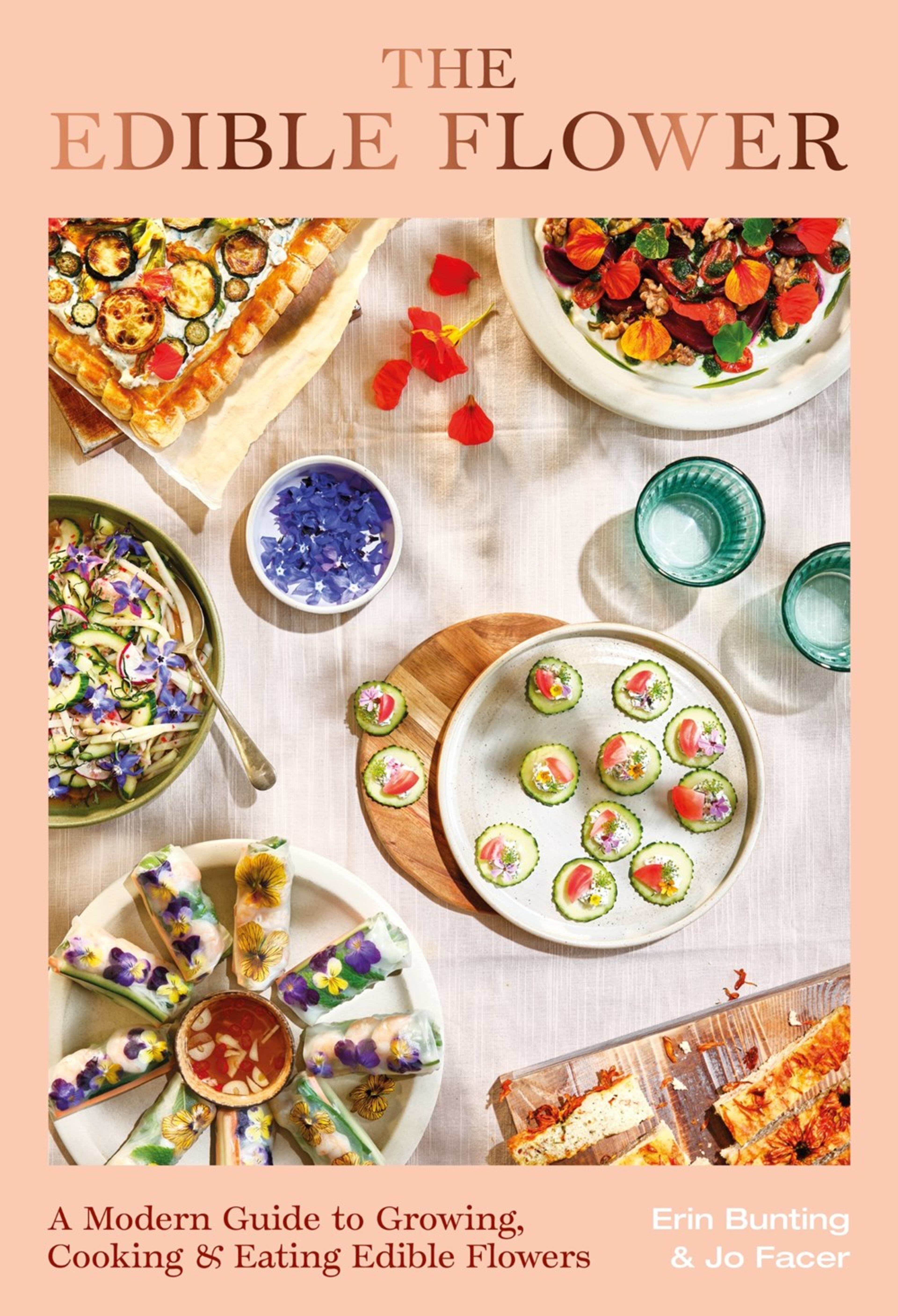
The chapter on daisies, for example, explains how to grow, propagate and harvest these cheerful flowers and reminds the reader that they come from the plant family that includes lettuce, sunflowers, dandelions and dahlias.
Some plants included in the book, like primroses, may do better in an Irish garden than in the hot, humid Atlanta area, but the majority of plants included are easily grown here.
While the book’s recipe for Mexican Pickled Carrots with Coriander Flowers combines flavors that make you wonder why you hadn’t thought of that combination before, the book is also full of combinations you may never have considered, such as roasted carrots with lavender and orange.
Not all the recipes are geared for spring. Fall-blooming dahlias star in a salad of roasted rutabaga and grapes with blue cheese.
And heed the advice of the authors, whether it’s for harvesting saucer magnolias or the geraniums in someone’s window box. “Don’t steal flowers. If you don’t have your own tree, ask permission from the owner before harvesting.”
If you’re not growing your own edible flowers, you can find them in spring and through the summer at local farmers markets. Almost every market these days has one or more local farmers selling bouquets of their field and hoop-house grown flowers. Often they will have clamshells of edible flowers as well. Trader Joe’s and Whole Foods Market often offer clamshells of edible flowers, and Crystal Organic Farm in Newborn sells dried calendula flowers most of the year and fresh calendula blossoms in season.
RECIPES
These recipes from two new cookbooks about growing and cooking with edible flowers provide inspiration for a wide range of sweet and savory dishes. Always remember when cooking with flowers to be careful of your source. You want to be certain your flowers haven’t been treated with chemicals, and remember that not every flower is edible. Even if the petals are edible, the stems or leaves may not be. Consult a reliable identification guide before using.

Floral Summer Rolls
These might be the prettiest thing you serve this spring or summer. “They remind me of light streaming through stained glass — the vibrant colors of the flowers shine through the rice wrappers, making for a beautiful, jeweled presentation,” writes Loria Stern, author of “Eat Your Flowers” (William Morrow, $34.99). She also suggests using the recipe for inspiration, customizing with whatever vegetables and herbs you have on hand and the flowers that are in season.
If you cannot find edible flowers, use colorful lettuces and shaved vegetables for a similar beautiful effect. Dried rice paper wrappers are the wraps for summer rolls and are available at stores that carry Asian groceries and may be in grocery stores with a well-stocked international food section. They may be labeled “spring roll wrappers” or “spring roll rice wrappers.” These are very thin rounds made from rice, water and flour. The crisp rounds soften when soaked briefly in water.
Additions to consider are cooked vermicelli rice noodles, diced avocado, julienned red peppers, shredded red cabbage, thinly sliced kale, cooked and shredded chicken, and cooked shrimp. Just be sure not to add too much filling as that makes them very difficult to roll.
- 6 dried spring rice roll wrappers
- Handful of bright edible flowers or flower petals such as pansies, violas, herb blossoms such as basil or chive, nasturtiums, snapdragons, marigolds and zinnias
- 1/4 packed cup fresh basil leaves
- 1/4 packed cup fresh mint leaves
- 1/4 packed cup fresh cilantro leaves
- 2 medium carrots, peeled and cut into matchstick pieces about 4 inches long
- 2 medium Persian cucumbers, cut into matchstick pieces about 4 inches long
- Miso-Almond Dressing, for serving (see recipe)
- Fill a 9-inch pie plate with room temperature water. Lay 1 rice wrapper in water for about 3 seconds, or just until soft and pliable. Do not let it soak too long. Remove wrapper from water, allow to drain for a few seconds, then lay it flat on a work surface. Arrange a few flowers or flower petals in a 5-inch circle in the center of the wrapper, with the “pretty” side of the flowers and petals facing down. Arrange a few basil, mint and cilantro leaves on top of the flowers. Place a few pieces of carrot and cucumber in a horizontal row across the center. Do not overstuff. Use no more than 1/4 cup total of filling.
- Fold the left and right sides of the wrapper toward the center, then fold the bottom of the wrapper over the filling and tightly roll toward the top. The action is similar to making a burrito. The wrapper will adhere to itself as long as you keep any stray flowers, herbs and vegetables out of the way. This can take some practice, so be patient with yourself and if you mess up, you can always just eat it right away. Repeat to fill the remaining wrappers.
- Serve these right away with Miso-Almond Dressing as a dipping sauce.
Nutritional information
Per serving: Per serving, without Miso-Almond Dressing: 130 calories (percent of calories from fat, 5), 5 grams protein, 27 grams carbohydrates, 4 grams total sugars, 2 grams fiber, 1 gram total fat (trace saturated fat), 3 milligrams cholesterol, 209 milligrams sodium.Miso-Almond Dressing
— Adapted from a recipe in “Eat Your Flowers” by Loria Stern (William Morrow, $34.99)
- 3 tablespoons water, plus more as needed
- 2 1/2 tablespoons creamy almond butter
- 2 tablespoons white miso
- 1 1/2 tablespoons fresh lime juice
- 1 1/2 tablespoons roughly chopped shallot
- 1 tablespoon tamari or soy sauce
- 1 tablespoon coconut sugar or pure maple syrup
- 1 (1-inch) piece of fresh ginger, peeled and roughly chopped
- 1 garlic clove
- 1 teaspoon toasted sesame oil
- In the jar of a blender, combine 3 tablespoons water, almond butter, miso, lime juice, shallot, tamari, coconut sugar, ginger, garlic and toasted sesame oil. Process on high speed until smooth, about 2 minutes. Pour mixture into a medium bowl. If the mixture is too thick, add more water, a teaspoon at a time, until it is the consistency you prefer.
Nutritional information
Per serving: Per tablespoon: 30 calories (percent of calories from fat, 56), 1 gram protein, 2 grams carbohydrates, 1 gram total sugars, trace fiber, 2 grams total fat (trace saturated fat), no cholesterol, 55 milligrams sodium.— Adapted from a recipe in “Eat Your Flowers” by Loria Stern (William Morrow, $34.99)

Pea Tendril Pressed Pie
“Eat Your Flowers” author Loria Stern writes, “I can get lost in decorating pie crusts with botanicals. It’s such a satisfying process that provides an even greater reward after the bake. The extra effort of decorating is worth it and this pie is delicious.”
Pea tendrils may be available in the spring at local farmers markets from farmers who are growing sugar snap or snow peas. They can also generally be found year-round at markets that offer Asian vegetables such as the Buford Highway Farmers Market or H Mart. If you can’t find pea tendrils, it still makes a beautiful pie decorated with sprigs of fresh herbs like parsley and dill.
This is essentially a double-crust quiche. You can use the rolled refrigerated ready-to-bake pie crusts available in the dairy section of your grocery store as called for here, or prepare your own crusts from your favorite recipe.
1 (14.1-ounce) package ready-to-bake refrigerated pie crusts (contains 2 crusts)
- 1 cup grated Comte or Gruyere
- 5 eggs, divided
- 1 1/4 cups half-and-half
- 1/2 cup frozen green peas, thawed
- 1/4 cup thinly sliced green onions, both white and green parts
- 3/4 teaspoon kosher salt
- 1/4 teaspoon freshly ground black pepper
- 2 tablespoons water
- 1/2 cup pea tendrils and soft green herbs, such as parsley or cilantro, including soft stems
- Edible flowers or herb blossoms, optional
- Heat oven to 375 degrees.
- Roll 1 crust out to 12 inches and arrange in a 9-inch pie plate, trimming any crust that extends over the edge. Line crust with a square of parchment paper and fill with 1 inch of pie weights or dried beans. Place the pie plate in the lower third of the oven and bake 20 minutes or until edges are just beginning to color. Remove pie plate from oven and carefully lift out parchment paper with weights or beans. Allow crust to cool while preparing the filling.
- In a medium bowl, whisk together grated Comte or Gruyere, 4 eggs, half-and-half, peas, green onions, salt and pepper.
- Place baked crust on a rimmed baking sheet to catch any spillover while the pie bakes. Pour the filling into the baked crust. Roll out second crust to 12 inches and carefully lay it on top of the filled crust. Fold the outside edge under itself, press lightly to adhere to the baked crust and make a decorative crimped edge.
- Cut several slits in the top crust. Make egg wash by whisking remaining egg with water. Use a pastry brush to apply the egg wash to the top crust. Decorate the top crust with pea tendrils, herbs and flowers creating a scene of climbing vines. Brush decorations with more egg wash to help them stay securely attached to the crust.
- Bake pie in the lower third of the oven until crust is golden brown, about 50 minutes. Let pie rest 10 minutes before serving. Serve warm or at room temperature.
Nutritional information
Per serving: Per serving: 479 calories (percent of calories from fat, 59), 16 grams protein, 34 grams carbohydrates, 2 grams total sugars, 1 gram fiber, 31 grams total fat (15 grams saturated), 148 milligrams cholesterol, 645 milligrams sodium.— Adapted from a recipe in “Eat Your Flowers” by Loria Stern (William Morrow, $34.99)

Pot Marigold Soda Bread
“Soda bread is ubiquitous in Ireland. It is quick to make, and there is no need for proofing because the rise is created by the combination of acidic buttermilk and alkaline baking soda. This focaccia-style loaf with lots of olive oil, rosemary, and calendula petals is in no way traditional. The flowers make it a gorgeous centerpiece for the lunch or dinner table,” write Erin Bunting and Jo Facer, authors of “The Edible Flower” (Laurence King Publishing, $40).
Pot marigold is commonly called calendula here in the U.S. We found this recipe baked up as a bread that resembled delicious Southern biscuits. We experimented with soft herbs in place of the calendula petals including basil and parsley, and chopped green onions. Calendula blossoms are a little bit spicy, and we found nasturtium flowers and leaves also made a nice substitute.
- 4 tablespoons pure olive oil, divided
- 2 1/4 cups all-purpose flour
- 1 teaspoon baking soda
- 1 teaspoon table salt
- 1 cup calendula petals, divided
- 2 teaspoons finely chopped rosemary leaves
- 1 1/4 cups low-fat buttermilk, plus more if needed
- Coarse sea salt to sprinkle on top
- Heat oven to 400 degrees. Drizzle an 8-by-8-inch baking dish with 2 tablespoons olive oil. Use a pastry brush to spread the oil evenly over the bottom and sides of the baking dish.
- In a large mixing bowl, whisk together flour, baking soda and salt. Stir in 1/4 cup calendula petals and rosemary. Stir in buttermilk. The mixture should be a little more liquid than biscuit dough. If it is too dry, add more buttermilk a tablespoon at a time. Put dough into prepared baking dish and use your hands to press the dough until it fills the baking dish in an even layer. Gently press remaining calendula petals into top of dough. Drizzle with remaining olive oil and use a pastry brush to spread the oil evenly on top of the dough. Sprinkle with sea salt and bake 15 minutes, then lower heat to 350 degrees and bake 20 minutes or until golden brown. Remove from oven and allow to cool on a wire rack a few minutes before serving. Serve warm or at room temperature.
Nutritional information
Per serving: Per serving: 100 calories (percent of calories from fat, 36), 2 grams protein, 14 grams carbohydrates, 1 gram total sugars, trace fiber, 4 grams total fat (1 gram saturated), 1 milligram cholesterol, 252 milligrams sodium.— Adapted from a recipe in “The Edible Flower” by Erin Bunting and Jo Facer (Laurence King Publishing, $40)
Sign up for the AJC Food and Dining Newsletter
Read more stories like this by liking Atlanta Restaurant Scene on Facebook, following @ATLDiningNews on Twitter and @ajcdining on Instagram.