A solution for awful NFL officiating? Simplify the rules
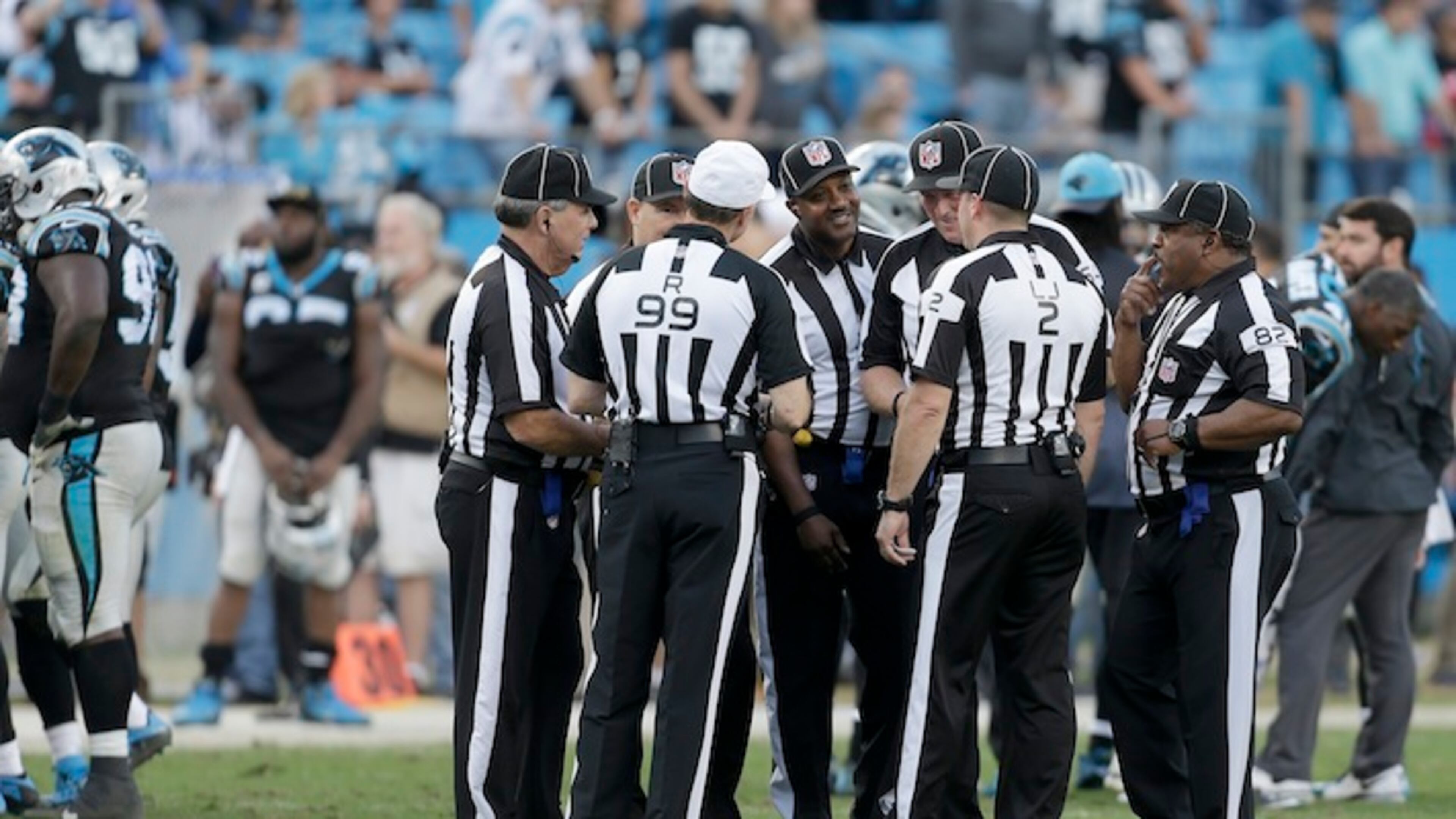
Officiating gaffes continue to be a story line of the 2015 NFL season, and the problem is not just human error.
Football rulebooks are too complicated and too freighted with zany distinctions: In high school, players must wear shoes, but socks are optional, while in the pros, players must wear socks but don’t need to wear shoes.
And was it a catch or not a catch? In the offseason, the league said, “The language pertaining to a catch was clarified.” The clarification — it’s below — is 158 words and incomprehensible to a Supreme Court clerk.
Rulebook simplification would improve officiating. As for replay review, how about making it blind? If the reviewing official did not know what call was made on the field, he or she wouldn’t have observer bias.
More on that in a moment: first the rulebooks.
The NFL’s is 79 pages single spaced. The rulebook used in college, and in high school play in Massachusetts and Texas, is 73 pages single spaced. The National Federation of High Schools rulebook employed in all other states drones on for 112 pages.
No official could possibly remember everything in any of these documents. When zebras botched the call at the end of the Detroit-Seattle contest on “Monday Night Football,” no one on the officiating crew knew how to enforce the rule regarding deliberate batting of a loose ball. Excessively complicated football rules reflect the over-lawyering of contemporary life — they are another way in which the National Football League holds a mirror to American society. But rules of half the length would be twice as good.
Football happens fast — “bang-bang” is the apt description. College action is faster than high school play, while at the NFL level, every player was the fastest guy on his college team. High-speed collisions mean that errors of judgment are inevitable; trying to keep all the rules in your head makes the situation worse. Simplifying the rulebooks would allow officials to concentrate on judgment.
Here’s the “clarification” of catch/no catch:
“In order to complete a catch, a receiver must clearly become a runner. He does that by gaining control of the ball, touching both feet down and then, after the second foot is down, having the ball long enough to clearly become a runner, which is defined as the ability to ward off or protect himself from impending contact. If, before becoming a runner, a receiver falls to the ground in an attempt to make a catch, he must maintain control of the ball after contacting the ground. If he loses control of the ball after contacting the ground and the ball touches the ground before he regains control, the pass is incomplete. Reaching the ball out before becoming a runner will not trump the requirement to hold onto the ball when you land. When you are attempting to complete a catch, you must put the ball away or protect the ball so it does not come loose.”
Got that? In this Bill Belichick transcript, scan for “specific rule.” Belichick goes on and on and on trying to explain penalties. Maybe a reason for the Patriots’ success is that New England has a secret committee of shamans and mages who actually understand every line of the rules. (Or alternatively, has Ernie Adams.) The web of rules regarding how to treat blocked punts versus field goals when the ball crosses the line of scrimmage, or how to enforce fouls occurring while neither team has possession, is excessively complex. And if you think you’re ready to be a Supreme Court clerk, take a gander at the All But One Principle. Good luck keeping it in your head at game speed.
Rules variations among the high school, college and pro levels add more layers of confusion. In high school, all kicks that reach the end zone are touchbacks. In the pros, some kicks that reach the end zone are live. In high school and college, downfield blocking is legal before a pass caught behind the line of scrimmage; in the NFL, it’s not. Different levels of the sport have different standards about where to spot the ball after a missed field-goal attempt and about exactly where a quarterback’s body needs to be to avoid an illegal forward pass. Pass interference is enforced differently in the NCAA than in the NFL. Some flags that are automatic first downs in the pros are not automatic first downs in college. Deliberate batting of a loose ball? Always illegal in high school, OK in the pros if the ball is batted toward the sidelines. But not if batted parallel to the sidelines!
People who become NFL officials usually begin at the high school or college levels — the celeb referee Ed Hochuli started by working Pop Warner games. If rules were standardized, zebras would need only to keep one set of rules in their heads, and would get more reps enforcing the unitary standards.
Maybe the solution to NFL yellow-flag woes would be full-time officials. Pro zebras average about $200,000 a year in pay and deferred compensation, for part-time work. Most hold other jobs; Hochuli is a lawyer. The roughly $25 million the NFL spends annually on officials is petty cash to a $12 billion organization; higher pay for full-time positions could be arranged. But even if NFL officials did nothing all year but prepare to call games, the rulebook complexities and bang-bang speed would remain problematic. Complexity, at least, can be reduced.
Now the blind review idea. The basic premise of NFL review is that the call on the field should be overturned only if the replay official is certain the call was wrong. There are, for example, lots of was-it-a-fumble situations that can be called either way. Unless there’s clear proof the call was wrong, whatever was signaled on the field should stand.
Technology has made possible a shift of challenges to the NFL office in New York; the replay official no longer attends the game. Since the replay official now sits in an office, reviews would be more credible if the reviewer did not know what had been called on the field. He or she would see the play out of context, and have this option:
The reviewer could say, “I am positive this is _____.” Or the reviewer could say, “It is not possible to be certain what happened.”
In the first case, the reviewer’s decision is enforced; in the second, the call on the field stands, without the reviewer ever knowing what the call on the field was.
More Stories
The Latest