The Win Column: Is Freddie Freeman now an Atlanta villain?


Greetings, Tyler Estep enthusiasts!
You’ll be pleased to know that the admired and capable Tyler will be back next week. This will be my second and final missive in his estimable place.
But enough blathering. On with the newsletter. I apologize in advance that I’m not as concise as Tyler, but I make up for it in by being less funny.
HOW ARE WE FEELING ABOUT FREDDIE FREEMAN?
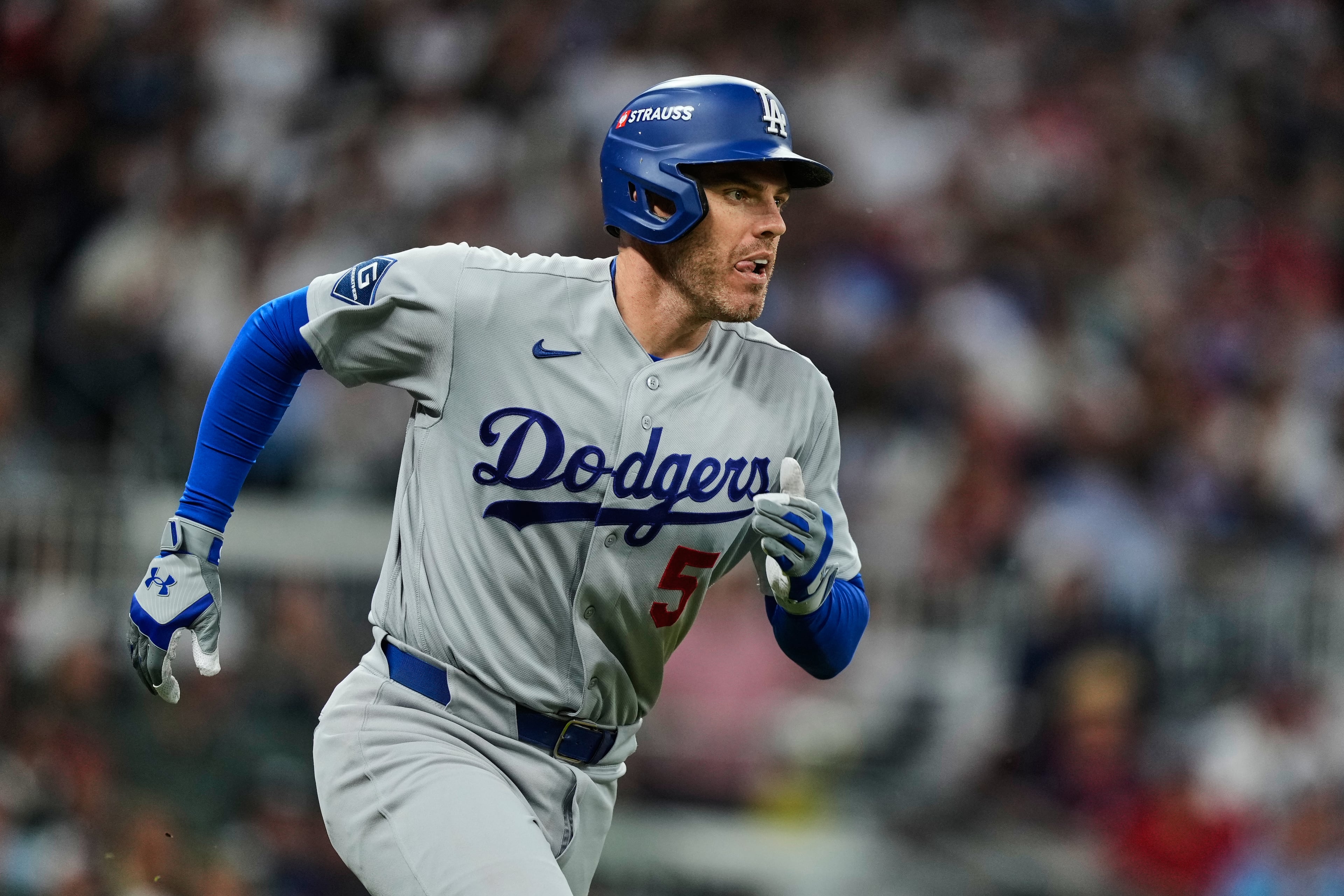
If you watched Tuesday’s broadcast of Game 3 of the NLDS between the Braves and the Dodgers or were at Truist Park, surely you heard the boos raining down on the longtime Brave when he came to the plate.
I was fascinated by this. On social media — granted, not the best barometer for anything except for measuring people’s capacity for surliness to complete strangers — there was a lot of chatter from fans about how Freeman cannot be welcomed back like the prodigal son, as has been the case since he signed with the Dodgers before the 2022 season.
At least not in the playoffs, his first at Truist in Dodgers colors.
It was a reasonable (and evidently popular) position to take, although I don’t know why there has to be a group think about this.
But the interesting thing to me was that the response went all the other way, to where he was getting booed with more intensity than anyone except maybe Shohei Ohtani.
I had thought the switch would just be from applause to indifference.
But it was like he went from “guy we still love” to “guy we now despise.”
It was almost like a scene out of a movie, where the boy has a dog he can no longer keep as a pet but the dog still follows him around so the boy tearfully has to turn on the dog (“Now, git! You hear me!”) to make it clear that he is no longer wanted. (That was weirdly specific, I realize.)
Was it because he left the Braves or because he’s one of the Dodgers’ best players (he did homer) or my own movie/dog/boy interpretation?
This was Freeman’s explanation, as reported in a story worth reading by colleague and longtime Freeman chronicler Gabe Burns:
“I’ve got a gray uniform on, I expect boos.”
Eager to hear your thoughts.
A DREAM SCENARIO
You may have missed this, but the Dream made a rather newsy announcement Tuesday. They will play all of their home games at State Farm Arena next season (and at least the one following) after playing for the past six seasons at Gateway Center Arena (capacity: 3,575, smallest in the WNBA).
The Dream liked the College Park arena but it was too small to be sustainable. But another aspect of it was, as much as they liked bragging about selling out Gateway Center, it was difficult to ascertain what the demand would be in a larger arena.
Ever since the team’s inception in 2008, they’ve had trouble drawing, even when they’ve had competitive teams, starting at State Farm (then Philips Arena).
But a telling moment came when the Dream played at State Farm in June against a non-marquee opponent (the Toronto Tempo) on a Monday night. In recent seasons, they’ve moved games to State Farm for surefire draws like Caitlyn Clark’s Indiana Fever and the Las Vegas Aces.
Team president and chief operating officer Morgan Shaw Parker told me then that “this is a way for us to really test that out and understand the market a little better. Because you can’t just understand if you’re only bringing in one (visiting) team to play (in State Farm).”
The Dream-Tempo game drew nearly 10,000.
That and other indicators evidently informed the ownership group that it was time to take the next step. It’s great for fans of the team and women’s basketball in general.
A team spokesperson told me Tuesday that it’s not yet decided if they’ll use a smaller configuration as they did for Game 1 of the WNBA semifinals on Sunday or use the full configuration.
It wouldn’t surprise me if it was a mixture. And the team’s ownership continues to explore having its own arena. (Georgia State Convocation Center makes a lot of sense to me.)
The Dream and New York Liberty play Game 2 of their WNBA semifinal series Wednesday night at State Farm. They are using the smaller configuration (closing off most of the upper deck) because of, I was told, the quick turnaround for playoff ticket sales.
Game 1 drew 9,745 and the get-in price for Game 2 on Seatgeek on Wednesday morning was $98.
A new chapter is beginning.
KIRBY SMART ASKED, WE ANSWERED
This is something of an homage to the very capable Tyler, whose work I really appreciate for the way he approaches sports. Saturday, after Georgia whipped up on Vanderbilt, Bulldogs coach Kirby Smart was asked about a particular officiating call on quarterback Gunner Stockton.
Smart declined to offer his evaluation of the call, saying “the last thing I do is judge officials,” which, if you’ve ever seen a Georgia game or are an SEC official, you may quibble with.
But he went on to explain his non-judging stance by saying he doesn’t even know — for instance, when a punt is shanked out of bounds — how officials determine where to spot the ball.
I saw that and thought: A) I am always intrigued by how Smart’s mind works, and B) This is prime Win Column material.
And so I sought out an answer.
Big thanks to former longtime SEC official Gus Morris, who delivered perfectly.
Per Morris (whose “Saturdays in the South” book about his life as an SEC official is great): “The referee is positioned near the punter and then, after the ball is punted away, goes to the punter’s spot. If the ball is punted out of bounds, he notes where it landed to establish the flight path of the ball.”
An official lined up deep downfield on the sideline (there’s one on each) starts to move up toward the line of scrimmage with an eye on the referee. (Not that important, but this “Where’s he going to stop?” march has always made me think of the mountain-climber game on “The Price is Right.” If you know, you know.)
“When he intersects with the line that the referee establishes, then you’ll see the referee (drop his raised arm) and then the deep-wing official will stop there and establish the spot there,” Morris told me. “It’s not just arbitrarily determined. There’s actually a mechanic that handles that situation.”
I thought that was pretty interesting. Hope you did, too.
At the Win Column, we are all Kirby Smart.
A SHOUTOUT TO MY DAD
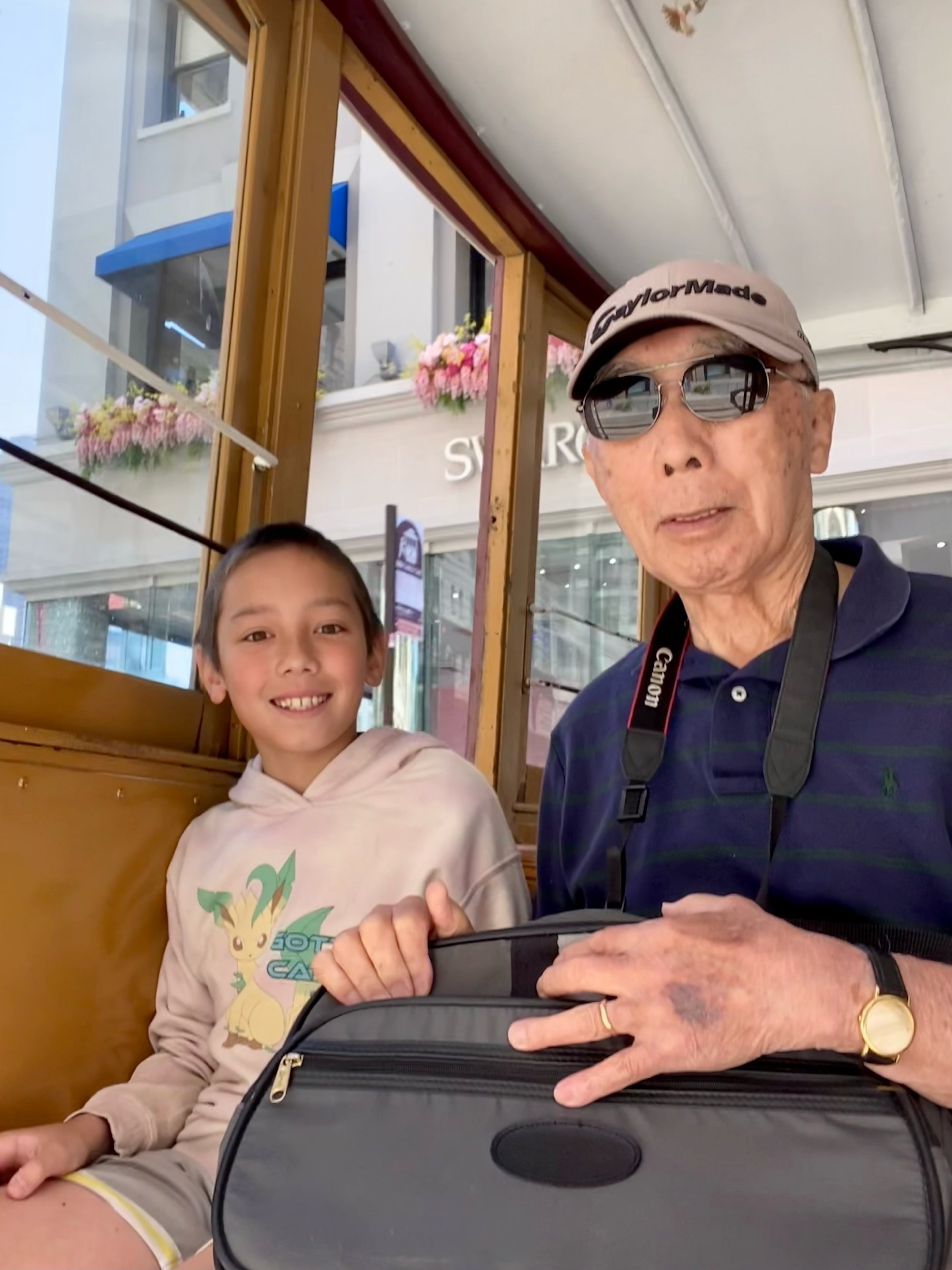
To my chagrin, I will miss the remainder of the Braves NLDS and the Georgia-Alabama game because I will be off from this afternoon through Sunday for a great reason. My father, Go Sugiura, is turning 90 on Sunday and my family will be flying to San Francisco to help celebrate.
Among many other things, my dad fostered my love for sports and helped me on my path to this job. He gave me countless weekend afternoons in our backyard in Northfield, Illinois, playing catch and throwing batting practice in the spring and summer and tossing the football in the fall. I didn’t realize it then, but those were truly some of the best days of my life.
Serendipitously, he was able to get two Bears season tickets for the 1984 and 1985 seasons, the latter proving to be only arguably the greatest in NFL history, and we went to nearly all of them together. (Amusingly, my dad’s friend who gave up the tickets for those two years because the Bears had forever been mediocre wanted them back after that and then they didn’t go to another Super Bowl for almost 20 years.)
And while my dad knew little about the newspaper business and had no connections to leverage, he did what he could.
When I was in college, rather randomly, he ended up sharing an office floor with Walter Payton and, surely knowing he couldn’t ask for too many favors, spent one of them asking him if he could talk with me and share advice about journalism from his perspective as a former professional athlete. (Which Payton graciously did, and I still think back to.)
I went to Japan (my parents’ country of origin) after I graduated to study and travel (a trip my parents funded) and, as I began to look for a job upon my return, heard from The Philadelphia Inquirer.
I went to Philadelphia for an interview and when I met with an editor, she mentioned talking to my dad (because I’d left our home phone as my contact information) and smilingly referred to him as “your agent,” which I’m sure meant that he, as is his way, had been responsive, thorough and eager in his communication.
I didn’t get a job there immediately, and as I looked for a job after returning home, I remember he bought a CD-ROM (this was 1995) with the address of, literally, every publication in the United States.
Even, like, Cat Fancy magazine.
And his plan was that I was going to write to all of them to find a job. He set up a mail merge and the address labels and everything.
Thankfully, we didn’t follow through completely on this strategy, as it may have resulted in me becoming the unwitting cub reporter of Crocheting Monthly or some such.
Regardless, it was an expression of love that I cherish still.
Happy birthday, Dad. And thank you.
PHOTO OF THE DAY
Thanks for reading to the very bottom of the Win Column. Questions, comments, ideas? Contact me at tyler.estep@ajc.com (or me, Ken, at ken.sugiura@ajc.com)
Until next time.