
Meet the Falcons draftee who was ‘giving up on football’ 6 years ago
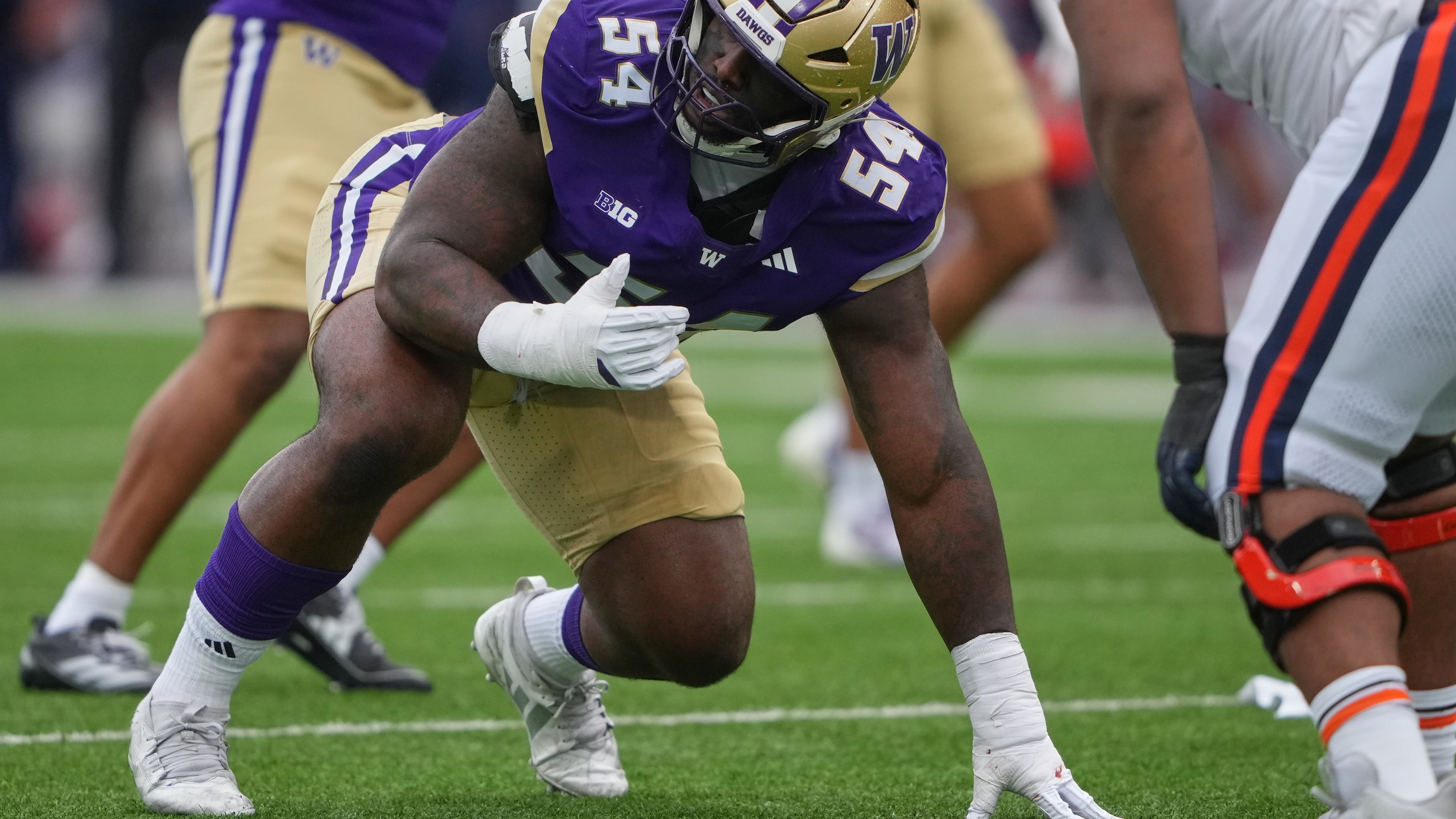
FLOWERY BRANCH — Anterio Thompson’s voice crackled. His body started shaking.
“Are you for real?” Thompson asked Falcons GM Ian Cunningham.
“This can’t be real,” he told Falcons coach Kevin Stefanski.
It was real. The Falcons used the 208th pick in the sixth round of the 2026 NFL draft on Thompson, a defensive tackle from the University of Washington. He didn’t let himself truly believe his fate until a minute into his phone call, when he finally heard familiar voices.
Thompson met with Falcons defensive line coach Nate Ollie and defensive coordinator Jeff Ulbrich during the predraft process. They were the final two parties on the call Thompson never thought he’d get.
“I’m not going to lie, I’m just speechless,” he told reporters immediately after. “I had no words.”
Six years prior, Thompson wasn’t even sure he wanted to play football, let alone whether he liked the sport.
By the time his freshman season at Hempstead High School in Dubuque, Iowa, rolled round, Thompson had already moved three times. He was more of a basketball player who decided to try football. He stood around 6 feet tall, maybe 160 pounds, Dubuque coach Jeff Hoerner estimates. No way he reached 200 pounds.
Thompson was confident his future rested on the hardwood. Football was, if anything, a side gig. When he tried, he’d finish first in the team’s sprint drills, even as a tight end and defensive lineman. He had promising flashes as a freshman and sophomore, but nothing consistent, and he didn’t particularly care enough to fix it. Basketball had his allegiance.
There were times, Hoerner remembers, where Thompson went to basketball open gyms instead of football practice as an underclassman.
“It was, like, if you would coach him hard, he would just kind of shut down,” Hoerner told the AJC. “I think that kind of happened during his freshman year, his sophomore year and his junior year, where most of those years, he was like, ‘Well, this is dumb. I don’t need to work hard at this. I’m just going to leave and get ready for basketball season.’”
As a junior, Thompson finally reached his breaking point. He wasn’t playing much. He wasn’t enjoying it. And on the basketball floor, he grew into his 6-foot-3 frame and routinely delivered powerful, electrifying dunks.
“I was giving up on football at a point in high school,” he said.
Life outside sports was difficult for Thompson, too. He faced family trouble. His grades were slipping. He had, in Hoerner’s words, a “don’t-care attitude.”
Then, at the end of Thompson’s junior year, the COVID-19 pandemic hit. It may have saved his career. Iowa was one of the first states to play football during COVID-19, and because of the pandemic, all athletes were eligible to play no matter their academic issues.
Hoerner, his staff and his captains realized Thompson had the potential to be Hempstead’s missing piece as a senior.
“We basically said, ‘We’re not going to let ‘Terio mess this up,’” Hoerner said. “Like, he’s a huge part. We know we could be so much better with him, but we know his upside — this is a college football player.”
Thompson started to buy in. He went to every practice, every workout. He gained more muscle. He had fun.
“He was a totally different kid,” Hoerner said. “That might’ve been the first time I’ve ever seen him really smile, and the kid’s got just an amazing, big ol’ smile.”
Football was Thompson’s relief from everything — the pandemic, the grade trouble, the family struggles. When he first picked up the sport, he played soft. He didn’t have much violence. When he tackled opposing players, he’d hug them and safely put them on the ground.
As a senior, with life taking plenty of shots at Thompson, he realized football served as an outlet to punch back.
“Football is the only sport where it’s violent and you don’t go to jail for it,” he said. “So I kind of started practicing and playing with a little bit more anger.”
Thompson flourished. He grew to 6-foot-3 and 230 pounds, and he earned first-team all-conference honors after collecting 39 tackles and seven tackles for loss as a nose tackle in Iowa’s largest classification.
Violence surely wasn’t an issue. Thompson is so big, so athletic, he also played gunner on special teams at Hempstead. Leading by eight points late in a critical game, Thompson was the team’s first player down the field on a kickoff and, running full speed, stuck out his arm. The returner’s chest met Thompson’s hand. The returner fell. The referee threw a flag. His reasoning? Too violent of a hit.
That moment, Hoerner said, was a culmination of Thompson’s rare size, speed and newfound desire to be violent. Colleges started noticing. So, too, did JC Moreau.
A longtime strength and conditioning coach who spent time at Iowa, Arkansas and Memphis, among others, Moreau now runs his own, independent training program near Iowa City. While watching one of his other local clients, he paused the film. Thompson, seemingly out of nowhere, exploded toward an opposing quarterback. His closing speed popped.
Moreau saw Thompson, tall, wide, with big legs and long arms dangling to his knees, and quickly identified a Division I athlete. Moreau sent a direct message to set up a call with Thompson, who didn’t have a phone at the time and needed his mother to buy more data.
Thompson was an ascending prospect with academic baggage. College coaches called Hoerner and inquired about Thompson. Hoerner said they’d have to wait two years — Thompson didn’t qualify academically and needed to go to junior college.
Moreau and Hoerner helped that process. Both sent Thompson’s name to Iowa Western Community College defensive line coach Aaron Terry.
“The kid’s a freak,” Moreau told Terry. “(But) he doesn’t have a clue what he’s doing.”
Thompson’s upside sold Terry, and the Reivers offered him soon thereafter. Thompson committed almost immediately. Moreau’s final message: “Ignore all the outside noise. Go there, take care of you, work your ass off, do what they tell you, take care of school and you’ll be fine.”
Iowa Western is a junior college powerhouse. The Reivers have made the NJCAA national championship game each of the past five years, and six of their former players were taken in the 2026 NFL Draft.
Terry prides himself on development. Thompson, an elite athlete but raw football player, was a difficult challenge. Iowa Western redshirted Thompson in 2021, prioritizing personal and physical growth. He added 40 pounds, ballooning to nearly 290 pounds, and still had one of the fastest 10-yard splits on the team. He learned the Reivers’ system and understood how to control gaps and execute his responsibilities.
By the spring semester of his first year on campus, football clicked for Thompson. He was a second-team All-American in the fall of 2022, tallying six sacks and winning a national championship at Iowa Western.
“I looked at it as a second chance,” Thompson said. “I knew I wanted to play football, but I knew I had to get through JUCO, so I kind of just put my head down and worked there. I just found all my ways of learning and the way I move best.”
Thompson racked up more than two dozen offers, including several high-majors, and ultimately chose Iowa. He played in seven games in 2023 but saw only two defensive snaps, according to Pro Football Focus. Much of his work came on special teams, where he blocked two punts.
But their timelines didn’t match. The Hawkeyes wanted to continue growing Thompson into a rotational player while incrementally expanding his role. Thompson, with two years of eligibility remaining, wanted to play significant snaps on defense. Ultimately, he chose to transfer.
Still, Thompson’s year at Iowa left a positive impression. Iowa special teams coordinator Lavar Woods grew fond of his punt-blocking specialist. Coach Kirk Ferentz touted Thompson’s work ethic and willingness to use academic support. The Hawkeyes believed Thompson had a next-level future.
“This kid’s going to make it if he just keeps his nose down, he keeps doing what he needs to do,’” Ferentz told Hoerner.
Thompson went to Western Michigan, where he reunited with three teammates from Iowa Western. He started 12 of 13 appearances and made 34 tackles before entering the portal once more. To cap his college career, Thompson transferred to Washington, playing in 13 games with three starts while tallying 30 tackles, 2.5 tackles for loss and 1.5 sacks.
Thompson didn’t get an invite to the NFL scouting combine, but he turned heads at Washington’s pro day, running a 4.73 40-yard dash and pumping 30 reps on the bench press. The same blend of size, speed and strength that put him onto junior college radars put him on the Falcons, too.
Cunningham credited the Falcons’ scouts, along with personnel and coaching assistant Cami Pasqualoni, for discovering and pounding the table for Thompson, who also had a big fan in Ollie.
“He’s sawed off, powerful, explosive, really good hand strength, good instincts,” Cunningham said. “He plays the brand of ball that our defensive staff looks for. He’s powerful. We look forward to bringing him in and helping him add to the group in the run and in the pass game.”
It’s only fitting the Falcons are bringing Thompson, a Midwestern transplant in the Pacific Vorthwest, to the South. He often walked around Iowa Western’s facility wearing cowboy hats, Terry said, and he has a “country kid” vibe to him.
But Thompson long doubted this life were truly possible. Not at Iowa Western, and certainly not in high school. Hoerner thought it’d be difficult for Thompson to make it because he had so much to persevere through.
Thompson’s road to the Falcons — with an upbringing Terry described as “rough,” a stronger initial preference for basketball and, ultimately, four colleges — was bumpier than most. The journey didn’t break him. It molded him.
“When people face adversity, it reveals what type of character they have,” Terry said. “And that’s the thing for him. He’s continued to show up. He’s continued to work.”
The Falcons gave Thompson his first professional office. He’s no longer “Juco Terio,” the name he embraced after committing to Iowa Western. He’s “NFL Terio,” and he holds full control over where his story goes next.