
Georgia Tech leans heavily on potential impact of new athletics center
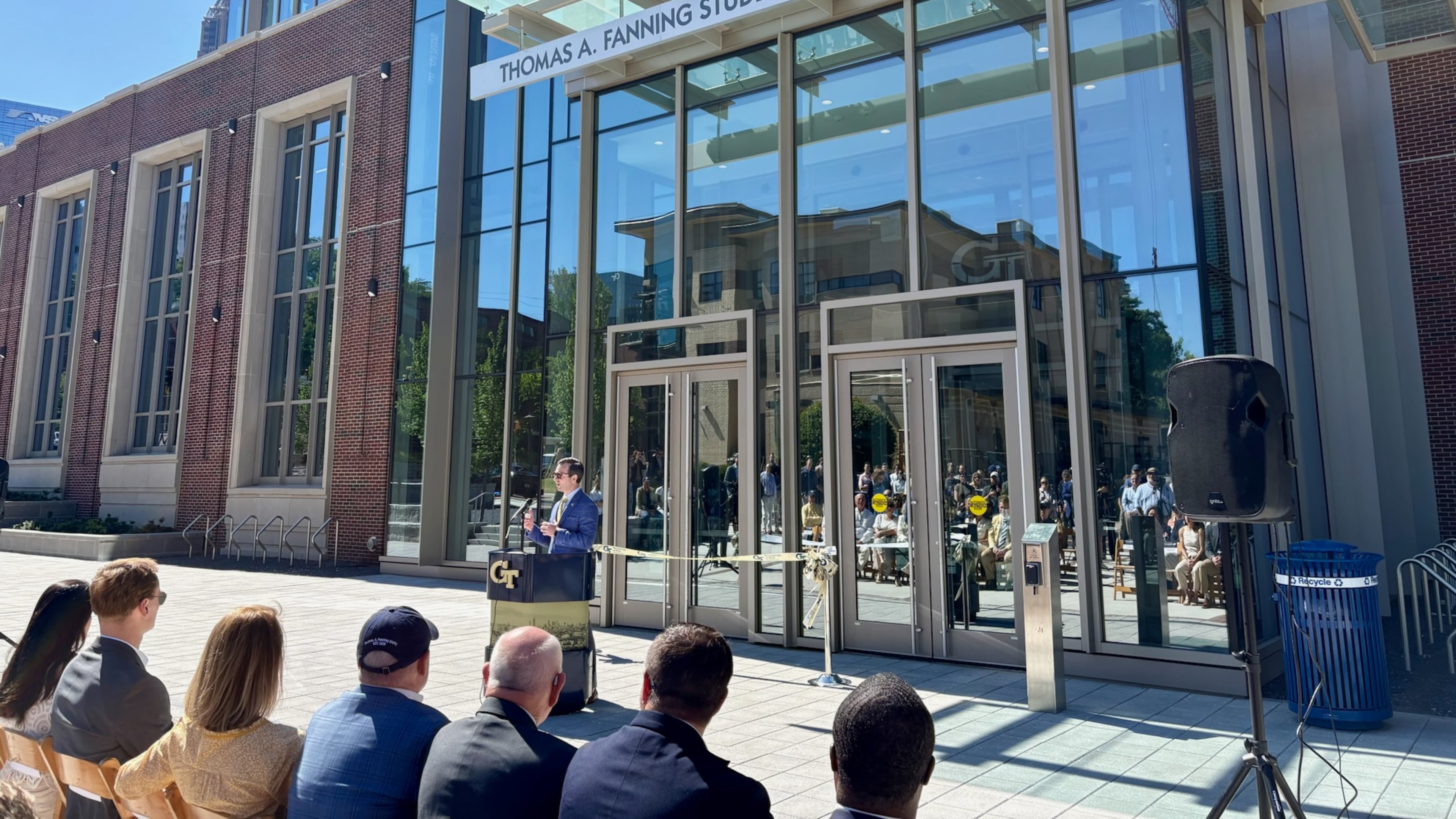

The glass doors of Georgia Tech’s new Thomas A. Fanning Student-Athlete Performance Center officially opened Thursday, completing a project that spanned no less than eight years and three athletic directors and cost $90 million.
A four-story building adjacent to Bobby Dodd Stadium, it replaces the Edge Center, which was opened in 1982 during the tenure of legendary AD Homer Rice.
Technologically advanced, thoughtful in design, full of natural light and intended to cast the aesthetic of a high-tech company, the building’s purpose is to serve Yellow Jackets athletes by tending to their health, building their strength and supporting their academic endeavors. AD Ryan Alpert called it a demonstration of the institute’s commitment to help them optimize their experience at Tech.
“Everything that you need as an athlete, when you are selecting where you’re going to go in the future, Georgia Tech is going to be on the leading edge of providing that to athletes,” Alpert said.
The first floor features a technologically enhanced weight room with 16 double-sided weight racks that can measure athletes’ explosiveness in lifts. (The 32 stations are more than twice the number that Tech’s former primary weight room had.)
That sort of data can help strength coaches and trainers get a clearer picture of athletes’ strength as they recover from an injury or need to develop a particular aspect of their musculature.
The weight room adjoins a sports science lab that includes three force plates that measure athletes’ running, jumping and cutting. Along with an array of motion-capture cameras stationed around the perimeter of the room, the system can collect 200 data points from one single jump, such as how much an athlete favors one leg over the other.
Comparing it with baseline data, that information can inform trainers of an athlete’s health level as he or she returns to competition or be used to design a program to enhance his or her explosiveness.
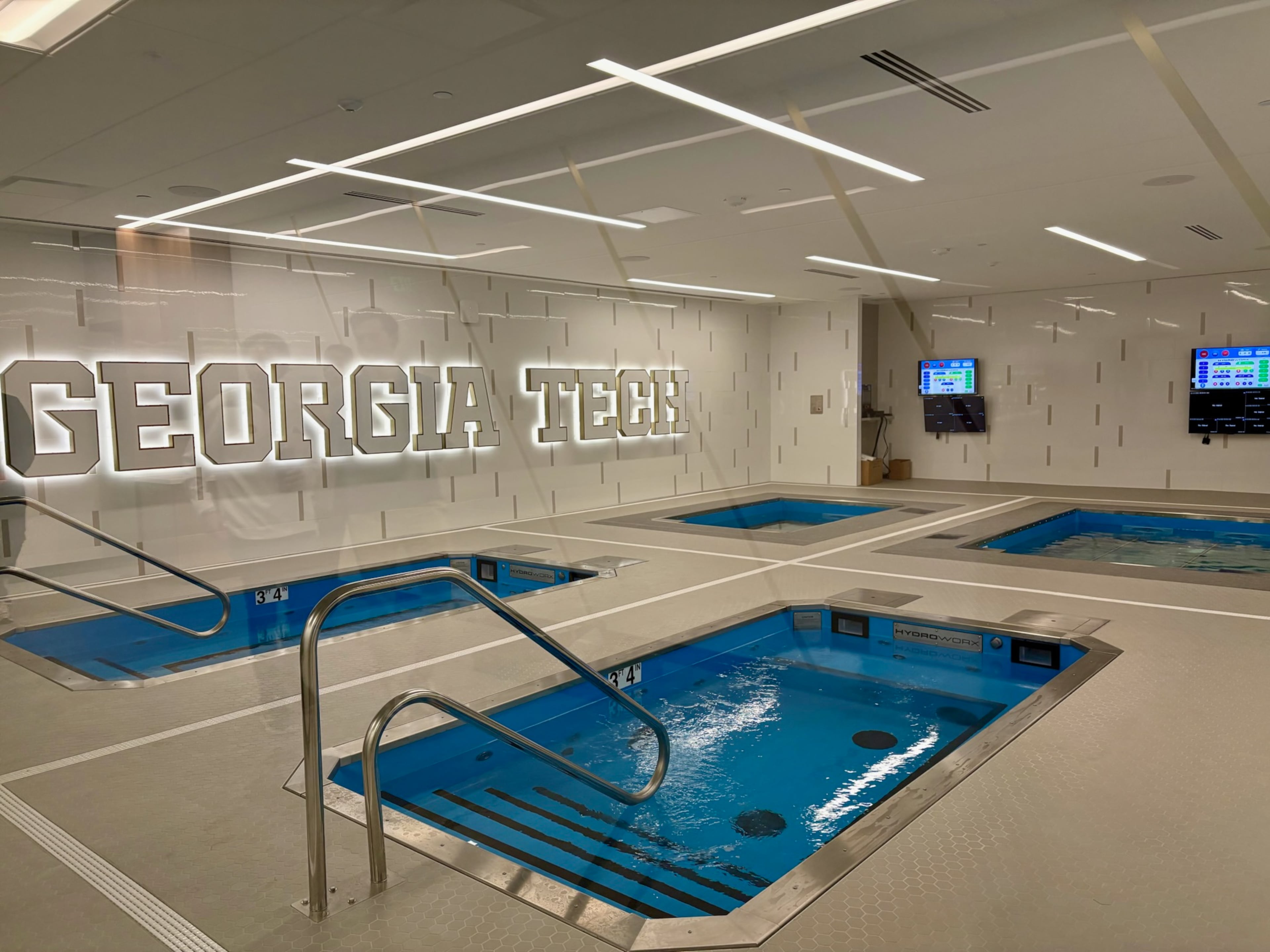
“I went back and told the Board of Regents these people have more metrics in their student-athlete performance center than we have in the Board of Regents,” retiring University System of Georgia chancellor (and former Georgia football player) Sonny Perdue said in his remarks at the ceremony.
Alpert said that 80 to 90% of the center is focused on Tech athletes, but it was nevertheless built to gain a financial return. The fourth-floor cafeteria looks out onto the stadium above the northeast corner of the field, with the room opening out onto a veranda.
On game days, the space will be converted into a premium seating area. Alpert said it might be fashioned into a beer garden party deck, an area meant as much for socializing as it is for watching the game.
The football team’s offensive-line meeting room demonstrates the thought and attention that went into the building. While there are typically around 20 offensive linemen on the roster, the meeting room has seating for many more than that.
It was at the request of coach Brent Key. The extra seating is to accommodate running backs, tight ends and quarterbacks, as players at those positions often meet with the offensive line to coordinate on pass-protection and run-blocking plans. There’s also room at the front of the meeting for players to line up and walk through a play.
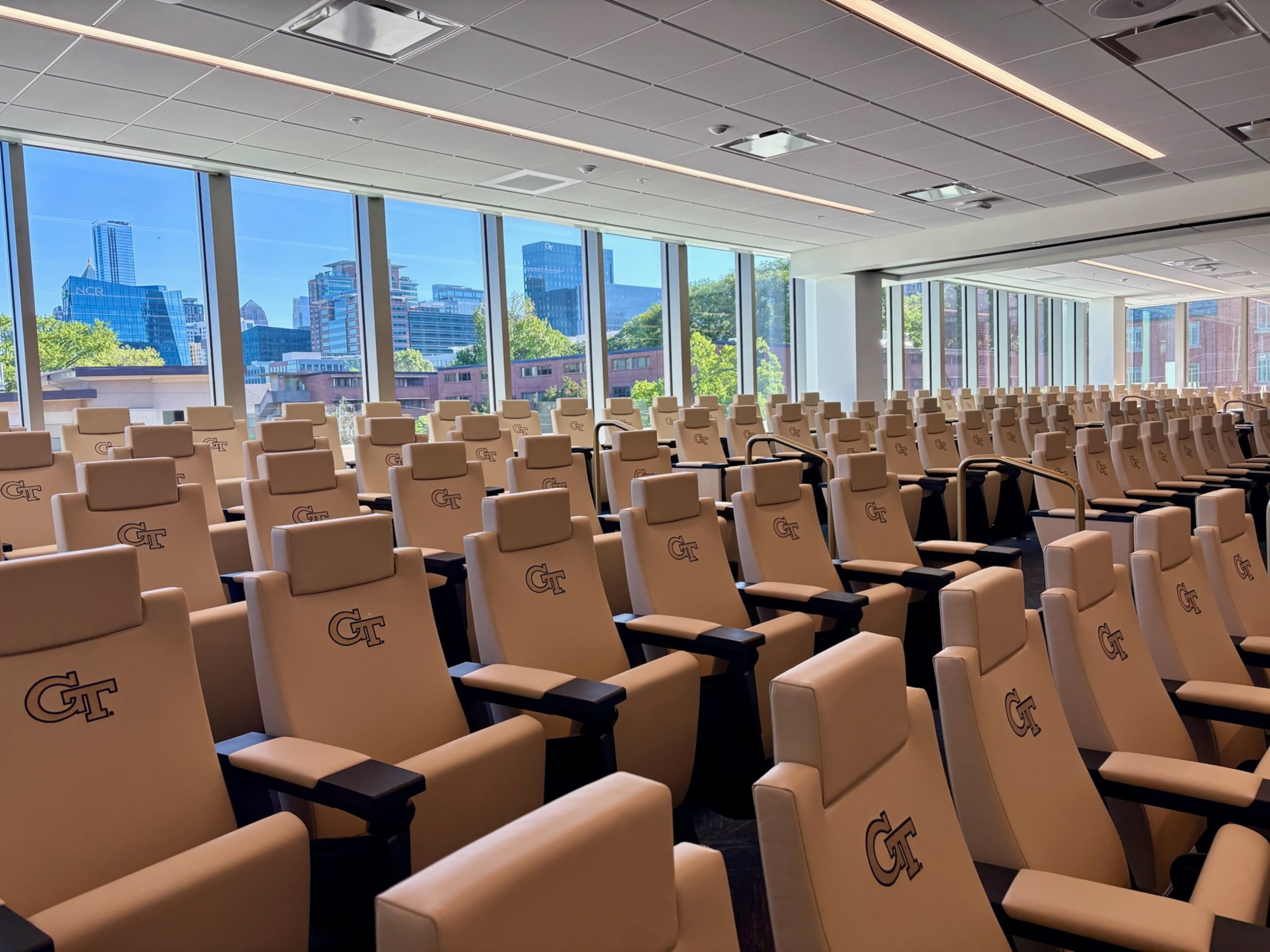
While the other position groups have seats arranged in rows, the quarterback room has players seated around a conference table. Key wanted a room that would recognize their status as team leaders.
“I wanted the quarterbacks to be able to sit with (quarterbacks coach Chris Weinke) at the table and be able to have roundtable discussions and have those have input and know they have input,” Key said. “That room was designed a little bit for that reason.”
The building was named in honor of Tech alumnus Thomas A. Fanning, who worked at the Southern Company for 43 years and was chair, president and CEO 2010-2023. Fanning has been a longtime donor to the institute and has served on many of its most important boards.
Fanning called it “the honor of my life.”
Projects like the Fanning Center are no longer the norm.
“I don’t think there’s any doubt about that at all,” Jeff Schemmel, president and CEO of the Atlanta-based consulting firm College Sports Solutions, told the AJC. “The priorities have shifted.”
The project crossed the divide of perhaps the most significant change in college athletics history. It was officially launched by former AD Todd Stansbury in 2018, three years before the NCAA freed athletes to accept compensation for name, image and likeness deals and seven years before colleges began paying athletes directly from revenue-sharing agreements, changes that dramatically changed how prospects evaluated colleges.
ADs and fundraisers who once sought donors’ help in building the biggest and fanciest locker rooms, indoor practice facilities and weight rooms to appeal to the hearts of teenage recruits are now more commonly asking the same donors for help with name, image and likeness deals.
That said, the dated and frayed Edge Center did need replacing. Too, Alpert asserted that this is not a project in the vein of eye-candy projects that stuffed facilities with video game rooms and barber shops.
“This is really about Georgia Tech wanting to be a leader in sports performance, in sports analytics, in sports medicine, in sports nutrition,” he said.
Key likened it to how NFL franchises have to differentiate themselves to free agents beyond salary offers.
“It’s great to make those (financial) investments in people,” Key said. “How are you going to develop them to reach that potential? Because when I stand in front of people and I say I want guys to be first-round picks and CEOs, that’s truly what we mean.”
The center begins a new era in Tech’s athletic department. Its impact will be measured on the field next to it.
You can now get my column sent straight to your inbox. Sign up for my newsletter here.