A scrubby practice field hasn’t held back state finalist Hapeville Charter

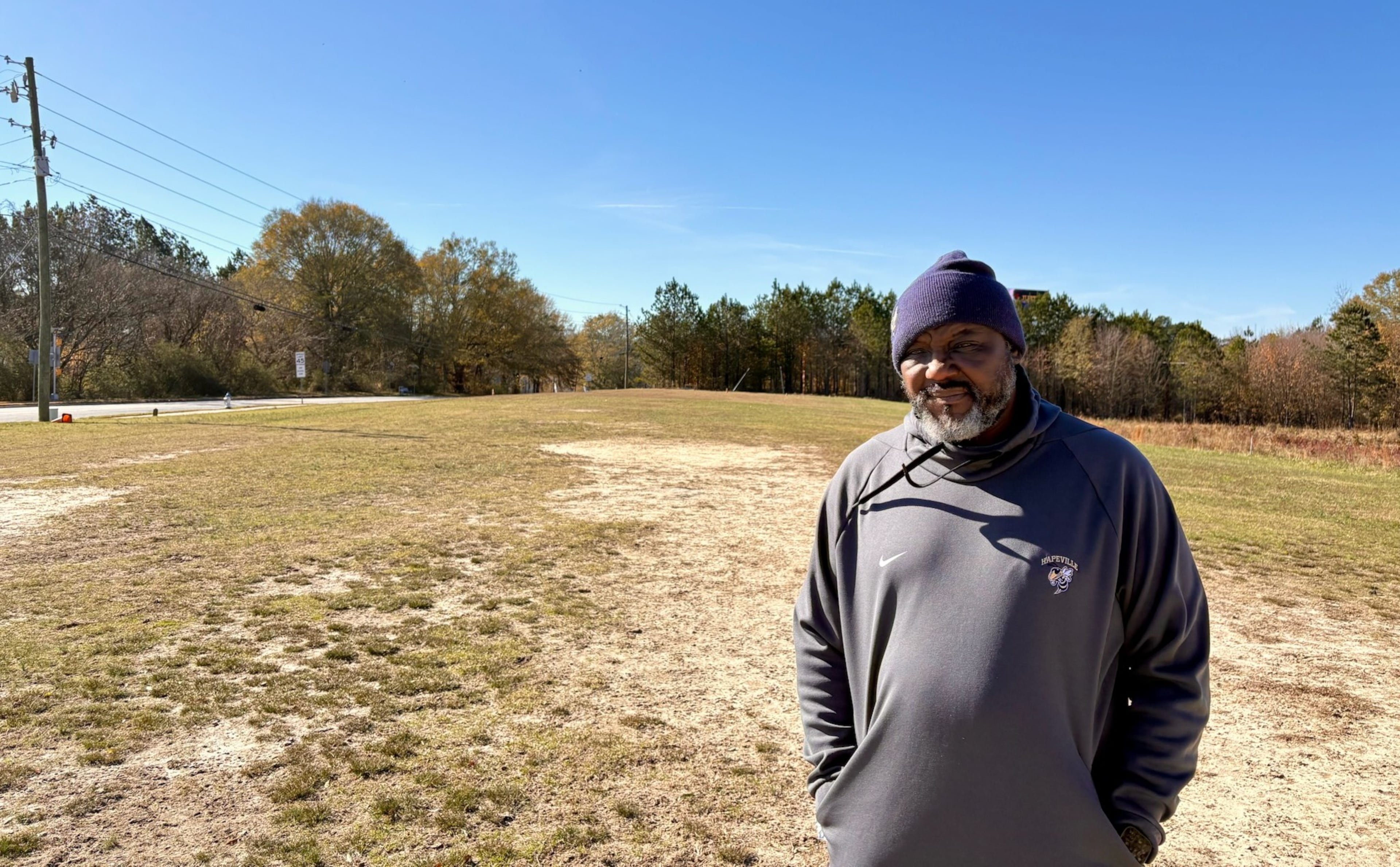
There are sandy expanses pocked with cleat marks. Other parts of Hapeville Charter’s practice field are bare dirt, worn down by hundreds of tackling drills, pass routes and blocking exercises. A lot of weeds, some rocks. At one end of the field, two PVC pipes rise into the air with no crossbar, remnants of field-goal posts.
The surface is uneven and slopes into a retention area. Don’t even ask if there are any field markings.
“It felt like where you would play flag football with your friends,” recalled Best Uchehara, a former Hapeville Charter player.
This humble plot of land symbolizes the challenges that Hapeville Charter has overcome to become one of the state’s more competitive programs under coach Winston Gordon, the only coach the school has had since it opened in south Fulton County in 2009.
It’s an accomplishment for any program to make the state playoffs 10 consecutive years and play for a second state title in nine years, the latter of which the No. 7 Hornets will do Tuesday at Mercedes-Benz Stadium against No. 1 Carver High of Columbus for the Class 2A championship.
But it’s all the more impressive for a program with the resource and facility challenges that Hapeville has faced as a charter school.
Public school systems generally provide their schools with infrastructure like stadiums and practice fields. That’s not necessarily so with charter schools, which is why Hapeville trains on a sandlot adjoining the school and plays home games at nearby Banneker High.
“You can’t miss anything that you don’t have,” Gordon told The Atlanta Journal-Constitution. “These kids buy in from Day One. You know what the circumstances are. You know what we’re about. We do more with less and they have a hard-hat mentality.”
Using the cafeteria for walk-throughs when it rains, building strength with makeshift exercises like pushing SUV’s in the school parking lot and competing for a Title I school didn’t prevent the Hornets from beating three top-10 teams to gain the state final.
“Just because we don’t have as much as everyone else, we don’t feel bad for ourselves,” senior offensive tackle and Alabama signee Chris Booker told the AJC. “We carry ourselves like we’re equal to them, if not better.”
Along with the 2017 Class 2A state title, Hapeville has won five region titles and reached the state quarterfinals four times, the semifinals three times and the finals twice — all since beginning varsity play in 2011.
“I think he’s a guy that does more with less,” said McEachern High coach Kareem Reid, who knows Gordon from when he coached at Westlake, another south Fulton County school. “That’s how I kind of always rank coaches. I see who has success with less — either talent or resources at their disposal — and he’s done, obviously, an amazing job there over the years.”
Further, Gordon said that of the Hornets players who have gone on to college — and he said that he hasn’t had a single player who wanted to go to college that he couldn’t find a place for — nearly all have graduated.
“Whether it’s a school building, whether it’s for grades, academics, whether it’s on the football field or whether it’s life, he’s all about the kids,” said Hapeville alumnus Arden Key, now a Tennessee Titans linebacker.
While lacking in facilities, Gordon and his staff — many of whom played for him at Hapeville — have developed a stream of talented athletes. The Alabama-bound Booker is only the latest Hornets player to sign with an FBS-level program. Key is one of three former Hapeville players in the NFL, a remarkable rate for any high school, let alone one in Class 2A.
Transfers, including Key, have benefited the program. But Gordon said that he makes no effort to attract players, that most players who transfer in do so before they’ve become college prospects and that most team members live near the school, located a few miles southwest of Hartsfield-Jackson Atlanta International Airport.
“I coach what we have,” Gordon said. “You just have to have a kid that wants to buy in.”
Key was one of them. He remembers Gordon’s resourceful training regimen — exercises like flipping massive truck tires, going on two-mile runs down Buffington Road (the street that borders the practice field) and running while holding a 45-pound weightlifting plate over his head — as well as the dips in the practice field.
“We were just happy we were out there playing football,” said Key, an eight-year NFL veteran who has contributed significantly to a capital campaign for a legitimate practice field.
Uchehara, who likened the practice field to a place where you might go to play flag football with friends, is another. He recalled the mixed emotions he felt when Hapeville played games at schools with opulent facilities, feeling the sting of class division but also the pride in still being able to win anyway.
He remembered, too, how Gordon pushed him to excel in his schoolwork, helping him graduate as class valedictorian while also earning an associate degree.
“I really, really enjoyed (playing at Hapeville),” said Uchehara, who is in his last year of training as a resident physician at Duke University Hospital. “I think very fondly of my few years on the team.”
Uchehara said he’ll be livestreaming the game Tuesday while at work. He’ll see a team that has shown tenacity and resolve, traits developed on a ragged practice field by a coach who won’t use it as an excuse.
“That’s what we do,” Gordon said. “We make a way.”
You can now get my column sent straight to your inbox. Sign up for my newsletter here:
About the Author

Ken Sugiura is a sports columnist at the Atlanta Journal-Constitution. Formerly the Georgia Tech beat reporter, Sugiura started at the AJC in 1998 and has covered a variety of beats, mostly within sports.


